AI Character Flaw Generator: Build Complex, Believable Characters
2026-09-06
Writing Assistant helps you generate psychologically grounded character flaws by turning a brief, a backstory, and a story goal into defects that actually create conflict. While random tables and one-field web forms spit out generic vices, this AI writing partner designs flaws that fit your character's history, relationships, and arc.
As of September 2026, novelists, screenwriters, and game masters still lose hours rolling dice or filling shallow forms that ignore context. A dedicated writing partner that remembers your cast, genre, and stakes is a sharper way to work.
- ✅ Flaws tied to backstory, relationships, and plot—not a random adjective
- ✅ Works for novels, scripts, comics, and tabletop RPGs
- ✅ Persistent memory so a cast stays consistent across drafts
- ✅ Free to start, with no credit card required
To understand why this matters, look at how most “character flaw generators” actually work—and why so many protagonists still feel like Mary Sues in nicer clothes.
Quick Answer: What Is an AI Character Flaw Generator?
An AI character flaw generator is a writing tool that turns a character’s history, personality, and story stakes into defects that create conflict, not decoration. Used well, it replaces random vice lists with flaws a reader can believe.
Key capabilities:
- Match a flaw’s severity to the story—minor, major, or fatal
- Root the defect in a lie the character tells themselves
- Show how the flaw damages relationships, choices, and the plot
- Keep a whole cast consistent across scenes, drafts, and sessions
Why Most Character Flaw Generators Produce Flat People
Readers expect characters who feel as contradictory as real people. Craft guides are blunt about this: without weaknesses, a story has no suspense, because the hero will always do the right thing. Real character is also personal, contextual, and relational—shaped by failures, attachments, and the rooms a person has to survive in.
But accessing that kind of specificity from a generator is frustratingly difficult:
- Random tables ignore backstory, genre, and tone
- Form-based tools ask for two fields, then return a cliché
- “Perfectionist” and “trust issues” get used as fake flaws—quirks that never cost the character anything
- Writers still have to invent the scenes, the lie, and the arc by hand
Minor, major, and fatal — the three degrees of character flaw that decide whether a trait is flavor, fuel, or downfall
The Mary Sue problem — characters without weaknesses grind narratives to a halt because nothing inside them is at risk
Random tables confuse flavor with fuel
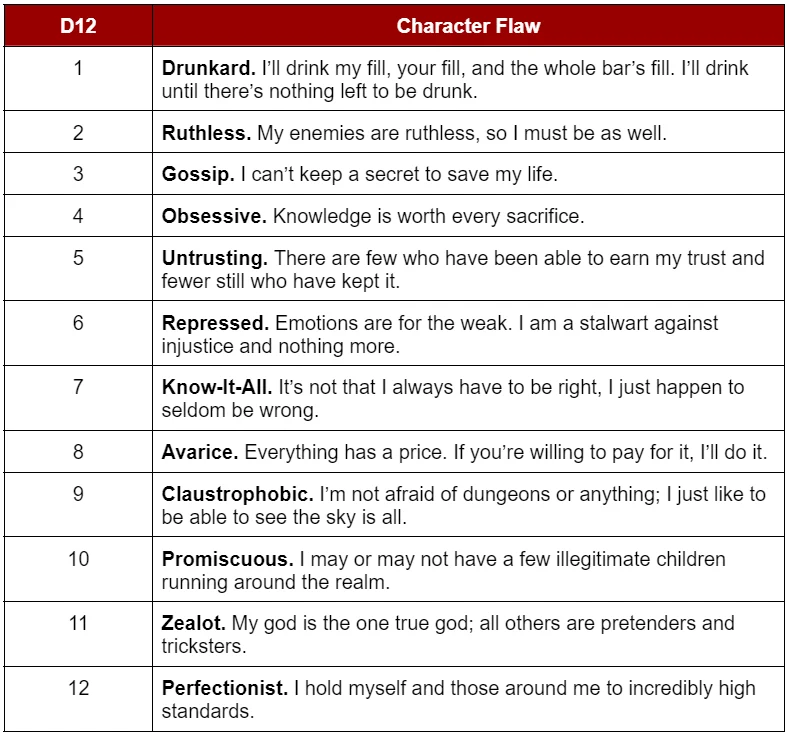
A D12 chart can be fun at a game table. It is a poor substitute for character work. “Gossip,” “know-it-all,” and “perfectionist” are labels. They do not tell you what the character is afraid of, who they hurt, or which choice they will make when the plot tightens. Flaws create external conflict only when they force action. A roll does not do that.
Generic web forms flatten psychology
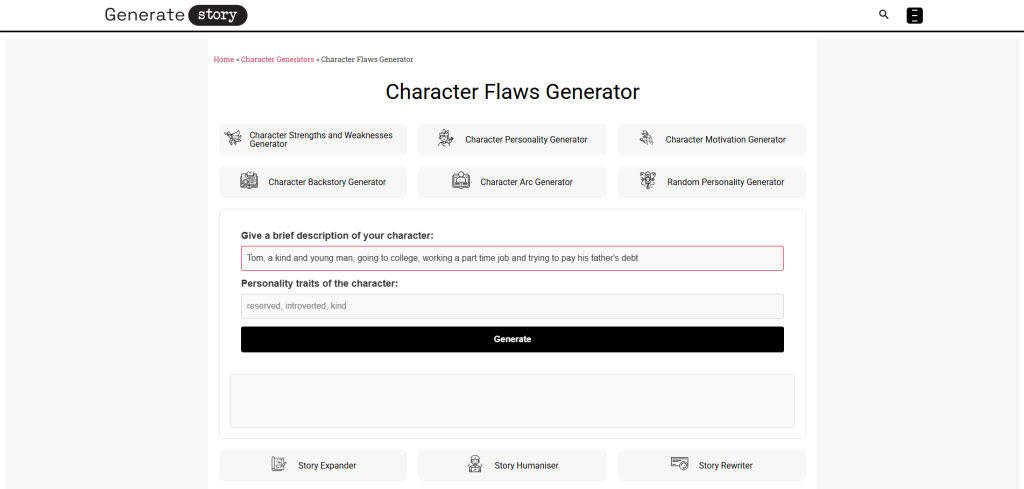
Typical online generators ask for a one-line bio and a handful of traits, then return a paragraph that could belong to anyone. Kind, reserved, in debt—those are circumstances and manners, not a wound. Without a theory of how the flaw formed, you get a costume, not a person.
Catalogs do not choose for you
Lists of 70 or even 250+ character flaws are useful reference, not a design process. The hard part is picking the defect that belongs to this protagonist, in this genre, at this point in the arc—and then making it cost them something on the page.
Fake flaws leave the plot untouched
A protagonist who is “too dedicated” or “too loyal” is usually a not-flaw flaw. Readers forgive a likeable, flawed lead; they bounce off a perfect one wearing a decorative crack. If the defect never creates a bad decision, it is not doing story work.
This is exactly what Writing Assistant was built for.
Why Writing Assistant
Writing Assistant is not a dice roller with nicer typography. It is a writing partner that treats a flaw as a design problem: What does this person believe that is not true? Who taught them that? What will it cost in the next scene?
You bring the character, the genre, and the stakes. It returns defects with consequences—dialogue tells, relationship damage, and plot pressure—rather than a single adjective.
| Traditional Approach | Writing Assistant |
|---|---|
| Roll a D12 and hope the vice fits | Flaws derived from backstory, relationships, and story goal |
| Two-field web form, generic paragraph | Iterative briefs that tighten severity, tone, and cost |
| “Perfectionist” as a fake virtue | The lie underneath, plus the scene where it fails |
| Separate notes for novel, script, and RPG | One character bible that adapts to format |
| You rebuild context every session | Persistent memory across drafts and revisions |
Flaws that generate plot, not wallpaper
Craft discussion keeps returning to the same test: a real flaw is detrimental to the character or to other people. Ask for a defect and you should get the bad decision it produces, not a mood. That is the difference between “untrusting” as a label and a scene where the protagonist withholds a letter that would have saved an ally.
"Tom is kind, reserved, and working through college to pay his father's debt. Give him one major flaw that grows from that kindness—not a cute quirk. Show the lie he tells himself, one relationship it damages, and the act-two choice it forces."
Severity you can actually use
The same trait can be comic in one book and fatal in another. Vanity is a small amusement in Little Women and a catastrophe for Narcissus; Reedsy’s framing is useful because it forces you to choose a degree. Specify minor, major, or fatal and the output changes: a verbal tic, a belief that must be unlearned, or a hamartia that arrives too late.
"Turn 'perfectionist' from a fake flaw into a fatal flaw for a trauma surgeon in a medical thriller. Name the lie, the professional strength it is tied to, and the scene where it costs a life."
A cast, not a single protagonist
Supporting characters need defects that collide. Jealousy in a best friend, rigidity in a mentor, cowardice in an official—those are engines. Because the writing partner keeps context, you can generate a flaw for character B that specifically antagonizes character A’s wound, then keep both consistent fifty pages later.
Format-aware, not template-locked
A novel wants interior contradiction. A screenplay wants behavior the camera can see. A TTRPG wants a flaw a player can roleplay in one sentence at the table. You can ask for any of those without rebuilding the character from scratch.
Related Agents You'll Also Find Useful
If you are generating flaws as part of a larger production, these partners sit next to the same desk.
Film Screenwriter
If the character has to play on camera, Film Screenwriter turns a psychological defect into visible action: the argument they pick, the object they cannot throw away, the silence that reads as guilt. Useful when a flaw looks sharp in prose and disappears in a scene.
- Structure, dialogue, and character development through draft and revision
- Visual storytelling so the flaw is something an audience can watch
- Outline-to-page workflow for features and shorts
Game Designer Assistant
Tabletop and video-game characters need flaws that are playable, not literary. This partner helps you convert a wound into a mechanic, a bond, or a GM-facing hook—without recycling “greedy rogue” for the hundredth time.
- Systems analysis and documentation across genres and platforms
- NPC and player-character design that survives contact with a party
- World and faction logic so a flaw has somewhere to land
Personality Analyzer
When a defect feels arbitrary, run it through a real personality lens. Big Five, Enneagram, attachment patterns—this is how you check that “untrusting” is not just a costume, but a coherent way of relating.
- Integrative profiles instead of a single-type slogan
- Pattern language for wounds, defenses, and growth paths
- A useful brake on clichés when a flaw is doing too much or too little
Try Writing Assistant free—no credit card required. Pair it with the agents above when the same character has to survive a novel, a session zero, and a second draft.
How It Works
Step 1: Describe the person, not the adjective
Open Writing Assistant and give role, age, pressure, and relationships. Skip “make them flawed.” Specifics produce specific defects.
"Protagonist: 22, first-generation college student, night-shift stocker, sending money home. Reserved, conflict-avoidant, praised for being 'the good one.' Contemporary literary novel."
Step 2: Name the story job the flaw must do
Tell it whether you need a minor tic, a major lie, or a tragic engine. Add genre promises so the defect belongs in this book, not a generic drama.
"I need one major flaw that will sabotage a romance subplot and one minor flaw that only shows up under exhaustion. Do not use perfectionism or trust issues."
Step 3: Demand cost, not flavor
Ask for the lie, the origin, a damaged relationship, and a concrete bad decision. If the reply could be swapped onto another character, push back.
"Rewrite so the flaw is a distorted version of his kindness. Show me the scene where he covers for a coworker and makes his own debt worse."
Step 4: Stress-test the rest of the cast
Generate colliding flaws for the rival, the parent, and the ally. Then ask who would enable the protagonist’s worst habit. That is how you avoid a perfect hero surrounded by scenery.
"Give his father a major flaw that explains the debt without making him a cartoon villain. Show how father and son trigger each other in one dinner scene."
Step 5: Lock it into the bible and reuse it
Save the agreed language—lie, tell, cost, growth condition—and reuse it in later chapters, session notes, or a screenplay pass. Persistent memory means you are not re-explaining the character every time you sit down.
Results & Use Cases
📊 Novel protagonist who is kind in a way that harms him
- Scenario: A reserved college student works nights to pay a parent’s debt. Early drafts make him purely sympathetic; beta readers call him bland.
- Traditional Approach: Skim a flaw list, pick “selfless,” and hope the middle of the book develops a pulse.
- Writing Assistant: Kindness is redesigned as conflict avoidance: he absorbs other people’s crises so he never has to ask for help, then resents them in silence.
- The lie (“If I am useful, I am safe”) becomes an act-two betrayal of himself
- A minor tell—apologizing when others bump him—stays human without stealing the plot
- Revision notes target scenes, not vibes
💼 Tabletop NPC who is more than a D12 vice
- Scenario: A GM needs a city magistrate for a political campaign. Random tables keep returning zealot, drunkard, or know-it-all.
- Traditional Approach: Roll, copy a one-liner, and improvise when players poke the character.
- Game Designer Assistant with a writing pass: Avarice is rebuilt as a need to buy loyalty after a public humiliation, with three roleplay beats and a faction consequence.
- Players can exploit the flaw without the NPC collapsing into cartoon evil
- The defect connects to a dungeon, a vote, or a patron—so it is playable
- Session notes stay consistent when the party returns three weeks later
🎬 Screenplay lead whose flaw has to photograph
- Scenario: A feature outline has a brilliant architect whose “flaw” is working too hard. The pages feel airless.
- Traditional Approach: Add a drinking habit in act two and call it depth.
- Film Screenwriter: Hubris is tied to a childhood of being the family translator. The camera gets the tell: she corrects strangers’ stories about themselves.
- Dialogue carries the defect without a monologue about trauma
- The fatal version of the flaw costs a building, a partner, or a client—not a speech
- Later drafts can scale the same wound for a limited series
📱 Mobile rewrite between rehearsal and the subway
- Scenario: A writer is on a phone between scenes, staring at a supporting character who only exists to agree with the hero.
- Traditional Approach: Bookmark another listicle and forget it by the next stop.
- Writing Assistant on iOS or Android: A 40-second voice note becomes a jealousy pattern with one stolen action and one line that cannot be taken back.
- Full feature parity with desktop, including speech-to-text
- The same character bible is waiting when you open a laptop
- Useful for punching up a scene, not just brainstorming at a desk
FAQ
What is a character flaw generator?
A character flaw generator is any tool that proposes defects for fictional people. Random tables and simple web forms produce labels. An AI character flaw generator, used with a partner like Writing Assistant, should also return origin, severity, cost, and the lie the character believes—so the trait can drive a scene instead of sitting in a bio.
Is an AI character flaw generator free?
Jenova’s Writing Assistant is available on a free plan with core features and limited monthly usage. Paid tiers increase usage if you are generating full casts, revising novels, or running a campaign bible. You can start without a credit card and upgrade only if you outgrow the free limit.
How is this different from a random D12 or a two-field website?
Dice and short forms ignore context. They cannot tell a minor tic from a tragic hamartia, and they will happily hand a contemporary realist novel a “zealot” pulled from a fantasy table. This workflow starts from your character’s history and the job the flaw must do in the plot, then iterates until the defect would not fit anyone else.
Can I use it for RPG characters and NPCs?
Yes. Describe system, tone, and table needs—bonds, ideals, a one-sentence roleplay hook—and ask for playable defects rather than novelistic interiority. For mechanics, factions, and encounter logic, bring in Game Designer Assistant and keep the psychological through-line in your writing partner.
Does it work on mobile?
Yes. Web, iOS, and Android share the same conversations, memory, and documents. You can dictate a character, generate a flaw on a phone, and continue the same thread on a laptop without rebuilding context.
Will the flaws feel psychologically real or just edgy?
They feel real when you demand structure: origin, lie, relationship cost, and a bad decision. Pairing the draft with Personality Analyzer is useful when you want attachment patterns or trait language that is not a TV-diagnosis. Edgy is easy. Coherent is the standard.
Conclusion
Perfect characters are unreadable. Random vices are not the fix. A serious character flaw generator has to produce defects that belong to one life, collide with other people, and force a choice the plot cannot dodge.
That is the job Writing Assistant is built to do: take the person you already care about and give them a wound that creates story. Use it to replace D12 clichés, fake flaws, and two-field web forms with defects a reader—or a party—will remember.
Try Writing Assistant now. Explore more at Jenova.
For Developers: Writing Assistant is available programmatically via the Jenova API — integrate context-aware character flaw generation into your writing or game application with a single API call. Full documentation →