AI Character Chemistry Generator: Spark Pair Dynamics That Stick
2026-09-06
Writing Assistant helps you generate character chemistry readers can actually feel — friction plus care, banter with a job, and pair dynamics textured enough to survive a novel, a series bible, or a long campaign. In September 2026, too many casts still look vivid on a sheet and go flat on the page, because “they have chemistry” was never specified as a pattern of opposition, timing, and how each person shows affection. This AI character chemistry generator turns tropes and personalities into scene-ready spark instead of a mood you hope the reader infers.
✅ Builds pair energy from contrast, complementary rhythm, and emotional language ✅ Separates trope (what the pairing promises) from texture (how it behaves in a scene) ✅ Stress-tests spark with dialogue, missed signals, and the moment the bond becomes visible
To understand why this matters, it helps to look at what readers ship — and what collapses when chemistry is only a label.
Quick Answer: What Is a Character Chemistry Generator?
A character chemistry generator is an AI writing tool that designs how two or more fictional people spark — contrast, care, timing, and scene behavior — so the bond feels inevitable on the page. It does not stop at “enemies to lovers.” It specifies the dance of opposition and harmony, how each person shows affection, and the beat that would prove or break the pairing.
Key capabilities:
- Pair profiles for romance, rivalry, found family, and uneasy alliance
- Trope-aware contrast (grumpy/sunshine, childhood friends, power couple) with non-generic texture
- Love-language mapping so care and conflict come from mismatched signals
- Banter, slow-burn, and disaster scores you can write against
- Pressure scenes that make the chemistry visible in behavior, not in a speech
Why Character Chemistry Goes Flat
Character chemistry is the quality that makes a reader believe a relationship — the thing that turns two names into a bond instead of adjacent résumés. Craft guides treat it as more than romance: build chemistry into every major relationship around a protagonist, or the supporting cast will feel interchangeable.
The intangible that makes a reader believe a bond — chemistry defined as what transforms names on the page into a relationship
That belief does not come from listing hobbies. It comes from a dance of opposition and harmony — two lively people who collide and complete each other in a rhythm the reader can track. Romance scholarship now treats tropes the same way readers do: as named, portable plot devices (“grumpy/sunshine,” “friends to lovers,” “only one bed”) that raise expectations about how a pairing will move.
But turning those expectations into durable spark is frustratingly difficult:
- Tropes get pasted on without a private cost, a shared joke, or a missed signal
- Every scene has the same voltage — either constant banter or constant angst
- Characters “care” in identical ways, so affection never misfires
- Only the main ship gets chemistry; the rest of the ensemble is furniture
Tropes Without a Private Cost
Romance tropes work because they are familiar, legible, and portable. That is also why they fail when you stop at the tag. “Opposites attract” is a promise, not a pairing. If you cannot say which opposites, who is actually the dork, and what would make the power couple a disaster, the reader has seen the poster and not the people.
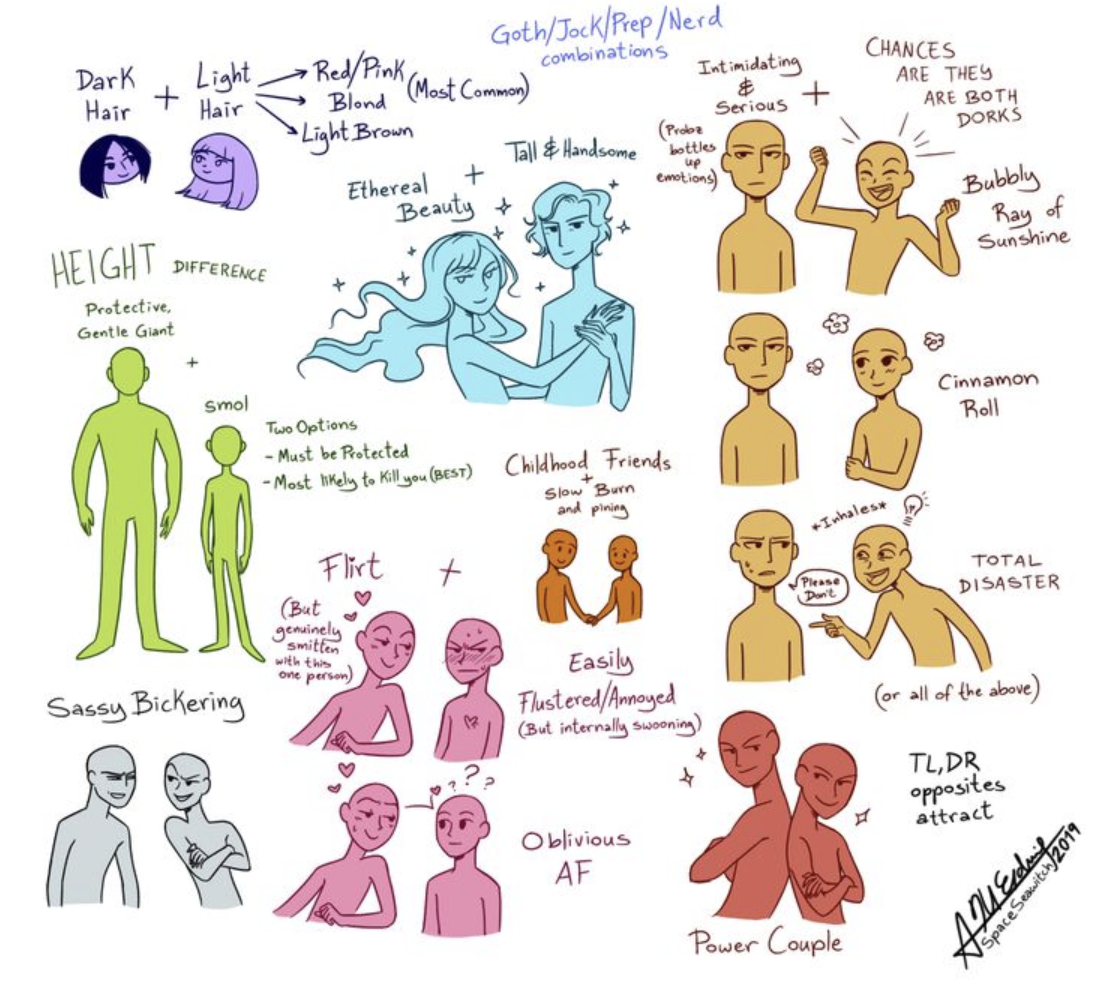
A board like this is useful as a menu. It is not chemistry until you choose one axis of contrast and attach a cost.
Same Voltage in Every Scene
Spark needs variation. Childhood friends who slow-burn should not flirt at full volume in chapter two. A cinnamon-roll pairing should not suddenly trade snark like a sitcom. Without scores for banter, pining, and disaster risk, drafts default to one energy and call it a dynamic.
Care That Never Misses
People show affection differently. If both characters only speak in compliments, you never get the scene where one person cleans the apartment and the other wanted to be told they matter. Unmapped “love languages” flatten conflict into generic misunderstanding instead of a specific miss.
This is exactly what Writing Assistant was built for.
Why Writing Assistant
Writing Assistant is a dedicated writing partner you can run as a character chemistry generator — not a random ship spinner. You bring the pair, the genre, and the constraint (a heist timeline, a court season, a 12-issue comic). It returns contrast, care-style, voltage, and the scene that would make a stranger in the back row believe the bond.
It treats chemistry as a revisable object: change one missed signal, and the banter, the slow-burn, and the blow-up change with it — in language you can paste into a bible, a beat sheet, or session notes.
| Traditional Approach | Writing Assistant |
|---|---|
| “They have chemistry” with no mechanism | Opposition, harmony, and a named cost |
| Trope tags copied from a list | Trope plus private history, joke, and failure mode |
| Identical affection in every pair | Love-language mismatch that generates scenes |
| Banter that could be swapped between casts | Rhythm, status, and who gets the last line |
| A chart that dies after outline week | Regenerated spark when a betrayal or truce lands |
Contrast First, Then Complements
Height difference, goth/jock, intimidating-plus-sunshine — these are contrast knobs, not personalities. Ask the generator to pick one visual or social contrast and one hidden sameness (they are both dorks; they both freeze in hospitals). Dynamic archetypes only spark when they also complete each other. Completeness without friction is bland; friction without care is noise.
Map How Each Person Shows Care
Treat affection as a compatibility matrix, not a vibe. Words of affirmation against acts of service, quality time against gifts — the misses are plot. High alignment is not automatically interesting; it is a different kind of scene (ease, then the outside world interrupting). Low alignment is not automatically doomed; it is the argument that sounds like love if you write the subtext.
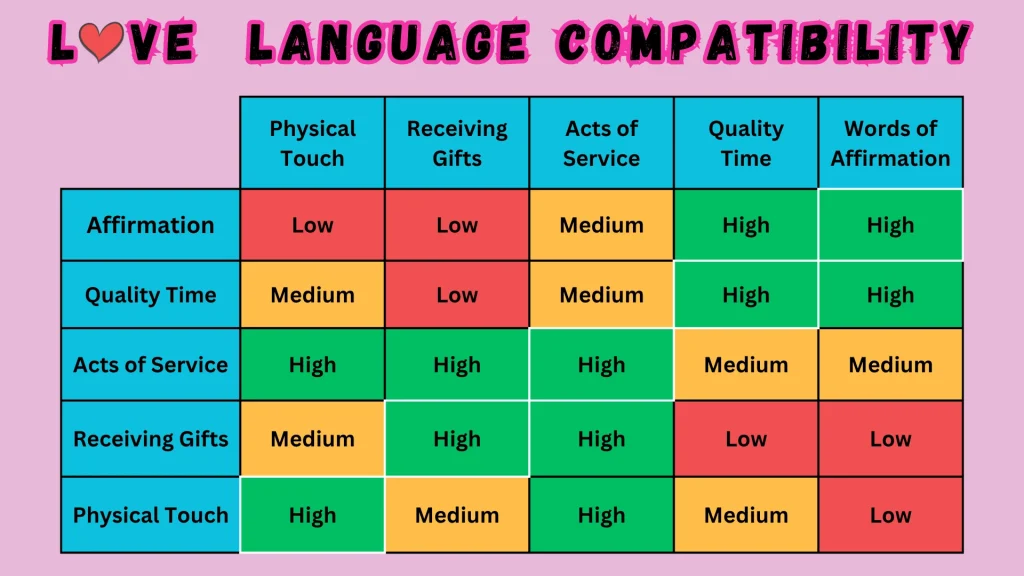
A matrix like this is a conflict engine: it tells you why one character keeps cooking and the other keeps waiting to be praised.
Voltage You Can Direct
Banter, slow-burn, disaster, power-couple poise — score them. High banter plus high disaster is a different night than high slow-burn plus high care. Ask what a +2 in intimacy or a −3 in trust would look like after the midpoint, then demand the beat that moves the number.
"Goth archivist + rescue diver. Opposites attract, but they are both dorks. Score banter, slow-burn, and disaster. Give me the first argument that is actually flirting, and the secret neither will say."
"Childhood friends, slow-burn. She is acts of service; he is words of affirmation. Show three missed signals, then the scene where the languages finally match. Do not resolve the romance in that scene."
Computational work on stories already treats social structure as something you can extract and map from narrative text. Your generator should go further: not a poster of who knows whom, but the charge between them.
Related Agents You'll Also Find Useful
If you are generating character chemistry, you are usually one step from putting that spark on a page, a panel, or a table. These agents sit in that same workflow.
Film Screenwriter — When chemistry has to play in behavior, blocking, and subtext, take the pair into screenplay craft. Useful when you need:
- Banter that reads as action, not as a transcript of jokes
- Romantic or rival scenes with a job in the outline
- Status shifts the camera can see (who pays, who leaves first, who looks away)
Manga Creator — Ensemble manga lives on who stands where, who looks away, and which pair the reader ships without a caption. Useful when you need:
- Silent two-page proofs that the scores work
- Recurring pair rhythm across chapters
- Visual contrast (height, costume, energy) that stays on-model
Roleplay Game Master — Live play dies when NPCs reset their feelings every session. An immersive GM with persistent character memory is chemistry under pressure. Useful when you need:
- NPCs who remember a slight, a joke, or a near-kiss
- Party dynamics that stay uneven on purpose
- Consequences that land without you re-explaining last month’s vibe
Try Writing Assistant free — no credit card required. Bring two names and a constraint; leave with a pairing you can write.
How to Generate Character Chemistry Step by Step
Step 1: Name the Pair and the Constraint Give roles, a setting rule that shapes intimacy, and the energy you want (slow-burn, disaster, power couple). Specificity kills generic “they bicker but it’s cute” filler.
"Fantasy port city under a new harbor tax. Pair: dock-boss Mara and watch captain Sera. I want strained allies with delayed spark, not instant romance. Generate the chemistry profile."
Step 2: Lock One Contrast and One Hidden Sameness Ask for a single visible opposite (status, temperament, aesthetic) and one private overlap. Opposites attract is a starting diagram; the overlap is why they cannot walk away.
"One visual contrast, one social contrast, one way they are secretly the same. No extra tropes. Tell me who has the higher status in public and who has it in private."
Step 3: Assign Care Styles and Missed Signals Map how each person gives and wants care. Demand three misfires before any successful translation. The misfires are your middle-grade scenes.
"Mara is acts of service. Sera is quality time. List how each will misread the other this week, and the one gesture that would actually land."
Step 4: Score Voltage, Then Attach a Milestone Banter, pining, trust, disaster risk — 1 to 10 — plus the event that justifies the numbers. “Banter 8” with no shared history is a wish. “Banter 8 because they ran the same night market stall at sixteen” is a story. Character relationship maps exist so the whole social field is visible at once; chemistry scores are what keep that field from being a static org chart.
Step 5: Prove It With One Unresolving Scene Ask for the conversation or confrontation that would move a score by two points. Keep the ones that hurt. Discard the ones that only restate the profile. Then lock the new status so later chapters do not quietly heal a rift you earned.
"Write the warehouse scene where Sera almost arrests Mara’s cousin. End on a choice that could raise trust or spike rivalry. Do not have them confess anything."
Characterization is not a costume; it is how a person treats other people under pressure. Your generator should force that pressure on command.
Results & Use Cases
📊 Slow-Burn Novel That Readers Can Ship Without a Speech
- Scenario: A literary or SFF novel whose central pairing currently exists only in the pitch. Draft 1 is two interesting people in adjacent chapters.
- Traditional Approach: A trope list, then coffee-shop dialogue that could belong to any couple in the genre.
- Writing Assistant: A chemistry profile with contrast, care-style mismatch, voltage scores, and three misfire scenes. Each chapter goal is restated as which signal is sent and which is missed.
- Benefits:
- The ship has a private language before it has a kiss
- Middle chapters stop cloning the same argument
- Revision starts from scores, not from “make them cuter”
💼 Screenplay Banter That Has to Play in Behavior
- Scenario: A feature whose “great chemistry” is currently a note in the logline.
- Traditional Approach: Talky two-handers and a third-act speech.
- Film Screenwriter: Take the generated scores into scene work — who interrupts, who pays, who leaves first — so the pairing is visible without a monologue.
- Benefits:
- Status changes land as action
- Each pair has a distinct rhythm
- The outline can assign a chemistry job to every sequence
🎯 Party Chemistry for a Tabletop Group
- Scenario: A GM with four players who get along as friends and therefore play a blandly loyal party.
- Traditional Approach: Recycled tavern NPCs; last session’s almost-betrayal forgotten.
- Roleplay Game Master: Generate pair chemistry first (who is the cinnamon roll, who is easily flustered, who is the disaster), then run play against it. NPCs keep grudges and almost-kisses because the charge already exists.
- Benefits:
- Hooks are social, not only MacGuffins
- Player choices rewrite voltage instead of resetting it
- Rival NPCs connect to the party through people, not exposition
📱 Mobile: Comic or Manga Pair Proof Between Commutes
- Scenario: A creator outlining a series on a phone, ten minutes at a time.
- Traditional Approach: Notes-app soup; the rival’s tone changes every Sunday.
- On iOS or Android: Dictate the pair, generate the chemistry profile, then send them into Manga Creator for a silent two-page scene that proves the scores without a caption.
- Benefits:
- Full pairing workflow on the device already in your bag
- Visual proof the contrast reads
- A bible that travels with you
FAQ
What is a character chemistry generator?
A character chemistry generator is a writing tool that designs the spark between fictional people: contrast, complementary rhythm, how each shows care, and the scene that would make a reader believe the bond. Used well, it produces more than a trope tag. It produces missed signals, private jokes, and voltage scores you can drop into a chapter or a session.
Is Writing Assistant free to use as a chemistry generator?
Yes. You can start on the free tier with no credit card. Paid plans raise usage if you are generating series-wide pairing bibles, many revision passes, or full campaign casts. For most writers, the first useful output is one pair profile plus one unresolving pressure scene.
Can a character chemistry generator handle enemies-to-lovers, found family, and rival pairs in the same cast?
Yes — and it should. Chemistry belongs in every major relationship around a protagonist, not only the romance. Ask for overlapping types (mentor and rival; found family and debt) and for non-matching voltage on each side of the pair. If those dynamics have to survive dialogue and blocking, Film Screenwriter is the natural next step.
How is this different from a random trope spinner?
Random spinners ignore your plot. A dedicated generator accepts your setting rule, your villain’s goal, and your timeline, then returns spark that could only exist in that story. You can demand scores, missed signals, and a scene that does not resolve the bond. You can also refuse generic “they bicker” filler until the profile names a specific cost. Tropes are generative only when they still invite variation.
Does it work on mobile for outlining or game night?
Yes. Web, iOS, and Android share the same workflow, including voice-to-text if you want to capture table talk. Many GMs generate the pair profile on a phone, then continue the same cast in Roleplay Game Master so NPCs do not forget who almost confessed.
Will the chemistry stay consistent across a series or a long campaign?
It stays consistent if you treat the profile as canon and update it when the story earns a change. Save the scores, note the milestone that moved banter or trust, and start the next chapter or session from the new voltage. Relationship maps are only useful if they stay current with the plot; chemistry scores are the same discipline, applied to spark.
Conclusion
Flat pairings fail for a simple reason: tropes without texture do not generate scenes. A character chemistry generator repairs that by making contrast, care-style, voltage, and missed signals visible — then by forcing those facts to collide without a speech.
Writing Assistant gives you that object on demand: pair profiles, love-language misfires, scored dynamics, and the pressure scenes that prove the spark. Use it to draft the emotional engine of a novel, a screenplay, a comic, or a campaign, then keep revising the charge as the story earns new scars.
Try it with the two names you already have. Explore more at Jenova.
For Developers: Writing Assistant is available programmatically via the Jenova API — integrate character chemistry generation into your application with a single API call. Full documentation →