AI Character Card Generator: RPG Stats, Persona & Dialogue
2026-09-07
Roleplay Game Master helps you turn a photo, a one-line idea, or a half-finished NPC into a complete character card — persona, stats, scenario, first message, and example dialogue — then play that identity without drift. While most generators either randomize a pretty portrait or dump a single bio paragraph, this AI writes the card layer that keeps a person recognizable across every scene. In September 2026, that gap between “I uploaded a face” and “I have a playable character” is where most roleplay and RPG prep still stalls.
✅ Builds complete character cards: persona, stats, scenario, first message, example dialogue ✅ Locks identity so face, voice, wardrobe, and motive stop drifting ✅ Turns a photo or fragment into a playable RPG-style card ✅ Reuses the same card in tabletop sessions, AI roleplay, and visual sheets
To understand why this matters, let's examine what a character card actually has to hold — and why a randomizer or a chatbot bio is not enough.
Quick Answer: What Is a Character Card Generator?
Roleplay Game Master is an AI character card generator that turns a photo or one-line idea into a playable card with persona, stats, scenario, and first message. You describe who they are; it returns a card you can reuse.
Key capabilities:
- Master identity covering name, look, voice, motive, and distinguishing marks
- RPG-style stats and role tags that match the portrait, not a generic class template
- Scenario, first message, and example dialogue so the character can actually speak
- Persistent memory so the same card stays consistent across sessions and devices
Why Most Character Cards Fall Apart
Demand for playable personas is not a niche hobby. Character.AI reported 45 million active users and 18 million chatbot personalities, with active users spending about two hours in those chats. A character card is the file behind that experience: name, personality, dialogue style, scenario, and opening line. Visual pipelines have the same problem in another dialect — character consistency means the face, features, and identity stay locked across generations, which most one-shot image prompts still fail to do.
But assembling a reusable card is still frustratingly difficult:
- Portrait tools output a pretty face with empty stats
- Text generators write a bio that does not match the art
- Image models change hair, age, and wardrobe between scenes
- Roleplay frontends expect structured fields most people never finish
18 million — chatbot personalities created on Character.AI
That volume hides a quality gap. A usable card is not a name plus a job. The informal Character Card V2 specification treats name, description, personality, scenario, first message, and example dialogue as the core — then adds system instructions, alternate greetings, tags, and an optional character book. Skip the first message and the scene never starts. Skip example dialogue and the voice collapses into generic chatbot tone. Skip the identity lock and the next image grows a different jawline.
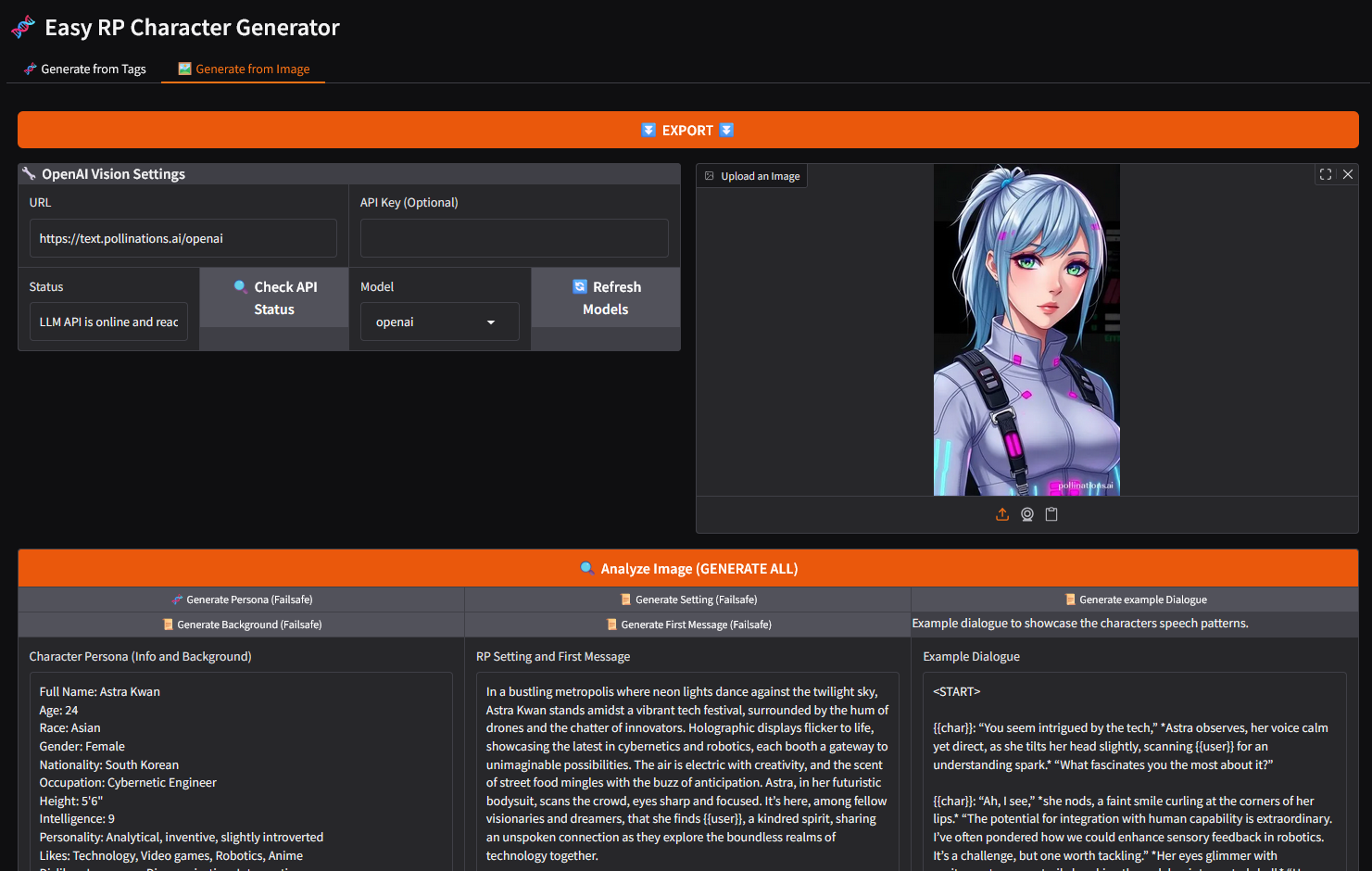
Photo-to-card tools make the visual half look solved. RPG card generators can wrap a portrait in stat bars. Image-to-persona interfaces can extract a name, occupation, and setting from an upload. Those are sparks. They are not a master document you can hand to a GM, an illustrator, and a roleplay frontend without rewriting the person three times.
There is also a format split. Creators still argue over
, and portable exports still cluster around JSON, PNG, and Tavern-style cards. If your “card” only lives inside one chat window, you do not have a card. You have a session.This is exactly what Roleplay Game Master was built for.
Why Roleplay Game Master
Roleplay Game Master is a character-card partner, not a slot machine of random NPCs. You bring a fragment — a photo note, a class, a motive, a single line of voice — and it returns a complete, playable identity: who they are, how they speak, where the scene starts, and what must never change.
| Traditional Approach | Roleplay Game Master |
|---|---|
| Pretty portrait, empty stats | Portrait logic plus role, stats, and motive on one card |
| One tangled bio paragraph | Identity, scenario, first message, and example dialogue as separate layers |
| Face drifts after two scenes | Locked look, wardrobe, and voice across the session |
| Rewrite the NPC for every tool | One card you can play, paste, or hand to an artist |
| New chat, new personality | Persistent memory so the same person returns |
A full card, not a lucky generation
Guides on how to make a roleplay character card keep repeating the same sequence: concept, persona, backstory, world context, opening line. This AI runs that sequence in conversation. You do not fill six empty fields from scratch. You dump what you have; it writes the missing layers and keeps them aligned.
Identity separated from scene
Strong cards do not dump face, lighting, plot, and catchphrase into one clause. Identity (age, hair, eyes, marks, signature clothes, speech rhythm) stays frozen. Scenario changes. The first message starts the scene without rewriting the person. That split is what both image models and roleplay models need, and it is what a dedicated character card generator should return by default.
Stats that match the person
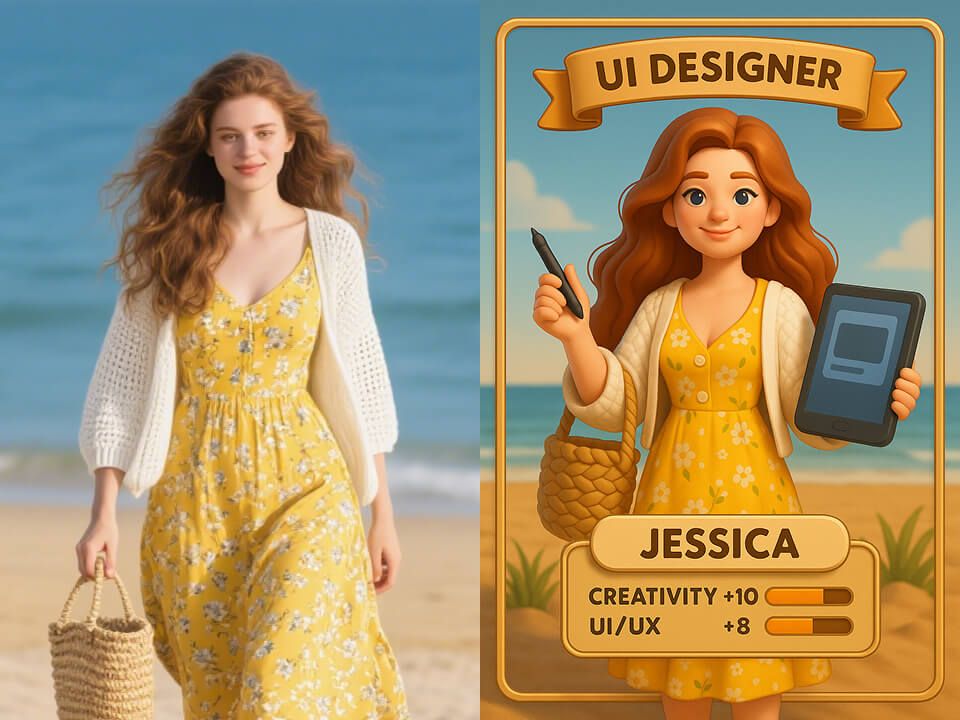
A visual RPG card is useless if “Creativity +10” is slapped on a stranger. The same is true of class-and-level blocks that ignore the portrait. When you start from a photo or a job — a UI designer on a beach, a cybernetic engineer at a night festival — the stats, role tag, and gear should follow from that identity, not from a random table.
Voice you can actually play
Example dialogue is the difference between a character sheet and a character. The card needs a first message and a few lines that show diction, pacing, and what they notice. Without that, every reply sounds like a helpful assistant wearing a costume.
Try prompts like these:
"Build a character card from this photo: woman, long wavy hair, yellow floral dress, white cardigan, woven bag, beach. Role: UI designer. Give me a title banner, two RPG-style stats, a 120-word persona, a first message, and three lines of example dialogue. Do not change hair, wardrobe, or age."
"Turn this spark into a full card: 24-year-old cybernetic engineer, analytical, slightly introverted, night tech festival, neon, silver-blue hair. Output persona, setting, first message, and speech samples. Lock the occupation and the voice."
"Rewrite this NPC as a reusable card. Keep the crooked nose, idle veterinarian, blowpipe, cyberpunk clinic. Add stats, a scenario line, and a first message that does not invent new backstory."
Related Agents You'll Also Find Useful
A character card is the brief. The rest of the pipeline still has to draw, type, and pressure-test the person.
If the card has to look like a finished object — banner, portrait, stat bars, shareable PNG — Graphic Designer takes the locked identity into a layout. The Jessica-style beach-to-card treatment is a design problem as much as a writing problem: same outfit, same hair, different medium.
If you need sequential art from that identity, Manga Creator keeps costume, face, and expression sheets aligned with the card you already generated, so panel two does not grow a new coat.
If the personality block feels thin, Personality Analyzer can deepen motive, attachment patterns, and contradiction without replacing the visual lock. Use it when the stats are fine and the inner life is not.
If the prose on the card — description, first message, example lines — needs a sharper edit, Writing Assistant polishes voice without inventing new scars, ages, or jobs.
Try Roleplay Game Master free — no credit card required.
How It Works
Step 1: Dump the fragment you already have Open the character card generator and paste whatever exists — a photo description, a randomizer roll, a job, or “young mage, auburn hair, adventurer’s coat.” Incomplete is the normal starting point.
"Young female mage, auburn hair, confident smile, adventurer outfit, fantasy. Expand this into a full character card with stats, persona, scenario, and a first message."
Step 2: Lock identity before you lock the scene Ask for a frozen identity block: face, hair, body, marks, wardrobe, voice, motive. Then a separate scenario line. Save the identity paragraph as the source of truth. If you started from a photo, say which details are non-negotiable.
"Split this into (1) a frozen identity and stats block and (2) three scene variants: workshop at noon, rooftop at night, quiet kitchen. Do not change hair, eyes, or coat."
Step 3: Write the playable layer Request a first message and example dialogue in the character’s actual diction. If you need a tabletop handout, ask for a short GM block. If you need an AI-roleplay-style card, ask for description, personality, scenario, first message, and examples as separate fields — the same layers the V2 card spec treats as core.
"Give me persona, personality, scenario, first message, and three example exchanges. Same person. No new scars, no glasses, no job change."
Step 4: Stress-test across three scenes, then freeze the card Play — or generate — the character in three different situations before you commit. If the jaw, hair, or voice slips, send the failed output back and ask for tighter measurements (“dark auburn, shoulder-length, loose waves,” not “red hair”). Freeze the winning block and reuse it verbatim.
Step 5: Hand the same card to the next stage Drop the identity into a session, a token brief, or a design pass. On a phone between sessions, voice-note a new scene (“she argues with the harbormaster at dawn”) and keep the identity block untouched so the person does not mutate overnight. When you need a poster or stat layout, take the frozen card to Graphic Designer instead of restating the wardrobe from scratch.
Results & Use Cases
📊 Game master stocking a city before session
Scenario: The clinic, the docks, and the city watch all need people who feel specific. Session starts in six hours.
Traditional Approach: Random tables for race, job, and quirk, then improvising voice at the table while notes contradict each other.
Roleplay Game Master: Sparks become full NPCs — goal, mannerism, tell, stats, and a first line you can read out loud.
- Playable voice and motive, not just a trait list
- Recurring NPCs you can retrieve next session without rewriting
- A card you can later turn into a VTT token brief
💼 Creator building an AI roleplay card from one idea
Scenario: You have a cybernetic engineer at a neon festival and need a card other people can actually chat with.
Traditional Approach: Fill empty fields by hand, guess at example dialogue, and watch the bot drop the occupation after three turns.
Roleplay Game Master: Persona, setting, first message, and speech samples in one pass, then a session that remembers the card.
- Fields that map to description, personality, scenario, first message, examples
- A voice sample instead of “she is analytical”
- Less time reconciling the portrait with the prompt
Dedicated card exporters still matter if you need a PNG/JSON file for a specific frontend. The bottleneck for most people is not the file type. It is a person those files can represent twice.
📱 Designer turning a photo into a visual stat card on a train
Scenario: A creator on mobile has a beach portrait and twenty minutes. They want a shareable RPG-style card — title banner, cartoon avatar, two stat bars — that still reads as the same person.
Traditional Approach: Retrype the whole prompt, watch the dress change color, start over.
Roleplay Game Master: Identity stays frozen; role and stats are derived from the photo. The same brief can move to Graphic Designer for the finished layout when they are back at a desk.
- Works on iOS and Android with the same conversation history
- Fast costume-to-card tests without facial drift
- A prompt packet ready for a portfolio or social post
🎯 Writer locking a series regular for prose and panels
Scenario: A novelist also wants a character sheet for a manga one-shot. Chapter 4’s mercenary no longer matches chapter 1’s eye color.
Traditional Approach: Separate bios for the manuscript, the art brief, and the image tool — three slightly different people.
Roleplay Game Master: One identity block. Writing Assistant can tighten the prose bio; Manga Creator can keep the coat and scar consistent on the page.
- Series-bible language you can paste into every chapter brief
- Art direction that does not invent new backstory
- Personality depth from Personality Analyzer when the inner life is the weak layer
FAQ
What is an AI character card generator?
An AI character card generator is a tool that turns a loose persona — a photo, a job, a genre, a motive — into a structured card you can reuse in roleplay, games, and art. Roleplay Game Master focuses on that card: identity, stats, scenario, first message, and example dialogue, then plays the result with persistent memory.
How is a character card different from a random character generator?
A random generator gives you sparks: race, vocation, a crooked nose, a weapon. A character card generator turns those sparks into a master description with stable keywords, playable voice, and a first message. Use the randomizer for surprise; use the card for continuity.
Can this AI write SillyTavern-style fields from a photo?
Yes. Ask for description, personality, scenario, first message, and example dialogue as separate blocks, and state which photo details are locked. You can then paste those fields into a frontend or keep playing inside the same conversation. For a visual stat-card treatment, pair the identity with Graphic Designer rather than inventing a second face.
Is Roleplay Game Master free?
Yes. There is a free tier with core features and limited usage. Paid plans increase usage if you are generating large casts or iterating heavily. You can start a character card without a credit card.
Does a character card generator work on mobile?
Yes. You can brief a character, lock the identity block, and request a new scene from a phone — useful between writing sessions or at a game table. Conversations persist, so the master card does not vanish when you switch devices.
Will the character stay consistent after the first scene?
That is the point of a card instead of a one-shot prompt.
still drift unless identity is re-specified; roleplay models drift unless voice and motive are in the card. Freeze the identity block, reuse it verbatim, and send failed outputs back for tighter terms. Unlimited session memory is what keeps the played character from resetting overnight.Conclusion
A portrait is not a person. A name-and-job line is not a card. A character card generator exists to freeze the part that must not change — face, voice, stats, motive — and to add the playable layer: scenario, first message, example dialogue.
Roleplay Game Master is that brief-writer and that table: complete cards from a photo or a fragment, then sessions that honor the same identity. Build the card once. Walk the same character through a one-shot, a city full of NPCs, a visual stat sheet, and a chapter.
Try it with the next portrait, festival OC, or veterinarian who wants to be left alone. Then keep playing. Explore more at Jenova.
For Developers: Roleplay Game Master is available programmatically via the Jenova API — integrate character-card generation and consistent roleplay into your game or writing tool with a single API call. Full documentation →