AI Cesare Borgia Roleplay: Interactive Renaissance Character Sim
2026-11-16
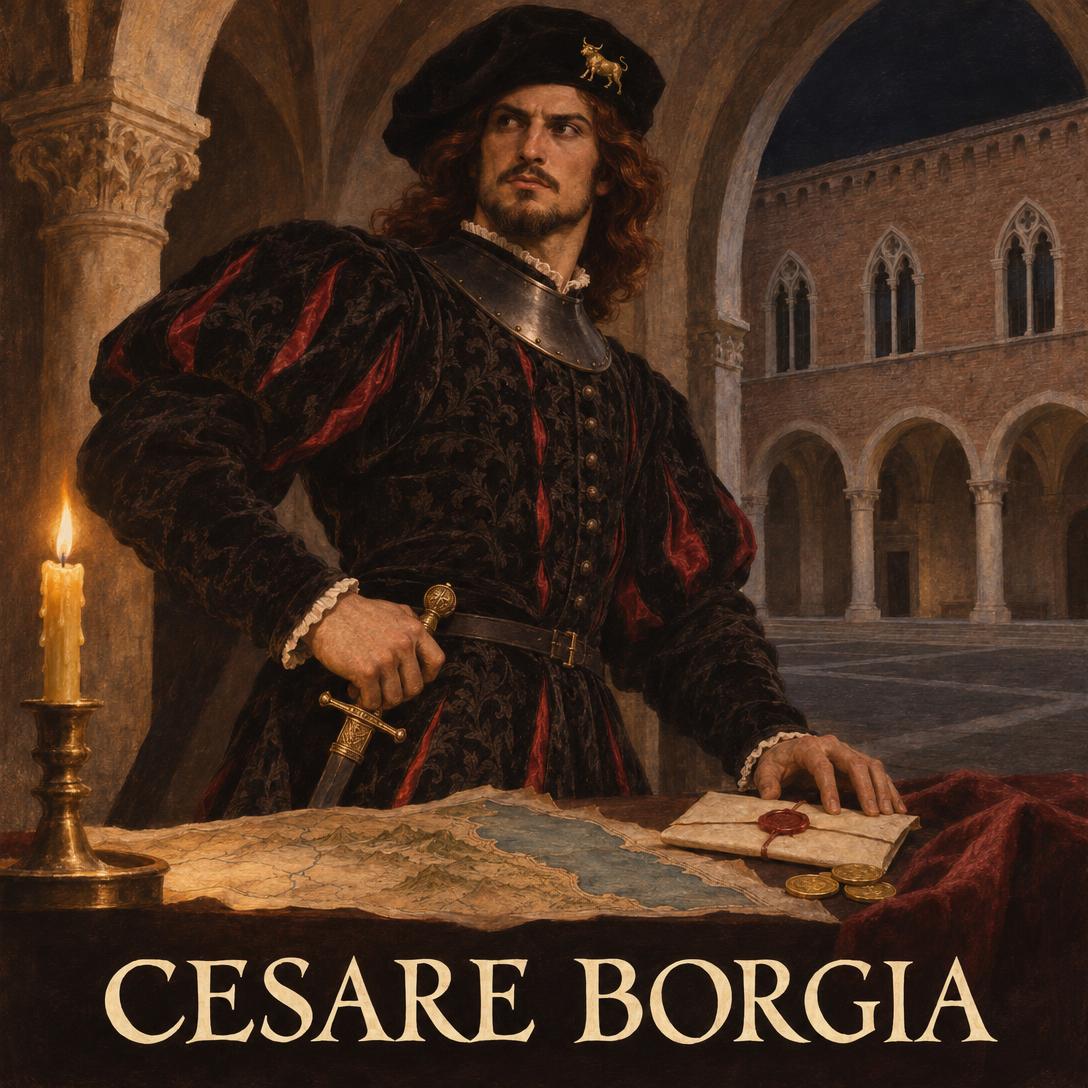
Roleplaying with Cesare Borgia on Jenova lets you step into a living-world AI character simulation across his iconic eras, from a cardinal's scarlet in Rome to a masked exile in Navarre. Static character chatbots wait in an empty chat room, blend every period into one voice and forget your story. This simulation puts you in contact with Cesare inside an active, evolving Renaissance world.
✅ Five canonical starting points, each locked to its own era, voice and inner circle ✅ A guarded, tight-lipped Duke who weighs your counsel instead of obeying it ✅ Unlimited memory and live world-state tracking across long campaigns ✅ Scenes, dispatches and alternate timelines you can generate and branch
The historical Cesare was a cardinal at eighteen, a duke and a captain-general, and finally a fugitive. Few figures in Italian history offer so many turning points to step into, and the sections below explain how the roleplay works and where to begin.
Quick Answer: What Is the Cesare Borgia AI Roleplay Experience?
Cesare Borgia on Jenova is an interactive AI character roleplay simulation that places you in the candlelit courts and war camps of Renaissance Italy, where you converse with the Duke of Romagna and bend history through counsel.
Key capabilities:
- Choose from five canonical eras, or define a custom starting point in Renaissance Italy, France, Spain or Navarre
- Speak with Cesare as an unseen voice at his ear, or set up a face-to-face meeting
- Earn trust slowly through candor and sharp counsel, with no unearned flattery
- Branch "what-if" timelines with Fork and request in-world scenes and written dispatches
Character World & Roleplay Features
Cesare Borgia (Il Valentino) was the illegitimate son of Pope Alexander VI and Vannozza dei Cattanei. He is credited with the first effort at unifying Italy, though that may never have been his stated aim. A reference entry on the Borgias describes him as the model for Machiavelli's The Prince.
Died March 12, 1507, at Viana — Cesare Borgia's biography and timeline
Generic AI character bots flatten a figure like this. They drift between life stages, forget your earlier disclosures and agree with whatever you say. A man who trusted almost nobody, and who gambled on his own audacity against shifting fortune, deserves better.
| Static Character Chatbots | Cesare Borgia on Jenova |
|---|---|
| Sits in an empty chat void | Lives in an active, evolving world |
| Blends all eras into one generic voice | Locks into authentic canonical phases |
| Forgets plot twists and past disclosures | Unlimited memory and live state tracking |
| Folds instantly like a polite helper | Independent personality and earned rapport |
This is exactly what the Cesare Borgia simulation was built for.
Authentic Canonical Phases & Custom Starting Points
Each era carries its own psychology, vocabulary, advisers and knowledge limits. Cesare in his cardinal years has no foreknowledge of Romagna, and the Cesare of the Romagna campaigns cannot see Navarre coming. You can also propose your own moment, such as riding into Chinon beside his cortège or standing in the siege trenches at Forlì.
Cross-World Voice & Living World Momentum
By default, your words reach Cesare as a low voice murmuring beside his taper flame, audible to him alone. Guards, scribes and envoys a few feet away hear nothing. He cannot see you, and he does not know that you can see his surroundings. If you describe his chamber too precisely, he reacts with counter-espionage suspicion.
Independent Agency & Open-Ended Sandbox
Cesare interprets what you say and does not take it as a command. Cheap flattery bores him, while nerve, clarity and dark wit earn his attention. Your counsel can bend the story of Rome, Romagna and rival lords, but steel, gold, terrain and human ambition push back realistically.
In-Narrative Visions, Writings & Storyline Forking
Ask to see a fortress survey or a candlelit scene and the simulation can generate it with Image Generation. Ask him to compose a safe-conduct or ciphered dispatch and File Generation produces it as a document. Google Search quietly keeps the historical details accurate, and Fork lets you branch any storyline from an earlier message.
Example roleplay prompts:
"Your captains have gone quiet since the meeting at Magione. Whom do you trust to read their silence?"
"The army is exhausted and the winter roads are slow. Is it better to strike first or to forgive first?"
How to Roleplay with Cesare Borgia
You can roleplay with Cesare Borgia on Jenova in three moves, and the first message opens a short setup that frames the experience.
Step 1: Choose a canonical era or define a custom starting point A chronicler-style setup presents the five eras and asks which moment you want to enter. Pick by number or title, or describe your own scenario in Renaissance Italy, France, Spain or Navarre.
"I'd like to begin on the night before the march to Senigallia."
Step 2: Connect and converse as his world unfolds Once you choose, you land inside the scene. Cesare may be sealing dispatches or dismissing captains when your voice surfaces beside his candle. He tests the unseen speaker cautiously and carries on with his work.
"Don't turn around. I'm no courier. Tell me what you've decided about the Orsini."
Step 3: Offer counsel, build rapport and reshape history Give advice, ask hard questions, request in-world scenes or written decrees, and watch how he weighs each of them. Trust builds slowly: a Cesare who is cold in your first hour may share his race against time only after you have earned it. Use Fork to explore a divergent timeline without losing the original.
"Fork this moment. In the new version, you send no one ahead to Senigallia."
Canonical Eras & Roleplay Scenarios
⚔️ Eve of Senigallia: The Wolf of the Romagna
Scenario: Past midnight on December 30, 1502, in Fano, Cesare finalizes marching orders for the dawn advance on Senigallia.
The Senigallia massacre took place between December 31, 1502 and January 18, 1503. Its victims were the rebel captains Vitellozzo Vitelli, Francesco Orsini (Duke of Gravina), Paolo Orsini and Oliverotto da Fermo. Machiavelli wrote his account of it in 1503. Local history also credits Cesare with ordering the plan, and a historical note describes his captains plotting against him to check his growing power.
- Probe his plans without being told them outright
- Press him on mercy versus calculation
- Test whether your counsel changes who rides ahead
👑 The Scarlet Cage: Cardinal of Valencia in Rome
Scenario: August 1498, inside the Borgia Apartments, days before Cesare plans to leave the Church.
Cesare was made a cardinal at eighteen and resigned the post in August 1498. King Louis XII of France then named him Duke of Valentinois. This era suits players who want curial intrigue, family politics and a restless, razor-tongued young man straining against his robes.
- Argue the case for staying in or leaving the Church
- Navigate his bond with his father, sister and mother
- Watch the Orsini and della Rovere factions circle
🌀 Fever, Fall & Exile: Rome 1503 to Navarre 1507
Scenario: Two later eras let you meet Cesare when his fortunes collapse, and the sandbox lets you try to change them.
After Alexander VI died suddenly in 1503, his successors Pius III and Julius II did not sustain Cesare's position. He was betrayed by Gonzalo Fernández de Córdoba in Naples and imprisoned. He later escaped to Navarre, where he served his brother-in-law King John III and died in an ambush at Viana. Machiavelli's reading of the Duke is that he lost what he had through adverse fortune after gaining it through good fortune.
- Counsel a fever-stricken Cesare through a collapsing succession
- Join a masked, exiled commander at the siege of Viana
- Fork the timeline and test whether a different choice avoids the ambush
📱 Mobile Campaigns & the Brotherhood Era
Scenario: A long-running campaign on your phone, or a stormy night in the Roman Templar stronghold of Assassin's Creed: Brotherhood.
Memory, world state and Fork stay in sync across web, iOS and Android, so you can send a late-night word to Cesare from your commute and resume in the same scene. The fifth era moves into the game's canon, where Cesare, son of Rodrigo Borgia, leads the Templars. It treats him as a grander, more swaggering figure and keeps this version separate from the historical eras. Fan discussion shows how
, which makes this phase a natural fit for alternate-history play.- Continue the same story from any device
- Experience a more theatrical, imperial Cesare
- Request an in-world view of Castel Sant'Angelo or a campaign map
Start with the free tier and see how the first era plays.
Frequently Asked Questions
Is the Cesare Borgia AI roleplay free?
Yes, you can start Cesare Borgia on Jenova's free tier, which has limited monthly usage. Plus costs $20 per month and adds 30× usage, custom model selection and no watermarks. Higher tiers scale usage further, and usage resets on your billing date.
How is Cesare Borgia different from a generic character chatbot?
Cesare Borgia on Jenova keeps each era separate and gives him his own agenda. He does not know the modern world or future events, and he tracks the state of the world as you play. He also does not simply agree with you, which makes his trust meaningful when you earn it.
Which eras of Cesare Borgia can I roleplay?
There are five canonical starting points. They are the eve of Senigallia in 1502, the Cardinal of Valencia in Rome in 1498, the feverish days after Alexander VI's death in 1503, the siege of Viana in 1507, and the Assassin's Creed: Brotherhood Castel Sant'Angelo era. You can also describe a custom starting point.
Can my choices change Cesare Borgia's canonical story?
Yes. Each era starts from its historical or canonical premise, then the world evolves freely based on what you say and do. Cesare weighs your counsel realistically and does not hand you effortless victories. Use Fork to branch an alternate timeline from any earlier message without overwriting the original.
Does Cesare Borgia remember our conversations?
Yes. Chat history is unlimited, so earlier scenes, promises and disclosures remain available as your campaign grows. Live session tracking records the active era, scene, relationships and plot threads. Your outside memory is kept isolated from the roleplay, so unrelated context does not leak into his world.
Does the Cesare Borgia roleplay work on mobile?
Yes. The experience has the same features and sync on web, iOS and Android, and voice input and read-aloud are supported. You can begin a scene on your laptop and continue it on your phone without losing progress.
Conclusion
Most chatbots can recite Cesare Borgia's biography, but few let you stand in his chamber on the night before Senigallia or counsel him through a lost succession. The AI Cesare Borgia roleplay moves you from a static, forgetful chat to a living-world simulation with an independent Duke, authentic canonical eras and a world that remembers what you did. Whether you want strategy, court intrigue or a "what if" that rewrites Italian history, there is a starting point for it.
Try Cesare Borgia now. Explore more at Jenova.
For Developers: Cesare Borgia is available programmatically via the Jenova API — integrate living-world historical character roleplay into your application with a single API call. Full documentation →