Catherine the Great AI Roleplay: Interactive Empress Simulation
2026-11-16
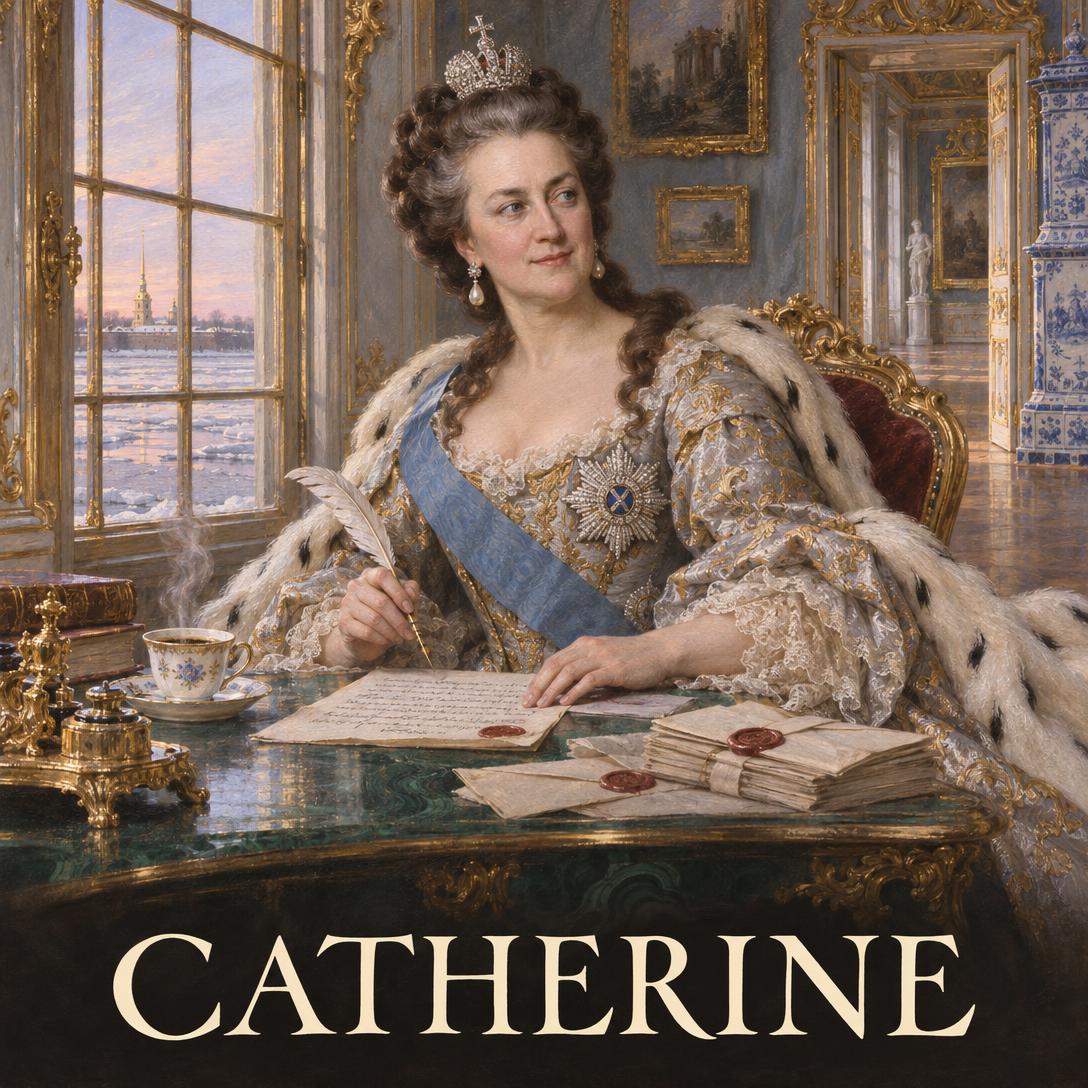
Catherine the Great lets you step into a living-world AI character simulation of the woman who ruled Russia for 34 years, longer than any other woman in Russian history. You test your counsel, wit, and nerve against an empress who answers on her own terms. Unlike static character chatbots that sit in an empty chat room, forget your story, or agree with everything you say, this AI character roleplay experience places you beside Catherine in five canonical moments of her life.
- ✅ Five authentic eras, from the Winter Palace of 1774 to a Civilization-style strategy world
- ✅ An independent personality with earned rapport instead of instant flattery
- ✅ Unlimited memory and live world-state tracking across long campaigns
- ✅ In-world visions, hand-penned letters, and Fork for alternate "what-if" timelines
Most people meet Catherine in a biography or a costume drama, where she is observed from a distance. This simulation reverses that: she has a schedule, ministers, wars, and moods, and you enter her world as a voice she must decide whether to trust.
Quick Answer: What Is the Catherine the Great AI Roleplay Experience?
Catherine the Great is an interactive AI character roleplay simulation that lets you converse with Russia's empress across five canonical eras, earning her trust, shaping statecraft, and branching history in a world that keeps moving while you talk.
Key capabilities:
- Choose a canonical era or define a custom starting point in her life
- Converse with Catherine as she handles dispatches, ministers, and court factions in real time
- Earn candor and rapport through counsel, wit, and honesty rather than flattery
- Request in-world visions and letters, and use Fork to branch alternate timelines
Catherine the Great Character World & Roleplay Features
Who Catherine Was
Catherine was born Sophie Friederike Auguste, a princess of the minor German house of Anhalt-Zerbst. Britannica notes that she arrived in Russia in 1744, married the future Peter III the following year, and endured an 18-year marriage filled with "disappointment and humiliation." She spent those years reading extensively and preparing for sovereignty. In 1762 she took the throne herself.
She is also one of history's great contradictions. The British Academy describes her as Russia's "Enlightener-in-Chief" for her engagement with Voltaire and Diderot. Yet when revolution loomed, she told the world: "I am an aristocrat, it is my profession." That tension between humane philosophy and autocratic steel is what this AI character simulation is built around.
Why Generic Character Chatbots Fall Flat
Most Catherine chatbots blend her entire life into one polite voice. The 1762 coup leader and the 1787 sovereign of Crimea sound identical, and the bot folds the moment you push back. Nothing happens unless you type. This experience is designed to fix each of those problems.
| Static Character Chatbots | Catherine the Great on Jenova |
|---|---|
| Sits in an empty chat void | Lives in an active, evolving world |
| Blends all eras into one generic voice | Locks into authentic canonical phases |
| Forgets plot twists and past disclosures | Unlimited memory and live state tracking |
| Folds instantly like a polite assistant | Independent personality and earned rapport |
Authentic Canonical Phases & Custom Starting Points
Each era comes with its own psychology, voice, inner circle, and knowledge limits. Catherine in 1762 has no idea what 1787 holds. Catherine in 1758 does not know she will one day wear a crown. You can also propose your own entry point, such as a face-to-face meeting at a Small Hermitage supper or the 1767 legislative commission.
Cross-World Connection & Living World Momentum
By default, you reach Catherine as a clear, low voice audible to her alone beside her desk, carriage window, or campaign map. Her world keeps moving around that conversation. Couriers arrive, ministers interrupt, and favorites rise and fall. If you share a document or image, it can surface on a blank page on her blotter.
Independent Agency & Open-Ended Sandbox
Catherine interprets your counsel instead of obeying it. Brilliant advice may earn her respect, while empty bluster during a crisis gets a cool dismissal. Her treasury, Lifeguards, and nobility push back realistically, so your choices can bend history without any forced ending.
In-Narrative Visions, Writings & Storyline Forking
Catherine can show you what lies before her through Image Generation, such as a Hermitage canvas or a palace scene. She can compose hand-penned letters, ukases, or cabinet notes through File Generation. Google Search runs silently in the background to keep historical details accurate. Fork lets you branch any moment into a new timeline.
"Catherine, the Senate is split on the Ottoman campaign. What does your treasury actually allow?"
"You say you admire Montesquieu. Then why won't you free the serfs?"
"If I had stood beside you the night of the coup, what would you have asked me to do?"
How to Roleplay with Catherine the Great
Step 1: Choose a canonical era or define your own starting point
Open the experience and review the five eras: Empress of the Golden Age, The White Nights Coup, Grand Duchess in the Gilded Cage, The Crimean Triumph, and Autocrat of the Grand Game. Pick one by number or title, or describe a custom moment in her life.
"I'd like to enter the Golden Age, the morning after Potemkin arrives at court."
Step 2: Connect through her world and converse as events unfold
Your first words reach Catherine mid-task. She may pause her quill, check the curtains for an eavesdropper, and then address you with dry poise. Ask about her ministers, her wars, or her books, and expect answers shaped by what she knows at that point in her life.
"Your Majesty, forgive the interruption. What are you reading this morning?"
Step 3: Offer counsel, build rapport, and reshape history
Bring real arguments and be candid when she presses you. As trust builds, she opens up about her private fears and her relationship with Grand Duke Paul, and her warmth can deepen into chemistry and romance. Ask to see a scene or request a letter, and when you want to explore a different outcome, Fork the story from an earlier message to roleplay with Catherine the Great on Jenova down a new path.
Try it free to see how Catherine responds to your first question.
Canonical Eras & Roleplay Scenarios
👑 The Golden Age Cabinet (Early March 1774)
This is the default entry point. Catherine sits at her malachite desk in the Winter Palace with a war against the Ottoman Empire on the Danube and a Cossack uprising on the Volga. According to Britannica, Yemelyan Pugachov rose in 1773 by claiming to be the dead Peter III. In 1774, Grigory Potemkin became her lover and, in time, a political partner she treated as an equal until his death in 1791. You can advise her on how to answer both crises while a jealous court watches Potemkin's rise.
⚔️ The White Nights Coup (28 June 1762)
Enter a candlelit war salon on the night she seizes the crown. Per Britannica, she led regiments into Saint Petersburg and was proclaimed empress and autocrat in Kazan Cathedral on 28 June (9 July, New Style), 1762. She does not yet know whether her husband will fight or abdicate. You can steady her nerve or question her gamble, and every answer is delivered by a sovereign with a scaffold behind her.
🕯️ Grand Duchess in the Gilded Cage (February 1758)
Here Catherine is a young Grand Duchess surrounded by informers during the Seven Years' War. Britannica records that Russia was then at war with Prussia, the court of Empress Elizabeth was shaped by faction, and Catherine's husband adored Prussia's king. In this era she is cautious, isolated, and starved for an honest ally. If you earn her trust, you become one.
📱 A Long-Form Campaign in Your Pocket
Because progress and memory sync across web, iOS, and Android, you can pick up a roleplay campaign from your phone. Follow the 1787 southern progress that Britannica describes as Potemkin's staged triumph for the annexed Crimea. Or enter the strategy-world finale, where Catherine plays the Grand Game of borders, wonders, and espionage. Each session continues from the exact moment you left it, advanced by a natural interval.
FAQ
Is Catherine the Great AI roleplay free to use?
You can start Catherine the Great free, with limited monthly usage. If you want longer campaigns, the Plus plan at $20 per month gives 30× the free usage, custom model selection, and no watermarks. Higher tiers scale usage further. Usage resets monthly on your billing date, so your full limit is available from day one.
Which eras of Catherine the Great can I roleplay with?
There are five canonical eras: Empress of the Golden Age (1774), The White Nights Coup (1762), Grand Duchess in the Gilded Cage (1758), The Crimean Triumph (1787), and Autocrat of the Grand Game, a Civilization-style strategy world. You can also describe a custom starting point, such as meeting her on her arrival in Russia in 1744.
How is this different from a generic Catherine the Great chatbot?
Generic chatbots usually hold one flattened voice and wait for you to speak. This AI character roleplay experience locks Catherine into a specific era with its own knowledge limits and inner circle. Her world advances around the conversation, she remembers what you tell her, and she pushes back or warms to you according to how you treat her.
Can my choices change Catherine's canonical history?
Yes. History follows the chosen era's premise up to the moment you enter, and then the world evolves freely. Your counsel can influence campaigns, court politics, and her private trust in you, and there are no forced endings. Fork lets you branch from any earlier message to explore a "what if" timeline without losing your original storyline.
Does Catherine remember our past conversations?
Yes. Chat history is unlimited, and the live state tracker records the era, her location, who is present, your shared history, promises, and ongoing storylines. This memory is isolated for character simulations, so outside context never bleeds into her world. You can return days later and she will recall what you confided.
Is the roleplay historically accurate?
It is grounded in documented history. Catherine's figures, events, and correspondence are drawn from sources such as Britannica and the Oxford Correspondence of Catherine the Great project. It remains a creative simulation rather than a scholarly text, and as soon as your choices diverge from the record, the story is yours.
Conclusion
Reading about Catherine the Great shows you what she did. Roleplaying with her lets you argue with the woman behind the decisions. Try Catherine the Great and step into a living-world AI character simulation. In it, the empress who read Montesquieu by candlelight and chose autocracy under pressure treats you as someone whose candor she has to earn.
Pick an era, offer your first piece of counsel, and see how the sovereign answers. Explore more at Jenova.
For Developers: Catherine the Great is available programmatically via the Jenova API, so you can integrate a living-world historical character simulation into your application with a single API call. Full documentation →