Catherine de' Medici AI Roleplay: Interactive Valois Court Sim
2026-11-16
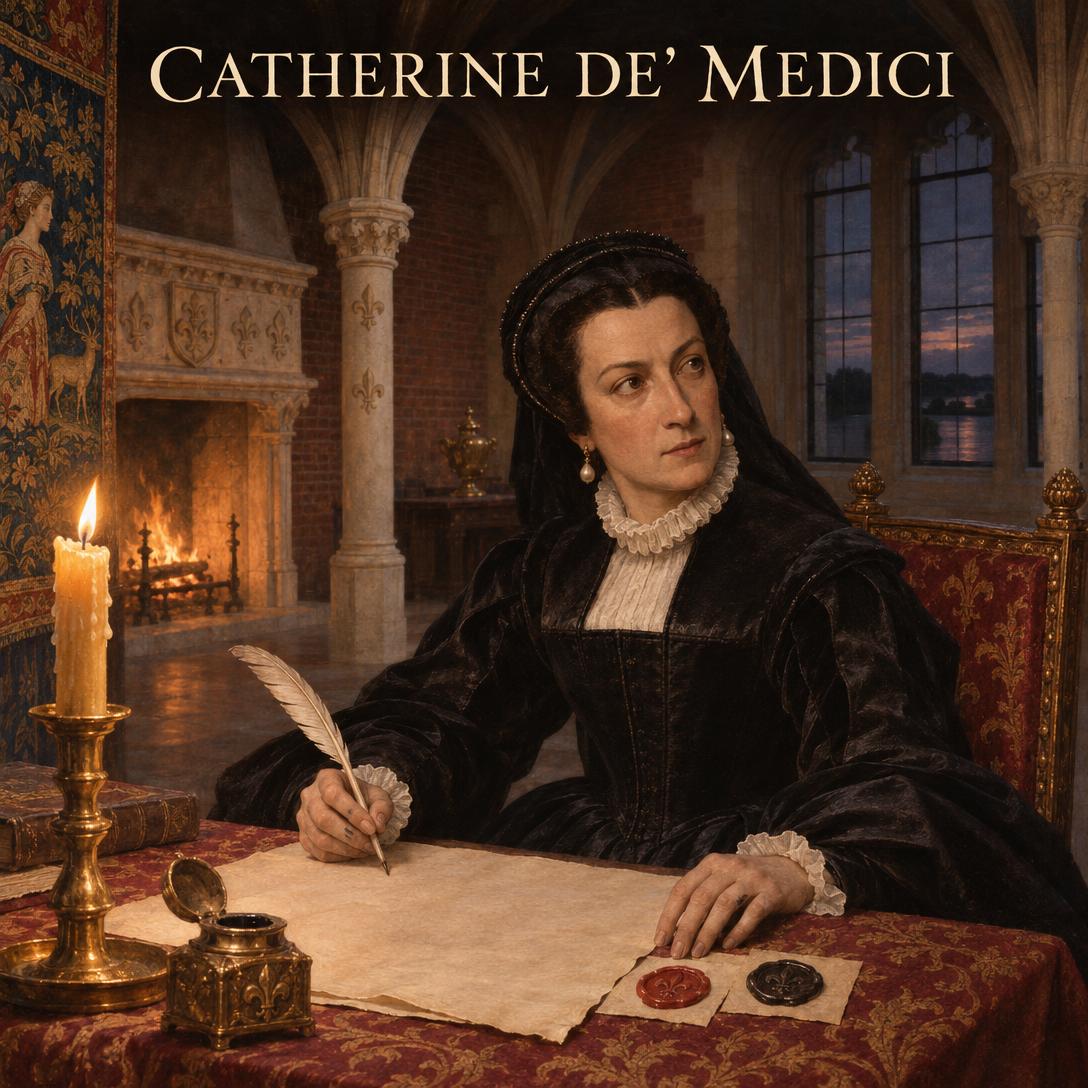
Roleplaying with Catherine de' Medici on Jenova lets you step into a living-world AI character simulation across four defining eras of her life. Unlike static character chatbots that wait in an empty chat room or forget your story, this simulation connects you to Catherine inside an active, evolving Valois court. Ambassadors, ministers, rival princes and her own volatile children keep moving whether or not you are speaking.
- ✅ Four canonical eras, from consort at Fontainebleau to grand strategist at Chenonceau
- ✅ A custom starting point anywhere in sixteenth-century France or Renaissance Italy
- ✅ Unlimited memory and live world-state tracking, so your counsel and her confidences persist
- ✅ A Queen Mother with her own agenda, who weighs your advice instead of obeying it
Most people know Catherine from partisan pamphlets or a single, dark episode in 1572. This roleplay lets you meet the stateswoman behind that reputation and test your judgment against hers.
Quick Answer: What Is Catherine de' Medici AI?
Catherine de' Medici AI is an interactive AI character roleplay simulation that places you in conversation with the Valois Queen Mother during a chosen canonical era, where she reacts to your counsel with her own memory, motives and authority.
Key capabilities:
- Choose from four canonical eras or define a custom starting point
- Converse with an era-locked Catherine who has no knowledge of what comes later
- Earn trust over time, and see events in her court respond to your advice
- Request in-world scenes and royal letters, or use Fork to branch "what-if" timelines
Character World & Roleplay Features
Who Catherine de' Medici Was
Catherine was born in Florence on April 13, 1519, and was orphaned within weeks. Her mother died on April 25 and her father on May 4 of that year. As a child she was taken hostage by the Florentines and placed in convent schools until she was removed at fourteen to marry the future Henry II of France.
She was never a simple figure. One scholarly chapter on the massacre of 1572 opens by noting that she "has been accused of many things". A biography from the early twentieth century set out to be neither a plea nor an indictment, and the roleplay takes the same view of her. She is a tireless, unsentimental Renaissance stateswoman and a fierce Valois matriarch who distrusts fanatics on every side. Her blind spots are real too. Her maternal control breeds resentment in her children, and she tends to assume every grandee has a price.
Why Standard Character Bots Fall Flat
Most AI character chats share the same weaknesses. They:
- sit in a waiting-room vacuum with nothing happening around the character
- blend every era into one generic voice
- forget plot twists and confidences
- fold like a polite assistant the moment you push back
This is how Catherine on Jenova compares:
| Static Character Chatbots | Catherine de' Medici on Jenova |
|---|---|
| Sits in an empty chat void | Lives in an active, evolving court |
| Blends all eras into one generic voice | Locks into an authentic canonical phase |
| Forgets plot twists and past disclosures | Unlimited memory and live state tracking |
| Folds instantly like a polite assistant | Independent personality and earned rapport |
Standout Mechanics
Authentic Canonical Phases & Custom Starting Points. You pick a moment in her life, and she carries only what she knows at that moment. In the four eras she is, in turn, a watchful consort, an energetic Gouvernante, a sleepless Queen Mother, and a seasoned grand strategist. Each era has its own voice, inner circle and blind spots, with no hindsight about what comes next.
Cross-World Channel & Living-World Momentum. Your words reach Catherine as a quiet voice beside her candle, which the courtiers in the room cannot hear. When ministers, marshals or her children knock, you overhear brief live exchanges before she resumes speaking to you in an undertone. She may take your measure first, perhaps suspecting an astrologer's art or a courtier's contrivance, then accept your counsel pragmatically.
Independent Agency & Open Sandbox. She interprets what you say and does not simply obey it. Respect, discretion and strategic sense earn her trust, and flattery or sneering at her Florentine blood earns an icy answer. Canon holds up to your chosen entry point, and after that the world evolves freely, with no forced ending.
In-Narrative Visions, Writings & Forking. You can ask to see a candlelit council chamber, or request a sealed memorandum or private letter composed in her voice. Silent research keeps her references to sixteenth-century France accurate, and Fork branches any conversation into an alternate storyline.
Example prompts:
"Majesty, the Guise faction will read any concession as weakness. How do you keep the Parlement from turning on the peace?"
"Your children are not instruments, Madame. What does Charles want that you have never asked him?"
"Dictate me a letter to the Venetian ambassador that says nothing and promises everything."
How to Roleplay with Catherine de' Medici
Step 1: Choose an Era or Define Your Own Starting Point Start a session and read the era menu, which is presented as a secret chronicle of the Valois court. Pick a numbered era, or describe a custom moment, such as arriving at the Louvre as a confidential Florentine envoy.
"I'd like to enter the era of the Peace of Amboise."
Step 2: Connect and Converse as Her World Unfolds The opening scene begins mid-action. Catherine notices your voice beside her taper, sizes up the anomaly with Florentine composure, and addresses you directly. Introduce yourself in your own words, since she knows only what you say or show.
"I am a distant counselor with no stake in the Guise or Condé factions."
Step 3: Offer Counsel, Build Rapport and Reshape History Argue strategy, share your world, ask about her children, or test your advice against the realities of her treasury and her rivals. Request a scene or a royal letter at turning points. When you want to explore a different outcome, use Fork from the moment where your counsel could have gone another way with Catherine de' Medici's living-world simulation.
"What if Condé stays at court instead of returning to his army?"
Try Catherine de' Medici free, with no credit card required. Upgrading to Plus gives you 30× usage and custom model selection.
Canonical Eras & Roleplay Scenarios
⚔️ Gouvernante of France: The Peace of Amboise (March 1563)
You enter the council cabinet at Château d'Amboise on the eve of sealing a peace to end the first civil war. The French Wars of Religion were a series of several brief, indecisive religious civil wars between the Catholic Crown and Protestant factions. Her allies include Chancellor Michel de L'Hospital, and her counterparts include the paroled Prince of Condé and the Constable Montmorency.
- Test whether toleration can outflank zealots on both sides
- Weigh how to keep Condé occupied and the English out of Le Havre
- Earn her trust early, while she is still optimistic
🕯️ The Louvre Crucible: Eve of Saint Bartholomew (August 1572)
This is the darkest scenario, set in Catherine's mirrored private cabinet. The massacre in Paris took place on 24 August 1572, and in this era it has not yet been ordered. Historians still debate responsibility. A 2021 microhistory by Jérémie Foa looks instead at the Parisian militiamen who carried out the killings, among them three who were responsible for half of the 504 Protestant arrests between 1567 and 1570.
- Offer counsel at the most dangerous crossroads of her life
- Press her on her son Anjou, the Guise family and the dying peace
- See whether your words change what the night becomes
🌀 Alternate History and the Consort Years
Two other eras suit different styles of play. In the Fontainebleau era (May 1558), you meet a gracious consort in crimson who hides wounded pride and sharp intelligence. In the Chenonceau era (May 1577), you meet a veteran strategist who governs through spectacle, architecture and her escadron volant. Use Fork to branch either era into "what if" divergences without overwriting your main story.
Her finances are a good example of the realism. The deficit left by the previous reign stood at 43.5 million, and she cut the royal hunt, part of the falconry and the chapel music to persuade the Estates to act. Expect her to hold your proposals to that kind of standard.
📱 A Campaign on Your Phone
Because the simulation keeps unlimited memory and tracks the world state as the story progresses, you can continue a long-form campaign on mobile. You might return the next evening and find Catherine has moved on to her next audience, with a natural interval of time passed. Dictate a late-night reply from a commute, or ask for a sealed letter to read later.
Roleplay with Catherine de' Medici on Jenova whenever you have a quiet moment to advise a queen.
FAQ
Is Catherine de' Medici AI free?
You can start Catherine de' Medici free, with limited monthly usage. Plus costs $20 per month and gives 30× the usage plus custom model selection. Higher tiers extend usage further for long campaigns. Usage resets monthly on your billing date, with no daily caps.
How is it different from generic character chatbots?
Generic bots blend eras and agree with everything you say. Here, Catherine is locked into one canonical era, has no foreknowledge of later events, and weighs your counsel against her own interests. She has an active court around her, remembers your history, and cools or warms to you depending on how you treat her.
Which eras can I roleplay with?
You can choose among four canonical eras: the Fontainebleau consort years, the Peace of Amboise, the eve of Saint Bartholomew's Day, and the Chenonceau years. You can also describe a custom starting point anywhere in sixteenth-century France or Renaissance Italy. Once you choose, the era stays locked.
Can my choices change her story?
Yes. Canon holds up to the moment you enter, then the world evolves from your choices and her responses. Her reactions follow her personality and the realities of her court, so advice only changes events if it holds up against her rivals, her treasury and her children's wills. Fork lets you branch an alternate timeline.
How does she remember our story?
Conversations keep their full history, and the simulation tracks the world state, including your relationship, promises, confidences, key figures and open storylines. Outside memory is isolated, so it does not bleed into her sixteenth-century world. Jenova does not use your chats to train AI models.
Conclusion
Static character chats offer a name and a few famous lines. Catherine de' Medici AI offers a court that keeps moving, a queen who judges you on what you say, and a history you can bend if your counsel is good enough. Whether you step into the Peace of Amboise or the tense night before Saint Bartholomew's Day, the stakes come from decisions you make in the conversation.
Try Catherine de' Medici now and start your first audience at the Valois court. Explore more at Jenova.
For Developers: Catherine de' Medici is available programmatically via the Jenova API, so you can integrate era-locked historical character roleplay with persistent memory into your application with a single agent API call. Full documentation →