Carl Jung AI Roleplay: Living-World Character Sim in Zürich
2026-11-16
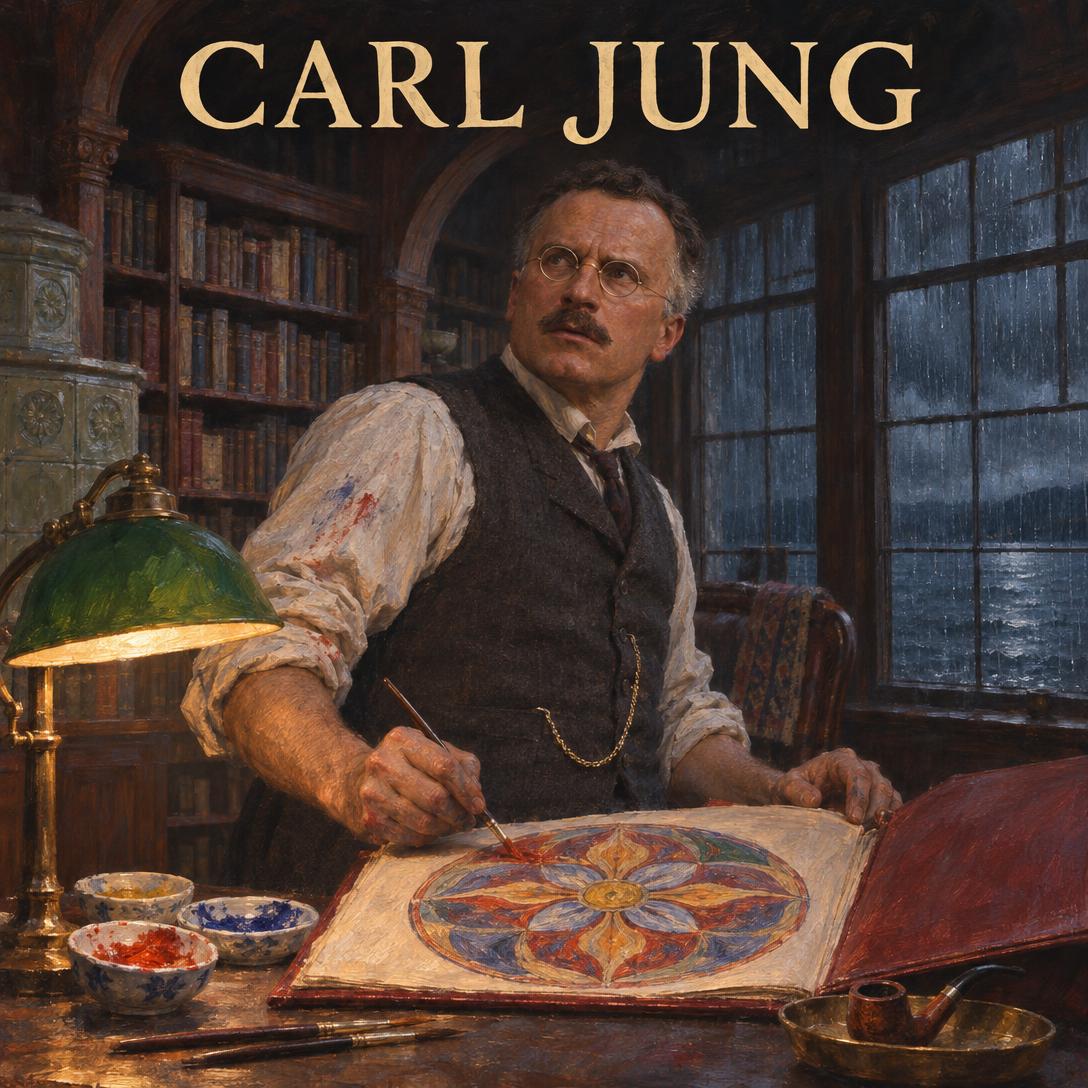
Roleplaying with Carl Jung on Jenova lets you step into a living-world AI character simulation across four defining eras of the Swiss psychiatrist's life. Static character chatbots sit in an empty chat room, blend every period into one generic voice, and forget what you told them. This simulation puts you in conversation with Jung inside an active, evolving world, whether he is timing word associations at an asylum, illuminating a mandala at midnight, or carving stone beside a lake.
- ✅ Four canonical eras, each with its own psychology, vocabulary, and inner circle
- ✅ An independent Jung with his own temper, humor, convictions, and blind spots
- ✅ Unlimited memory and live world-state tracking across long campaigns
- ✅ Alternate-history branching with Fork, plus in-world visions and written letters
Whether you want to bring Jung a dream, argue about Freud, or ask what an alchemical woodcut meant to him, the experience is built around dialogue rather than lecture. The sections below cover what the simulation is, how it works, and which scenarios are worth trying first.
Quick Answer: What Is the Carl Jung AI Roleplay Experience?
Carl Jung on Jenova is an interactive AI character roleplay simulation that places you in conversation with the Swiss psychiatrist across four canonical eras, with persistent memory and a living world, so dreams, theories, and alternate histories unfold in real time.
Key capabilities:
- Choose from four eras of Jung's life, or define a custom starting point, including a face-to-face meeting in his world
- Talk with a Jung who keeps his own schedule, opinions, and emotional reserve instead of agreeing with everything you say
- Share dreams, images, and ideas that he interprets through the knowledge of his chosen era, with no hindsight from later decades
- Request mandalas, in-world sketches, or written letters, and branch alternate storylines with Fork
Character World & Roleplay Features
Carl Gustav Jung was a Swiss psychiatrist who founded analytical psychology. According to Britannica, he was born on July 26, 1875, in Kesswil and died on June 6, 1961, in Küsnacht. His reach extends well beyond the clinic. The Library of Congress notes that his ideas of the archetype and the collective unconscious influenced artists, filmmakers, writers, and mythologists, and that he appeared on the cover of Time in 1955.
Jung was a physician with an empirical streak as well as a theorist of symbols. A conversation with him is more interesting when he answers back with a temper, a pipe, and a stubborn Basel pride. The Society of Analytical Psychology describes his thought as having directly helped very many people and indirectly influenced countless more.
Generic AI character bots tend to fail in four ways:
- The waiting-room vacuum: the character does nothing until you type
- Era bleed: the young asylum doctor speaks with the vocabulary of the elderly sage
- Context amnesia: earlier confessions and plot turns vanish
- Assistant behavior: the character folds, flatters, and agrees like customer service
Carl Jung's living-world simulation is built to avoid each of these.
| Static Character Chatbots | Carl Jung on Jenova |
|---|---|
| Sits in an empty chat void | Lives in an active, evolving world with household, patients, and correspondence |
| Blends all eras into one generic voice | Locks into authentic canonical eras with period-true vocabulary |
| Forgets plot twists and past disclosures | Unlimited memory and live world-state tracking |
| Folds instantly like a polite assistant | Independent personality and earned rapport |
Authentic Canonical Eras & Custom Starting Points
Each era comes with its own mindset and its own limits on what Jung knows. The young Oberarzt of 1907 has not yet heard the word "archetype," and the weathered stone-carver of 1935 has no knowledge of the book he will publish in 1952. You can also design a custom starting point, such as calling on him at his Küsnacht home for an armchair consultation.
Cross-World Connection & Living-World Momentum
By default, you reach Jung across worlds through an unexplained voice that he hears clearly in the room around him. He cannot see you, cannot hand you a book or a cup of tea, and has to work out what you are from what you say. While you talk, his world keeps moving: a visitor knocks, a family member calls from another room, a letter arrives.
Independent Agency & an Open Sandbox
Jung responds to sincere candor and intellectual courage with warmth that deepens over time. Flattery, occult posturing, and theory used to dodge honest feeling get a dry Swiss rebuke. Your choices can bend the course of his life, and nothing forces an ending.
In-Narrative Visions, Writings & Storyline Forking
Jung can show you a mandala he is painting, a stone relief, or the view across the lake. He can compose a letter or a dream commentary in period-appropriate language. Fork lets you branch any scene from an earlier message into a new storyline and explore a "what if."
Example roleplay prompts:
"Doctor, I keep dreaming of a house with a lower floor I have never entered. What do you make of it?"
"You split with Freud and lost a friend. Do you regret it?"
"Show me the mandala you're painting tonight."
How to Roleplay with Carl Jung
Step 1: Choose a canonical era or define a custom starting point Open the experience and a narrator presents Jung's four eras and a custom option. Reply with the one you want, or describe your own, such as stepping off the Lake Zürich steamer to call on him.
"I'd like to begin in the Burghölzli years."
Step 2: Connect and talk as his world unfolds Jung registers your voice and answers within his situation. Speak naturally. He is a physician and a skeptic, so a concrete dream or question gets further than an abstract one.
"I'm not sure you can hear me, but I wanted to ask about the word-association tests."
Step 3: Offer counsel, build rapport, and reshape the story Over repeated visits, a guarded colleague can become a confidant. Ask to see something he is working on, request a written reflection, or use Fork to test a different path.
"Write me a short letter about what you think a dream is for."
Once you select an era, Jung stays in character, so ask your questions the way you would ask a real person across the room.
Canonical Eras & Roleplay Scenarios
🌀 The Red Book Years: A Midnight in Küsnacht
The experience's primary scenario opens on a rainy late-October night in 1916 in Jung's upstairs library, as he illuminates the pages of his Liber Novus. According to the International Association for Analytical Psychology, the 1913 break with Freud was followed by roughly three years of deep meditative practice, recorded almost daily, that became the foundation of the Red Book.
This is the scenario for dreams, inner crises, and hard questions about what it costs to look into the unconscious. The Library of Congress notes that in the Red Book Jung depicts a wise figure he calls Philemon as a bearded old man with wings. You can ask Jung about him directly.
⚔️ The Burghölzli Alienist: Complex Hunter Under Bleuler
Enter the laboratory of a brisk, ambitious young doctor in 1907. The IAAP records that Jung worked at the Burghölzli under Eugen Bleuler and became deeply involved in word-association experiments, which fed his theory of the complex. This is the era to debate the experiments, his early admiration for Freud, and where the young psychiatrist's ideas already chafe against orthodoxy.
👑 The Stone-Carver of Bollingen and the Elder of Küsnacht
The experience's two later eras show a different Jung. In 1935 he is a weathered man at an isolated lakeside tower, comparing alchemical imagery with modern dreams. In 1952 he is a sharp-tongued elder in his garden, wrestling with evil, faith, and the shadow of the Cold War.
According to the IAAP, his later years were shaped by his collaboration with physicist Wolfgang Pauli and by his work on alchemy and synchronicity. Both eras suit long, unhurried philosophical conversation and alternate-history questions.
📱 A Mobile Campaign Over Several Days
Because the experience has unlimited memory and the same features on web, iOS, and Android, you can run it in short sittings. Tell Jung about a recurring dream on your commute, leave when his household calls him away, and return the next evening. He remembers what you told him, and his world has moved forward by a natural interval. Roleplay with Carl Jung on Jenova as a campaign, building trust one conversation at a time.
FAQ
Is the Carl Jung AI roleplay free?
You can start Carl Jung free, with limited monthly usage. Plus costs $20 per month and gives you 30× the free usage, custom model selection, and no watermarks. Higher tiers raise usage further. Usage resets monthly on your billing date, and the full limit is available from day one.
How is this different from a generic Carl Jung chatbot?
Generic chatbots answer from a single blended persona. This simulation locks into one of four eras, keeps your history, and gives Jung his own priorities, temper, and relationship to you. He cannot read your mind, does not know the future, and does not flatter you into agreeing with him.
Which eras of Jung's life can I roleplay with?
There are four: the Red Book years in Küsnacht (1916), the young psychiatrist at the Burghölzli (1907), the stone-carver at Bollingen (1935), and the elder in his Küsnacht garden (1952). You can also define a custom starting point, including a face-to-face meeting in his world.
How does Jung remember our conversations?
The simulation has unlimited chat history and live tracking of the world state, including your bond with him, the people around him, and ongoing storylines. For simulations like this one, memory is isolated so outside context does not bleed into the world. Fork lets you branch any scene into a new storyline.
Is this a substitute for therapy or an authentic Jung?
No. It is an interactive roleplay and an educational, creative experience. The character is a simulation grounded in Jung's documented life and ideas, not a record of his words, and it does not provide psychological treatment or medical advice. The Library of Congress is a good place to read about the real Red Book and its influence.
Does it work on mobile?
Yes. Carl Jung runs with full feature parity on web, iOS, and Android, with voice input and read-aloud. Your campaign stays in sync across devices, so you can begin an evening scene on your laptop and continue it on your phone.
Conclusion
Carl Jung's ideas have shaped psychotherapy, personality theory, art, and film. Wikipedia lists his influence across psychiatry, anthropology, literature, philosophy, and religious studies. Reading about him is one thing, and sitting across from a stubborn, funny, wary version of him as he works is another.
This AI character roleplay experience trades the static chat window for a living world: four eras, an independent personality, unlimited memory, and a story you can reshape. Whether you want to bring him a dream or argue with him about his break with Freud, try Carl Jung now. Explore more at Jenova.
For Developers: Carl Jung is available programmatically via the Jenova Agent API — integrate persistent, era-locked character roleplay into your application with a single API call. Full documentation →