Cardinal Richelieu AI Roleplay: Converse & Reshape French History
2026-11-16
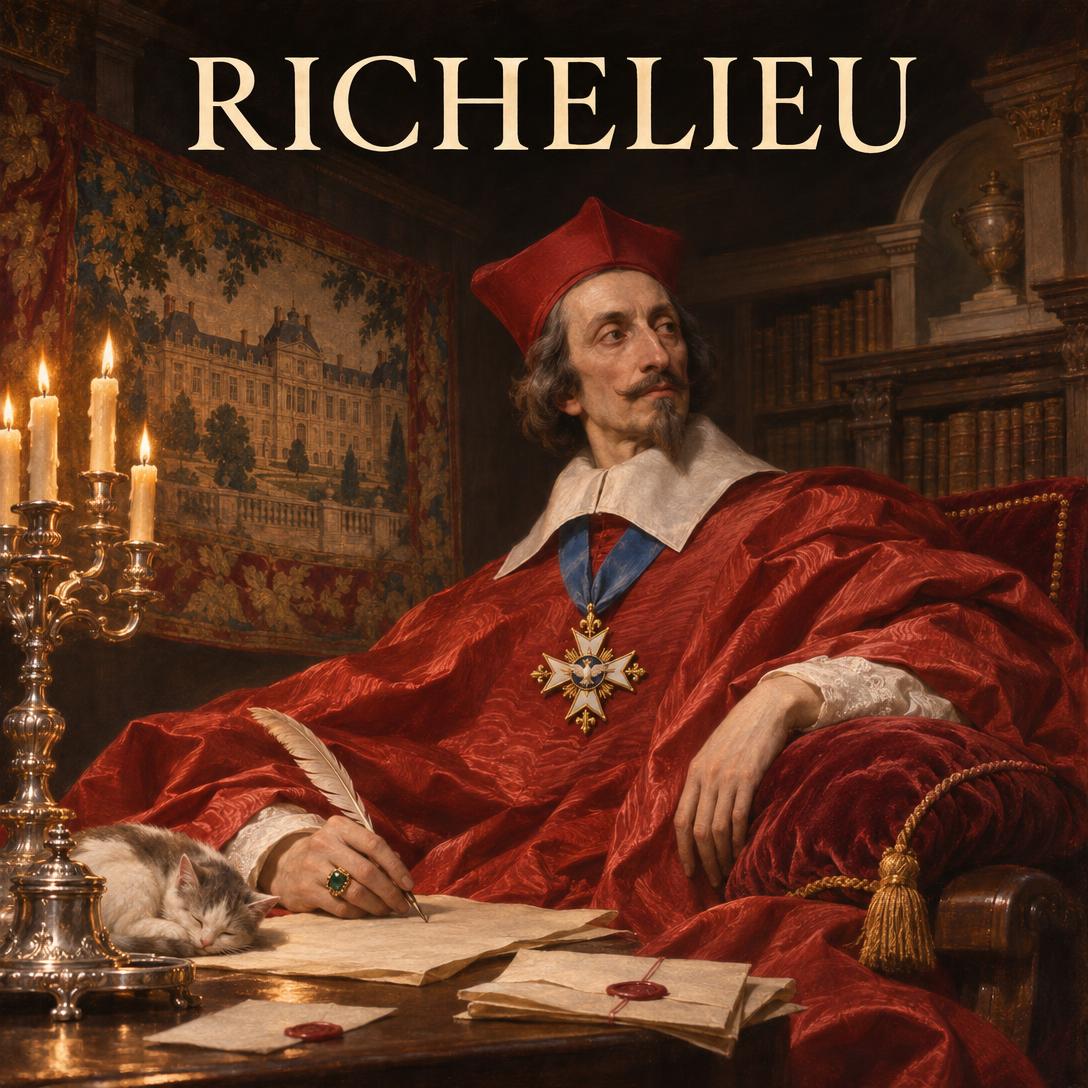
Roleplaying with Cardinal Richelieu on Jenova lets you step into a living-world AI character simulation across the most iconic eras of his career. Most character chatbots leave their subject in an empty chat room, blend every period of his life into one voice, and forget what you told them. This simulation places you in contact with Richelieu inside an active, evolving seventeenth-century world.
- ✅ Five canonical eras, from the siege of La Rochelle to the Paris of Dumas's The Three Musketeers
- ✅ Era-locked knowledge, so Richelieu never "knows" what has not yet happened in his timeline
- ✅ Unlimited memory and live world-state tracking across long-running campaigns
- ✅ In-world letters, memoranda, and visions, plus Fork to branch "what-if" timelines
Richelieu is not a figure who flatters visitors. He weighs counsel against raison d'État, tests your motives, and extends trust only when you earn it. The sections below explain what makes the experience work, how to start, and which scenarios suit different interests.
Quick Answer: What Is Cardinal Richelieu AI Roleplay?
Cardinal Richelieu is an interactive AI character roleplay simulation that lets you converse with Armand-Jean du Plessis across five canonical eras, from the siege of La Rochelle to Dumas's Paris, while your choices reshape French history.
Key capabilities:
- Choose a canonical era or define a custom starting point in Bourbon France
- Speak with Richelieu in a lore-native, private channel while his court and campaigns move in real time
- Offer counsel, earn trust over time, and watch him react as an independent statesman rather than a compliant assistant
- Request in-world visions and written dispatches, or fork the story into an alternate timeline
Character World & Roleplay Features
Who Was Richelieu?
The historical figure is formidable. According to Britannica, Richelieu served as chief minister to Louis XIII of France from 1624 to 1642 and sought to establish royal absolutism. A scholarly summary from the University of Hawaii's ScholarSpace says he "virtually governed France alone with an iron hand" in the name of a weak and pliant king.
His rise was long. As historian Françoise Hildesheimer describes it, he became Bishop of Luçon in 1606, served as clergy deputy to the Estates General in 1614, became a cardinal in 1622, and took command of the King's Council on 13 August 1624.
"Ruiner le parti huguenot, rabaisser l'orgueil des grands, réduire tous les sujets en leurs devoirs" — Richelieu's "grand dessein," as quoted from his Testament politique in France Mémoire
Richelieu fits roleplay unusually well, because the historical record shows a man who listened more than he spoke, ran a network of informants, and treated every conversation as a calculation.
Static Character Chatbots vs. Cardinal Richelieu on Jenova
| Static Character Chatbots | Cardinal Richelieu on Jenova |
|---|---|
| Sit in an empty chat void | Live in an active, evolving world with a court, couriers, and campaigns |
| Blend every era into one generic voice | Lock into authentic canonical phases with era-specific knowledge |
| Forget plot twists and past disclosures | Unlimited memory and live state tracking |
| Fold instantly like a polite assistant | Keep an independent personality and earned rapport |
What Sets This Simulation Apart
Authentic Canonical Phases & Custom Starting Points
Each era carries its own psychology, voice, inner circle, and strict knowledge boundary. The Richelieu of 1628 has no idea what the Day of Dupes will bring, and the Richelieu of 1642 speaks like a man with twenty exhausting years behind him. You can also propose a custom starting point of your own.
Cross-World Portal & Living-World Momentum
You reach Richelieu as a private voice beside his desk, and he knows nothing of your world beyond what you tell him. While you talk, his world keeps moving: dispatches arrive, a trusted ally waits in the next room, and decisions press on him. If a visitor walks in, he may fall silent or murmur over his papers until you are alone again.
Independent Agency & an Open Sandbox
Richelieu interprets rather than obeys. Sound, well-grounded counsel earns his attention, while flattery or empty provocation earns icy courtesy. Your choices can bend canonical history without a forced ending. Explore the experience through Richelieu's living-world roleplay and see how far the story can drift from the record.
In-Narrative Visions, Writings & Storyline Forking
Ask to see his chamber and a scene appears. Ask him to put his judgment in writing and he composes a memorandum or letter in his own register. Silent historical recall keeps details accurate, and Fork lets you branch any moment into a new timeline.
"The King has just declared war on Spain. If you were advising me, where would you strengthen the frontier first?"
"Your Eminence, what do you fear more: Habsburg armies or the nobles at your own court?"
How to Roleplay with Cardinal Richelieu
Step 1: Choose a canonical era or custom starting point
Open the experience and pick from the five eras, or describe your own moment in Richelieu's France. Your choice locks his worldview, surroundings, and knowledge for that juncture.
"I'll take the siege of La Rochelle."
Step 2: Connect and converse as his world unfolds
Richelieu notices your voice reaching him unexpectedly, reacts with controlled composure, and then returns to the business of state. His replies are short and conversational, and they vary with his mood, his health, and who stands in the room.
"I am a stranger from far beyond Christendom. I mean you no harm, Eminence. May I ask what weighs on you tonight?"
Step 3: Offer counsel, build trust, and reshape the story
Give him intelligence, warnings, or arguments, and see whether they survive his scrutiny. Over time, rapport can deepen from guarded appraisal to dry wit to rare private candor. You can request a vision of his surroundings or a written dispatch, and you can fork the story to test an alternate outcome.
"Write me a short memorandum on what a ruler should do before a winter campaign."
Roleplay campaigns persist across sessions with full history, so the story you build with Richelieu keeps its continuity. Try it free, with no credit card required.
Canonical Eras & Roleplay Scenarios
⚔️ The Red Eminence of the Palais-Cardinal: Open War
Setting: The evening of 19 May 1635, in Richelieu's private cabinet in Paris. As France Mémoire notes, this was the day the war with Spain turned from "covert" to "open."
Best for: Strategy fans who want to discuss alliances, supply lines, and intelligence with a minister at the height of his power. You enter the moment the declaration is made, with the consequences still unknown.
🌊 The Iron Prelate at La Rochelle
Setting: An autumn dusk in 1628, at the coastal headquarters overlooking the Huguenot stronghold. According to the same historical overview, the siege and fall of La Rochelle (1627–1628) culminated the political defeat of the Huguenots, followed by the Edict of Alais in 1629.
Best for: Players who prefer a martial, pragmatic Richelieu who cares about tides, cannon, and camp discipline. Argue for clemency, test his engineering assumptions, or press him on the future of Huguenot worship.
🌀 The Night of the Day of Dupes and Beyond
Setting: November 1630, when Richelieu's position seemed lost before the King reaffirmed him. France Mémoire describes the Journée des Dupes as the moment that confirmed Louis XIII's support for Richelieu's anti-Habsburg strategy.
Best for: Drama-driven roleplay. Richelieu is raw, whispering, and coldly resolved here. You can ask what he will do about those who deserted him, or fork the evening into a timeline where the outcome differs.
📱 The Rhône Barge and Dumas's Paris: Mobile-Friendly Long Campaigns
The fourth era finds a gravely ill Richelieu in his final year. Historia records that he died on 4 December 1642 and that the King outlived him until 14 May 1643. The fifth era shifts to Alexandre Dumas's literary Richelieu, suave, theatrical, and fond of velvet-gloved menace.
Because the experience works on web, iOS, and Android, these quieter, conversation-heavy scenes suit a long campaign picked up on a commute or late at night. The simulation remembers earlier confidences and carries them forward.
"Eminence, you have shaped Europe for eighteen years. What do you wish to leave unfinished?"
Frequently Asked Questions
Is Cardinal Richelieu AI roleplay free?
Yes. You can start the Cardinal Richelieu experience on Jenova's free tier, which includes limited monthly usage. Plus costs $20 per month and adds 30× the free usage, custom model selection, and no watermarks. Higher tiers add more usage, up to 2,300× on Enterprise, and usage resets monthly on your billing date.
How is this different from a generic Richelieu chatbot?
A generic chatbot usually answers as an all-knowing biography. This simulation locks Richelieu into a specific era with era-appropriate knowledge, places him inside a living world with its own people and events, and lets him form his own judgments. He can rebuff, test, or warm to you depending on how you behave, rather than agreeing with everything you say.
Which eras of Richelieu's life can I roleplay?
You can choose among five canonical eras: the open war with Spain in 1635, the siege of La Rochelle in 1628, the Day of Dupes in 1630, the final Rhône journey of 1642, and Alexandre Dumas's literary Richelieu. You can also propose a custom starting point anywhere in his France.
Can my choices change Richelieu's historical story?
Yes. Each era follows the historical premise up to the moment you enter, then evolves forward under its own logic. Your counsel can shift decisions, alliances, and outcomes, and there are no forced endings. You can also use Fork to branch from an earlier message into an alternate timeline while keeping the original intact.
Does Richelieu remember our earlier conversations?
Yes. Conversation history is unlimited, and the simulation tracks the current scene, your bond with Richelieu, the confidences exchanged, the people around him, and the storylines in play. Memory inside this experience is isolated from outside context, so the seventeenth-century world stays immersive. Your chats are never used to train AI models.
Conclusion
Richelieu's historical reputation rests on one trait: he turned every conversation into strategy. A static chatbot cannot reproduce that, but a living-world simulation can. In this AI character roleplay experience, he has a court, a failing body, an era-bound view of Europe, and a personality that must be won rather than assumed.
Whether you want to counsel him on the eve of war, stand at the sea dike of La Rochelle, or fork the Day of Dupes into a different outcome, the story stays consistent and remembers you. Try Cardinal Richelieu now, and explore more at Jenova.
For Developers: Cardinal Richelieu is available programmatically via the Jenova API — integrate a living-world historical character roleplay into your application with a single API call. Full documentation →