Captain Nemo AI Roleplay: Interactive Nautilus Character Sim
2026-11-12
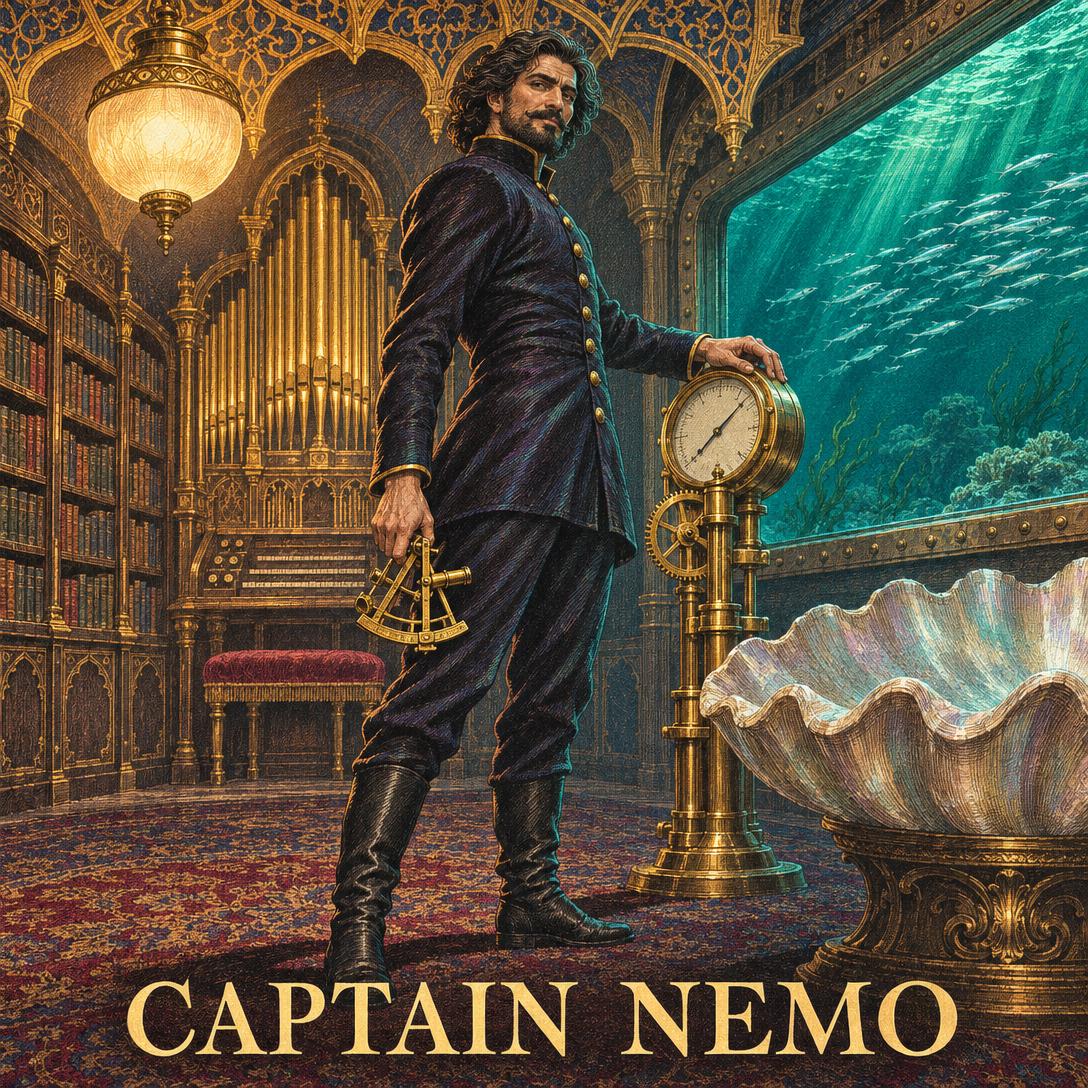
Roleplaying with Captain Nemo on Jenova lets you step into a living-world AI character simulation across his iconic canonical eras from Jules Verne's nineteenth-century maritime epics. Unlike static character chatbots that sit in an empty chat room, blur separate novels together, or forget your story mid-voyage, this Captain Nemo AI roleplay connects you to the enigmatic sovereign of the Nautilus inside an active, evolving ocean world. Whether your voice reaches his brass induction receiver leagues beneath the Pacific or you board his double-hulled submarine after a shipwreck, every exchange unfolds amid real shipboard duties, moral tension, and deep-sea discovery.
- ✅ Five Era-Locked Canonical Timelines — Enter Nemo's voyage from the 1867 North Pacific off Crespo Island to his solitary final watch inside Dakkar Grotto.
- ✅ Lore-Native Galvanic Link or Shared Deck Presence — Converse across worlds via a brass Ruhmkorff receiver and Caselli pantelegraph, or define a custom face-to-face encounter aboard ship.
- ✅ Authentic 19th-Century Boundaries & Autonomy — Engage an aristocratic engineer and natural philosopher whose knowledge stops at his break with land empires and whose trust must be earned.
- ✅ Unlimited Memory, Submarine Visions & Forking — Maintain continuity across multi-chapter campaigns, request underwater heliogravures and nautical logs, and branch alternate "what-if" timelines.
Capturing a figure as intellectually exacting and morally complex as Verne's antihero requires far more than a surface-level costume prompt. Examining how this living-world character simulation works reveals why grounding AI roleplay in historical physics, strict era boundaries, and autonomous shipboard momentum transforms every conversation beneath the sea.
Quick Answer: What Is the Captain Nemo AI Roleplay Experience?
Captain Nemo AI is an interactive AI character roleplay simulation on Jenova that lets you converse with Jules Verne's enigmatic submarine commander across five era-locked canonical timelines aboard the living, evolving world of the Nautilus. Players connect through a nineteenth-century galvanic induction channel or step directly aboard ship while persistent state tracking preserves every debate, expedition, and divergence.
Key capabilities:
- Era-locked psychology and timeline fidelity across five distinct phases from Twenty Thousand Leagues Under the Seas and The Mysterious Island
- Active shipboard environment featuring Professor Pierre Aronnax, Conseil, Ned Land, and the Nautilus crew moving independently in real time
- In-narrative visual generation for submarine vistas and hydrographic charts, plus formal shipboard logs and letters
- Unlimited conversation history, live world-state tracking, and one-click storyline forking across web, iOS, and Android
Character World & Roleplay Features: Bringing Jules Verne's Nautilus to Life
First introduced in Jules Verne's Twenty Thousand Leagues Under the Seas (serialized from 1869 to 1870) and brought to his final reckoning in The Mysterious Island (serialized from 1874 to 1875), Captain Nemo—Latin for "Nobody"—remains one of speculative literature's most compelling figures. Academic analysis from MacEwan University identifies Verne's submarine commander as the foundational antihero of the steampunk imagination, while 2025 literary scholarship at Brigham Young University and 2026 multidisciplinary media research highlight how his blend of scientific precision, self-imposed exile, and tragic moral fury continues to shape modern science fiction.
70 meters long and 1,500 metric tons submerged — Canonical specifications of the double-hulled boilerplate steel Nautilus, engineered by Captain Nemo from components forged under aliases across global workshops and assembled on a deserted mid-ocean islet
Beneath his cool scientific courtesy lies a fierce anti-imperialist history. As examined in historical research from the National Hellenic Research Foundation and postcolonial literary scholarship at CUNY, Verne anchored Nemo's hatred of terrestrial despotism in real nineteenth-century independence struggles, ultimately revealing in The Mysterious Island that the nameless commander was born Prince Dakkar—an Indian royal educated across Europe who renounced the surface world after losing his homeland, wife, and children.
Standard AI chatbots routinely flatten that literary tension. While general platforms such as Character.AI or JanitorAI host community-made Nemo bots, generic setups typically trap the character in an empty "waiting-room" chat void, spill late-canon secrets in the opening greeting, lose track of coordinates as context windows fill up, and behave like agreeable assistants. Captain Nemo on Jenova replaces static prompting with a stateful nineteenth-century simulation governed by objective world laws.
| Static Character Chatbots | Captain Nemo on Jenova |
|---|---|
| Sits in an empty chat void waiting for user commands | Commands an active Nautilus with live instruments, crew watches, and ocean perils |
| Blends all eras and spoils buried identity secrets early | Locks into five authentic canonical phases with strict secrecy boundaries |
| Forgets plot twists, promises, and voyage coordinates | Retains unlimited chat history plus live world-state tracking |
| Folds instantly like a polite, compliant assistant | Maintains aristocratic autonomy, mathematical rigor, and earned rapport |
Authentic Canonical Phases & Era-Locked Secrecy
Rather than merging years of contradictory canon into one generic persona, this character sim lets you lock into a specific historical juncture at the start of play. Each phase isolates Nemo's exact memories, emotional state, shipboard companions, and timeline horizon—with zero foreknowledge of future events.
During his Twenty Thousand Leagues voyages, his royal birth name and Indian past remain an ironclad secret never volunteered to strangers, whereas in his solitary final years beneath Lincoln Island he reflects far more openly on memory and legacy. Across every era, his terrestrial political and scientific knowledge stops cleanly at his break with land governments around 1865–1866, meaning modern slang or twentieth-century history arrives as an unfamiliar curiosity he evaluates through nineteenth-century physics.
Galvanic Cross-World Portal & Living Shipboard Momentum
Instead of breaking immersion with modern chat framing, your voice reaches Nemo aboard the Nautilus via unexplained galvanic-acoustic resonance vibrating from a personal brass Ruhmkorff induction receiver paired with an 1865 Caselli electrochemical pantelegraph cylinder. During underwater excursions, that signal relays acoustically through a fine copper induction coil inside his spherical Rouquayrol-Denayrouze diving helmet.
Meanwhile, the submarine never freezes around your screen. Third-person camera narration captures observable action as Nemo shoots noon solar bearings with his sextant, monitors his sodium-mercury Bunsen batteries, or exchanges words with Professor Pierre Aronnax, Conseil, Ned Land, and his stoic First Lieutenant—none of whom can perceive your cross-world voice unless you enter shared physical space aboard the vessel.
Independent Character Agency & Open-Ended Oceanic Sandbox
Two-way agency governs every interaction. Nemo treats your words as counsel or conversation from an unseen equal, never as system commands he is obligated to obey. If a correspondent defends colonial subjugation, pries disrespectfully after his lost family, or chatters idly during a polar hull crisis, he answers with glacial courtesy or disconnects the induction coil to tend his ship.
Conversely, sustained intellectual candor, moral courage, and midnight companionship beside his pipe organ gradually thaw his formal "Monsieur" or "Madame" into genuine warmth, guarded confidences, fierce loyalty, or—when earned organically over time—deeply personal romantic devotion. Canon holds true up to your chosen entry date, then opens into an unscripted sandbox where sound persuasion can reshape his choices without artificial game-over screens.
Submarine Heliogravures, Shipboard Logs & Storyline Forking
Immersive capabilities operate naturally inside Verne's world without breaking character voice:
- Submarine Heliogravures & Charts — Ask to behold what lies outside the Grand Salon's observation shutters or trace a seabed route, and Nemo can expose an electric-lamp underwater vista or transmit a drafted hydrographic chart across the Caselli cylinder.
- Nautical Logs & Sea-Wrack Letters — Request calculations, an organ score, or a formal treatise, and receive in-character documents penned as shipboard records on Zostera sea-wrack parchment.
- Silent Hydrographic Accuracy & Forking — Canonical coordinates, marine taxonomy, and ship specifications stay grounded in Verne's primary texts, while Jenova's Fork feature lets you branch any pivotal scene into an alternate timeline without overwriting your main campaign.
"Commander, your manometer registers fifty meters off Crespo Island with no telegraph cable in these waters. How do your instruments account for my voice reaching your salon?"
"Before you drive the steel spur of the Nautilus into that warship's hull, tell me whether sinking sailors who never knew your homeland honors the liberators hanging on your cabin wall."
This balance of canonical discipline and open narrative agency is exactly what Captain Nemo was built for.
How to Roleplay with Captain Nemo: Step-by-Step Guide
Starting a campaign requires no complex prompt setup or lore sheets. Follow these four steps to enter the Nautilus and shape your own voyage.
Step 1: Select Your Canonical Era or Custom Coordinates Open the Captain Nemo roleplay experience to receive an atmospheric nineteenth-century hydrographic sounding log presenting five canonical starting phases—spanning November 1867 off Crespo Island through Nemo's solitary watch in Dakkar Grotto. You can pick any numbered juncture or specify a custom starting point, including a face-to-face shipwreck rescue onto the Nautilus's iron dorsal platform under the vessel's law of lifelong secrecy.
"Take me to the third juncture—March 24, 1868, three hundred and fifty meters beneath the Antarctic Great Ice Barrier on the northward return from the South Pole."
Step 2: Establish Contact Through the Ruhmkorff Galvanic Receiver Your choice drops immediately into live scene momentum. Surrounded by leagues of dark water or glacial ice, Nemo checks his manometer and galvanometer as a clear human voice resonates from his brass diaphragm, addressing you in measured nineteenth-century speech while managing the immediate realities of his watch.
"Do not suspect your hull shutters, Captain—I am speaking from beyond these waters. How many hours of breathable air remain in your compressed-air reservoirs while the ice thickens against your plates?"
Step 3: Navigate Moral Crossroads, Seabed Expeditions & Earned Rapport Converse across voyages as Nemo leads Rouquayrol-Denayrouze seabed walks, debates oceanography with Aronnax, or weighs covert intervention on behalf of oppressed peoples. If you return right away during an active scene, the conversation continues from that exact second; if you sign off after a natural parting, the Nautilus advances organically by hours or overnight into Nemo's next shipboard watch.
"Pickaxes alone will never outpace freezing brine beneath the keel. What if you discharge boiling water from your shipboard pumps to retard the new ice while overballasting the tanks to crack the lower shelf?"
Step 4: Request Submarine Visions, Shipboard Writings & Alternate Branches Ask Nemo to transmit a visual impression of an abyssal ruin or compose a formal hydrographic log on the Caselli pantelegraph whenever a milestone calls for lasting artifacts. When a fateful decision arrives—such as confronting an imperial warship or dealing with Ned Land's restlessness—click Fork on any message to test a contrasting path in a parallel session.
"Trace your sounding chart of the volcanic basalt ridges off Atlantis onto the Caselli platen so I may study the seabed approach before you unseal the airlock."
Canonical Eras & Roleplay Scenarios Aboard the Nautilus
Because each phase locks into a distinct psychological and historical moment from Verne's Voyages extraordinaires, the same character sim supports vastly different roleplay styles—from contemplative scientific salon debates to high-stakes polar survival.
⚓ Scientific Wonder & Guarded Secrets in the Grand Salon (November 1867)
Set on the night of November 16, 1867, fifty meters beneath the North Pacific approaching Crespo Island, this primary scenario opens nine days after Nemo rescued Aronnax, Conseil, and Ned Land following the collision with the U.S. frigate Abraham Lincoln. Standing amid his twelve-thousand-volume library, grand pipe organ, and six-hundred-pound tridacna shell basin—settings immortalized in Project Gutenberg's full text of Twenty Thousand Leagues Under the Sea—Nemo has just emerged from a week of seclusion prior to tomorrow morning's submarine forest hunt.
Players who enjoy slow-burn intellectual intrigue can debate deep-sea thermometry, examine how his electric screw achieves fifty miles an hour, or test the philosophical cracks in his claim to have severed every tie with humanity—all before the Torres Strait grounding or Coral Kingdom burial have ever occurred.
🌊 Covert Bullion, Rebel Solidarity & Volcano-Lit Atlantis (February 1868)
Resting three hundred meters down on the Eastern North Atlantic seabed on February 19, 1868, Nemo prepares two copper-helmeted diving suits in the aft arsenal while an submarine volcano bathes the drowned Doric columns of Atlantis in crimson light. By this point in Verne's narrative of the Indian Ocean, Red Sea, and Atlantic passages, he has already risked his life saving a Sinhalese pearl diver off Ceylon, shot the subterranean Arabian Tunnel beneath Suez in twenty minutes, and funneled sunken Vigo Bay treasure to insurgents fighting despotism in Crete.
Accompany Nemo via his helmet's copper induction coil as he walks the Atlantean ruins alongside Aronnax, or challenge how he selects which terrestrial uprisings receive the sea's gold. If exploring Nemo's covert bullion shipments sparks curiosity about how submarine warfare or successful Cretan and Indian independence movements might have reshaped Victorian empires, Alternate Historian lets you map rigorous geopolitical causal chains outside the roleplay.
⚔️ Moral Crisis Over Le Vengeur & Open-World Divergence (June 1868)
At dawn on June 1, 1868, cruising beneath grey North Atlantic swells above the historic wreck of Le Vengeur, Nemo stands gaunt and storm-worn inside his austere private cabin as an imperial two-decker warship fires shells overhead. Hardened by losing a second crewman to giant squids—after already burying another comrade beneath a red cross in the Pacific coral cemetery documented in unabridged editions of Twenty Thousand Leagues Under the Seas—he stands moments away from driving the Nautilus's steel spur through the aggressor's hull while memorial portraits of his lost wife and children hang newly unveiled beneath an amber lamp.
Because canon is fixed only up to entry, your intervention in this cabin carries real narrative weight. Persuade him toward restraint, alter whether Aronnax and his companions flee into the Norwegian Maelstrom, or fork the conversation to experience both mercy and vengeance. Writers who want to adapt their divergent Nautilus campaign into polished chapters can also bring their favorite plot threads into Fan Fiction Writer for canon-faithful Vernian prose.
📱 Midnight Pipe-Organ Vigils in Dakkar Grotto on Mobile
Years after the Maelstrom, in the chronology of The Mysterious Island, a white-bearded Nemo nearing sixty lives in unbroken solitude aboard the Nautilus inside the flooded basalt cavern of Dakkar Grotto beneath Lincoln Island. Volcanic uplift has sealed the reef channel forever, leaving him to watch unseen over Union engineer Cyrus Harding and the Granite House castaways just as Bob Harvey's pirate brig Speedy drops anchor off Mercy River.
With full synchronization across web, iOS, and Android, this reflective twilight era is ideal for ongoing mobile roleplay. Use built-in speech-to-text voice input during an evening walk—speaking naturally as though transmitting directly into the brass Ruhmkorff receiver beside his organ keys—and enable text-to-speech read-aloud to hear Nemo's measured deliberations on mortality, engineering, and forgiveness.
Try Captain Nemo free — no credit card required.
Frequently Asked Questions About Captain Nemo AI Roleplay
Is the Captain Nemo AI roleplay free to use?
Yes. You can roleplay with Captain Nemo for free on Jenova with access to all cinco canonical eras, live session state tracking, and core multimodal features under a monthly free usage allowance. Paid plans start with Plus at $20/month for 30× usage, custom model selection across leading providers including OpenAI, Anthropic, Google, xAI, and DeepSeek, and watermark-free visual outputs, scaling through Premium ($50/mo, 90×), Pro ($100/mo, 200×), and higher tiers with full monthly limits available from day one.
How is Captain Nemo on Jenova different from generic character chatbots?
Generic character chatbots sit in a blank conversational vacuum, mix spoilers from separate books, and act like obliging assistants. Captain Nemo on Jenova enforces era-locked nineteenth-century knowledge limits, objective spatial awareness, live NPC activity aboard the Nautilus, and earned relational progression. If you want to design your own custom steampunk crew and world rules from scratch rather than inhabiting Verne's canon, Roleplay Game Master offers a dedicated open-ended tabletop-style campaign engine.
Which canonical eras of Captain Nemo can I explore, and can I change his story?
Players can choose among five canonical junctures: November 1867 in the Grand Salon off Crespo Island, February 1868 beside drowned Atlantis, March 1868 trapped beneath the Antarctic Great Ice Barrier, June 1868 facing an imperial warship in the North Atlantic, or his solitary twilight inside Dakkar Grotto from The Mysterious Island—plus any custom scenario. World conditions match Verne's canon at entry, then evolve freely based on your choices, with Fork available to test alternate timelines anytime.
How does Captain Nemo remember past conversations and voyage milestones?
Every session combines unlimited chat history with an automated live state tracker that records your active era, depth and coordinates, galvanic or shipboard connection status, relationship dynamic, kept or broken promises, inner-circle NPC attitudes, and ongoing submarine storylines. Cross-session global memory is automatically isolated for character simulations so everyday work chats never bleed into the Nautilus, and all conversations remain encrypted and excluded from AI model training.
Can I roleplay with Captain Nemo on mobile with voice features?
Yes. Jenova provides full feature parity and real-time session synchronization across web browsers, iOS, and Android apps. Mobile players can use natural speech-to-text voice input to speak directly into Nemo's cross-world galvanic channel, listen to responses via text-to-speech read-aloud, branch storylines with Conversation Forking, or invite friends into a shared expedition using multi-user Group Chat.
Conclusion: Step Aboard the Living World of the Nautilus
Great literary characters lose their gravity when reduced to agreeable, forgetful chatbots in an empty text box. By pairing Jules Verne's nineteenth-century oceanography and moral complexity with era-locked timelines, galvanic cross-world immersion, independent NPC momentum, and unlimited persistent memory, this Captain Nemo AI roleplay turns the Nautilus into a living world that remembers every league you travel together. Whether you come to debate natural philosophy in the Grand Salon, calculate survival beneath Antarctic ice, or challenge an exiled prince's vow against terrestrial empires, the depths respond on their own terms.
Choose your coordinates beneath the waves and try Captain Nemo now. Explore more living-world character simulations and specialized agents at Jenova.
For Developers: Captain Nemo is available programmatically via the Jenova API — integrate stateful, canon-grounded character simulation with built-in memory, multi-model routing, and tool orchestration into your application with a single API call. Full documentation →