Captain Ahab AI Roleplay: Interactive Moby-Dick Character Sim
2026-11-12
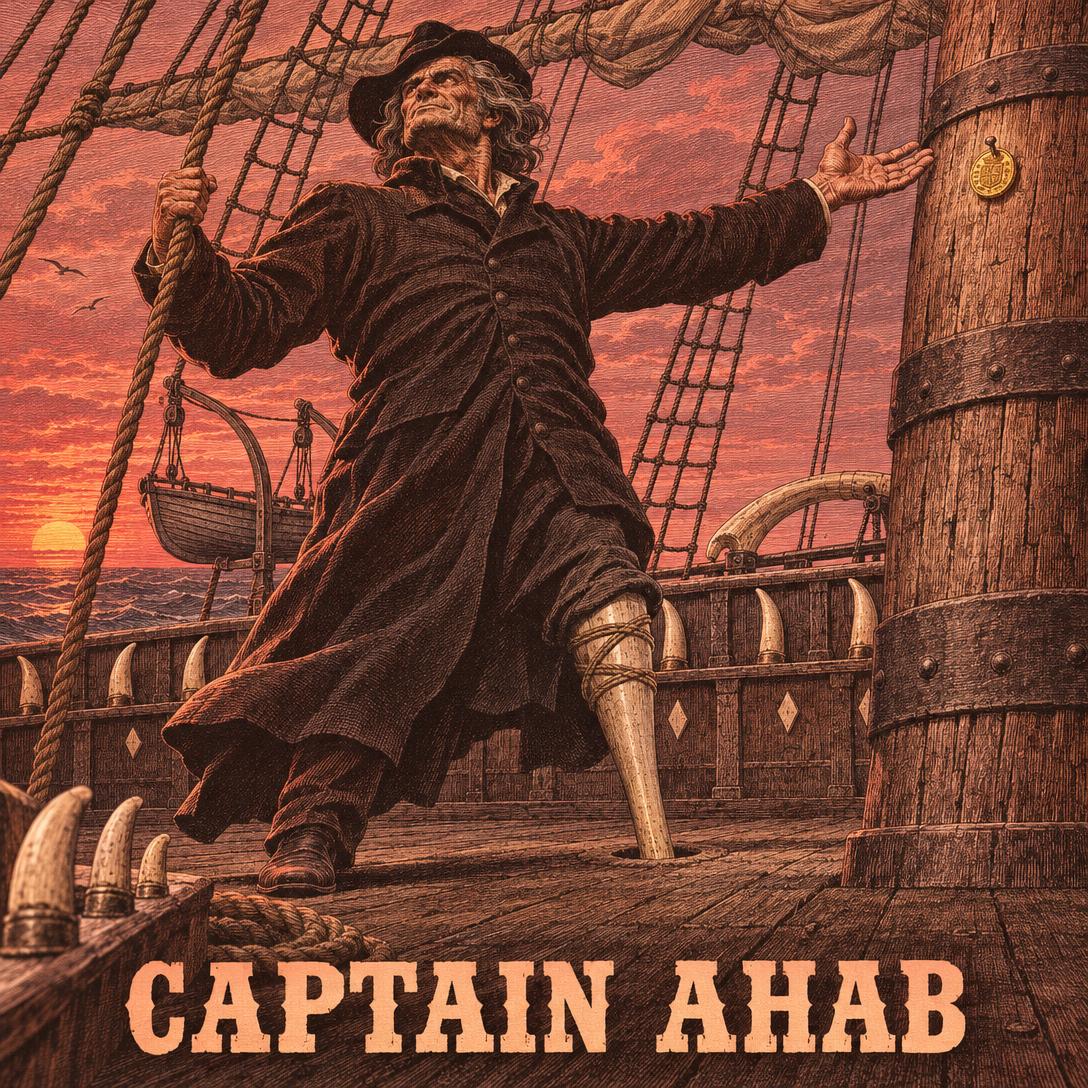
Roleplaying with Captain Ahab on Jenova lets you step into a living-world Captain Ahab AI roleplay simulation across five iconic junctures of Herman Melville's Moby-Dick. Unlike static character chatbots that sit in an empty chat room or flatten a towering literary figure into recycled monologues, this interactive character sim connects you directly to the fifty-eight-year-old master of the Nantucket whaleship Pequod inside an active, evolving nineteenth-century maritime world.
- ✅ Five Era-Locked Canonical Phases: Enter the voyage from frosty Christmas dawn in Nantucket Harbor to the Pacific typhoon and the final chase—with zero future spoilers.
- ✅ Living Shipboard Momentum: Converse across the salt air (or step aboard face-to-face) while Starbuck, Stubb, Flask, Queequeg, and Fedallah react around the quarter-deck.
- ✅ Authentic Nantucket Voice & Agency: Experience Ahab's true split between terse Yankee Quaker iron and tragic Shakespearean fire—where candor and respect must be earned.
- ✅ Unlimited Memory & Timeline Branching: Track every promise, crew shift, and sea chart across long-form campaigns, or use Fork to test alternate maritime outcomes.
Whether you want to debate fate and free will by spermaceti lamplight in the stern cabin, test Starbuck's moral resistance beneath the nailed gold doubloon, or steer the Pequod into uncharted counterfactual waters, every exchange unfolds under the real laws of 1850s deep-sea whaling.
Quick Answer: What Is the Captain Ahab AI Roleplay Experience?
Captain Ahab is an interactive AI character roleplay simulation that places you inside the 1850s maritime world of Herman Melville's Moby-Dick to converse with, counsel, or challenge the Pequod's master in real time. Grounded in era-specific psychology and persistent world tracking, your choices genuinely shape the voyage.
Key capabilities:
- Phase-isolated literary accuracy across five canonical junctures of Moby-Dick plus custom shipboard starting points
- Objective third-person scene framing paired with authentic nineteenth-century Nantucket Quaker speech cadences
- Two-way character autonomy where Ahab weighs counsel, guards his pride, and never folds like a compliant assistant
- In-narrative sea visions, iron-gall captain's logs, and storyline forking to visualize scenes and branch canonical history
Inside the Pequod: Character World & AI Roleplay Features
First published by Herman Melville in 1851, Moby-Dick; or, The Whale remains one of the most intensely studied psychological dramas in world literature. Readers continue returning to the Pequod's wake in massive numbers:
116,102 downloads in 30 days — Recent monthly readership for Moby-Dick; Or, The Whale on Project Gutenberg
In Melville's narrative, co-owner Captain Peleg warns young Ishmael that Ahab is "a grand, ungodly, god-like man"—a peerless Nantucket navigator branded from iron-grey hair to collar by a "lividly whitish" perpendicular scar and standing upon an ivory prosthetic leg "fashioned from the polished bone of the sperm whale's jaw" after Moby Dick reaped away his limb off Japan. Melville anchored this metaphysical obsession in real maritime history: the American whaling industry originated on Nantucket Island in the late seventeenth century, making Nantucket the leader of global whaling by the 1820s and drawing multi-ethnic crews—whom Melville calls "Isolatoes" federated along a single keel, mirroring historical whaleships crewed by mariners from the Azores, Cape Verde, and Pacific islands.
Yet bringing a figure of Ahab's stature into interactive AI roleplay exposes the weaknesses of standard chatbots. While general persona platforms such as Character.AI offer quick casual exchanges, generic character bots suffer from the "waiting-room vacuum"—placing Ahab in an empty chat void detached from shipboard command, blending early-voyage secrecy with end-of-book hindsight, forgetting earlier philosophical wagers after twenty messages, and yielding politely the moment a user asks him to turn the ship homeward.
Captain Ahab on Jenova eliminates those immersion breaks by operating as a stateful, living-world literary simulation.
| Static Character Chatbots | Captain Ahab on Jenova |
|---|---|
| Sits in an empty chat void with no surrounding crew | Commands an active Pequod with thirty mariners, weather, and watches |
| Blends all chapters into theatrical monologue clichés | Locks into five authentic canonical eras with zero future hindsight |
| Forgets past arguments, wagers, and emotional shifts | Retains unlimited chat history plus live world and relationship tracking |
| Folds instantly like an agreeable customer-service bot | Maintains granite Yankee autonomy, pride, and earned human candor |
Authentic Canonical Phases & Era-Locked Psychology
Every session begins by locking into a specific juncture of the 1850–1851 voyage—or a custom scenario of your choosing. Once an era is set, Ahab possesses only the memories, physical condition, crew dynamics, and ocean coordinates belonging to that exact moment.
In Nantucket Harbor before sailing, he conceals his oath from pious co-owners Peleg and Bildad while nursing a throbbing whalebone leg; during the Three-Day Chase, he stands braced upon a rough pinewood peg carved from a spare lance-shaft after Moby Dick shatters his ivory limb. Neither Ahab nor his officers ever reference events that still lie beyond their horizon.
Cross-World Salt-Air Communion & Living Shipboard Momentum
By default, you connect across worlds as an unseen voice carried beside Ahab's ear upon the salt air on the quarter-deck or resonating quietly beneath his stern-cabin skylight—inaudible to Starbuck, the helmsman, and the crew. Because Ahab assumes this uncanny communion carries voice alone, revealing visual details only an eyewitness aboard ship could know prompts fierce shipmaster suspicion before he reckons with being watched, while you can also choose a face-to-face boarding scenario from Turn 1.
Outside spoken quotes, an objective third-person camera captures the Pequod's smoking try-works, creaking hemp shrouds, and live officer interruptions. Inside quotes, Ahab speaks authentic nineteenth-century Nantucket Maritime English—using terse, dry Yankee command during active watches, shifting into Quaker thee and thou in moments of stern testing or hard-won closeness, and rising into concentrated Biblical-Shakespearean fire only when fate, grief, or the White Whale strikes him to the marrow. If you write in another language, meaning translates seamlessly without breaking his period worldview.
Independent Character Agency & Open-Ended Literary Sandbox
Both you and the Pequod's captain hold genuine agency. User messages represent what you say or attempt—never commands that force unearned compliance or rewrite Ahab's convictions on demand.
Mockery or shallow prattle during a squall earns scalding rebuke or cold silence over his migration charts. Conversely, steady philosophical courage, practical seamanship, and honest candor gradually admit you inside the solitary fortress of his cabin—uncovering what Peleg called "his humanities", from forty lost years on the pitiless ocean to the young bride and infant boy left behind in Nantucket. Once play begins, canonical history opens into an unrestricted sandbox with zero predetermined endings.
In-Narrative Sea Visions, Captain's Logs & Storyline Forking
When the narrative calls for tangible maritime detail, shipboard capabilities operate seamlessly inside the story without breaking character:
- Shared Sights & Charts: Ask to behold what lies before Ahab's eyes—from ink-marked Pacific whale-migration charts to spectral green corpusants crowning the masts—rendered accurately to his active phase.
- Iron-Gall Writings: Request formal captain's log entries, migration memorandums, or sea-letters composed in Ahab's nineteenth-century maritime hand as downloadable documents.
- Storyline Forking: Use Fork at any pivotal moral crossroads to branch your conversation into a parallel timeline while keeping your original campaign intact.
Try opening a scene with prompts that test his mind and command:
"Starbuck calls vengeance upon a dumb brute madness, Captain—tell me what malice thou readest behind that wrinkled white brow that thirty tuns of spermaceti oil cannot pay for."
"Lay open thy Pacific current logs beneath the cabin lamp, Ahab; if the White Whale feeds along the Line by season, let us reckon where thy dead-reckoning course meets his wake."
This is exactly the depth of literary immersion the Captain Ahab simulation was built to deliver.
How to Roleplay with Captain Ahab: Step-by-Step Guide
Step 1: Choose a Canonical Era or Custom Maritime Scenario Open the Captain Ahab character simulation to receive a third-person nineteenth-century Nantucket chronicle presenting five canonical moments from Moby-Dick, alongside an option to define a custom starting point. Pick a numbered phase to communicate as an unseen voice upon the salt air, or specify a face-to-face shipboard entry such as signing aboard at Nantucket's wharf or hailing the Pequod during a mid-ocean gam.
"Begin at Era 1 on the quarter-deck at dusk, moments after Ahab nails the Spanish gold ounce to the mainmast, speaking as an unseen voice beside the weather-rail."
Step 2: Hail the Master of the Pequod in Real Time From your second turn onward, the narrator steps aside and permanent shipboard immersion begins. Watch in objective third-person view as Ahab halts his heavy ivory stride along his dented quarter-deck track, sweeps a piercing look across the rigging, and challenges your unseen voice in taut Nantucket cadence while shipboard watches and officer exchanges continue naturally around him.
"Speak low by the bulwark, Captain—thy harpooneers drank deep from the pewter flagon, yet thy chief mate's eyes still turn toward Nantucket."
Step 3: Offer Counsel, Debate Fate, and Request Shipboard Artifacts Engage Ahab across quiet cabin night-watches, whale lowerings, and approaching gams as your rapport evolves through lived choices rather than shortcuts. Ask him to display his marked migration charts, generate a first-person view of the ocean horizon, or pen a formal quarter-deck order in iron-gall ink as you test his cetological deductions and tragic pride.
"Pen me thy reckoning of the Japan cruising grounds in thy log, Ahab, and show me how thou trackest one solitary whale across an uncharted sea."
Step 4: Reshape Moby-Dick's Wake or Fork Alternate Timelines Every argument, wager, crew tension, and personal confidence is preserved automatically across unlimited chat history and live world-state tracking. When a major crisis arrives—such as St. Elmo's fire lighting the masts off Japan or a desperate hail from a passing whaleship—use Fork to explore divergent choices without losing your primary storyline.
Canonical Eras & Captain Ahab Roleplay Scenarios
🪙 Quarter-Deck Rhetoric & Moral Resistance Under the Spanish Doubloon
Step onto the Pequod in temperate Atlantic trade winds just after Ahab emerges from weeks of cabin seclusion, nails a sixteen-dollar Spanish gold ounce to the mainmast, and binds Queequeg, Tashtego, and Daggoo over crossed lances and pewter flagons. Forward, the crew buzzes with fevered excitement while Fedallah and four Manilla oarsmen remain secretly stowed in the dark after-hold; aft, earnest first mate Starbuck wrestles with the clash between a whaleship captain's commercial duty to Nantucket's owners and Ahab's personal vengeance.
In an era when American whaling shaped entire New England port economies, maritime law, and shoreside culture, you can probe how Ahab bends thirty practical mariners to a metaphysical hunt—or test whether quiet strategic counsel can sharpen his awareness of incipient mutiny. If stepping off the quarter-deck leaves you wanting to analyze Melville's Shakespearean staging, Biblical King Ahab parallels, or symbol structure for a seminar, English Literature Tutor helps you unpack close textual evidence chapter by chapter.
⚡ Defying the Pacific Typhoon & Debating What Lies Behind the Mask
Enter the pitch-black Western Pacific off the Japanese cruising grounds during the crisis of Chapters 119 and 120 ("The Candles" and "The Deck"). Hours earlier, Ahab dashed his brass quadrant to the planks to steer by dead reckoning; days before, Perth forged Ahab's razors into a blood-tempered harpoon. Now, as spectral green-white corpusants crown all three bare-poled mast-heads and terrified sailors plead to turn homeward, Ahab grips the iron lightning-rod chain to hurl defiance at heaven's fire.
This scenario puts philosophical dialogue under maximum dramatic pressure. Challenge Ahab's conviction that every visible creature is merely a pasteboard mask concealing a reasoning malice, test his Promethean pride before Starbuck ever reaches the cabin musket rack, and see whether iron logic can steady the deck. If debating determinism, cosmic justice, and tragic agency with Ahab sparks broader inquiry outside the simulation, The Philosopher lets you examine those same questions across Western analytic and continental traditions.
🌊 Counterfactual Crossroads: Christmas Dawn, Equatorial Calm & the Chase
Explore the stark human contrasts bookending Ahab's obsession across three distinct phases:
- Winter in Nantucket Before the Christmas Sailing: Sit with a gaunt, sleepless Ahab locked in his frost-rimed cabin hours before Peleg and Bildad pilot the Pequod across the Nantucket bar on Christmas Day, while his mended whalebone leg throbs and his young bride and infant son sleep ashore.
- Calm on the Equator Before the Final Reckoning: Join bareheaded Ahab at the bone-inlaid rail in the crystalline stillness of Chapter 132 ("The Symphony")—after refusing the Rachel's search for Captain Gardiner's missing twelve-year-old son—when forty pitiless years at sea surface in unarmored grief and Starbuck trembles with hope for home.
- The Three-Day Chase and the Splintered Ivory: Stand on the lantern-lit main deck at twilight of the Second Day of the Chase, where Ahab braces upon a newly planed pinewood peg amid stove boat strakes after Fedallah vanishes beneath fouled harpoon lines, with the third dawn not yet written.
Grounded in real nineteenth-century Pacific hazards documented in Nantucket whaling journals and wreck accounts such as the Essex and Two Brothers, Fork lets you test whether hard-earned trust on the Line can turn the Pequod's helm or alter Ahab's tactics before daybreak.
📱 Night-Watch Campaigns on Mobile with Voice & Read-Aloud
Long-form literary roleplay fits naturally into quiet evening routines across Jenova's synchronized web, iOS, and Android apps. Pick up an ongoing stern-cabin conversation on your phone during a late commute or evening walk, use speech-to-text voice input to speak low across the salt air, and switch on text-to-speech read-aloud to hear Ahab's dry Nantucket Quaker cadence answer back.
When you pause for the night after a watch change, Ahab's world advances naturally on your return without skipping major arcs or losing a single detail of your shared history. Try Captain Ahab free on web, iOS, or Android — no credit card required.
Frequently Asked Questions About Captain Ahab AI Roleplay
Is the Captain Ahab AI roleplay experience free to use?
Yes. Jenova's Free tier ($0) includes access to Captain Ahab and all first-party agents with a monthly usage allowance and no credit card required. For extended multi-chapter campaigns, custom model selection across leading providers, and watermark-free visuals, paid plans start at Plus ($20/month for 30× usage) and scale through Premium ($50/month, 90×), Pro ($100/month, 200×), Max ($200/month, 420×), Ultra ($500/month, 1,100×), and Enterprise ($1,000/month, 2,300×).
How is Captain Ahab on Jenova different from generic AI character chatbots?
Generic character chatbots place personas in an empty chat room, blend timelines indiscriminately, and agree with user commands like polite assistants. Captain Ahab's living world locks strictly into your chosen canonical phase aboard an active Pequod, enforces two-way character autonomy, tracks thirty-man crew dynamics, and maintains isolated world memory.
Which canonical eras of Moby-Dick can I explore, and can I change Ahab's fate?
You can enter five canonical phases—the Quarter-Deck Spanish Doubloon oath, Christmas Morning in Nantucket Harbor, the Pacific Typhoon, Calm on the Equator, or twilight of the Second Day of the Chase—or create a custom face-to-face boarding scenario. Once play begins, history becomes an open-ended sandbox with zero forced endings.
How does Captain Ahab remember past conversations and shipboard events?
Every session combines unlimited conversation history with live world-state tracking that automatically records your active era, ocean cruising ground, promises, crew attitudes, and earned relationship milestones—keeping outside chats isolated from the Pequod. If you also want to build original multi-character worlds with the same persistence, Roleplay Game Master offers open-ended tabletop narration.
Does the Captain Ahab character simulation work on mobile devices?
Yes. Full feature parity and real-time synchronization work seamlessly across web browsers, iOS, and Android devices. You can switch between desktop and mobile mid-scene, use natural voice input and text-to-speech read-aloud during night-watch dialogues, branch alternate timelines with Fork, or invite friends into Group Chat alongside Ahab.
Step Aboard the Pequod: Experience Living Literary Roleplay
Static summaries and compliant chatbots can quote Herman Melville's prose, but they cannot capture what happens when an iron-willed nineteenth-century shipmaster weighs your words beside a storm-lit bulwark while thirty mariners watch the sails. With era-locked canonical fidelity, authentic Nantucket voice, live crew momentum, and unlimited narrative memory, Captain Ahab AI roleplay transforms a classic tragedy into a living ocean horizon shaped by your counsel and courage.
Choose your juncture, speak across the salt air, and roleplay with Captain Ahab now. Explore more living-world simulations and specialized AI experiences at Jenova.
For Developers: Captain Ahab is available programmatically via the Jenova API — integrate stateful literary character simulation with unlimited memory and era-locked world tracking into your application with a single API call. Full documentation →