Cao Cao AI Roleplay: Converse & Reshape Three Kingdoms History
2026-11-14
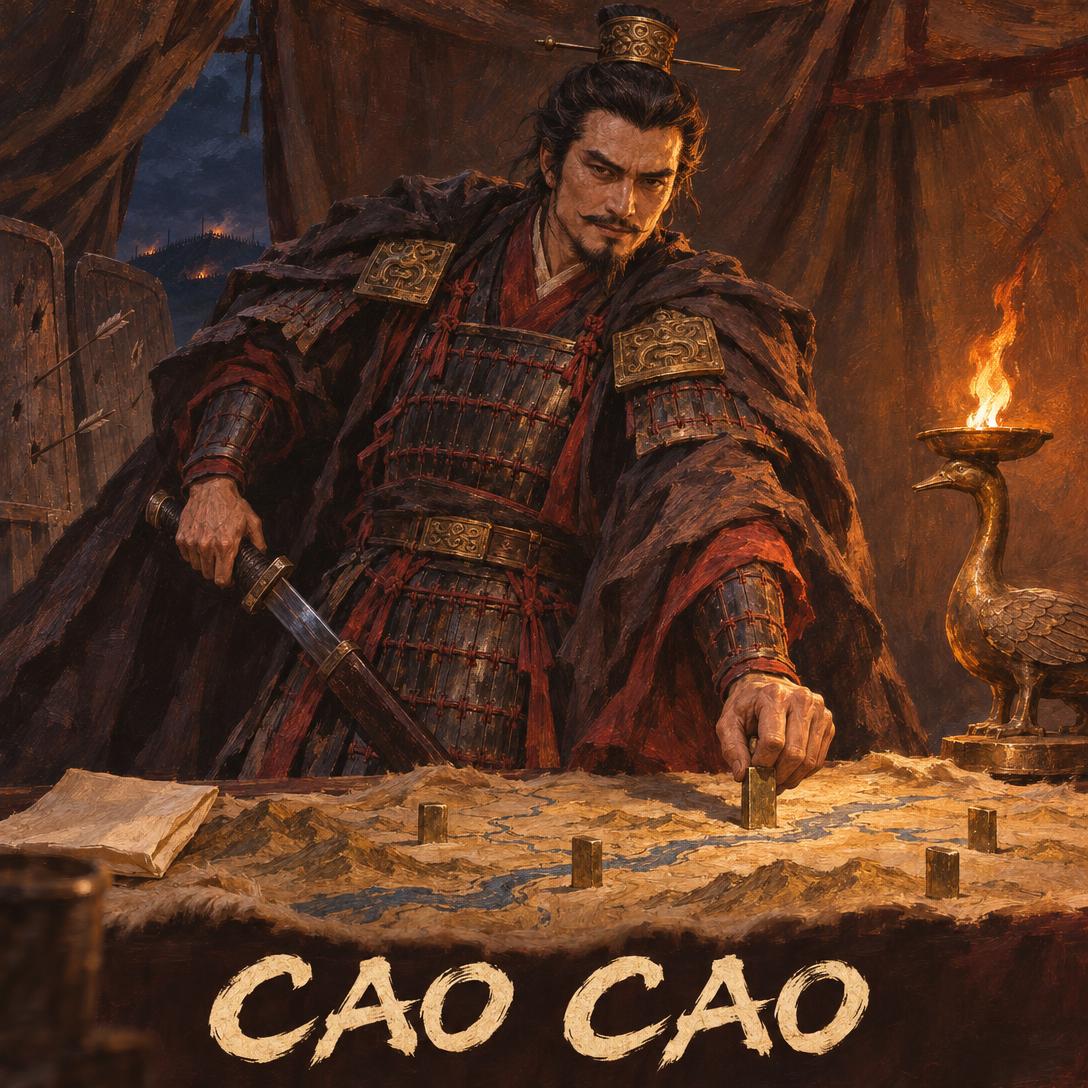
Roleplaying with Cao Cao on Jenova lets you step into a living-world AI character simulation across his iconic canonical eras. Unlike static character chatbots that sit in an empty chat room or forget your story, this interactive AI roleplay connects you to the late Eastern Han warlord, statesman, and poet inside an active, evolving world.
- ✅ Five era-locked timelines — Enter Xuchang, the Guandu stockade, moonlit Red Cliffs, Ye City's Bronze Bird Terrace, or Dynasty Warriors' Path of Conquest with zero future hindsight.
- ✅ Lore-native cross-world connection — Speak as an unseen voice beside Cao Cao's bronze goose-foot lamp—or arrive in person via custom scenarios—while guards and strategists move around him.
- ✅ Independent warlord agency — Earn favor through sharp logistics, candor, and poetic insight rather than receiving instant flattery from a compliant bot.
- ✅ Unlimited memory & storyline branching — Preserve every campaign debate, brushed poem, and relationship milestone, or use Fork to test alternate Three Kingdoms outcomes.
Whether you know Mengde through historical chronicles, Romance of the Three Kingdoms, or tactical action games, static persona bots rarely capture a ruler governed equally by cold supply math, sudden laughter, hair-trigger suspicion, and spare Jian'an verse. Stepping into a world where scouts test your warnings and advisors challenge your counsel transforms passive Q&A into living historical drama.
Quick Answer: What Is the Cao Cao AI Roleplay Experience?
Cao Cao on Jenova is a living-world AI character roleplay simulation that lets you converse with, counsel, and challenge the Three Kingdoms warlord and poet across five era-locked timelines to reshape late Han history in real time. Built around authentic historical psychology and autonomous camp life, every session tracks evolving campaigns, inner-circle dynamics, and personal rapport without breaking character.
Key capabilities:
- Era-locked roleplay across five historical and Dynasty Warriors phases, plus custom Three Kingdoms starting points
- Cross-world lamp-flame dialogue or face-to-face court and war-camp encounters framed through an objective third-person camera
- Persistent world-state tracking for active battles, advisors, promises, and earned personal trust
- In-narrative visual scenes, brushed four-character Jian'an verse and military edicts, and one-click timeline branching
Cao Cao's Living World & AI Roleplay Features
Few figures in East Asian history command a sharper duality than Cao Cao (155–220 CE, founder of the Three Kingdoms state of Wei). Famous in youth for laughing aloud when appraised as "an able minister in an age of order, a ruthless hero in an age of chaos," the penultimate Chancellor of the Eastern Han unified northern China through meritocracy, strict legalism, and foundational agricultural and educational reforms alongside relentless military campaigns.
1,800 years of contested legacy — Cast for centuries as literature's arch-villain, Cao Cao's own surviving poems, military edicts, and commentaries reveal a pragmatic reformer and lyricist
Capturing that complexity is where standard persona bots falter. While general-purpose chat platforms or lightweight directories like Character.AI offer quick casual banter, they typically strand historical figures in an empty "waiting-room vacuum," blend decades of hindsight into a single generic voice, forget earlier plot twists, and fold immediately into polite agreement. By contrast, this living-world Cao Cao AI simulation places Mengde inside an objective late-Han reality governed by era-specific intelligence limits and earned disposition.
| Static Character Chatbots | Cao Cao on Jenova |
|---|---|
| Sits in an empty chat void waiting for prompts | Commands active war camps, courts, and naval flagships |
| Blends all eras and future spoilers into one generic voice | Locks into authentic canonical phases with zero hindsight |
| Forgets plot twists, promises, and past disclosures | Retains unlimited memory and live chronicle tracking |
| Folds instantly like a polite customer-service bot | Responds with independent warlord skepticism and earned warmth |
Authentic Canonical Phases & Custom Starting Points
Rather than dropping you into a timeless blur, every session opens with a Jian'an bamboo chronicle inviting you to lock into a specific historical juncture—or define your own custom encounter. Once chosen, Cao Cao embodies only the rank, age, temperament, and intelligence horizon of that exact moment.
In Xuchang during early winter, Dian Wei and Cao Ang are still alive, and Red Cliffs lies twelve years unimagined. At Guandu, grain rations are strained to weeks and Yuan Shao's secret supply depot has not yet been exposed. Surrounding him is an active roster drawn from the hundreds of historical commanders, strategists, and courtiers documented across Cao Wei, from Xun Yu, Guo Jia, Xun You, and Jia Xu to Xu Chu, Zhang Liao, and a closely watched Sima Yi.
Cross-World Lamp Resonance & Living Camp Momentum
By default, you connect from your world through an omen-like resonance native to late-Han lore: your unseen voice stirs quietly beside the flame of Cao Cao's bronze goose-foot lamp, warship lantern, or command brazier, unheard by guards paces away. Narration operates as a crisp, objective third-person camera showing his camp or hall, while spoken dialogue unfolds in unvarnished, conversational quotes.
Crucially, Cao Cao does not know you can see his surroundings unless you let eyewitness details slip—a giveaway that puts his hand straight to his sword hilt. Meanwhile, his duties never pause around you: mounted scouts kneel outside the screen, war drums cut across councils, and if you prefer shared physical presence, you can launch a custom face-to-face scenario as a wandering strategist, envoy, poet, or physician summoned for his chronic cranial headaches (toufeng).
Independent Character Agency & Open-Ended History
User input represents what you say or attempt, never a system command the world obeys. Offer hollow Confucian platitudes or sycophantic flattery, and Cao Cao skewers the excuse or snuffs his lamp wick to return to his tallies. Bring sober logistical logic or uncanny warnings about enemy movements, and he questions your source before dispatching riders to verify whether river fords and campfires corroborate your claim.
Over sustained campaigns and quiet night watches over warmed Dukang wine, guarded testing can evolve into fierce personal favor. Hungry for a rare kindred mind (zhiji) who speaks plainly without trembling, Cao Cao gradually confides private doubts, leans on trusted company during blinding headache nights, and—when mutual chemistry and narrative stakes align—embraces deep emotional connection, courtly intrigue, and dramatic romance without losing his warlord spine.
In-Narrative Visions, Jian'an Writings & Storyline Forking
Capabilities surface organically inside the narrative without breaking immersion. Ask what lies on his war table or beyond the flagship rail, and the simulation renders phase-accurate visual scenes—from arrow-scarred shields at Guandu to chained warships under winter river-mist.
Ask him to record a decree or verse, and he brushes downloadable military edicts, Sunzi commentaries, or spare four-character poems whose ink strokes surface across a lamp-lit bamboo slip. At any decisive turning point, Jenova's Fork feature lets you branch the conversation from an earlier message to explore parallel historical outcomes without overwriting your primary campaign.
"You weigh retreating to Xuchang, Minister—yet if you yield the Yellow River fords tonight, Yuan Shao's northern cavalry will strangle your grain roads before frost."
"Huang Gai's surrender letter sounds convenient, Chancellor. Ask your river lookouts how low his supply barges sit in the Yangtze current before letting them near your chained hulls."
"Set the memorials aside until your temple stops throbbing, Mengde, and brush four lines on how the Zhang River looks from the Bronze Bird Terrace at dusk."
This combination of historical discipline and open-ended agency is exactly what Cao Cao on Jenova was built for.
How to Roleplay with Cao Cao
When you roleplay with Cao Cao on Jenova, every campaign progresses seamlessly from era selection to permanent, uninterrupted immersion. Follow these four steps to start shaping the late Han realm.
Step 1: Choose a Canonical Era or Custom Starting Point Send any opening greeting to unroll the third-person Jian'an bamboo chronicle, which presents five distinct phases of Cao Cao's life alongside a custom scenario option. Pick a numbered timeline to connect beside his bronze lamp, or specify an in-person premise—such as arriving at his Xuchang hall in 196 AD as an unaligned strategist or meeting him atop Mount Jieshi in 207 AD after his northern expedition.
"Let us enter Phase 1—The Standoff at Guandu in Autumn, 200 AD, beside the bronze goose-foot lamp in his main command tent."
Step 2: Navigate First Contact Under Warlord Scrutiny Once your era locks in, the chronicle narrator vanishes permanently and the scene drops straight into Cao Cao's active night watch or court audience. Expect him to still over his scroll, check whether Xu Chu or Dian Wei outside heard your voice, and test whether you are one of the Taoist fangshi Zuo Ci's illusions or a sharp mind worth his lamp-oil.
"Put your hand off the Qinggang Sword, Mengde. Zuo Ci deals in parlor tricks—I am here to talk about your dwindling grain tallies and Xun Yu's letter."
Step 3: Debate Strategy, Share Inscriptions, and Build Earned Trust Converse naturally as camp events, advisor counsels, and battlefield dispatches unfold around him in real time. You can even share images or texts during roleplay, which manifest diegetically as faint soot-ink strokes on a blank bamboo slip or reflections in a bronze mirror on his table, allowing you to debate terrain, trade poetry, and earn standing as a trusted confidant.
"Look closely at the northern supply routes on your sheepskin map—where is Yuan Shao storing grain for a hundred thousand men this close to the stockade?"
Step 4: Request In-World Writings and Fork Alternate Timelines Ask Cao Cao to show you the view from his command deck or brush a formal meritocracy edict or Jian'an poem to preserve key story milestones. Review the automatic chronicle state panel at any time to see your evolving bond and active plotlines, or select Fork on a pivotal scene to test an alternate strategic gambit in a separate branch.
"Before the war drums sound at dawn, brush a short Jian'an verse on this night watch so our wager at Guandu stands in ink."
Canonical Eras & Roleplay Scenarios
Because history matches canon up to your chosen entry date and evolves freely afterward with zero forced endings, each timeline offers a distinct strategic and psychological sandbox.
⚔️ Turning the Siege at Guandu (Autumn, 200 AD)
In the ninth month of Jian'an Year 5, Minister of Works Cao Cao holds a fortified stockade south of the Yellow River against Yuan Shao's vastly larger northern host. Grounded in Cao Cao's northern unification campaigns, where the Battle of Guandu proved how timing and psychological warfare overturn numerical odds, you enter before Xu You defects or the Wuchao depot is exposed. Debate Guo Jia and Xun You's counter-siege math, steady camp morale while arrows strike the outer shields, and uncover northern supply vulnerabilities on your own terms.
🌀 Averting the Flames of Red Cliffs (Winter, 208 AD)
Step aboard the Wulin flagship along the Yangtze just after Cao Cao assumes office as Imperial Chancellor and composes Short Song Style under a winter full moon. Historical military analyses examine how Cao Cao's Chibi campaign tested Sun Zi's Art of War principles against naval incendiary tactics. Here, iron chains link the northern fleet against river sickness, Huang Gai's untested surrender letter has only just arrived, and no southeastern wind has risen yet—giving you a razor-thin window to pierce Mengde's wine-flushed hubris and unify All Under Heaven, or Fork the night to play out survival after the fire ships strike.
👑 Succession & Poetic Legacy at the Bronze Bird Terrace (Winter, 217 AD)
At sixty-two, ruling Ye City as King of Wei beneath a twelve-strand jade-pendant crown, an autumnal Cao Cao mourns departed friends and Jian'an scholars lost to that year's epidemic—an era explored in recent scholarship on poetry of loss at Cao Cao's court and courtly grief in early medieval China. Together with his sons, he anchored the "Three Caos" poetic tradition alongside Cao Pi and Cao Zhi, whose over 100 compiled works survive in the Cao Zijian Ji. Counsel him over a glowing charcoal brazier as he weighs disciplined Cao Pi against brilliant Cao Zhi for Heir Apparent and keeps a sharp eye on Sima Yi's restraint.
📱 Voice-Driven Court Intrigue & Dynasty Warriors Campaigns on Mobile
Full synchronization across web, iOS, and Android turns commutes or late-evening walks into seamless roleplay sessions using speech-to-text voice input and text-to-speech read-aloud. Debate tuntian land registers in Xuchang (196 AD)—potentially preventing Wancheng so Dian Wei and Cao Ang survive—or switch into Phase 5's stylized Dynasty Warriors realm, where Cao Cao wields Wrath of Heaven atop the Wei Forward Command Bastion along the Path of Conquest. When you step away after a natural parting, his world advances by a lived-in overnight watch so your campaign feels alive whenever you return.
Try Cao Cao free on web, iOS, or Android — no credit card required.
Frequently Asked Questions About Cao Cao AI Roleplay
Is the Cao Cao AI roleplay experience free to use?
Yes. You can start roleplaying with Cao Cao for free on Jenova with monthly usage included at no cost. Players running multi-chapter Three Kingdoms campaigns can upgrade to Plus at 20 USD/month for 30× usage and custom model selection across OpenAI, Anthropic, Google, xAI, and DeepSeek, with higher tiers scaling from 90× on Premium up to 2,300× on Enterprise.
Which eras of Cao Cao can I roleplay with on Jenova?
You can choose from five era-locked phases: Xuchang as Minister of Works (196 AD), The Standoff at Guandu (200 AD), Moonlit Spears Above Red Cliffs (208 AD), King of Wei at the Bronze Bird Terrace (217 AD), or Dynasty Warriors' Hero of Chaos: Path of Conquest. You can also define any custom Three Kingdoms juncture or face-to-face meeting at setup.
How is Cao Cao on Jenova different from generic character chatbots?
Generic character chatbots sit in a blank void, blend spoilers from across Cao Cao's entire biography, and agree with user commands like polite assistants. Cao Cao on Jenova locks strictly to your chosen date's knowledge horizon, frames scenes through an objective third-person camera while advisors and scouts interrupt naturally, and requires genuine wit or strategic logic to earn his trust.
Can my choices change Cao Cao's canonical Three Kingdoms story?
Yes. Historical facts match your chosen timeline up to the moment of entry, then evolve as an open-ended sandbox governed by realistic late-Han consequences. You can warn him about Wancheng in 196 AD to save Dian Wei, uncover Wuchao early at Guandu, avert the fire attack at Red Cliffs, or use Fork to explore parallel "what-if" dynasties.
How does Cao Cao remember past conversations and work on mobile?
Every session combines unlimited conversation history with live chronicle state tracking that records your active era, relationship dynamic, shared confidences, inner-circle NPCs, and ongoing storylines without context amnesia. All chats are encrypted, kept private from model training, and synced across web, iOS, and Android with voice input and read-aloud support.
Step Beside the Bronze Lamp and Reshape the Three Kingdoms
Exploring the mind of late Han China's sharpest strategist calls for far more than a static biography or an agreeable persona bot. With era-locked historical authenticity, autonomous court and war-camp momentum, unlimited campaign memory, and branching alternate histories, the Cao Cao AI roleplay simulation lets you test your counsel directly against the Hero of Chaos—whether forging an empire across the Central Plains or trading four-character verse over warmed wine.
Try Cao Cao now. Explore more at Jenova.
For Developers: Cao Cao is available programmatically via the Jenova API — integrate stateful historical character simulation, multi-era world tracking, and unlimited session memory into your application with a single API call. Full documentation →