AI Campaign Setting Generator: Build Playable Homebrew Worlds
2026-09-03
A campaign setting generator used to mean random tables, a blank continent, and a weekend you would never get back. Jenova changes that work in September 2026 by giving dungeon masters and independent designers a studio of specialized AI agents that design geography, cultures, factions, names, and adventure hooks as one coherent world. While published settings bury you in decades of canon and homemade worlds stall in a notebook, this platform produces playable material you can put on the table the same night.
You describe the tone, the table, and the first town. The agents return a setting that hangs together—borders that imply wars, religions that imply taboos, and names that sound like they grew from the same language family.
- ✅ Specialized agents for game systems, naming, narrative, and research—not a single generic chatbot
- ✅ Persistent memory so factions, NPCs, and geography stay consistent across sessions
- ✅ Multi-model access so you can switch writing styles without rebuilding the world
- ✅ Full feature parity on web, iOS, and Android for prep between sessions
To understand why this matters, look at how most homebrew worlds actually fail: not from a lack of imagination, but from tools that generate disconnected pieces. Maps without politics. Names without languages. Lore wikis that players never read. The rest of this guide shows how a campaign setting generator should work when the whole world is built as a system.
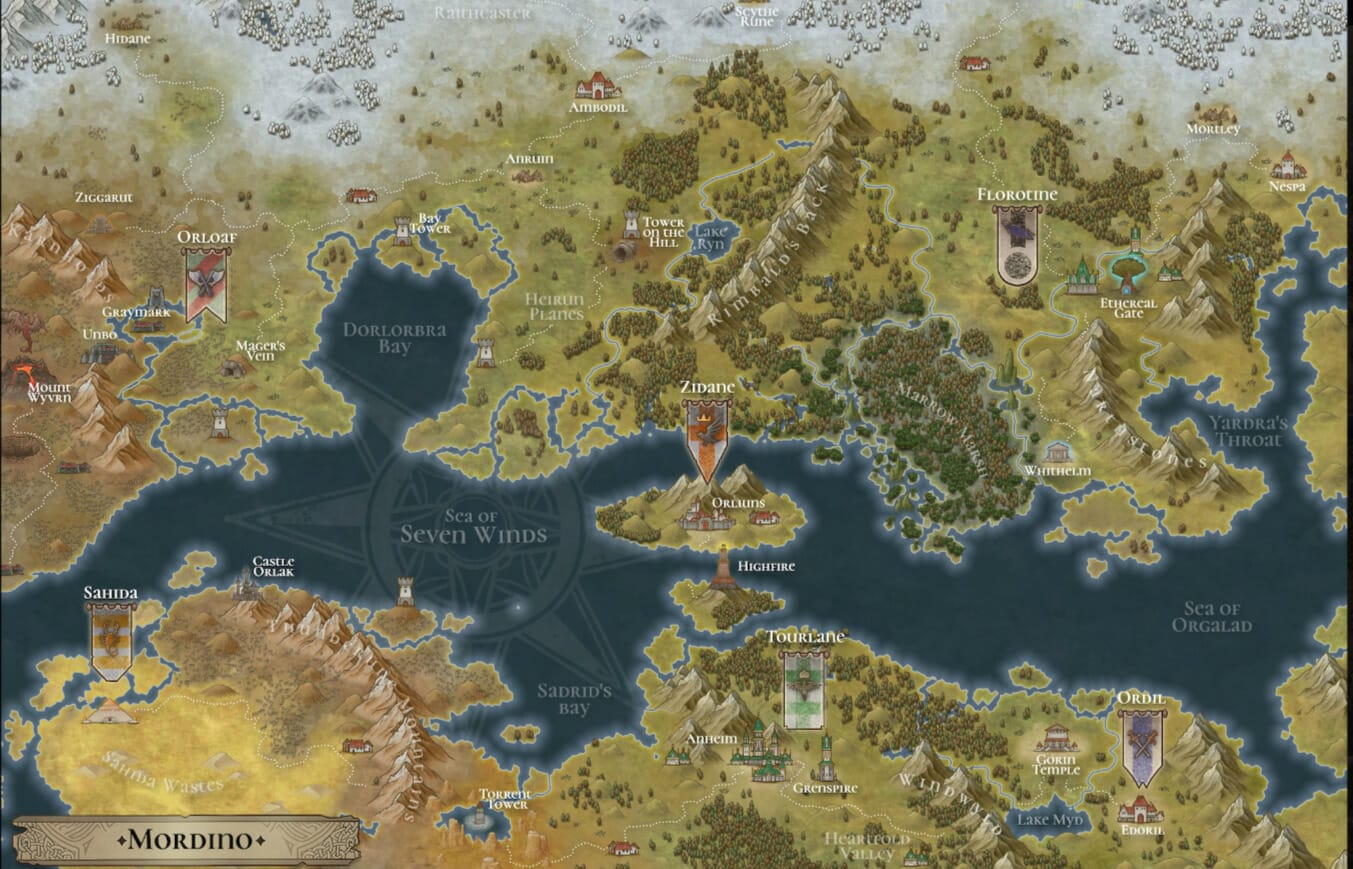
Quick Answer: What Is a Campaign Setting Generator?
A campaign setting generator is an AI toolkit that produces a playable TTRPG world—maps, cultures, factions, and lore—so you can start a campaign without months of solo prep. On Jenova, that work is split across specialized agents rather than dumped into one generic chat.
Key capabilities:
- Geography, biomes, and settlement layout that support actual travel and adventure sites
- Cultures, pantheons, and faction agendas that create conflict without a novel-length bible
- Place and character names with Name Generator that share linguistic roots instead of sounding like a random table
- Systems documentation and encounter logic through Game Designer Assistant
- Persistent memory so the world you sketched in session zero still matches session twelve
Why Homebrew Campaign Settings Stall
Tabletop role-playing is not a niche hobby anymore. The global TTRPG market was estimated at $2.41 billion in 2026**](https://www.businessresearchinsights.com/market-reports/tabletop-role-playing-game-ttrpg-market-110856), with forecasts pointing toward several times that size over the following decade. The broader [**tabletop gaming market reached $21.43 billion in 2026. Demand for original worlds is rising just as the labor of building them stays brutal.
$2.41 billion — Estimated global TTRPG market size in 2026
That growth sits next to a flood of new games. Designers on r/rpg noted that
—which means more tables hunting for a setting that feels theirs, and more referees drowning in prep.D&D Beyond's own new-DM guidance is blunt: homebrewing a setting is a lot of work, and you will do a great deal of real-world historical research if you want the result to feel natural. Published worlds solve some of that—and create new problems. But accessing a world that is both original and playable is frustratingly difficult:
- Continent-scale lore that never reaches the first three sessions
- Canon so dense that original plots feel like they need an apology
- Map tools, name generators, and chatbots that do not share a memory
- Prep hours that vanish when the group loses steam
- Settings that look detailed on paper and feel hollow at the table
Starting Too Large Burns the Campaign
The most common worldbuilding error is scale. First-time builders start too large—gods, planar politics, and dynasty charts—while the party is still arguing with a barkeep. Many groups fade around the three-month mark, often still in the low levels. Nation-scale notes written in week one never reach the table.
A useful campaign setting generator should default to the opposite: a settlement, a ten-mile zone, and one dungeon worth clearing. Continent maps can wait until someone actually buys a ship.
Published Canon Fights Original Stories
Forgotten Realms material has been in print since the late 1970s, with hundreds of thousands of words of lore. That depth is a gift until you need a plot the setting's famous wizards would have solved last Tuesday. Newer books feel the same weight, just with fewer footnotes.
Homebrew frees you from that gravity. It also means you must invent the gravity yourself: who holds power, why the roads are unsafe, and what the local priest will not say out loud.
Disconnected Tools Produce Disconnected Worlds
Inkarnate-style map studios produce beautiful coastlines. Wiki platforms store articles. A general chatbot will invent a pantheon on demand. None of those layers automatically agree.
You end up with a desert labeled next to a rainforest, a "high king" who has no tax base, and three cultures whose naming conventions collide in the same village. Players notice. They may not cite linguistics, but they feel the fake.
Prep Time That Players Never See
World Anvil's guidance on dark settings puts it simply: the setting is often the starting point of a roleplaying game. That is also why prep balloons. Atmosphere, history, and "what does this place feel like?" are not optional garnish. They are the product.
The 18–35 audience alone was projected to account for $925.67 million of TTRPG spend in 2025. Those players have less spare time than the hobby's reputation suggests. A generator that cannot turn a prompt into a playable town is entertainment for the referee, not infrastructure for the table.
Settings That Feel Thin at the Table
Random tables create novelty. They do not create causality. A good setting answers why the mine closed, who profits, and what rumor a farmer will actually share. Borough Bound's 200+ worldbuilding questions exist because most drafts skip those joints.
GMs who have used AI for town layouts, lore, and NPCs already report that the value is speed plus iteration—not a finished book in one click. The
is typical: useful output, still requiring a human to decide what is true in play.This is exactly what Jenova was built for.
The Jenova Solution
Jenova does not ask you to become a cartographer, a linguist, a historian, and a novelist before session one. It routes each job to an agent that already thinks in that craft, then keeps the results in persistent memory so the river on your map still feeds the city in your faction notes.
While a lore wiki is excellent at storing articles and a map studio is excellent at coastlines, this platform specializes in generating the interconnected setting—geography, culture, politics, and plot—through domain-specific agents rather than a blank wiki or a single chatbot.
| Traditional Approach | Jenova |
|---|---|
| Continent map first, playable town last | Start at the settlement and grow only as the table explores |
| Separate name lists, wiki pages, and chat logs | Agents that share context across names, factions, and adventure hooks |
| Published canon to memorize or ignore | Original worlds with no leftover epic NPCs blocking the plot |
| Weekend of notes that stall at month three | Session-ready material you can extend without rewriting the bible |
| One generic model for every creative job | Specialized agents plus the option to switch models without rebuilding |
Game Systems and Setting Bibles
Game Designer Assistant is the spine of a campaign setting generator workflow. It treats your world as a playable system: what the players can do, what the economy implies, how travel actually works, and which monsters belong in this biome.
Ask it for a starting region, not a planet. You will get adventure sites, faction pressure, and documentation you can keep next to your GM screen—not a lore dump that never becomes an encounter.
"Design a coastal frontier setting for a level 1–5 D&D table. Give me one home-base town under 1,000 people, four wilderness points of interest inside a day's travel, and one dungeon with a reason the locals will not go there."
Names That Sound Native to the Map
Generic generators spit out pretty syllables. Name Generator builds a naming culture: phonetics, titles, insult patterns, ship names, and the difference between what a noble is called at court and what the dockworkers call her.
That is the difference between a map that looks labeled and a world that sounds inhabited. Use it for people, taverns, rivers, and dynasties from the same root stock so players can guess origin by ear.
Campaign Arcs, Not Just Gazetteers
A gazetteer tells you what is where. A campaign needs what happens next. Film Screenwriter turns setting facts into structure: inciting incidents, escalating faction moves, mid-campaign reversals, and a climax that still works if the party goes sideways.
This is how you avoid the "beautiful world, no engine" problem. Geography becomes pressure. NPCs get wants that collide.
"Turn this three-faction coastal town into a 12-session campaign spine. I need a session-one hook, two points of no return, and a finale that still functions if the party allies with the smugglers."
Research That Makes Homebrew Feel Lived-In
Deep Research is the antidote to cardboard cultures. If you want a monsoon-and-monsoon-trade analog, a steppe confederation, or a legal system that is not "the king said so," it searches widely, synthesizes with citations, and gives you the historical joints to steal—without pasting Earth onto your map.
D&D Beyond is right that naturalistic worlds take research. You should not have to spend a graduate semester on irrigation law to make a river valley feel real.
Across these jobs, the platform's real advantage is infrastructure: multi-model access so a punchy pulp voice and a dry chronicle voice can coexist, MCP tool integrations when you need search or files in the loop, unlimited conversation history, and custom agents if your table's house rules demand a specialist the gallery does not already cover.
Specialized AI Agents for Campaign Worlds
Once the skeleton of the setting exists, the work shifts to texture—the details players actually poke. These agents extend a campaign setting generator from "here is a map" into "here is a place people live."
Personality Analyzer — NPCs Who Do Not Collapse Into Tropes
Personality Analyzer builds interior life for the innkeeper, the bishop, and the rival adventuring party. It synthesizes Big Five, attachment patterns, and other models so motives are specific.
- Distinctive fear, loyalty, and stress behavior you can play without notes
- Relationship maps that explain why two NPCs cannot share a room
- Growth or breakdown paths when the party changes someone's world
Machiavelli Mentor — Factions With Real Incentives
Machiavelli Mentor is the political engine. It maps who benefits, who pretends not to, and which "peace" is just a delayed war.
- Power maps for courts, guilds, temples, and crime
- Negotiation tactics you can put in an NPC's mouth
- Multi-move campaign architecture so villains act off-screen
Lyric Writer — The Songs the World Already Knows
Lyric Writer writes anthems, work chants, dirges, and tavern filth that encode history. A harvest hymn that never mentions the drowned god tells players more than a sidebar.
- Genre-fluent lyrics you can read aloud or hand to the bard
- In-world propaganda that factions would actually commission
- Motifs you can reprise when the campaign turns
Comic Creator — Visual Recaps Players Will Read
Comic Creator turns last session into sequential art: the ambush, the ruined gate, the face of the thing under the abbey. Between sessions, a one-page recap beats a three-page recap email.
- Issue-style recaps and rumor sheets
- Consistent character looks for handouts
- Graphic-novel pacing for cold opens
Tour Guide — Places That Feel Walkable
Tour Guide narrates a district the way a local would: smells, scams, which door to avoid after dark. Send a sketch or describe a street and get cultural texture plus practical detail.
- Sensory walkthroughs of markets, temples, and border forts
- Etiquette landmines that create play, not lectures
- Mobile-friendly briefs when you are prepping on a train
Poster Maker — The Handout That Sits on the Table
Poster Maker produces wanted notices, festival broadsides, recruitment posters, and wall maps that look like they belong in the world. Players remember a printed decree longer than a boxed-text speech.
- Period-aware layout for in-world documents
- Session-zero one-sheets and region primers
- Table-ready visuals without a separate design pass
Try Jenova free — no credit card required.
How It Works
A campaign setting generator is only useful if it follows the same discipline good referees already use: start small, make it playable, then zoom out when the table earns the horizon.
Step 1: State the Table, Not the Cosmos
Tell Game Designer Assistant the system, tone, session length, and what your players already love. Limits are a feature. A horror table that hates grimdark torture, or a heroic table that wants ruined empires but not hopelessness, should be in the first message.
"Five players, weekly three-hour sessions, D&D 5e, sword-and-sail tone. They like heists and hated the last campaign's railroad. Start me in a single port town, not a continent."
Step 2: Build the Home Base and the Ten-Mile Zone
Follow the classic settlement-then-wilderness method: a place of safety, a place to get work, a place to buy gear, a place to waste coin, and one location unique to that town. Then add villages, an abandoned site, a mystery, and one real dungeon within a day's travel.
"Create Phandalin-scale home base plus a 10-mile zone. Include five town fixtures, six villages max, one mysterious location, and one five-room dungeon with a boss the party cannot beat at level 1."
Step 3: Name the Culture Before You Name the King
Run Name Generator on the dominant language first. Lock phonetics, then generate people, streets, ships, and neighboring cultures that feel adjacent rather than copy-pasted. Inconsistent names are the fastest way to make a handsome map feel fake.
"Invent a coastal naming language with hard consonants and short given names. Generate 20 townsfolk, 8 ship names, and 12 geographic labels that could all appear on the same chart."
Step 4: Pressure-Test Politics, Faith, and Mood
Ask Machiavelli Mentor who eats if the grain fleet is late. Ask Daoist Sage how this culture thinks about fate, balance, and the state's right to act—or ask a darker brief if you are building a setting where atmosphere is the point. Then use Quiz Maker to turn your session-zero survey into something players will actually complete.
"Write a 12-question session-zero survey: tone, lines and veils, preferred adventure types, and how much politics versus dungeon crawling this group wants."
Step 5: Print What Hits the Table, Keep the Rest in Memory
Generate the wanted poster, the player primer, and the opening boxed text. Leave the dynastic chart in the thread. Persistent memory means you can return next week and ask what the rival guild did while the party was underground—without pasting a 40-page bible back into chat.
Results & Use Cases
📊 First Homebrew for a New Dungeon Master
- Scenario: A new referee has the Starter Set instincts—keep it local—but wants an original town instead of another Phandalin clone.
- Traditional Approach: Two weekends of maps, names, and NPCs, plus a creeping urge to invent a pantheon nobody will meet until level 9.
- Jenova: A playable port, a ten-mile zone, and a dungeon with a rumor mill in a single evening, with Game Designer Assistant holding the systems logic.
- The party has somewhere to sleep, spend, and get in trouble
- Prep matches the likely three-month attention span of a new table
- You can zoom out to a kingdom map only after someone cares
💼 Political Intrigue Campaign
- Scenario: Six veterans want courts, spies, and succession, not another goblin cave.
- Traditional Approach: A faction matrix in a spreadsheet, plus hours of "what would this duke do?" between sessions.
- Machiavelli Mentor + Film Screenwriter: Incentive maps and a 12-session spine where every peace treaty has a price.
- Off-screen moves that make the world feel alive
- NPCs who negotiate instead of waiting in rooms
- A finale that still works if the party crowns the wrong heir
📱 Commute Prep on a Phone
- Scenario: Game night is Thursday. The referee is on a train with a phone and twenty minutes.
- Traditional Approach: Laptop notes that are never opened, or improvising a market that feels like every other market.
- Tour Guide + Poster Maker: A walkable district brief and a festival broadside generated on iOS or Android, then dropped in the group chat.
- Speech-to-text for messy idea dumps between stops
- Handouts that look like in-world objects, not wiki printouts
- Same session memory as the desktop thread
🎯 Illustrated Setting Bible for a Visual Table
- Scenario: Players retain pictures, not paragraphs. The referee wants a lookbook, not a novel.
- Traditional Approach: Commission art you cannot afford, or paste mismatched stock into a mood board.
- Manga Creator and Comic Creator: Consistent character sheets, a two-page "how this city feels" opener, and recap pages after each arc.
- Shared visual canon for costumes, architecture, and monsters
- Recaps players actually read
- A primer you can print for session zero
FAQ
What is a campaign setting generator?
A campaign setting generator is a tool that produces the playable layer of a TTRPG world: geography, settlements, factions, names, and hooks. On Jenova, that work is split across specialized agents—game design, naming, narrative, research—so the map, the culture, and the plot share one memory instead of three disconnected files.
Is Jenova free to use as a campaign setting generator?
Yes. The free tier includes core features with limited monthly usage and no credit card. Paid plans increase usage (Plus starts at $20/month) if you are generating full region bibles, recap comics, and session handouts every week. Usage resets on your billing date, so the full allotment is available from day one.
How is this different from ChatGPT or a lore wiki?
A general chatbot will invent a pantheon, a map description, and an NPC in three separate moods. A wiki stores what you already wrote. Jenova assigns each craft to a specialist—Game Designer Assistant for playable structure, Name Generator for linguistic consistency, screenwriter and research agents for arc and grounding—and keeps the world stable across sessions.
Can a campaign setting generator replace published settings like the Forgotten Realms?
It can replace the obligation to master someone else's canon. It cannot replace your taste. You still decide what is true, what is secret, and what never reaches the table. The value is speed to a playable town and consistency as the map grows—not an official hardcover in an afternoon.
Does Jenova work on mobile for last-minute session prep?
Yes. Web, iOS, and Android share feature parity, including speech-to-text. That matters for campaign work: you can generate a district walkthrough, a wanted poster, or a session-zero quiz on a phone, then continue the same thread at the table.
Will the lore stay consistent across a long campaign?
Persistent, cross-session memory is the point. Agents remember the river you named, the guild you invented, and the promise you made in session two. You can still contradict yourself on purpose—new revelations, unreliable narrators—but you should not have to re-teach the setting to the tool every Thursday.
Build a World Your Table Will Actually Reach
Most campaign worlds die of scale: too much cosmos, not enough tavern. A campaign setting generator is worth using only when it respects that fact—when it builds a town you can play this week, names that belong on the same tongue, factions that want things, and a memory that does not reset when you close the laptop.
Jenova is that workflow: Game Designer Assistant for the playable skeleton, naming and research for texture, screenwriter and political counsel for pressure, and visual agents for the handouts players keep. The hobby is growing. Your Thursday night does not need a second unpublished novel.
Explore the full agent library at Jenova and start with the region your party can walk across in a day.
For Developers: Campaign worldbuilding agents in this article are available programmatically via the Jenova API — integrate setting generation, naming, and narrative tools into your application with a single API call. Full documentation →