AI Campaign Recap Generator: Keep Your D&D Campaign Consistent
2026-09-05
A four-hour session produces maybe two pages of usable memory — if anyone writes it down. Jenova helps dungeon masters generate campaign recaps that players will actually read: structured session summaries, NPC logs, loot lists, and next-session hooks drawn from the notes you already have. In September 2026, more tables are running longer campaigns across more apps, and the gap between what happened and what anyone can find later keeps growing.
A campaign recap generator on this platform does not replace the table. It turns last night's chaos into a document you can open before dice hit the mat.
✅ Specialist agents for narrative recaps, continuity, and player-facing handouts ✅ Persistent memory that keeps NPCs, loot, and unfinished threads consistent ✅ Multi-model drafting so you can switch tone without juggling accounts ✅ Full feature parity on web, iOS, and Android for recaps written on the commute
To understand why this matters, look at how session memory actually fails — and why a blank recap doc rarely fixes it.
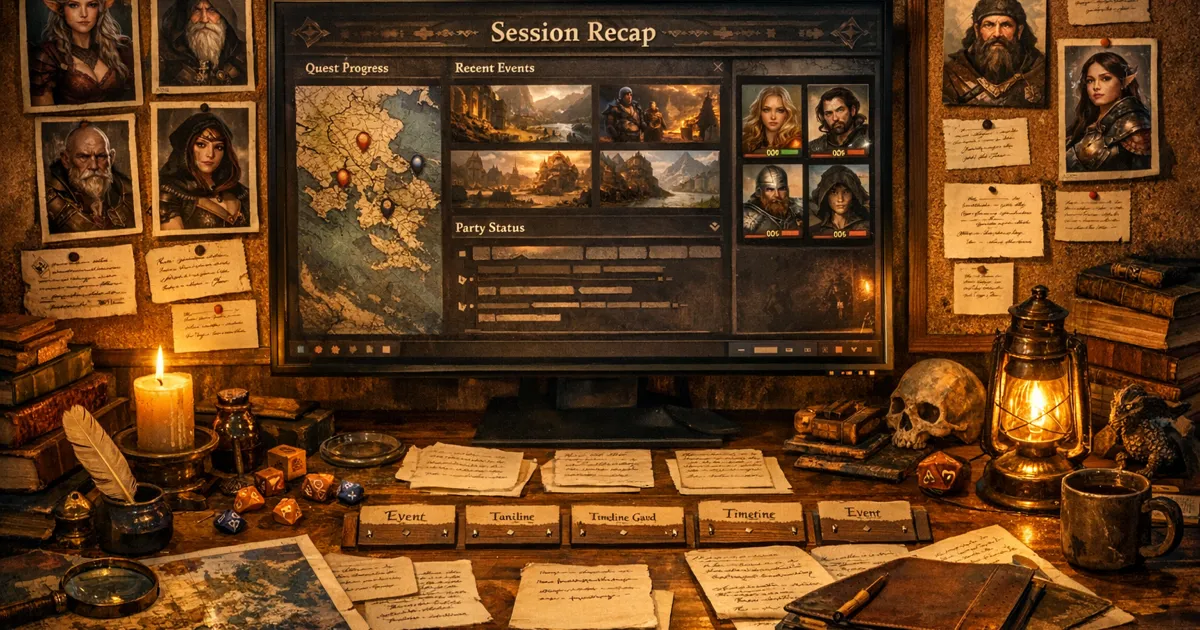
Quick Answer: What Is a Campaign Recap Generator?
A campaign recap generator is an AI prep tool that turns messy session notes into structured summaries — NPCs, loot, decisions, and next-session hooks — so a table can resume play without reconstructing last week from memory. It produces a usable record, not a novel nobody rereads.
Key capabilities:
- Convert bullets, Discord logs, or voice notes into a scannable session recap
- Separate player-facing lore from DM-only secrets and upcoming hooks
- Log NPC names, loot, and decisions so they are searchable later
- Turn the recap into a "previously on" opening, a quiz, or a visual handout
Why Campaign Recaps Fall Apart Between Sessions
Tabletop play is not a niche hobby anymore. The global TTRPG market is valued at $2.41 billion in 2026, with a forecast toward $6.59 billion by 2035. That growth shows up at the table as longer campaigns, more digital tools, and more weeks between sessions — which is exactly when memory fails.
A recap is the campaign's short-term memory. Without it, last session's clues become folklore, and the next session opens with ten minutes of argument about a merchant nobody named.
But producing recaps that actually get used is frustratingly difficult:
- Notes live in a graveyard of mismatched docs
- Players forget clues the DM assumed were obvious
- Recap time eats the first chunk of game night
- Recording tools still leave you with unstructured text
- Multi-campaign DMs cannot reconstruct session 7 on demand
Notes Exist. They Are Just Unusable.
The notes problem is not discipline. It is structure. Minva's session-notes guide describes the familiar graveyard: a folder of recaps that seemed useful at the time and became unnavigable three weeks later. One session is three paragraphs of prose. The next is five bullets. None of them are linked to NPCs, loot, or locations.
When someone asks which merchant sold the cursed sword, you reread session two instead of scanning a field. After that happens twice, "check the old notes" stops feeling worth the effort.
Write the recap within 24 hours — memory degrades fast after a session, and ten minutes now beats an hour a week later
Players Did Not Hear What You Think They Heard
On the D&D Beyond DM forums, the recurring complaint is not "my players are lazy." It is that salted clues go over heads, few people take notes, and week-over-week recall is unreliable. One common fix is a GM-led pre-session recap. Another is making players deliver it, so you learn what actually stuck.
Both work. Both assume someone already captured the session in a form you can summarize in five to ten minutes — not a transcript, and not a short story.
5–10 minutes — the recap length many GMs aim for at the start of a session, so play is not delayed by rambling
A good recap is a "previously on" reel, not a court transcript. It highlights what might matter tonight. That editorial choice is the work. Dumping everything is how recaps become unread homework.
Audio Pipelines Still Leave You Holding the Pen
Recording-based tools exist for a reason. SessionKeeper turns session audio into summaries and a campaign wiki. RollSummary pitches a four-hour session becoming a clean recap in about ten minutes. Those products solve capture. They do not, by themselves, write the player-facing card, the DM-only sequel hooks, or the handout you will actually paste into Discord.
DMs who roll their own pipeline already know the hidden cost. One widely shared
described turning a roughly two-hour audio file into a comprehensive summary in about 40 minutes — useful, and still a second job after game night.If your table does not record, or if you already have bullets in a notes app, you need a campaign recap generator that starts from the mess you have — not from a microphone you do not want on the table.
Longer Campaigns Multiply the Filing Problem
Digital TTRPG platform adoption has reached 48% in market research covering the same growth wave. More virtual tabletops and Discord tables mean more campaigns per DM, more missed sessions, and more "wait, which island did we sail to?" arguments. SessionKeeper's own user stories include parties fighting over a shady merchant from two months ago, and DMs drowning in notes across three concurrent games.
That is continuity work. It is also logistics: who missed session four, what loot is on whose sheet, and which hook you promised out loud. This is exactly what Jenova was built for.
The Jenova Solution
Jenova is not a single "summarize this" box. It is a bench of specialist agents you can brief the way you would brief a co-DM: here are the raw notes, here is what the players were allowed to know, here is the cliffhanger — now give me a recap I can read in ninety seconds and a DM version I can prep from.
| Traditional Approach | Jenova |
|---|---|
| Prose recap in a Google Doc nobody searches | Structured fields: what happened, NPCs, loot, decisions, hooks |
| One generic chatbot for every creative job | Specialist agents for narrative, names, visuals, and table logistics |
| Recap that spoils DM secrets or omits player-facing clues | Split player version and DM version from the same notes |
| Static notes that cannot remember last month's NPC | Persistent memory across sessions, campaigns, and unfinished threads |
| Recap as unread homework | Recap as opening scene, quiz, comic, or Discord card |
Narrative Pressure: The Recap as a "Previously On" Scene
Game Designer Assistant treats the recap as a design document, not a diary. You can demand the five fields a usable session record actually needs — what happened, who appeared, what was taken, what was decided, and what is dangling — then ask it to flag where your notes are still a fetch quest in costume.
Film Screenwriter is the right partner when the recap must play as an opening: one location, one image, one unfinished choice. That matches how experienced tables already think about synopses — less "everything that happened," more the details that might matter in the next hour.
When your campaign is episodic by nature, Microdrama Screenwriter is built for cliffhangers, payoffs, and the sentence that makes people sit down. Useful for West Marches tables and for any group that lives on unfinished business.
"Turn these bullets into a 120-word player recap and a DM recap. Player version: no secret traitor info. DM version: list dangling hooks and the NPC they never named. End the player version on a choice, not a paragraph of lore."
Continuity People Can Find Later
A recap dies when the innkeeper is still "the innkeeper" in session twelve. Name Generator backfills culturally consistent names for people, ships, relics, and taverns so the written record matches the world you already built.
Personal Secretary is the logistics layer: assemble the recap, attach last session's file, schedule the send to the group, and keep campaign threads from living in four inboxes. Recaps fail as often from delivery as from writing.
For location-heavy sessions, Tour Guide turns a place back into sensory briefing — the harbor at dawn, the temple annex, the alley you only described once. Players remember rooms. Recaps that only list room names feel like minutes from a meeting.
Texture the Party Can Share
A recap is stronger when it can leave the notes app. Comic Creator can turn three key beats into a one-page sequential handout for Discord. Manga Creator and Webtoon Creator cover the same job in different visual rhythms — useful if your table already thinks in panels rather than bullet lists.
Quiz Maker converts the recap into tavern trivia or a five-question cold open, which is how some tables already test what stuck without lecturing. Music Composition Assistant can sketch a motif for the quest giver's house or the dungeon the rumor points toward, so the recap has a sound as well as a paragraph.
Children's Book Creator is the specialist when the table includes younger players and the recap needs to be a short illustrated "last time" story rather than DM jargon.
Specialized AI Agents for Campaign Recaps
Once the raw notes exist, these agents do the work you will actually run.
Game Designer Assistant
Game Designer Assistant is the closest thing to a systems-literate co-DM. Brief it on genre, party, and what you planned versus what the table did, then ask for a recap that is scannable in five minutes.
- Separates planned beats from what actually happened
- Flags missing loot, unnamed NPCs, and empty hook fields
- Documents the session as DM-facing reference, not a short story
Film Screenwriter
Film Screenwriter keeps the opening playable. You get a recap that establishes tone in one image and ends on "what do you do?" — the opposite of boxed-text fatigue.
- Builds the recap as a scene the party can interrupt
- Cuts exposition the players already lived
- Revises until the first ninety seconds produce a decision
Personal Secretary
Personal Secretary is how recaps leave your head and reach the table. Use it to file the document, remind you to write within a day, and send the player-safe version without accidentally pasting the DM layer.
- Campaign logistics with persistent personal context
- Recap delivery instead of "I'll post it later"
- Cross-session memory for schedules, absences, and follow-ups
Try Jenova free — no credit card required.
How to Generate a Campaign Recap in Minutes
Step 1: Dump the Raw Record, Not a Polished Story Open Game Designer Assistant and paste what you actually have: bullets, a Discord export, a voice memo transcript, or five lines written on a phone at 11 p.m. Do not rewrite first. The agent is cheaper than your evening.
"Here are my messy notes from session 12. Party: hexblade, grave cleric, thief, druid. We play 5e. Do not invent facts I did not write. Mark anything that is ambiguous."
Step 2: Demand the Five Fields That Make Notes Searchable Ask for the structure good session templates already use: what actually happened, NPC interactions, loot given out, player decisions, and hooks for next time. Kill prose. Keep lines you can scan in ten seconds.
"Format the recap as: What Happened / NPCs / Loot / Decisions / Hooks. One line per item. If a name is missing, insert [UNNAMED] instead of guessing."
Step 3: Split Player-Facing Lore From DM Prep Hand the structured recap to Film Screenwriter. Request a 90-second "previously on" the players can hear, plus a DM page that lists secrets, fail-forward outcomes, and which dangling thread you might revive. The D&D Beyond recap thread is explicit that a GM recap can accidentally lead the table — so label the two versions.
"Player recap: 120 words, no traitor identity, no unfound clues. DM recap: include the sealed letter they ignored and two ways it can resurface next session."
Step 4: Make One Artifact the Table Will Actually Open Move to Comic Creator or Quiz Maker and produce a single shareable object: a three-panel recap, a wanted update, or five trivia questions for the cold open. Personal Secretary can file both versions and draft the Discord message.
"Make a five-question recap quiz. Wrong answers should be plausible. Include one question about the harbormaster's lie. No spoilers for unfound rooms."
Step 5: Start Next Session From the Hooks Field Save the thread. The last thing you write after a session should be the first thing you read before the next. On game night, open the same agents on your phone — web, iOS, and Android share state — and generate the rumor the bard overhears when the party ignores your planned door.
Results & Use Cases
📊 Monday Recap Before Memory Collapses
Scenario: You ran Sunday night. Work starts in nine hours. The notes are a pile of names you will not recognize on Thursday.
Traditional Approach: Promise yourself you will write it tomorrow. You do not. Session 13 opens with a ten-minute argument about who has the ring.
Jenova: Paste the bullets into Game Designer Assistant before you sleep. Film Screenwriter produces the player cold open. You send it while the session is still warm.
- Captures decisions while they are still specific
- Gives you a hooks field to start next week's prep
- Stops the notes graveyard from gaining another unread page
💼 Three Campaigns, One Brain
Scenario: You DM a weeknight 5e table, a monthly horror one-shot, and a West Marches Discord game. Someone asks what happened to the smuggler captain.
Traditional Approach: Search four docs, a wiki, and a chat log. Guess. Get it wrong. The table loses trust in continuity.
Jenova: Keep a thread per campaign. Personal Secretary files recaps by table. Name Generator keeps each city's naming language from bleeding into the others. Game Designer Assistant can answer "every session the harbormaster appeared" from the stored notes rather than from your recollection.
- Campaigns stay isolated instead of merging in your head
- NPC names remain searchable
- Missed details are a lookup, not a rewrite
🎯 Player Missed Session Four
Scenario: One player had a recital. They need to rejoin without a 20-minute lore dump that bores everyone else.
Traditional Approach: A rushed verbal summary that either spoils DM information or skips the one clue their character would care about.
Jenova: Generate a character-facing recap: what their PC would know, what the party decided in their absence, and one question they can ask in-character. Children's Book Creator or Comic Creator can make a one-page version if they prefer images to paragraphs.
- Catch-up without stalling the table
- No accidental secret leaks
- The returning player gets agency, not a lecture
📱 Bus-Ride Recap on a Phone
Scenario: Session is tonight. Your notes are in a graveyard. You have a commute, not an afternoon.
Traditional Approach: Scroll old documents, reuse last month's cult, hope improvisation holds when someone asks about loot.
Jenova: Open the campaign thread on iOS or Android. Ask for three recap lengths — 40 words for the cold open, a fielded DM sheet, and a Discord paragraph. Quiz Maker gives you two questions to throw at the table while people find their character sheets.
- Feature parity with desktop, including memory
- Recap and next-hook prep in one ride
- Hands-free drafting with speech-to-text if your hands are full of dice
FAQ
What is a campaign recap generator for D&D?
A campaign recap generator is a prep tool that turns last session into a usable record: what happened, who appeared, what was taken, what was decided, and what is still dangling. On Jenova, that work is split across specialist agents rather than a single summarize button. You can structure the notes with Game Designer Assistant, then write the player-facing opening with Film Screenwriter in the same campaign thread.
How is an AI campaign recap generator different from session recorders?
Recording tools such as SessionKeeper capture audio and build searchable wikis. That is valuable if your table records. A campaign recap generator on Jenova starts from the notes, Discord logs, or bullets you already have, then produces the artifacts you will actually use: a 90-second cold open, a DM hook list, a quiz, or a comic handout. You do not need a microphone at the table.
Is Jenova free to use for session recaps?
Jenova has a free tier with all core features and limited monthly usage. Paid tiers increase usage and unlock custom model selection. You can generate recaps, NPC logs, and player handouts without a credit card. If you run multiple campaigns or produce long illustrated recaps, a paid plan simply raises the ceiling.
Can I generate recaps that match my homebrew world?
Yes. Attach prior session notes, naming conventions, and lore documents, then brief the agents on tone and taboos. Persistent memory keeps a coastal city's speech patterns from drifting into generic fantasy by week four. Name Generator and Tour Guide are particularly useful for making new recap details feel native to a place you already built.
Does a campaign recap generator work on mobile at the table?
Yes. Jenova runs with full feature parity on web, iOS, and Android, and settings sync across devices. That matters when a player disputes last month's loot or interviews an NPC you barely named. You can regenerate the relevant recap slice on your phone, including speech-to-text if you are mid-setup.
Will an AI recap spoil secrets or feel generic?
It spoils secrets when you paste the DM layer into the player channel. It feels generic when the prompt is generic. Feed the agents what the party actually did, mark [UNNAMED] instead of letting them invent, and keep a player version and a DM version. The agents draft. You remain the editor of what the table is allowed to remember.
Conclusion
A campaign recap generator is only useful if it produces something you will open again. Prose in a forgotten doc is not a record. A structured recap — what happened, who appeared, what was taken, what was decided, what is dangling — is how a campaign survives the week between sessions.
Jenova replaces that gap with specialists. Game Designer Assistant frames the recap as playable design. Film Screenwriter turns it into an opening the party can interrupt. Personal Secretary gets the player-safe version out of your drafts folder. Name Generator, Comic Creator, and Quiz Maker make the memory shareable instead of homework. You still decide what is true. You stop spending your only free weeknight reconstructing that truth from a notes graveyard.
When the next session is closer than your notes are ready, generate the recap, keep the thread, and walk into the scene with a question instead of a speech. Explore the full agent library at Jenova.
For Developers: Every agent in this article is available programmatically via the Jenova API — integrate campaign recap generation, session-note structuring, and continuity tools into your application with a single API call. Full documentation →