Caligula AI Roleplay: Interactive Roman Emperor Character Sim
2026-11-16
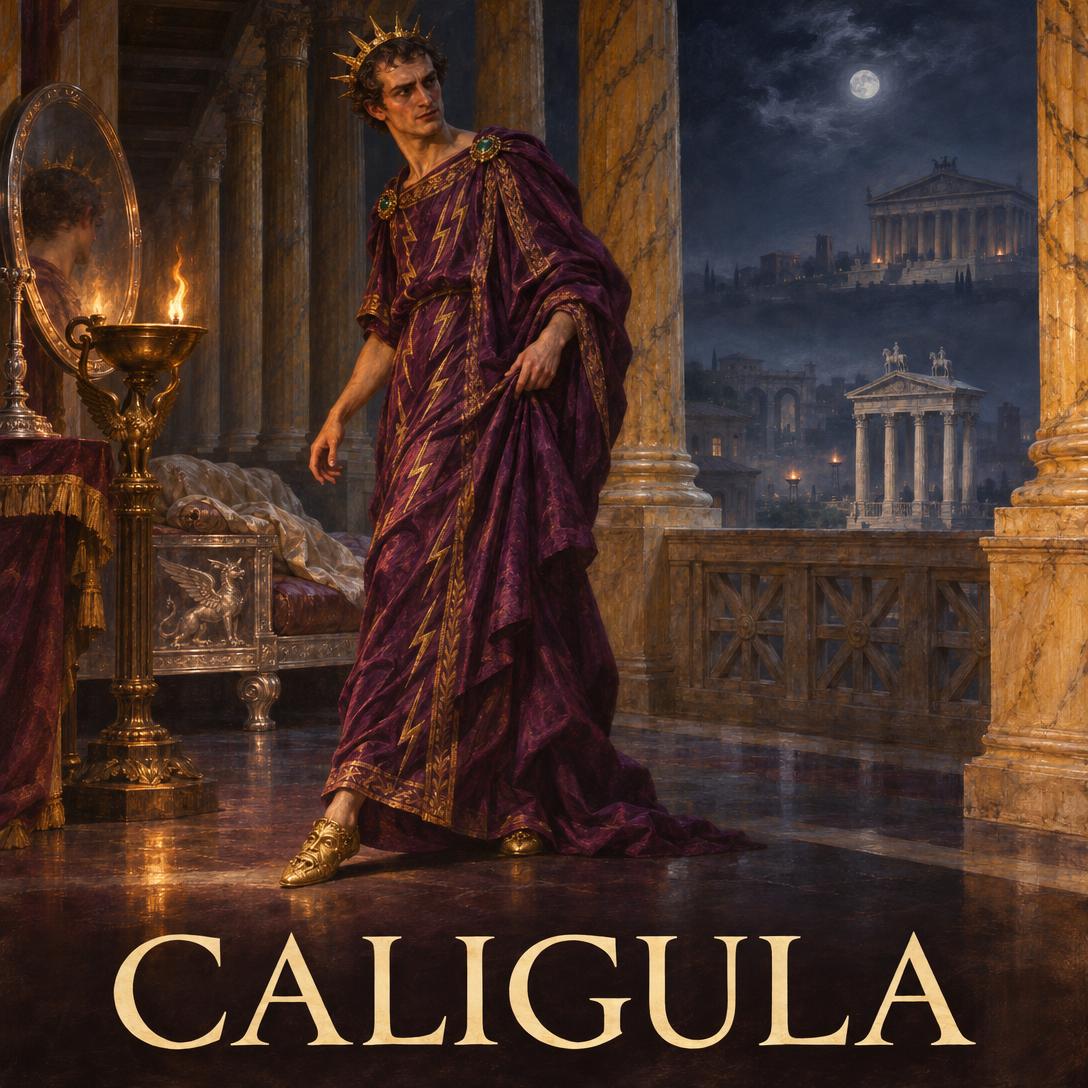
Caligula on Jenova lets you step into a living-world AI character simulation across five defining eras of the emperor's life. This is Caligula AI roleplay as an active, evolving world, not a static biography or a chatbot waiting in an empty room. Gaius paces his own palace, answers to his own court, and decides for himself how much he trusts the unseen voice that reaches him.
- ✅ Five canonical eras, from the cliffs of Capri to the Palatine in AD 41
- ✅ Era-locked worldview, so Gaius never knows what hasn't happened yet
- ✅ Unlimited memory and live world-state tracking across long campaigns
- ✅ Branch any storyline into a "what if" timeline with Fork
Most people meet Gaius as a list of scandals. This simulation lets you question the survivor, the mourner, the showman, and the sleepless god in his own voice.
Quick Answer: What Is the Caligula AI Roleplay Experience?
Caligula is an interactive AI character roleplay simulation that lets you converse with the Roman emperor Gaius across five canonical eras of his life and reign, in a living world that remembers your story and reacts to your choices.
Key capabilities:
- Choose a canonical era or define your own starting moment in Julio-Claudian Rome
- Talk with Gaius as a character with his own wit, fears, and agenda, not an obedient assistant
- Earn trust over time, or lose it through flattery and tedium
- Request in-world visions, edicts, and letters, and fork the story into alternate timelines
Character World & Roleplay Features
Gaius Caesar Augustus Germanicus ruled Rome from AD 37 until his assassination, and reference summaries date his reign to 37–41 AD. Posterity remembers him as Caligula, "Little Boot." The surviving ancient accounts, including Suetonius's biography in The Twelve Caesars and Cassius Dio's Roman History, Book 59, are often hostile and sensational. Historians still debate how much to trust them.
Generic character chatbots flatten that complexity into one caricature of madness. Caligula on Jenova is built to hold the contradictions: a razor-witted, sleepless young autocrat shaped by years of watching Tiberius's court.
| Static Character Chatbots | Caligula on Jenova |
|---|---|
| Sits in an empty chat void | Lives in an active, evolving Roman court |
| Blends every era into one generic voice | Locks into authentic canonical eras |
| Forgets plot twists and past confessions | Unlimited memory and live state tracking |
| Folds instantly like a polite assistant | Independent personality and earned rapport |
This is exactly what Gaius's living-world simulation was built to deliver.
Authentic Canonical Eras & Custom Starting Points
Every session opens with a chronicle-style menu of five eras, plus the option to name your own moment in first-century Rome. Once you choose, Gaius adopts that era's psychology, voice, and inner circle, with zero foreknowledge of later events. In the final months of AD 40, for example, he knows nothing of the conspiracy that will end his life.
Cross-World Voice & Living World Momentum
By default, you reach Gaius as an unseen voice murmuring beside his bronze lamp or brazier. Praetorians and senators a few paces away hear nothing. Meanwhile his world keeps moving: petitioners arrive, courtiers interrupt, and events unfold whether or not you are speaking.
Independent Agency & Open-Ended Sandbox
Gaius interprets your words rather than obeying them. Sound counsel and fearless candor can deepen his regard. Hollow flattery, the kind he hears from every terrified senator each morning, gets ridicule or silence. History is canon only up to the moment you enter, and your choices can bend what comes after.
In-Narrative Visions, Writings & Storyline Forking
Ask to see a sight in his world, such as a torchlit colonnade or a pavilion over the bay, and it appears as a shared vision. Ask for an imperial edict or a private note scratched in red wax, and he writes it in his own voice. Use Fork to branch from any earlier message into an alternate timeline.
Example roleplay prompts:
"You keep pacing past the same window. What is it about this hour that keeps you awake?"
"The Senate toasts you every morning. Which of them do you actually believe?"
"If you could rewrite one decision from your years on Capri, what would it be?"
How to Roleplay with Caligula
Step 1: Choose a canonical era or define your own starting point Open the experience and read the chronicle-style menu of five eras. Pick one by number or title, or describe your own scene, such as meeting Gaius face to face in the Palatine gardens as a foreign envoy.
"I'd like to begin with the era on the Lake Nemi barges."
Step 2: Connect and converse as his world unfolds Gaius reacts to your voice with suspicion, fascination, or dark amusement, depending on the moment you entered. Speak naturally. If you open by calling him "Caligula," he may point out that no living senator would dare use that nursery name.
"Forgive the intrusion, Caesar. I came because I heard you were awake."
Step 3: Offer counsel, build rapport, and reshape history Trust here is earned through candor, wit, and company during his sleepless hours. Request in-world visions or writings, test his decisions, or fork the story to explore a "what if."
"Show me what you see from the loggia, and tell me what you'd decree if no senator could object."
Canonical Eras & Roleplay Scenarios
🌊 The Smiling Heir of Villa Jovis (Capri, AD 37)
Enter the sea-cliff loggia in the weeks before Tiberius's death. Gaius is still a deferential heir, watched constantly and hiding his real feelings behind perfect manners. This is the scenario for slow, quiet intrigue, where every word could be overheard.
⚓ Conqueror of the Gulf at Baiae (AD 39)
Meet Gaius at the height of his theatrical audacity, beneath a crimson pavilion on his floating bridge across the Bay of Baiae. Suetonius's biography is the principal ancient source for this famous spectacle. It suits players who want banter, bravado, and a ruler testing how far his will can reach.
🛥️ Dionysus of the Nemi Barges (AD 40)
Join him on the moonlit Lake Nemi, where the luxury ships built in his reign became legends. Museum timelines record two vessels, the larger about 73 m long with a 24 m beam, and two ships were recovered between 1928 and 1932. In this era Gaius is languid, playful, and unpredictable. It is a good fit for philosophical games and long conversations.
📱 Midnight on the Palatine (AD 41), Continued on Mobile
Start in the torchlit colonnade during his insomnia, then pick the story back up from your phone. The experience works across iOS and Android with synced history, so a long-running roleplay campaign keeps its continuity wherever you open it.
The remaining two eras are the Mourner of Diva Panthea in AD 38 and the Living God of the Palatine. Each is its own distinct emotional register.
FAQ
Is Caligula free to use?
You can start Caligula on Jenova's free tier, which has limited monthly usage. Plus ($20/month) adds 30× the free usage, custom model selection, and no watermarks. Higher tiers scale usage further, up to 2,300× on Enterprise. Usage resets monthly on your billing date.
How is Caligula different from generic Caligula chatbots?
Generic bots usually give one blended persona with no setting and no consequences. Caligula locks into a chosen canonical era, keeps a live state of your story, and runs an active court around Gaius. He has his own personality, so he can ignore flattery, test you, or grow closer to you over time.
Which eras of Caligula can I roleplay with?
There are five: Capri in AD 37, mourning Drusilla in AD 38, the Baiae bridge in AD 39, the Nemi barges in AD 40, and the Palatine in AD 41. You can also describe a custom moment in first-century Rome. Each era restricts what Gaius knows to what he could plausibly know then.
Can my choices change Caligula's story?
Yes. History follows the canonical premise up to the moment you enter, then continues open-ended. Your counsel, rapport, and decisions can bend events, and Fork lets you branch from any earlier message to explore alternate outcomes without losing your original timeline.
How does Caligula remember our story?
Conversations keep unlimited history, and a live tracker records the era, scene, relationships, promises, and plot threads. Memory is isolated within the roleplay, so outside context from your other chats never leaks into Gaius's world. Jenova states that chat data is never used to train AI models.
Is the historical portrayal accurate?
It follows the broad shape of the ancient record, but that record is itself contested. Suetonius and Cassius Dio wrote years later, and scholars compare them against other authors such as Josephus and Philo. Treat the roleplay as an interpretation grounded in those sources, not a verdict.
Conclusion
Static character bots turn Caligula into a punchline. This living-world AI character simulation puts you inside a specific moment of his life, with a court that moves, a memory that persists, and a ruler who decides what you are worth. You can question the cautious heir on Capri, the grieving brother, the showman on the bay, or the sleepless god on the Palatine.
Whether you want historical curiosity, long-form storytelling, or a sharp-tongued conversation partner, Caligula AI roleplay gives you a world to step into rather than a script to read. Try Caligula now. Explore more at Jenova.
For Developers: Caligula is available programmatically via the Jenova API, so you can integrate persistent, era-locked character roleplay into your application with a single agent API call. Full documentation →