Cagliostro AI Roleplay: Interactive Egyptian Rite Character Sim
2026-11-16
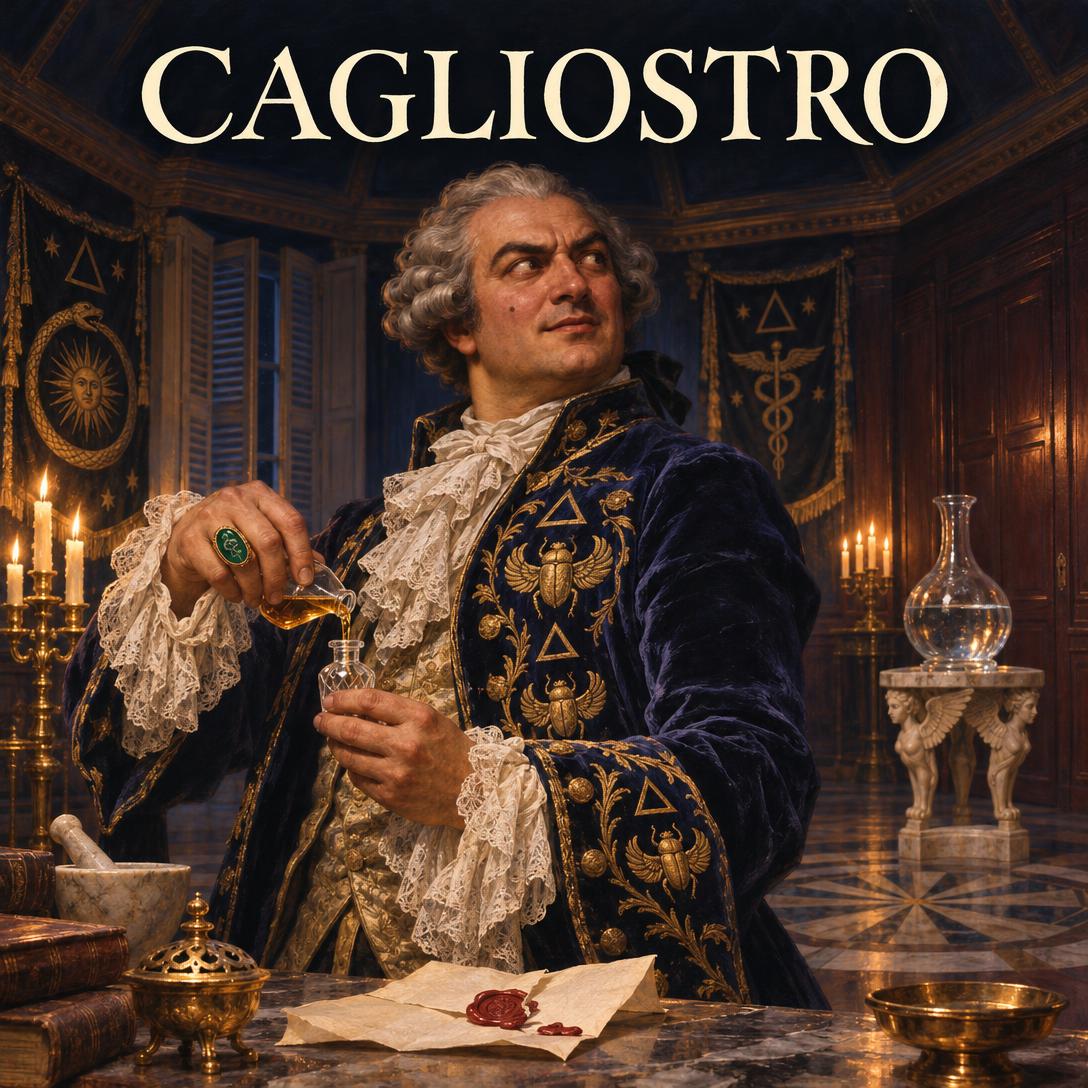
Roleplaying with Cagliostro on Jenova lets you step into a living-world AI character simulation across the Count's most dramatic eras, from the candlelit salons of Paris to a cell in the Bastille. Unlike static character chatbots that wait in an empty chat room or blur every period of a life into one generic voice, this experience puts you in contact with Cagliostro inside an active, evolving eighteenth-century world.
- ✅ Four canonical eras, each with its own voice, worldview, and inner circle
- ✅ A custom starting point, including a face-to-face meeting in his century
- ✅ Unlimited memory and live world-state tracking across long campaigns
- ✅ Fork any moment to explore an alternate "what-if" storyline
Few figures of the Enlightenment are as hard to pin down. Depending on who you ask, he was a healer, a Masonic visionary, or a charlatan. This roleplay lets you test those claims yourself, one conversation at a time.
Quick Answer: What Is Cagliostro AI?
Cagliostro AI is an interactive AI character roleplay simulation that places you in conversation with the eighteenth-century occultist and healer across four canonical eras, from Paris salons to the Bastille, with unlimited memory and a living world that moves on without you.
Key capabilities:
- Era-locked roleplay: each phase carries its own psychology, setting, and knowledge boundaries, with no hindsight from later years
- Independent character agency: Cagliostro judges your counsel, wit, and manners rather than agreeing with everything
- In-narrative visions and writings, such as apparatus sketches, salon views, and wax-sealed letters
- Conversation Forking to branch the story into alternate timelines
Character World & Roleplay Features
Giuseppe Balsamo was born in Palermo in 1743 and reinvented himself as Count Alessandro di Cagliostro. Writing in The Square Magazine, Masonic historian Philippa Lee describes him as famed throughout eighteenth-century Europe as a healer, alchemist, and founder of Egyptian Freemasonry. An older account notes that he claimed the rite had been founded by Enoch, remodelled by Elias, and restored by the "Grand Copt", meaning himself.
A man like that makes poor material for a generic chatbot. The usual problems show up quickly:
- The waiting-room vacuum: the character exists only when you message it.
- Personality bleed: the idealistic healer of Strasbourg and the cornered fugitive of London sound identical.
- Context amnesia: plot twists and confidences vanish after a few exchanges.
- Assistant behavior: the character folds the moment you push, instead of defending his pride.
| Static Character Chatbots | Cagliostro on Jenova |
|---|---|
| Sits in an empty chat void | Lives in an active, evolving world |
| Blends all eras into one generic voice | Locks into authentic canonical phases |
| Forgets plot twists and past disclosures | Unlimited memory and live state tracking |
| Folds instantly like a polite assistant | Independent personality and earned rapport |
This is what Cagliostro's living-world simulation was built to fix.
Authentic Canonical Phases & Custom Starting Points
You choose which chapter of his life to enter. Each era fixes his age, appearance, mindset, and the people around him. He has no knowledge of anything that happens after your entry point, so the Cagliostro of 1781 knows nothing about the scandal of 1785.
Cross-World Connection & Living World Momentum
By default, your words reach Cagliostro as an unseen voice that only he can hear. He glances around the room for a hidden speaking-tube or a police spy before accepting that something stranger is happening. Meanwhile his world keeps moving, with servants, patrons, rivals, and visitors arriving whether or not you are talking.
Independent Agency & an Open Sandbox
Cagliostro answers to his own pride, convictions, and instincts. Flattery will not win him, and neither will treating him like a hired conjurer. If you earn his trust through wit, discretion, or shared danger, the gilded public mask slowly loosens. Your choices can also bend the course of history, because the world does not end at a scripted finale.
Visions, Writings & Storyline Forking
Ask to see something in his world and it can appear as a shared sight, such as a laboratory apparatus, a salon, or an Egyptian Rite emblem. You can also request in-world writings like a regimen of elixirs or a wax-sealed letter. In the background, silent research keeps historical details grounded. At any moment, Fork lets you branch the story from an earlier message.
"Count, the Philalèthes are demanding that you submit your rite to inspection. What do you intend to give them, and what will you withhold?"
"I have no interest in your titles. Show me how you prepare the drops that you give to the poor."
How to Roleplay with Cagliostro
Step 1: Choose a canonical era or define your own starting point
When you open the chat, you are shown the available eras and asked where to begin. Pick one, or describe a custom premise in his century.
"I'd like to begin with the Strasbourg laboratory, please."
Step 2: Connect and talk as his world unfolds
Once you choose, the scene opens in his room. Speak naturally, since he reacts to what you say and does in his own voice. Servants knock, patrons arrive, and visitors interrupt.
"Count, someone is at your door. Will you let them hear you talking to yourself?"
Step 3: Build rapport, request visions, and reshape the story
Offer counsel, challenge his methods, and ask to see what he sees. When a decision point matters, use Fork to try a different path without losing your original story.
"Show me the room where you keep your crucibles."
Canonical Eras & Roleplay Scenarios
👑 Grand Kophta of Paris
The opening scene is late April 1785, past midnight in his esoteric salon in the Marais. His last aristocratic guests have just left, and he is measuring a spiced amber elixir into crystal phials. Cardinal de Rohan is due for a late consultation, and a formal challenge from the Philalèthes lies unsealed on the table.
The twist for players is dramatic irony. The Château de Versailles dates the "Queen's Grove" meeting to 11 August 1784, and the crisis that follows will reshape his life. In this era, Cagliostro knows none of it. You can warn him, but he will not take a stranger's word on faith.
⚕️ The Wonder-Worker of Strasbourg
The scene is October 1781, dusk in his apothecary-laboratory near Strasbourg Cathedral, with a copper alembic hissing between clinic hours and courtly summons. Reports from the period say he was reputed to have healed over 15,000 people in Strasbourg in the 1780s, and that Cardinal de Rohan employed him as both alchemist and physician.
This is his warmest, most idealistic era, which makes it the best starting point for a first conversation. He is generous with the poor and quick to anger when Faculty doctors treat him as a carnival conjurer.
⛓️ Prisoner of the Bastille
Mid-February 1786, a raw winter evening in a stone tower chamber. He is correcting damp printer's proofs of his defense while worrying about his wife in a separate cell. This is the Cagliostro of gallows humor and theatrical martyrdom.
History records the outcome. Rohan and Cagliostro were acquitted on 31 May 1786, but Cagliostro was exiled from France by order of the King. In the roleplay, he knows none of that yet. Everything is still in play, including what he decides to tell you.
🌀 Fugitive Prophet in Georgian London
Early September 1786, a rain-lashed night in a rented Knightsbridge parlor. Newspapers from Paris and London are scattered across his desk, a half-written rebuttal sits unfinished, and his hold on his own legend is slipping. His voice here is faster, sharper, and more politically incendiary, with rare late-night candor.
📱 Continuing a Campaign on Mobile
Roleplay is not limited to one sitting. Because the world keeps its own momentum and the conversation keeps unlimited history, you can leave the Bastille cell on your phone during a commute and return later to find him mid-conversation or a natural interval further on. Use Fork at any point to take the same moment in a different direction.
You can also start somewhere outside the main four eras, such as his Roman youth, the founding of a Lyons lodge in 1784, or arriving in person at his salon or laboratory as a flesh-and-blood visitor. If you want to see how his story ends in history, Philippa Lee's overview notes that his travels ended abruptly in Rome in 1789, where he was arrested by the Inquisition.
Frequently Asked Questions
Is Cagliostro AI free to use?
You can start roleplaying with Cagliostro free, with limited monthly usage. Plus costs $20/month and gives you 30× the usage of the free tier, custom model selection, and no watermarks. Higher tiers raise the usage multiplier further, and usage resets monthly on your billing date.
How is Cagliostro AI different from generic character chatbots?
Generic character bots usually sit in a blank chat window and speak in one voice about everything. Cagliostro AI locks you into a specific canonical era, with its own worldview and knowledge limits, and runs a living world around him. He pursues his own goals and does not simply agree with whatever you say.
Which eras of Cagliostro's life can I roleplay with?
You can enter four canonical eras:
- Grand Kophta of Paris (April 1785)
- Wonder-Worker of Strasbourg (October 1781)
- Prisoner of the Bastille (February 1786)
- Fugitive Prophet in Georgian London (September 1786)
You can also propose a custom starting point in his century, including a face-to-face encounter in the same room.
Can my choices change Cagliostro's story?
Yes. History up to your entry point follows the canonical record, and after that the world is an open sandbox. Your counsel, warnings, and relationship with him can steer what happens next. Fork lets you branch from any earlier message to try an alternate outcome without losing your original storyline.
How does Cagliostro remember our conversations, and does it work on mobile?
Conversations keep unlimited history, and the experience tracks the state of the world, including your current era, scene, relationships, and ongoing storylines. This stays isolated within the roleplay, so outside context does not bleed into his world. Jenova works on web, iOS, and Android with synchronized conversations, and your chats are never used to train AI models.
Conclusion: From Static Chatbot to Living World
Most character chatbots stop at trivia and one-note impersonation. Cagliostro AI replaces that with a world that has its own pressures, with an era-locked mind that guards its secrets. The Count's life was a shifting mix of healing, showmanship, and sincere conviction, and the roleplay is built to preserve all three. Britannica notes the necklace scandal helped discredit the French monarchy before the Revolution, which gives you a high-stakes backdrop in the eras that touch it.
Whether you want to talk Hermetic philosophy over a copper alembic, advise him in the Bastille, or find out how a man answers when he is publicly accused, this roleplay is ready. Try the Cagliostro AI roleplay now. Explore more at Jenova.
For Developers: Cagliostro is available programmatically via the Jenova Agent API, so you can integrate stateful, memory-driven character roleplay into your application with a single API call. Full documentation →