AI Burnout Coach: Personalized Recovery Plans for Work Stress
2026-08-16
A dedicated AI burnout coach helps you recognize the exact drivers of your exhaustion and build a structured recovery plan by combining stress diagnostics, evidence-informed techniques, and consistent accountability between conversations. Burnout rarely resolves on its own — it compounds quietly until performance, sleep, and relationships all take the hit. An AI coach gives you a private, always-available space to name what's happening and act on it.
✅ Available 24/7 — process a brutal Sunday-night spiral at 11 PM, not three weeks from now ✅ Zero stigma — no colleague, HR file, or manager involved in the conversation ✅ Persistent memory — remembers your workload patterns, triggers, and what's already been tried ✅ Structured, not vague — produces actual plans, scripts, and check-ins instead of generic advice
The value of this becomes obvious once you look at what workers are actually facing. Burnout is not a fringe problem, and the barriers keeping people from support are structural — not personal failings. To understand why an AI coach fills a real gap, let's examine the challenges facing exhausted workers today.
Quick Answer: What Is an AI Burnout Coach?
An AI burnout coach is a conversational AI tool that helps you identify burnout drivers, build personalized recovery plans, and maintain accountability through ongoing check-ins — available instantly, privately, and without scheduling.
It works as a structured thinking partner for the parts of burnout you can actually change: workload boundaries, recovery habits, and how you communicate under pressure.
Key capabilities:
- Diagnose which specific work factors are driving exhaustion — demand, control, support, role clarity, or relationships
- Build a personalized recovery plan with realistic, scheduled steps rather than generic self-care lists
- Draft boundary-setting scripts for managers, clients, and colleagues
- Track patterns across weeks so recurring triggers become visible instead of invisible
- Pair with complementary support like a Meditation Guide or Fitness & Workout Coach for the physical side of recovery
The Problem: Burnout Is Widespread, and Support Is Hard to Reach
Burnout has moved from an occupational nuisance to a documented public health and economic issue. The World Health Organization frames poor working environments — excessive workloads, low job control, job insecurity — as direct psychosocial risks to mental health, and the productivity cost is staggering.
12 billion working days lost every year to depression and anxiety, at a cost of US$1 trillion annually in lost productivity — World Health Organization, Mental Health at Work
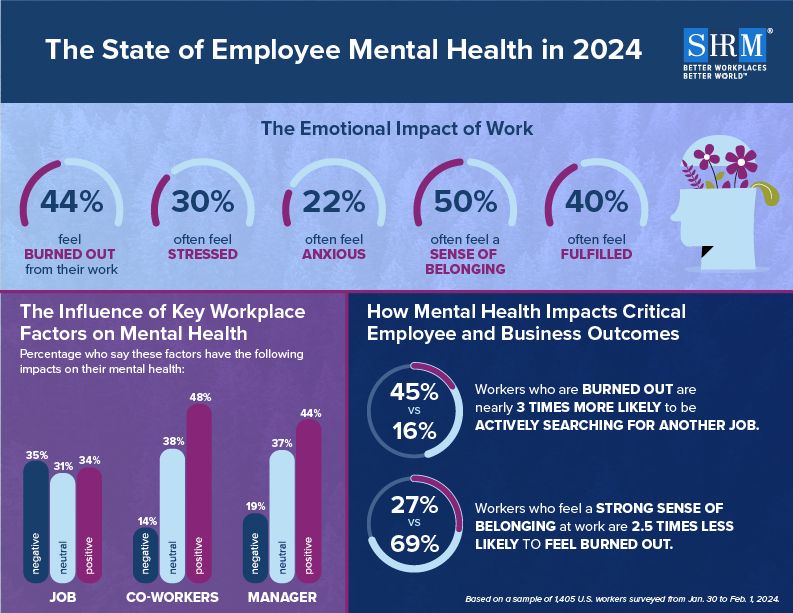
44% of workers feel burned out from their work, and burned-out employees are nearly 3 times more likely to be actively searching for another job — SHRM, State of Employee Mental Health
But actually getting support for it is frustratingly difficult:
- Stigma keeps people silent — the fear of being judged or seen as weak outweighs the desire for help
- Benefits exist but are invisible — many workers don't know what's available or how to access it
- Managers are unequipped — even supervisors frequently don't know their own company's mental health offerings
- Help is slow and scheduled — burnout spikes at 11 PM on a Sunday, not during a booked appointment slot
- Generic advice doesn't fit — "take a vacation" doesn't address a role-clarity problem or a chronic overload problem
Stigma Is the Primary Barrier
The 2025 NAMI Workplace Mental Health Poll found that 42% of workers worry their career would be negatively impacted if they discussed mental health concerns at work, and nearly half worry about being judged by colleagues. Only 13% told their manager their mental health was suffering due to work demands in the past year.
Notably, NAMI observed that employees readily report high rates of "burnout," "stress," and "overwhelm" — while far fewer describe their "mental health" as poor. The language people are comfortable using is a signal: workers want practical help with exhaustion, framed as a work problem, not a diagnosis.
Access Is Broken Even When Benefits Exist
The same poll found that only half the workforce knows how to access mental health care through employer-sponsored insurance, and 45% of employees at the manager level don't know how to access it either. Roughly a quarter of respondents didn't know whether their employer offered mental health benefits, an employee assistance program, or flexible work arrangements at all.
The Cost of Waiting
Burnout doesn't stay contained. Research summarized by the National Institutes of Health notes that workers experiencing burnout report higher levels of anxiety and depression, with documented links to more serious outcomes. Meanwhile, Mental Health Research Canada estimates burnout costs employers $5,500–$28,500 per employee annually — a figure that reflects how much productive capacity quietly disappears before anyone intervenes.
One in Four Have Considered Quitting
NAMI's data shows one in four employees have considered quitting due to mental health concerns, and 7% actually did. By the time exhaustion reaches the resignation threshold, the recoverable window has usually already closed.
This is exactly the gap an AI burnout coach is built to close — not as a replacement for clinical care, but as the accessible, immediate, structured layer that currently doesn't exist for most people.
The Solution: Why an AI Burnout Coach Works
An AI burnout coach doesn't try to be a therapist. It occupies a specific and useful position: the always-available, non-judgmental space where you diagnose what's draining you and build a concrete plan to change it.
This is an important distinction. Stanford HAI researchers have raised serious concerns about AI chatbots positioned as therapy replacements, documenting stigma and unsafe responses in clinical scenarios. Their researchers were explicit about where AI does fit well: "supporting journaling, reflection, or coaching" in less safety-critical scenarios. Burnout coaching — workload structuring, boundary practice, habit design, reflection — sits squarely in that zone.
At the same time, evidence for the underlying techniques is solid. A systematic review in Frontiers in Public Health concluded that mindfulness-based interventions "could be approaches of choice to prevent emotional distress of burnout," and an Oxford Academic review found AI-based interventions show early promise for workplace mental health, "particularly in reducing burnout and enhancing resilience."
| Traditional Approach | AI Burnout Coach |
|---|---|
| Weeks-long waitlist for a first appointment | Available the moment you notice the spiral |
| Requires disclosing to HR, manager, or insurance | Fully private — no workplace paper trail |
| $150–$300+ per coaching session | Free tier available, no credit card required |
| Advice reset every session, no memory of context | Remembers your triggers, workload, and prior attempts |
| Generic "practice self-care" recommendations | Specific plans mapped to your actual work conditions |
| One 50-minute window per week | Unlimited check-ins between the hard moments |
Diagnosis Before Prescription
Burnout is not one thing. Occupational research consistently maps work-related stress across six domains of work design: demand, control, support, relationships, role, and change. A recovery plan built for the wrong domain doesn't work — more sleep won't fix a role-clarity problem, and better time management won't fix an understaffing problem.

A good coaching conversation starts by isolating which domains are actually loaded:
"I'm exhausted every day but I can't tell if it's the workload or the fact that nobody ever tells me if my work is good. Help me figure out which."
Boundary Scripts You'll Actually Send
The hardest part of burnout recovery is usually a conversation you're dreading. An AI coach drafts the exact wording — calibrated to your relationship with the person, your leverage, and your tolerance for conflict:
"Draft a message to my manager declining a fourth project this quarter without sounding like I'm complaining or unreliable."
Recovery Habits That Fit Your Actual Life
Generic wellness advice fails because it assumes free time you don't have. Effective coaching works backward from your real calendar — a 6-minute morning practice, a hard laptop-close time, a Friday shutdown ritual. The Meditation Guide agent can then build the specific practice, with technique matching and troubleshooting for when it stops working.
Pattern Recognition Across Weeks
The single most underrated capability is memory. When the same conversation surfaces every third Tuesday, that's data. Persistent context turns scattered venting into a visible pattern — and patterns are actionable in ways that individual bad days are not.
Where to Draw the Line
An AI coach is a support layer, not clinical care. For persistent depression, anxiety that interferes with functioning, or any thoughts of self-harm, a licensed professional is the correct and necessary path — and the American Psychological Association's guidance on AI wellness tools is worth reading before relying on any AI tool for mental health support. Coaching handles the workload, habits, and communication layer. It does not replace treatment.
Related Agents You'll Also Find Useful
Burnout recovery is rarely a single-front effort. These agents handle the adjacent pieces that consistently show up in the same conversations.
Meditation Guide
The most evidence-supported intervention category for burnout is also the one most people quit within a week. This agent is deeply trained across every major tradition and handles the part that usually causes dropout — matching the technique to your temperament and troubleshooting when it isn't working.
- Technique matching based on your actual stress profile, not a one-size app default
- Structured practice programs with progression, plus custom script generation
- Expert guidance for adverse effects — including the agitation some people experience early on
Fitness & Workout Coach
Physical recovery capacity collapses first under chronic stress, and it's the fastest lever to move. If you've stopped training entirely — the near-universal burnout pattern — this agent rebuilds from wherever you actually are.
- Custom programs calibrated to low-energy weeks, not idealized ones
- Real-time session coaching and form guidance with video demos
- Progress tracking that keeps momentum visible when motivation is thin
Negotiation Coach
Sometimes the honest answer to burnout isn't a breathing exercise — it's renegotiating scope, headcount, deadlines, or comp. If you're heading into that conversation, rehearse it first.
- Role-play simulations so the real conversation isn't the first attempt
- Strategy sessions and preparation playbooks for workload and salary discussions
- Skill assessments that identify where you fold under pressure
Personal Nutritionist
If you're also working on the energy-crash side of burnout — the 3 PM collapse, the erratic eating, the caffeine dependency — this agent provides evidence-based guidance tailored to your goals and lifestyle, with the accountability that makes changes stick.
- Personalized plans built around real schedules and constraints
- Ongoing accountability rather than a one-time meal plan
- Evidence-based, not trend-driven
Try these free — no credit card required.
How It Works: From First Message to Recovery Plan
Step 1: Describe what's actually happening
Skip the polished version. Give the coach the unedited state — hours, sleep, what you're avoiding, what you dread most. Specificity is what separates a real plan from a generic one.
"I'm working 55-hour weeks, I've stopped exercising entirely, I dread Monday by Saturday afternoon, and I snapped at my team lead last week for no real reason."
Step 2: Isolate the actual drivers
Work through which of the six work-design domains are loaded. Most people discover the problem isn't the one they assumed — it's frequently low control or role ambiguity rather than raw volume.
"Walk me through demand, control, support, relationships, role, and change one at a time and help me score where I actually am on each."
Step 3: Build a plan you'll realistically follow
Ask for something sized to your current capacity, not your ideal self. A plan with three changes you'll actually do beats one with twelve you won't.
"Give me a two-week plan with a maximum of three changes. I have almost no free time and low willpower right now."
Step 4: Rehearse the hard conversation
Whatever boundary you need to set, draft and pressure-test it before you send it.
"Role-play my manager pushing back on my request to drop one project. Be realistic and a little difficult."
Step 5: Check in and adjust
Return weekly. Report what worked, what didn't, and what got in the way. Persistent memory means each conversation compounds instead of starting over — which is precisely where a standalone chatbot session fails and a real coaching relationship succeeds.
"Week one recap: kept the laptop-close time four out of five days, completely failed on the morning walk. What do we change?"
Results & Use Cases
📊 The High-Performer Who Can't Say No
Scenario: A senior analyst has absorbed three extra workstreams over six months because saying no felt career-limiting. Output quality is slipping and they know it.
Traditional Approach: Wait for the annual review to raise it, or quietly burn out and resign — the path one in four workers report considering.
AI Burnout Coach: Maps current commitments against realistic capacity, identifies which workstream has the weakest business case, and drafts a scope conversation framed around protecting delivery quality rather than personal limits.
- Reframes the ask as a business risk, not a complaint
- Rehearsed with pushback via the Negotiation Coach before the real meeting
- Produces a written follow-up so the agreement doesn't evaporate
💼 The Manager Carrying Everyone Else's Stress
Scenario: A team lead is absorbing their reports' anxiety on top of their own workload, with no one above them doing the same for them.
Traditional Approach: No structural support exists — and NAMI found that 45% of manager-level employees don't even know how to access their company's mental health benefits.
AI Burnout Coach: Provides the missing upward support layer — a private space to process team dynamics, plus practical frameworks for supporting reports without absorbing their emotional load.
- Separates what's genuinely theirs to carry from what isn't
- Scripts for escalating team-level capacity problems to leadership
- Weekly decompression that doesn't require burdening a colleague
📱 The 11 PM Sunday Spiral
Scenario: Anticipatory dread hits every Sunday night. By Monday morning the person is already depleted, and the cycle repeats weekly.
Traditional Approach: Nothing is open. The moment passes unprocessed, and the pattern entrenches.
AI Burnout Coach: Available in the exact moment it's happening, on mobile, with full context from previous weeks. Interrupts the spiral, identifies the specific Monday trigger, and builds a shutdown ritual for Friday that reduces Sunday's load.
- Full feature parity across web, iOS, and Android — the support is where you are
- Speech-to-text for when typing feels like too much effort
- Recognizes the recurring pattern rather than treating each Sunday as isolated
🎯 The Post-Burnout Rebuild
Scenario: Someone has already taken leave and is preparing to return. The fear is obvious: returning to identical conditions and repeating the collapse.
Traditional Approach: Return-to-work is often handled administratively, with no plan for the conditions that caused the absence.
AI Burnout Coach: Builds a phased re-entry plan and identifies the specific accommodations worth requesting — an approach aligned with WHO's return-to-work recommendations, which pair work-directed adjustments with ongoing support.
- Concrete accommodation requests instead of vague "I need less stress"
- Early-warning indicators defined in advance so relapse gets caught early
- Physical rebuild coordinated with the Fitness & Workout Coach
Frequently Asked Questions
Is an AI burnout coach free?
Yes — Jenova offers a free tier with access to all core features and no credit card required, so you can start a burnout coaching conversation immediately. Paid plans starting at $20/month provide substantially higher usage limits and custom model selection if you want daily check-ins or extended sessions. You can explore the full agent library at Jenova.
Can an AI burnout coach replace therapy?
No, and it shouldn't try. Stanford HAI research documented meaningful risks when AI chatbots are positioned as therapist replacements, including inadequate responses in safety-critical situations. AI coaching is appropriate for workload structuring, habit building, boundary practice, and reflection. For clinical depression, anxiety disorders, or any thoughts of self-harm, contact a licensed professional or a crisis line.
How is this different from a meditation or wellness app?
Wellness apps deliver pre-recorded content on a fixed schedule. An AI coach has an actual conversation about your specific situation, remembers it, and adjusts. When a technique stops working, the Meditation Guide can troubleshoot and switch approaches — something a static content library can't do.
Is my conversation private from my employer?
Yes. This is a personal tool with no employer integration, no HR reporting, and no involvement in your workplace. Given that 42% of workers fear career damage from discussing mental health at work, this matters. Jenova encrypts data in transit and at rest, never uses your data to train public AI models, and doesn't sell or share it with advertisers.
Does it work on mobile?
Yes — full feature parity across web, iOS, and Android, with all settings and conversation history syncing across devices. Speech-to-text is available for moments when typing feels like too much. This matters more than it sounds, since burnout peaks rarely occur at a desk during business hours.
Will it remember my situation between conversations?
Yes. Persistent memory across sessions means the coach retains your workload patterns, past attempts, and known triggers. This is the core difference between a one-off chatbot exchange and an ongoing coaching relationship — recurring patterns become visible, and each conversation builds on the last instead of resetting.
Conclusion
Burnout persists not because people lack awareness, but because the support layer between "I'm exhausted" and "I need clinical care" barely exists. Stigma keeps people quiet, benefits go unused because nobody knows how to find them, and the worst moments arrive at hours when nothing is open.
An AI burnout coach fills that gap directly: private, immediate, structured, and persistent. It won't fix an understaffed team or a broken management culture — no tool will. What it will do is help you identify precisely which conditions are draining you, build a recovery plan sized to your actual capacity, rehearse the conversations you're avoiding, and keep showing up week after week until the pattern shifts.
Start with a single honest conversation about what your week actually looks like. Pair it with the Meditation Guide for the practice side, the Fitness & Workout Coach to rebuild physical capacity, and the Negotiation Coach when the real fix is a workload conversation.
Explore the full agent library at Jenova — free to start, no credit card required.
For Developers: Every agent in this article is available programmatically via the Jenova API — build AI-powered wellness and coaching features into your application with a single integration. Full documentation →