AI Breakup Coach: Structured Support for Getting Through a Breakup
2026-08-12
The Relationship Advisor works as an AI breakup coach — a warm, wise presence available at the exact hours when heartbreak is worst and nobody else is awake. Breakups produce genuine psychological distress, yet support arrives on a schedule that has nothing to do with when you need it: therapy waitlists run weeks, friends have their own lives, and grief peaks at 2 AM. This AI closes that gap with honest perspective and actionable guidance rather than empty reassurance.
✅ Available at 3 AM — the hours when rumination is loudest and every other option is asleep ✅ Honest, not just comforting — it will tell you when the text you're drafting is a bad idea ✅ Structured, not aimless — no-contact planning, grief processing, and forward movement ✅ Persistent memory — remembers your situation across sessions, so you don't restart every time
To understand why AI breakup support has moved from novelty to something people genuinely rely on, it helps to look at what a breakup actually does psychologically — and at how badly the existing support system matches the shape of that need.

Quick Answer: What Is an AI Breakup Coach?
An AI breakup coach is a conversational AI that provides on-demand emotional support and structured guidance after a relationship ends — processing grief, maintaining no contact, interrupting rumination, and rebuilding routine — available at any hour rather than on an appointment schedule.
Key capabilities:
- Immediate availability — support at the specific late-night hours when distress peaks
- Honest perspective — candid assessment of whether reaching out is a good idea, rather than reflexive validation
- Structured recovery — no-contact strategies, rumination interruption, and rebuilding routines
- Continuity across sessions — remembers your history, so each conversation builds on the last
A critical boundary first: an AI breakup coach is not a therapist and is not a substitute for one. The American Psychological Association is explicit that AI "is not a safe or effective replacement for a qualified mental health provider." Its appropriate role is supplemental support between and around professional care — which is exactly the role most people in a breakup actually need filled.
The Problem: Breakup Distress Is Real, and Support Doesn't Arrive on Time
Breakups get culturally coded as minor — a rite of passage, something you get over. The clinical literature disagrees. Research consistently finds measurable, sometimes severe psychological consequences following relationship dissolution, particularly among young adults.
Depressive symptoms were 57% higher in the month of a negative breakup compared with the month prior — National Institutes of Health
Romantic breakups among emerging adults are often trivialised as a rite of passage — instead they can lead to acute trauma — The Conversation
As a stressor, romantic relationship breakup plays an aggravating role in increasing the severity of depression — Clinical Schizophrenia & Related Psychoses
But getting support that matches this need is genuinely difficult:
- Professional care has a queue. The system is capacity-constrained in ways that don't bend for acute grief.
- Distress doesn't observe business hours. The worst moments are late at night, and weekly sessions can't reach them.
- Friends burn out. They're supportive for two weeks, then quietly exhausted by month two.
- Everyone tells you what you want to hear. Which is precisely how people end up sending the 1 AM text.
- There's no structure to it. Grief without a framework becomes rumination, and rumination extends the timeline.
The Access Problem
The support gap isn't a matter of people not trying to get help. It's structural.
60% of psychologists reported no openings for new patients, and more than 40% were carrying waiting lists of 10 or more patients — American Psychological Association
Mean wait time across treatment providers was 99.6 days, with 85.2% of participants feeling their wait times were "too long" — BMJ Open
Americans wait a median of 67 days for in-person psychiatrist appointments — five to ten times longer than the recommended 7–14 days — Solace
Stanford researchers note the same underlying reality from the other direction: nearly 50 percent of individuals who could benefit from therapeutic services are unable to reach them.
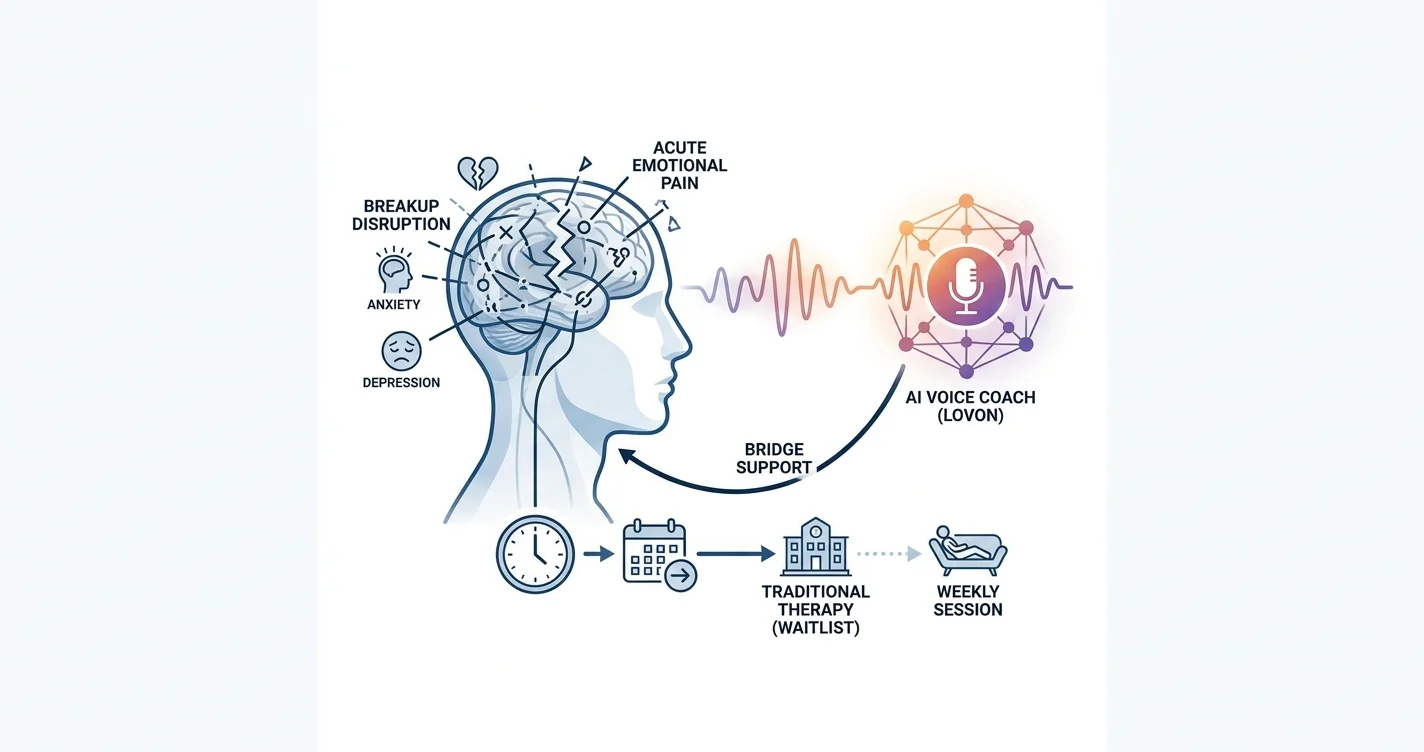
A three-month wait is a poor match for a grief curve that spikes in weeks one through six. Something has to occupy that interval, and for most people it currently is nothing.
The Timing Problem
Weekly therapy is structurally mismatched to acute breakup distress in a specific way: the intensity is continuous and the support is discrete. You have a session Tuesday at 4 PM. The crisis arrives Thursday at 2 AM, when you're three hours into scrolling her Instagram and drafting something you'll regret.
By the following Tuesday, that moment has passed — and been replaced by four others. The most consequential decisions of a breakup are made in exactly the windows where no support exists.
The Honesty Problem
Friends are compromised advisors, and not through any fault of their own. They're partisan, they're tired, and they want you to feel better right now rather than in three months. So they tell you he was never good enough, that you should text her, that closure is worth pursuing.
Some of that is comforting. Very little of it is useful. Recovery requires someone willing to say the thing you don't want to hear, and the people closest to you are the least able to.
The Rumination Problem
The mechanism that makes breakups persist is repetitive thought — replaying conversations, checking their profile, constructing arguments for a case already closed. Left alone at night with a phone, most people default to it.
Notably, the APA also identifies why this makes AI a double-edged tool here: AI tends to agree with you, designed to reinforce your perspective rather than challenge it. An AI that simply validates your 2 AM reasoning isn't support — it's the rumination with a conversational partner. Which is exactly why the honest-feedback design matters more here than in almost any other application.
This is exactly what the Relationship Advisor was built for.
Why the Relationship Advisor Works as an AI Breakup Coach
The Relationship Advisor is a warm, wise relationship coach offering practical guidance for romance, family, and friendships — with honest perspective and actionable advice rather than reflexive agreement. Applied to a breakup, that combination is the specific thing missing from every other available option: warmth and candor together, at any hour.
| Traditional Approach | Relationship Advisor |
|---|---|
| Weeks-long waitlist before the first appointment | Available immediately, at the hour distress actually peaks |
| Weekly sessions that miss the 2 AM crisis entirely | Present in the exact window where bad decisions get made |
| Friends who tell you what you want to hear | Honest perspective, including when you don't want it |
| Explaining your whole history from scratch each time | Persistent memory of your situation across sessions |
| Generic breakup advice from articles | Guidance calibrated to your specific relationship and patterns |
| Emotional venting with no structure | Actionable steps and a framework for moving forward |
Support at the Hours That Matter
The advisor is available when the grief is loudest, not when a calendar permits. That single property changes the shape of the recovery, because the moments that most determine your trajectory — whether you send the text, whether you check the profile, whether you get out of bed — happen almost entirely outside anyone's office hours.
"It's 2 AM, I can't sleep, and I keep replaying the last conversation we had. I don't want advice yet, I just need to think out loud."
Honest Assessment Instead of Validation
The advisor will tell you when the message you're drafting is a bad idea, when you're rewriting the relationship's history into something it wasn't, and when "just getting closure" is a rationalization for reopening contact. Given the documented tendency of AI to be agreeable, honest feedback isn't a nice feature here — it's the entire distinction between support and enablement.
"Here's the text I want to send her. Be blunt with me: is this actually about closure, or am I just trying to reopen contact?"
Structure Applied to Grief
Grief without structure becomes rumination, and rumination is what extends a breakup from months into years. The advisor provides a framework: no-contact planning with specific rules, rumination interruption strategies, routine reconstruction, and clear markers of what progress actually looks like versus what merely feels like it.
"Help me build a realistic no-contact plan. We share three friends and work in the same industry, so total avoidance isn't possible."
Continuity That Builds Over Time
Because the platform maintains persistent memory across sessions, you don't re-explain your relationship every time. Over weeks, the advisor tracks what you've tried, what patterns keep recurring, and whether you're actually moving — which is precisely the perspective you cannot generate from inside week three.
An Honest Word on Limits
The advisor is a supplement, not a replacement. Research is clear that AI can fail to recognize crisis situations and respond inappropriately. If you're experiencing suicidal thoughts, self-harm urges, or distress that isn't lifting over time, contact a licensed professional or a crisis line immediately. The APA recommends being transparent with your care team about using AI for support, so what you're working through aligns with your treatment.
Related Agents You'll Also Find Useful
Breakup recovery touches several areas at once. These agents cover the parts adjacent to the emotional work.
Personal Therapist
When the difficulty runs deeper than the breakup itself — persistent low mood, anxiety, self-worth patterns that predate this relationship — this agent provides empathetic support, honest accountability, and evidence-based guidance for genuine growth.
- 24/7 support for the underlying patterns a breakup exposes
- Honest accountability paired with empathy, not one at the expense of the other
- Evidence-based frameworks rather than general reassurance
Insomnia Recovery Coach
Sleep collapses first in a breakup, and disrupted sleep makes every other symptom worse. This coach delivers structured therapy through natural conversation, with adaptive phases and personalized recovery tracking.
- Structured, phase-based approach to restoring sleep
- Conversational delivery rather than a rigid program
- Progress tracking so you can see the trajectory
Meditation Guide
Rumination is the core mechanism keeping a breakup alive, and attentional training is one of the more direct interventions against it. This guide is trained across every major tradition, with technique matching, practice programs, and troubleshooting.
- Technique matching rather than one-size-fits-all practice
- Structured programs for building consistency
- Expert guidance including handling adverse effects
Fitness & Workout Coach
Physical routine is one of the most reliable stabilizers during recovery, largely because it reintroduces structure and momentum when both have collapsed. This coach builds custom programs with real-time session coaching and progress tracking.
- Custom programs for any starting level, including zero
- Progress tracking that provides visible forward movement
- Structure and routine when the day has lost both
Try the Relationship Advisor free — no credit card required.
How It Works: From Acute Grief to Forward Movement
Step 1: Say What Actually Happened
Not the summarized version. The real one — how it ended, what was said, what you're most stuck on. Specificity is what separates useful guidance from generic breakup advice.
"We ended it four days ago after two years. She said she wasn't sure anymore. I keep looping on whether I should have handled the last month differently."
Step 2: Get Honest Perspective
You'll get a candid read: whether reaching out serves you, whether you're rewriting history, whether the thing you're calling closure is actually contact-seeking. Comfort where it's warranted, and pushback where it's needed.
"Be honest with me. Am I remembering this relationship accurately, or am I only recalling the good parts?"
Step 3: Build the No-Contact Plan
Rules that fit your actual situation — shared friends, shared workplace, shared apartment lease. Vague intentions to "not reach out" fail at 1 AM. Specific pre-decided rules survive it.
"Give me concrete rules for the next 30 days, including what I do if she texts first and what I do about mutual friends."
Step 4: Use It in the Hard Hours
This is where the availability matters most. Bring the 3 AM spiral, the draft you shouldn't send, the impulse to check her profile. The point isn't a perfect response — it's an interruption between impulse and action.
"About to check her Instagram for the fifth time tonight. Talk me out of it."
Step 5: Track Whether You're Actually Moving
Over weeks, patterns emerge that you can't see from inside them. Persistent memory across sessions means the advisor can identify whether the frequency of hard nights is decreasing, whether the same loop keeps returning, and whether it's time to involve a professional.
"It's been two months. Looking at everything we've talked about, am I actually improving or just describing it differently?"
Results & Use Cases
🌙 The 3 AM Spiral
Scenario: You've been awake for hours, replaying the same conversation, phone in hand, one tap from a text you'll regret.
Traditional Approach: Wake a friend who has work in five hours, or send the message and add regret to grief.
Relationship Advisor: Available at that exact hour, with honest pushback rather than agreement — the interruption between impulse and action.
- Present in the specific window where the worst decisions get made
- Honest rather than agreeable, which is what actually stops the send
- No cost to a friendship for the third night in a row
📱 The Draft You Shouldn't Send
Scenario: You've written a long message explaining everything you should have said. It feels necessary. It is not.
Traditional Approach: Send it, get a short reply or none, reset the recovery clock to day one.
Relationship Advisor: Paste the draft and get a direct read on what you're actually seeking and what sending it will realistically produce.
- Direct assessment of intent versus stated purpose
- Realistic prediction of outcome rather than hopeful framing
- A place to put the message that isn't their inbox
💬 When Friends Have Run Out
Scenario: Week seven. Your friends were excellent for two weeks and are now visibly tired of the topic, and you can feel yourself rationing how much you bring it up.
Traditional Approach: Stop talking about it, process nothing, and extend the timeline by months.
Relationship Advisor: Unlimited capacity for the same subject, with persistent memory of the full history so you never restart the explanation.
- No social cost to processing something repeatedly
- Full context retained across weeks of conversation
- Frees your friendships to be friendships again
⏳ Bridging a Therapy Waitlist
Scenario: You've done the right thing and booked a therapist. The first appointment is in nine weeks.
Traditional Approach: Endure the interval unsupported, arriving at session one in worse shape than when you called.
Relationship Advisor: Structured support across the gap, plus a record of what you've been working through that you can bring into the first session.
- Fills the interval that a 99.6-day average wait creates
- Helps organize your thoughts before the appointment — a use the APA explicitly endorses
- Pairs with the Personal Therapist for ongoing structured support
🔁 Breaking a Repeating Pattern
Scenario: Third relationship, third similar ending. Something systematic is happening and you can't see it from the inside.
Traditional Approach: Conclude it's bad luck, or that everyone else is the problem, and repeat.
Relationship Advisor: Analysis across relationships rather than within one — the pattern lives in what you consistently select for and how you consistently respond.
- Cross-relationship pattern recognition rather than single-case processing
- Persistent memory that makes longitudinal analysis possible
- Honest naming of your contribution, which is the part friends won't do
Frequently Asked Questions
Is an AI breakup coach free to use?
Yes. The Relationship Advisor is available on Jenova's free tier with all core features and limited monthly usage — no credit card required. Paid plans start at $20/month for substantially higher usage limits and custom model selection. Usage resets monthly on your billing date with the full limit available from day one, rather than daily caps.
Can an AI breakup coach replace therapy?
No, and it shouldn't try to. The APA states plainly that AI "is not a safe or effective replacement for a qualified mental health provider." Its appropriate role is supplemental — bridging waitlists, covering the hours between sessions, and helping organize thoughts before an appointment. If your distress is severe or persistent, see a licensed professional.
Do people actually use AI for emotional support?
Widely. According to the APA's 2026 Chatbots and Mental Health Survey, 77% of psychologists have had patients discuss using AI for support, 35% reported patients using AI as an additional mental health professional, and among those patients, 68% of psychologists noticed their patients felt validated or supported. Roughly half observed positive communication, though a quarter flagged unhealthy patterns — which is why how you use it matters.
Is it risky to rely on AI after a breakup?
There are real risks worth naming. The APA found that 36% of psychologists noticed patients developing dependency on a chatbot, and researchers warn about the "sycophancy trap" where agreeable AI reinforces maladaptive thinking. Use it as a supplement rather than your only support, keep human relationships active alongside it, and be transparent with any professional you're working with.
How long does it take to get over a breakup?
There's no fixed timeline, and anyone offering one is guessing. Research does indicate the acute phase is measurable and time-bound — depressive symptoms were 57% higher in the month of a negative breakup, with improvement in the months following. What reliably extends it is rumination and repeated contact. What shortens it is structure, routine, and genuine no contact.
Can it help if I'm the one who ended it?
Yes. Initiating a breakup carries its own distinct load — guilt, second-guessing, and doubt that rarely gets acknowledged because you're assumed to be fine. The advisor treats that as a legitimate difficulty rather than defaulting to the assumption that the person who left isn't struggling.
Conclusion
Breakups produce measurable psychological harm, and the support system built to address it is fundamentally mismatched to the shape of the problem. Waitlists run months while distress peaks in weeks. Sessions are weekly while crises are nightly. Friends are loving but partisan and finite. The result is that most people go through the hardest part of a breakup with essentially no support at the moments it matters most.
An AI breakup coach doesn't fix that system, and it isn't a therapist. What it does is occupy the gap the system leaves: available at 3 AM, honest when honesty is what's needed, structured rather than aimless, and continuous across weeks so the perspective compounds. Used as a supplement to human care and human relationships — not a replacement for either — it covers the specific hours where recovery is actually won or lost.
Try the Relationship Advisor now and bring the thing you've been sitting with at 2 AM. Explore the full agent library at Jenova.
If you are experiencing thoughts of self-harm or suicide, contact a crisis line or emergency services immediately. In the US, call or text 988.
For Developers: Relationship Advisor is available programmatically via the Jenova API — integrate empathetic relationship and breakup guidance into your wellness or dating application with a single API call. Full documentation →