AI Bounty Hunter Game: Hunt Targets, Work Leads & Collect Bounties
2026-10-16
Roleplay Game Master lets you play an AI bounty hunter game in any world you can describe, from a dusty frontier town to a neon megacity or a necromancer-haunted marsh. It acts as a live game master that voices every informant, rival, and fugitive, and it remembers every deal you strike. Bounty missions in most video games still come down to "go to the marker, eliminate the target." This AI gives you open-ended manhunts where questioning witnesses, reading a trail, bargaining, and bringing someone in alive all matter. As of October 2026, it is one of the most flexible ways to live out a bounty hunter fantasy without waiting for a studio to build it.
- ✅ Unlimited memory. Contracts, grudges, debts, and reputation carry across sessions.
- ✅ Consistent characters. Your fixer, your rival hunter, and your quarry keep their own motives and voices.
- ✅ Any setting, any rules. Space western, Old West, cyberpunk, or dark fantasy, with mechanics you define.
- ✅ Plays anywhere. It works on web, iOS, and Android, and supports speech-to-text if you'd rather talk than type.
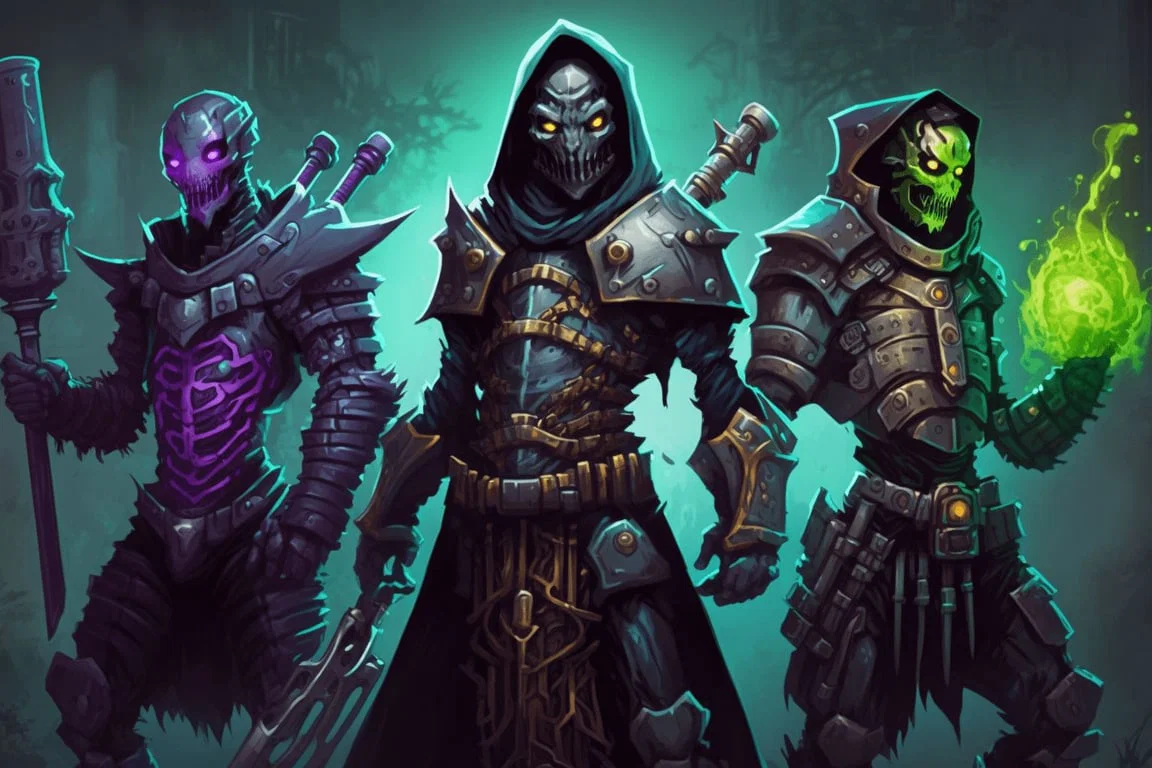
Picture the three figures above as names on a guild bounty board: a skeletal enforcer, a death knight, and a necromancer with a price on his head. In a traditional game, each would be a health bar waiting at a map marker. In an AI-driven hunt, each has a history, a hideout, people who owe them favors, and reasons to run. To see why that difference matters, it helps to look at how bounty hunting usually plays out in games today.
Quick Answer: What Is an AI Bounty Hunter Game?
An AI bounty hunter game is an interactive story where an AI game master generates targets, leads, and consequences in real time, letting you track, question, and capture fugitives through open-ended choices instead of scripted missions. You describe what your hunter does, and the world responds.
Key capabilities:
- Dynamic contracts. You get targets with backstories, aliases, and escape routes you have to uncover.
- Investigation by conversation. You interrogate informants, bribe bartenders, and bluff your way past guards in your own words.
- Persistent reputation. Every capture, betrayal, and broken deal shapes how the world treats you.
- Custom mechanics. You can add credits, heat levels, injuries, or a hunter's guild ranking, whatever makes the hunt feel real to you.
Why Bounty Hunting in Most Games Still Feels Scripted
AI is moving quickly into game development. Interest in smarter characters is a large part of that growth, because players want NPCs who react to them rather than recite lines.
$5.8 billion — Estimated size of the global AI in gaming market in 2026, per Grand View Research
24% — Share of AI gaming revenue held by NPC behavior modeling in 2025, the largest application segment
$22 billion — Potential profit opportunity AI tools could create for video game companies, according to Morgan Stanley Research
Demand from players appears just as strong. Survey findings summarized in a Medium analysis of AI-powered NPCs report that 81% of respondents would be willing to pay more for a game with AI-improved NPCs.
Even so, finding a bounty hunter experience that actually reacts to you is still frustratingly difficult:
- Targets are waypoints, not people. Most bounty loops send you to a marked location to fight whoever spawns there.
- Investigation is cosmetic. Clues are usually pre-placed, and dialogue trees offer three fixed options.
- Talking AI NPCs often can't act. Early AI characters can chat but rarely follow through on what you agree to.
- Choices rarely stick. Letting a target walk or double-crossing a client seldom changes the world in later missions.
The "Assassination Mission" Problem
Space sims and open-world games often treat bounty work as combat with a different label. As one player put it in a
, NPC bounty hunting "doesn't feel much like bounty hunting anyway. Feels more like assassination missions." What gets lost is the actual craft of the job: tracking, leverage, and choosing how to bring someone in.The Talk-Versus-Action Gap
Studios are experimenting with AI-driven characters, but the results are uneven. After testing AI NPC demos at GDC, Aftermath reported that some characters "functioned like glorified wiki entries." In one demo, a security robot agreed to follow the player as a bodyguard "and then it continued to stand in one place, forever." The same piece describes a second uncanny valley: once an NPC can respond to anything you say, you expect it to do anything you say. Building that into a 3D world requires enormous production effort.
A text-driven AI game avoids that gap by design. When the story itself is the action layer, a fixer who agrees to tail your target actually tails your target. That is the opening a dedicated AI game master was built to fill.
Why Roleplay Game Master Works as an AI Bounty Hunter Game
Roleplay Game Master is an immersive roleplay partner built around unlimited memory and consistent characters. It gives you complete creative freedom over the scenario. For bounty hunting, that combination matters more than graphics. A good manhunt depends on the world remembering that you roughed up the dock foreman three sessions ago, and on the foreman holding that grudge when you come back for information.
You don't pick from a menu of missions. You describe the hunter you want to be and the kind of contracts you take, and the game master builds the world around that.
| Traditional Bounty Missions | Roleplay Game Master |
|---|---|
| Fixed target at a map marker | Fugitives with motives, aliases, and escape plans you have to uncover |
| Three-option dialogue trees | Free-form interrogation, bribery, bluffing, and negotiation |
| Choices reset after each mission | Unlimited memory, so reputation, debts, and rivalries persist |
| Locked to one setting and ruleset | Any genre, with mechanics you define (credits, heat, injuries, guild rank) |
| "Dead or alive" usually means dead | Capture, recruit, release, or cut a deal, and live with the consequences |
A Bounty Board Built Around Your Hunter
Start with a one-line pitch or a full character sheet. A disgraced marshal, a cybernetic skip tracer, or a guild-licensed monster hunter will each get contracts that fit their skills, contacts, and reputation. You can ask for a board of three or four open bounties at a time, each with its own payout and risk level.
Informants, Rivals, and Targets Who Stay in Character
The game master is designed to keep each character's personality and agenda intact across a long campaign. A nervous informant stays nervous. A rival hunter keeps trying to poach your contracts. Your quarry reacts to how close you're getting by moving camp, hiring muscle, or sending a message.
Consequences That Carry Across Sessions
Because memory doesn't run out, the world builds a record of your choices. Let a sympathetic fugitive go, and your client may put a bounty on you. Pay off a sheriff once, and he'll expect it again. This long-term cause and effect is what scripted bounty loops struggle to deliver.
Any Setting, Any Rules
You can ask the game master to track whatever makes the hunt feel tense: a credit balance, a "heat" level that rises when you're noticed, ammunition, wounds, or a crew with specialist roles.
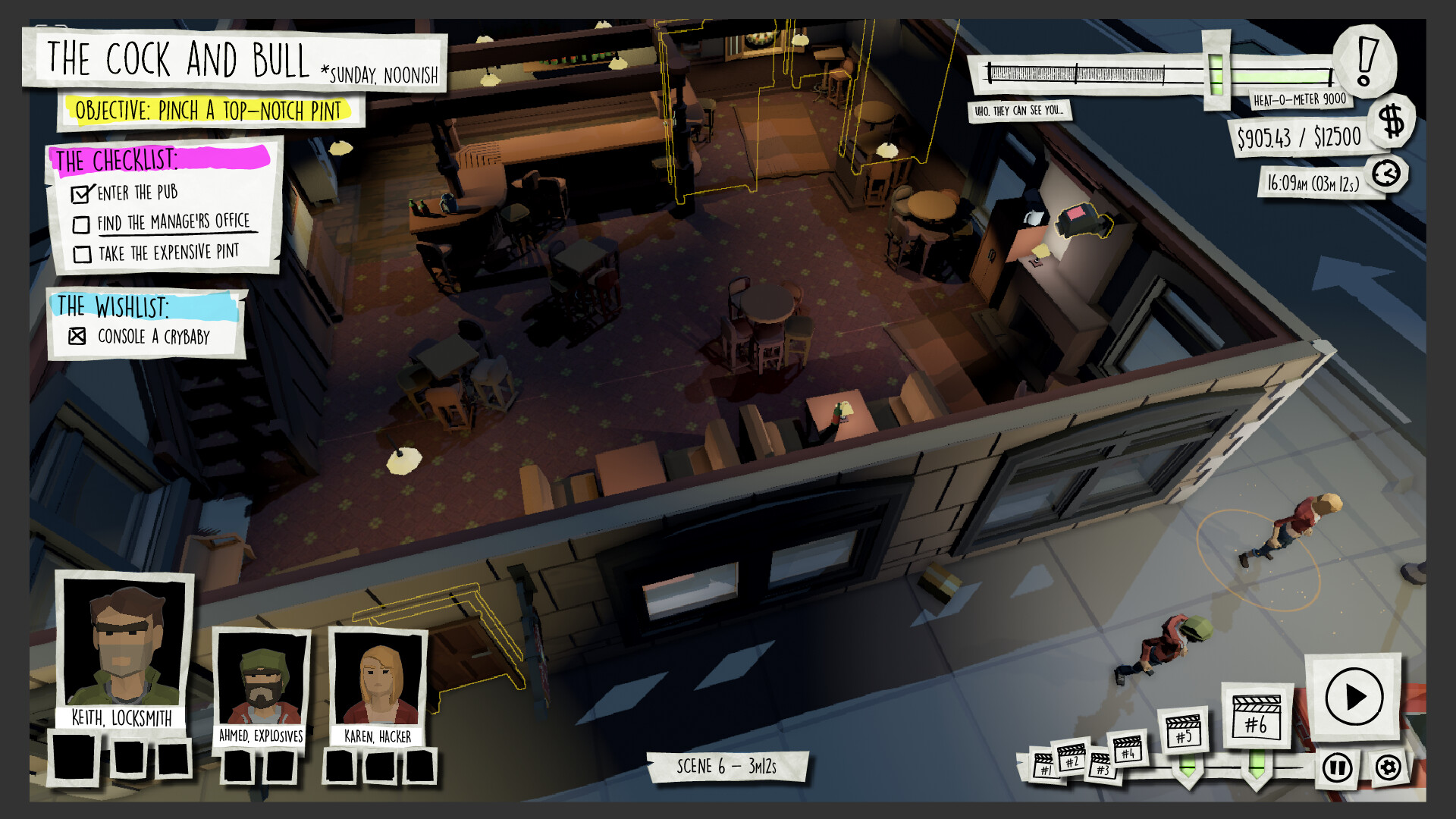
The screen above shows the kind of structure players respond to in stealth and heist games: a clear objective, a checklist, optional side goals, a heat meter, a money target, and a crew with specialties. You can recreate that scaffolding in plain language. The difference is that every checklist item can be solved however you choose, rather than in the few ways a designer anticipated.
Try openers like these:
"Run a space-western bounty campaign. I'm Kade Voss, an ex-navy pilot with a debt to a crime syndicate. Give me three bounties, track my credits and heat, and make the first target someone I might sympathize with."
"Dark fantasy setting. I'm a guild-licensed hunter tracking a necromancer who raises the dead in the marshlands. I want investigation-heavy play, so make me earn every lead."
"Cyberpunk skip-tracer campaign with a heist-style structure: objectives, optional wishlist goals, and a crew with a hacker and a fixer. Keep a running checklist at the end of each scene."
A realistic expectation: this is a narrative, text-driven experience. There is no real-time shooting, and the "bounties" you collect are in-story rewards. If you want twitch combat, a traditional action game is the better fit. If you want the detective-and-negotiator side of bounty hunting, this is where the format is strongest.
Related Agents You'll Also Find Useful
If a bounty campaign appeals to you because of the investigation, these agents extend the same kind of play.
The Asylum You play an investigator sent to a shuttered psychiatric institution, where every ward hides secrets. It's a natural next step if your favorite part of a hunt is following a cold trail.
- Investigator role with a hidden story to uncover
- Atmospheric, exploration-driven pacing
- Choices determine what you discover
The Mansion You wake in a mansion with no memory of how you arrived, and every room hides secrets. It suits players who enjoy the tension of being hunted as much as hunting.
- Survival-mystery premise with escape as the goal
- Room-by-room discovery
- High-stakes atmosphere where mistakes cost you
Game Designer Assistant If playing a bounty hunter story makes you want to build one, this agent is a design partner for brainstorming, systems analysis, documentation, and concept art across genres and platforms.
- Bounty and reputation system design
- Game design documents and mechanic breakdowns
- Concept art for targets, factions, and locations
Your first contract takes about a minute to set up. Start free, with no credit card required.
How to Play an AI Bounty Hunter Game, Step by Step
Step 1: Define Your Hunter Open the agent and describe who you are: background, skills, gear, and what drives you to take contracts. One or two sentences is enough, though more detail gives the world more to react to.
"I'm Mara Quill, a former bounty clerk who went freelance after her guild framed her. Good with forgeries and locks, bad in a straight fight."
Step 2: Set the World and the Rules Pick a genre and tell the game master which mechanics to track. This is where you decide whether the campaign leans toward gritty survival or cinematic adventure.
"Setting: a frontier mining colony on a frozen moon. Track my credits, a heat meter from 0 to 10, and my guild reputation. Injuries should matter."
Step 3: Take a Contract Ask for a bounty board and choose a target. A good contract arrives with a name, a payout, a last-known location, and a hint that the story is more complicated than the poster suggests.
"Show me the bounty board. I'll take the highest-paying contract I can realistically survive."
Step 4: Work the Leads Investigate in your own words. Question witnesses, search rooms, tail suspects, or pay for information. The game master plays every character and remembers what each one told you.
"I buy the bartender a drink and slide a forged guild seal across the counter. I want to know who's been paying for the target's rooms upstairs."
Step 5: Make the Capture, or Make a Deal When you corner your target, choose how it ends: capture, combat, negotiation, or letting them go. Ask for a scene-end summary of your credits, heat, and reputation, and pick up next time exactly where you left off.
"I don't draw. I tell him I know who framed him, and that I can prove it if he comes in quietly."
Results & Use Cases
🤠 Frontier Manhunt Campaign
Scenario: A western fan wants a slow-burn campaign hunting an outlaw gang across territory towns.
Traditional Approach: Open-world westerns offer bounty side activities, but targets rarely carry over between missions, and outcomes don't build into a larger story.
With the AI game master: Each gang member becomes a separate contract. Capturing one alive opens leads on the next, and the gang leader starts hunting you back.
- Interconnected targets that form a campaign arc
- Persistent consequences for mercy or brutality
- A rival posse that remembers your tactics
🌌 Sci-Fi Guild Contract Chain
Scenario: A player wants a space bounty hunter career, starting as a low-ranked guild member and climbing to elite contracts.
Traditional Approach: Space sims frame bounty work mostly as ship combat. Progression is often a stat increase rather than a story.
With the AI game master: Guild rank becomes a tracked mechanic tied to reputation, with each promotion unlocking more dangerous and morally gray contracts.
- A career arc with narrative milestones
- Guild politics, rivals, and informants with long memories
- Credits and heat tracked across dozens of sessions
📱 A Bounty Between Commutes
Scenario: A player with 15-minute windows wants a game they can continue on a phone without losing the thread.
Traditional Approach: Mobile games built for short sessions rarely support deep, persistent investigation stories.
With the AI game master: The campaign runs on iOS and Android with full feature parity and synced history. Speech-to-text lets the player dictate an interrogation on the train.
- Short scenes that end on a clear checkpoint
- Voice input for hands-busy moments
- Seamless handoff between phone and desktop
🎲 Prototyping a Bounty System for a Real Game
Scenario: An indie developer is designing the bounty loop for a stealth game and wants to stress-test reputation and heat mechanics before writing code.
Traditional Approach: Paper prototyping and playtests with friends take weeks to surface edge cases.
With the AI game master: The developer plays the system as a narrative campaign to see where it breaks, then takes the findings to Game Designer Assistant to formalize mechanics and documentation.
- Fast narrative playtesting of mechanics
- Edge cases surfaced by improvised player behavior
- A clean handoff into formal design documents
Frequently Asked Questions
Is the AI bounty hunter game free to play?
Yes. You can start a bounty campaign with the AI roleplay game master on Jenova's free tier, which includes all core features with limited usage. Players who run long campaigns can upgrade to Plus at $20 per month for 30 times the free usage and custom model selection. Higher tiers are available for heavier use. Usage resets monthly on your billing date, with no daily caps.
How is an AI bounty hunter game different from bounty missions in Star Citizen or open-world games?
Bounty missions in most games are built around combat at a set location. An AI bounty hunter game focuses on the full job: investigation, interrogation, negotiation, and choosing how a capture ends. Because an AI game master generates responses in real time and remembers past events, your reputation and decisions carry forward. The tradeoff is that the experience is narrative and text-driven rather than real-time action.
Can I bring targets in alive instead of killing them?
Yes, and it's often the more interesting route. You decide how each hunt ends. You can talk a target into surrendering, trap them, cut a deal, or even let them go if you uncover a reason to. The game master tracks the fallout, whether that's an angry client, a grateful informant, or a fugitive who owes you a favor later in the campaign.
Does the AI bounty hunter game work on mobile?
Yes. The game runs on web, iOS, and Android with full feature parity, and your campaign history syncs across devices. You can start a manhunt on your laptop and continue it on your phone. Built-in speech-to-text means you can speak your hunter's lines instead of typing, which is useful for quick sessions on the go.
Is an "AI bounty hunter game" the same as AI bug bounty programs?
No. Those use the same phrase for very different things. Platforms like huntr run bug bounty challenges for finding vulnerabilities in AI and machine learning systems. Deadline reports that the startup LightBar is recruiting "bounty hunters" to probe AI systems for misuse of film and TV content. An AI bounty hunter game is entertainment: you play a fictional hunter in a story driven by AI.
What other AI mystery games are similar to a bounty hunter campaign?
If you enjoy the investigation side of bounty work, investigator-led stories are the closest match. The Asylum casts you as an investigator uncovering what happened inside a shuttered psychiatric institution, with every ward hiding secrets. Like a good manhunt, it rewards careful questioning, observation, and following leads to their source.
Conclusion: Your Next Contract Is Waiting
Bounty hunting in games has long promised more than it delivered. Players get waypoints instead of manhunts, menus instead of interrogations, and choices that reset as soon as the mission ends. Even studio experiments with AI characters still struggle to make NPCs act on what they say.
An AI bounty hunter game built on narrative closes that gap. Your fugitives think, your informants remember, and your reputation follows you from one contract to the next. Whether you want a frontier outlaw chase, a sci-fi guild career, or a dark fantasy hunt for a necromancer, you set the stakes and the world responds.
Try Roleplay Game Master now and take your first contract. Explore more at Jenova.
For Developers: Roleplay Game Master is available programmatically through the Jenova API. You can integrate persistent, character-consistent interactive storytelling into your game or app with a single API call. Full documentation →