AI Board Game Creator: Design Mechanics, Components & Rulebooks
2026-10-06
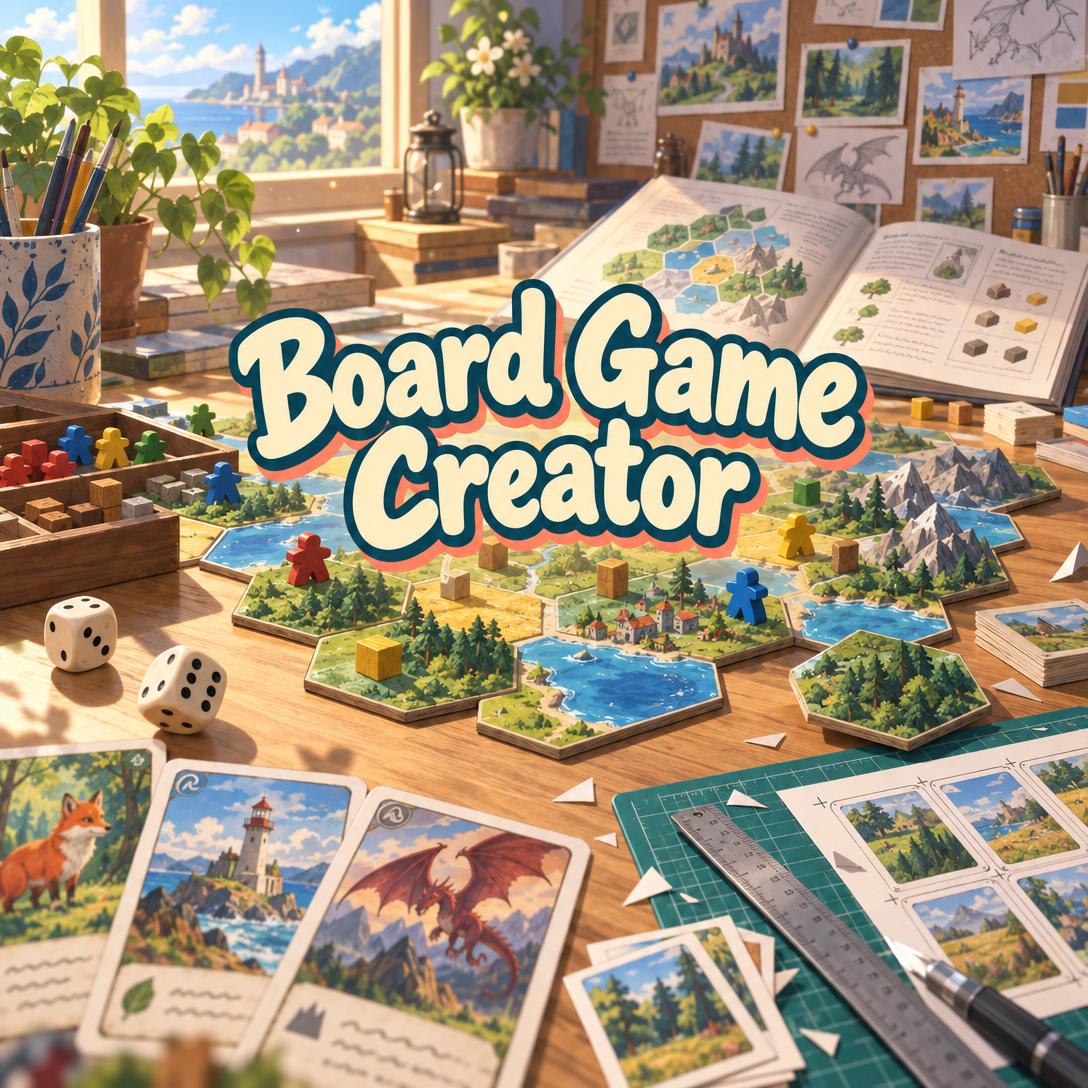
Board Game Creator helps you turn a game idea into a playable prototype. It acts as your game designer, component architect, visual director, and rulebook author in one conversation. Most aspiring designers stall between a promising concept and a table-ready game. This AI board game creator covers that gap, from the first "what should players feel?" question to cut-ready cards and a finished rulebook.
- ✅ Experience-first design: You start from the feeling you want at the table, then pick the mechanics that create it.
- ✅ Full-stack pipeline: It handles mechanics, economy, component specs, iconography, art direction, and individual component art.
- ✅ Visual consistency: Templates and reference assets keep card #40 looking like card #1.
- ✅ Production deliverables: It produces rulebooks, player aids, print-and-play packages, sell sheets, and pitch decks.
Tabletop gaming keeps growing, and more people are trying to design their own games. Getting from idea to prototype is still slow, expensive, and full of hidden pitfalls. To see why a dedicated AI design studio matters, start with the real obstacles designers face today.
Quick Answer: What Is Board Game Creator?
Board Game Creator is an AI board game design studio that takes your idea from core mechanic to playable prototype. It builds rules, component specs, consistent card and board art, and a print-ready rulebook in one continuous conversation. It supports any scope, from an 18-card micro game to a multi-hour strategy epic with expansions.
Key capabilities:
- Mechanic and economy design with honest trade-off analysis (downtime, kingmaking, runaway leaders)
- Component architecture with an "elegance check" to merge or cut unnecessary pieces
- Consistent component art built from locked templates, reference assets, and colorblind-safe iconography
- Rulebooks, player aids, print-and-play files, sell sheets, pitch decks, and crowdfunding copy
The Creative Challenges of Designing a Board Game
The audience for new tabletop games has never been larger. Analysts expect strong global growth, and U.S. retail data shows games outpacing other toy categories:
$16.32B → $32.79B: Projected global board games market growth from 2025 to 2031 at a 12.33% CAGR
$4.9 billion: Games and Puzzles became the #1 U.S. toy category in 2025, up 39% from the prior year
$1.7B → $3.8B: India's board game market in 2024, projected for 2033 (IMARC, via LinkedIn)
Crowdfunding demand is still strong too. One creator on r/kickstarter noted that
.But turning an idea into something publishers or backers will take seriously is hard:
- Art is the biggest early cost. Illustration alone can run from $2,000 to $10,000+. Many designers need visuals before they know whether the game even works.
- Budgets add up quickly. A typical crowdfunding campaign budget falls between $10,000 and $50,000. Kickstarter takes 5% and payment processors take another 3–5%.
- Manufacturing constraints arrive late. Most factories set minimum order quantities between 1,000 and 2,000 copies. A bloated component list directly raises unit cost.
- Regulation is changing. At GAMA Expo 2025, publishers discussed how EU sustainability rules such as the Ecodesign for Sustainable Products Regulation are pushing the industry toward recyclable components and less plastic.
The common thread is that design decisions made early, such as component count, card sizes, and how much art each piece needs, decide what the game costs later. Industry guidance stresses that strong development starts with repeatable play and a structured prototyping process.
That structured, play-first process is exactly the gap a dedicated AI design studio was built to close.
How the AI Board Game Design Process Works
The studio follows the same workstreams a professional design team would. You can move between phases freely, and it flags hard dependencies along the way. For example, it builds card templates before it generates any final cards.
Step 1: Define the Player Experience
Before discussing mechanics, the studio asks what the game should feel like. That means the core emotion, the central fantasy, the player count, the play time, and how long the teach should take. A 5-minute teach points toward a party game. A 30-minute teach signals an enthusiast-weight design.
"I want a 45-minute co-op game for 2–4 players where lighthouse keepers race against a storm. It should feel tense, like we're always one bad turn from losing a ship."
Step 2: Lock the Core Loop and Mechanics
Next, it designs what players actually do on most turns, which decisions are hard, and why. Recommendations come with trade-offs. For instance, worker placement creates painful choices but adds downtime at 5+ players, so simultaneous selection or action drafting may scale better. It also maps your economy: where resources enter, where they leave, and whether they can convert.
"Compare dice drafting and card-based action selection for this game. Which gives more tension with less frustration from bad luck?"
Step 3: Build the Component Inventory
Once the rules are locked, Board Game Creator's workflow defines every component. That includes board layout, card types and sizes (mini 41×63, standard 56×87, tarot 70×120mm), tiles, tokens, and player boards. An elegance check then looks for pieces that can merge or disappear, such as score tracks on the board or cards that double as resources. Every cut matters when the box alone is typically at least 10% of total production cost.
If your design is turning into a standalone collectible card game, Trading Card Game Creator specializes in TCG mechanics, lore, and set balance.
Step 4: Establish the Visual System, Then Generate Components
The studio sets an art direction, such as Classic Euro, Epic Fantasy, Whimsical/Family, or a custom style. It then creates an Art Style Exemplar, component templates, and a completed reference asset for each component type. Iconography uses shape plus color, never color alone, so it stays colorblind-safe.
Each card, tile, or board is then generated individually against those references. Every image passes a quality check for text accuracy, layout consistency, and style match. You can switch image generation models with the "App" button beneath the chat input.
"Create the card template for our Keeper cards: name at top, portrait art window, ability text box, and a lamp-oil cost icon in the corner."
Step 5: Produce the Rulebook and Deliverables
Finally, it writes a structured rulebook covering components, setup, turn walkthrough, actions, component anatomy, iconography glossary, scoring, end game, variants, and a quick reference. It can also produce a one-page player aid and a print-and-play package with cut guides. Files can be exported as PDF, DOCX, CSV/XLSX component registries, or PPTX pitch decks.
You can start a design on Jenova's free plan and see how far one session takes your concept.
Creative Showcase: What You Can Build
🎲 From Theme to Playable Core Loop
Scenario: A first-time designer has a theme (rival botanists cataloguing a newly discovered island) but no mechanics.
Traditional Approach: Months of reading design forums, reverse-engineering favorite games, and paper prototyping by trial and error.
With Board Game Creator: In one session, it proposes card drafting plus tableau building. It explains why that pairing creates "I need that specimen" tension, and it flags the hate-drafting problem early.
- Theme and mechanics stay aligned: cataloguing feels like collecting, not accounting
- Common pitfalls (runaway engines, analysis paralysis) are flagged before playtesting
- The session arc is mapped across opening, midgame, and endgame
🃏 A Consistent Print-and-Play Prototype
Scenario: A designer needs 60 illustrated cards and a modular hex board for a convention playtest next month.
Traditional Approach: Commissioning art that can cost $2,000–$10,000+, or using mismatched placeholder clip art that hides how the game will actually feel.
With Board Game Creator: Templates and reference assets are locked first. Then each card is generated individually so the art style, icon placement, and text zones stay consistent across the set.
- Print-and-play sheets come with cut guides and simplified rules
- Every component is checked against the reference before it's presented
- Revisions replace the old version instead of piling up drafts
If you want deeper exploration of world, creature, or box-cover concepts before locking the art style, Concept Art Creator focuses on intentional character and environment design.
📱 Fixing a Broken Playtest on the Go
Scenario: Right after a playtest, a designer dictates notes on their phone during the commute home. The player in the lead won by turn six every time.
Traditional Approach: Scribbled notes, a week of second-guessing, and another expensive reprint.
With Board Game Creator: Using speech-to-text on iOS or Android, the designer describes the problem. The studio diagnoses a snowballing resource engine and proposes fixes such as diminishing returns, a maintenance cost, or a catch-up mechanic.
- Full feature parity on mobile, with projects synced across devices
- Structured playtesting questions to confirm the fix next session
- Persistent memory keeps rules, components, and decisions in context
💼 Publisher Pitch and Crowdfunding Materials
Scenario: A designer with a tested prototype wants to pitch publishers and gauge Kickstarter interest.
Traditional Approach: Building sell sheets and pitch decks from scratch, often without knowing what publishers expect.
With Board Game Creator: It produces a one-page sell sheet (hook, audience, component list, key art) and a pitch deck with comparable titles and positioning, plus crowdfunding page copy and stretch-goal ideas.
- Stretch goals are designed so they don't break the base game's balance
- Expansions are planned for backward compatibility
- Pitch materials draw directly from your locked rules and components
FAQ
Is Board Game Creator free to use?
Yes. Board Game Creator is available on Jenova's Free plan with all core features and limited usage. Heavier projects, such as large card sets with many generated components, benefit from paid tiers. Plus ($20/month) offers 30× the usage plus custom model selection and no watermarks. Premium, Pro, and higher tiers scale further. Usage resets monthly with no daily caps.
Can an AI balance a board game?
An AI can analyze balance in a structured way. It can map action efficiency, resource flow, scoring path viability, and how play changes across player counts, and it can flag dominant strategies, kingmaking, and runaway leaders. It cannot replace real playtesting, however. Publishing guides stress validating your game with real players before investing in art or production. The studio supports this with specific test scenarios and playtester questions.
Can I make a print-and-play board game prototype with AI?
Yes. Once your rules and component schemas are locked, the studio generates individual components and assembles a print-and-play package with card sheets, cut guides, board tiles, token sheets, and simplified rules. Home printing lets you iterate cheaply before ordering print-on-demand copies, which can cost around $25.99 for a single copy through services like The Game Crafter.
Can it help me launch my board game on Kickstarter?
It can prepare the creative materials, including sell sheets, pitch decks, campaign page copy, and stretch-goal design. For the financial side, such as funding goals and fees (Kickstarter charges 5%, and payment processors take another 3–5%), pair it with Business Plan Writer to pressure-test costs, margins, and contingency budgets.
Does the AI board game designer work on mobile?
Yes. Jenova offers full feature parity across web, iOS, and Android, and all settings and projects sync across devices. You can dictate design ideas with built-in speech-to-text, review generated cards on your phone, and continue on desktop later. Persistent memory means your rules, components, and decisions stay intact between sessions.
Can I adapt an existing IP or franchise into a board game?
Yes. The studio maps IP elements to board game structures. Factions become asymmetric player powers, locations become board zones, and story arcs become campaign scenarios. It still runs a full design and visual process rather than simply reskinning an existing game. If you plan to publish commercially, secure the appropriate license from the rights holder first.
Conclusion: From Idea to Playable Prototype
Designing a board game used to mean months of trial and error, art budgets you couldn't justify, and finding manufacturing constraints only after the design was set. An AI board game creator changes that order. You start from the experience you want players to have, build mechanics and components that serve it, and arrive at a consistent, playable prototype ready for real playtests.
Whether you're making a 15-minute filler or a heavyweight strategy game with expansions, you get a design partner that explains the why behind every decision and keeps your whole project consistent from the first card to the rulebook.
Try Board Game Creator now. Explore more at Jenova.
For Developers: Board Game Creator is available programmatically via the Jenova API. You can integrate end-to-end tabletop game design and component generation into your application with a single API call. Full documentation →