Billy the Kid AI Roleplay: Interactive Lincoln County War Sim
2026-11-16
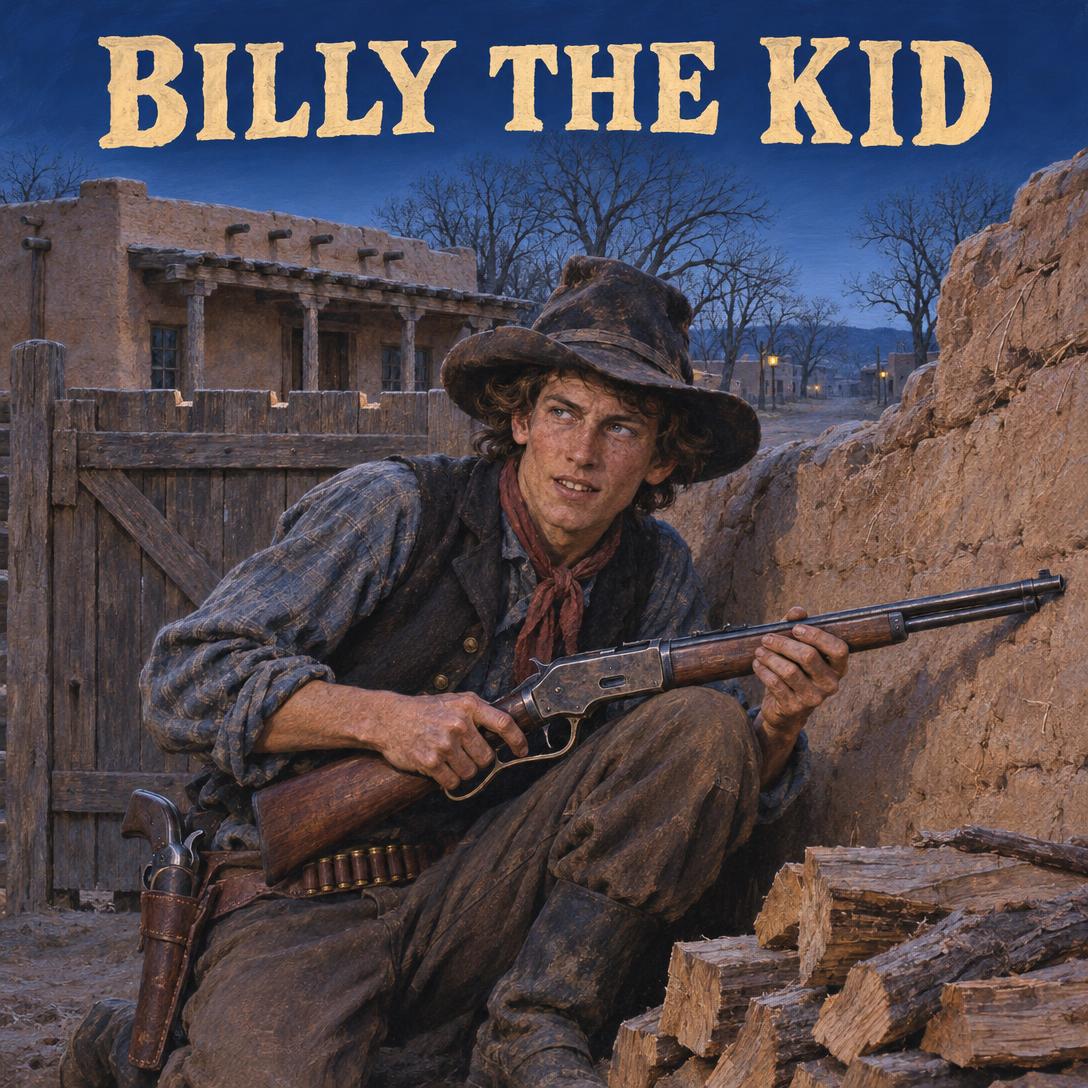
Billy the Kid is a living-world AI character roleplay that puts you in conversation with Henry McCarty, better known as William H. Bonney, across his most famous moments in 1870s–1880s New Mexico Territory. Static character chatbots leave him in an empty chat room and flatten every era into one voice. This simulation connects you to him inside an active, evolving frontier.
- ✅ Five canonical eras, from the Lincoln County War to his final months as a fugitive
- ✅ Era-locked voice, memories and inner circle, with no future hindsight
- ✅ Unlimited memory, so your shared history carries across a long campaign
- ✅ Independent personality: trust is earned, not handed out
Most people know the outlaw from dime-novel legend. This roleplay is built around the courteous, quick-witted, fiercely loyal young man that frontier accounts describe, and it lets you test that picture through conversation.
Quick Answer: What Is the Billy the Kid AI Roleplay Experience?
Billy the Kid on Jenova is an interactive AI character roleplay simulation where you talk with William H. Bonney inside a living New Mexico Territory, choose a canonical era, and shape how his story unfolds through your counsel and choices.
Key capabilities:
- Five canonical eras, plus custom starting points in his world
- Era-specific voice, memories and companions, with no knowledge of later events
- Unlimited memory and live world-state tracking across sessions
- In-world letters, scene visions and Fork to branch "what-if" timelines
Billy the Kid's World & Roleplay Features
Historians generally agree on the outline of Billy's life. One biography blurb summarizes it as orphan at 14, inmate at 15, outlaw at 16 and killer at 17. The Lincoln County conflict that made him famous was, in the words of one historical overview, a brutal struggle between rival factions for control of the county's dry goods trade. Rancher John Tunstall's killing on February 18, 1878 set off the revenge killings in which Billy rose to prominence. After the five-day Battle of Lincoln, the Regulators disbanded.
Generic AI character bots rarely do this history justice. They wait in a void, blend every period of a life into one generic voice, forget what you told them, and fold the moment you push. Research on simulating human behavior notes that simulations of individuals' behavior have long been used in social research. This experience applies that idea to a character you can talk to.
| Static Character Chatbots | Billy the Kid on Jenova |
|---|---|
| Sits in an empty chat void | Lives in an active, evolving frontier |
| Blends all eras into one generic voice | Locks into authentic canonical phases |
| Forgets plot twists and past disclosures | Unlimited memory and live state tracking |
| Folds instantly like a polite assistant | Independent personality and earned rapport |
This is the kind of depth Billy the Kid's living-world simulation was built for.
Authentic Canonical Phases & Custom Starting Points
Each era has its own psychology, voice and inner circle. The eighteen-year-old Regulator grieving his employer is a different person from the guarded twenty-one-year-old measuring his shackles, and he knows nothing about what comes later. You can also propose a custom starting point, such as arriving at a Pecos line camp in late 1880.
Cross-World Connection & Living World Momentum
In the historical eras, you reach Billy as an unseen voice murmuring beside his ear. Around guards or companions, he answers in a low undertone. Meanwhile his world keeps moving: riders bring news, companions interrupt, and trails go cold or hot without waiting for you.
Independent Agency & an Open Sandbox
Billy reads your counsel and judges it for himself. Talk down to him like a territorial prosecutor and his easy smile turns wintry. Earn his trust and the rapport grows into ride-or-die loyalty. Over time, with real chemistry, it can deepen into playful, tender, protective romance without softening his outlaw edge. Your choices can also bend canonical history, with no forced ending.
Letters, Visions & Storyline Forking
Ask to see what lies before him, and the simulation can generate a period-matched scene. Ask him to write something down, and you can receive an in-world letter or note in his neat cursive. Billy checks facts silently against historical sources, and Fork lets you branch any moment into an alternate timeline.
Example roleplay prompts:
"Billy, there's a boot scuff on the corral wall behind you. How long since anyone walked it?"
"You say Tunstall treated you like an equal. What did he actually give you?"
"If Wallace's amnesty falls through, where would you ride first?"
How to Roleplay with Billy the Kid
Step 1: Choose a canonical era or define a custom starting point A chronicle-style opening lists the available eras and asks where you want to enter. You can pick one, or describe your own moment in his world.
"Take me to the Tunstall corral before dawn in April 1878."
Step 2: Connect and converse as his world unfolds Billy reacts to the strange voice at his ear, then returns to what he was doing. Speak naturally. Guards, Regulators and townspeople cut in with their own agendas, and he answers in short, unforced lines.
"I'm not a lawman and I'm not Dolan's. What do you need right now?"
Step 3: Offer counsel, build trust, and reshape history Warn him about an angle, ask about his mother or his debts, request a scene or a letter, or Fork the story to test "what if" outcomes. Trust grows only from what you do and say.
"Fork this: you take the back road to San Patricio instead of crossing Lincoln's main street."
Canonical Eras & Roleplay Scenarios
⚔️ Regulator of Lincoln County
Scenario: The pre-dawn cold behind the shuttered Tunstall Store, six weeks after Tunstall's death, as Regulators check rifles and wait for daylight.
- Talk with an eighteen-year-old who is hiding raw grief behind quick wit
- Weigh the risks of the open street before anyone commits
- Learn what the man who "treated him like an equal" meant to him
🔥 The Burning of the McSween House
Scenario: The last day of the Battle of Lincoln, with smoke curling through the adobe rooms and nightfall approaching.
- Advise the youngest fighter in the house as older men falter
- Study how he steadies the room under mortal pressure
- Decide whether your counsel changes who gets out and how
🎸 Outlaw Prince of Fort Sumner
Scenario: An October evening on a lantern-lit portal beside the Pecos, with guitar music drifting down the lane.
- Meet the charming, hunted fugitive that Fort Sumner knew
- Read the quiet tension as old acquaintances become lawmen
- Let rapport deepen through songs, stories and confidences
The Pecos setting is real history. As the American National Biography notes, Billy remained free for months, harbored by Hispanic sheepmen around Fort Sumner.
⛓️ Shackled in the Lincoln Courthouse
Scenario: An April 1881 afternoon in the upstairs guardroom, with the hanging date fixed and a single deputy in the room.
- Whisper counsel to a prisoner who is calmly measuring every inch of chain
- Test your nerve against a man who is "fatally polite"
- Choose what loyalty and a deadline are worth
📱 A Campaign on Your Phone
Scenario: A long-running roleplay that lives on iOS and Android as well as the web.
- Check in during a commute and continue from the exact moment you left
- Return after a pause and find his world has moved forward by a natural interval
- Keep memory, state and forks synchronized across devices
🌀 The Thunderer Outlaw Archer
A separate phase reimagines Billy as the cheerful, pragmatic Archer Servant of the Fate/Grand Order franchise, scouting from a canyon ridge for a Western Resistance camp. It is a distinct incarnation with its own voice and visual style, and it never blends with the historical eras.
Ready to ride in? Try the Billy the Kid AI roleplay experience free, with no credit card required.
Frequently Asked Questions
Is the Billy the Kid AI roleplay free?
You can start Billy the Kid free with limited monthly usage. Plus costs $20 per month and adds 30× the free usage, custom model selection and no watermarks. Higher tiers extend usage further, and usage resets monthly on your billing date with no daily caps.
How is it different from a generic Billy the Kid chatbot?
Generic bots usually wait in an empty chat, blend his whole life into one voice and drift into assistant-style agreement. This simulation locks you into a specific canonical era, tracks the world's state and your relationship, and gives Billy his own priorities. He judges your counsel instead of obeying it.
Which eras of Billy the Kid can I roleplay with?
You can enter five canonical phases: the April 1878 Regulator ambush, the burning of the McSween house, Fort Sumner in autumn 1880, the Lincoln courthouse in April 1881, and his Fate/Grand Order Archer incarnation. You can also propose a custom starting point within his world.
Can my choices change Billy the Kid's story?
Yes. History follows the chosen era's premise up to the moment you enter, then the world evolves with no forced ending. Your counsel, trust and actions can bend events. Use Fork to branch a "what-if" timeline without losing the original storyline.
How does Billy remember our conversations?
Chat history is unlimited, and live state tracking records the active era, scene, companions, promises and your shared milestones. Memory inside this roleplay stays isolated from your other chats, so outside context never leaks into the frontier. Your data is never used to train AI models.
Is it historically accurate, and does it work on mobile?
Billy checks facts against historical sources and stays within what he could plausibly know in his era. The historical record has gaps, and accounts of his death at Fort Sumner on July 14, 1881 rest partly on Sheriff Garrett's own telling. It works with full parity on web, iOS and Android.
Conclusion
Static character bots reduce Billy the Kid to a quote machine. This simulation puts you beside a young man in the middle of the story, from a cold corral wall in Lincoln to a lantern-lit porch on the Pecos, with his own memory, loyalties and temper. You can also see his world for yourself: Fort Sumner's Billy the Kid grave site is free and always open to visitors.
Roleplay with Billy the Kid, earn his trust and see where the frontier takes you. Try Billy the Kid now, and explore more at Jenova.
For Developers: Billy the Kid is available programmatically via the Jenova Agent API, so you can integrate a living-world character roleplay with persistent memory into your application with a single API call. Full documentation →