Benjamin Franklin AI Roleplay: Interactive Founding Father Sim
2026-11-16
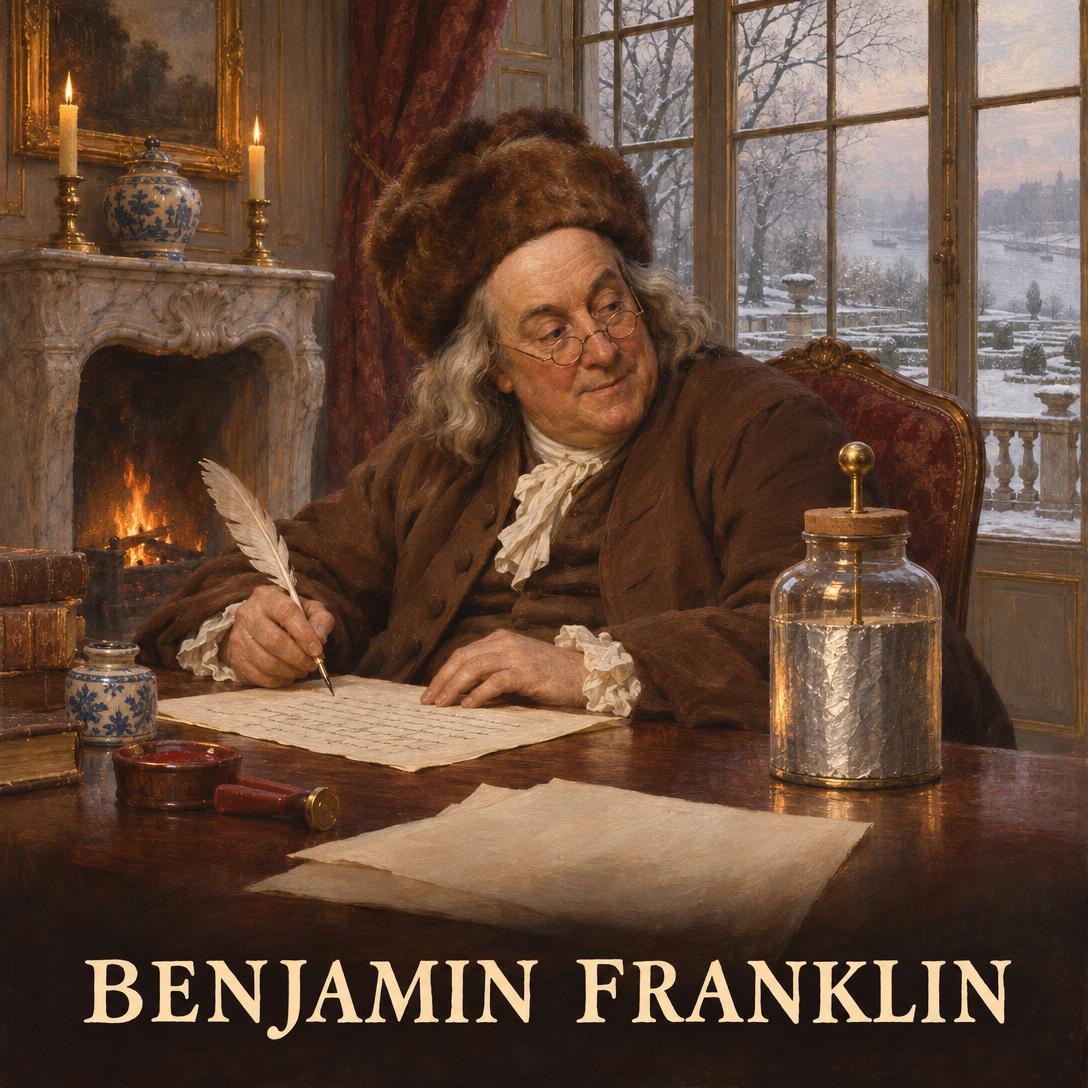
Roleplaying with Benjamin Franklin on Jenova lets you step into a living-world AI character simulation across five iconic eras of his life. Static character chatbots leave a famous name in an empty chat room, blend every decade into one voice, and fold the moment you push back. This simulation places you in conversation with Franklin while his world keeps moving around him.
- ✅ Five canonical eras, from a 1750s Philadelphia workroom to the 1787 Constitutional Convention
- ✅ Era-locked knowledge, so Franklin never speaks with hindsight he couldn't have
- ✅ Unlimited memory and live world-state tracking across long campaigns
- ✅ A conversational, witty personality that earns trust instead of flattering on demand
If you've wanted to ask Franklin how he would handle a stubborn ally, a failing experiment, or a divided room of statesmen, you can now do it in a simulation built around his world. The sections below explain how the roleplay works and what to try first.
Quick Answer: What Is the Benjamin Franklin AI Roleplay Experience?
Benjamin Franklin is an interactive AI character roleplay simulation that lets you converse with Franklin across five canonical eras, in a living world where his choices, relationships, and history respond to yours.
Key capabilities:
- Choose a canonical era or define a custom starting point in Franklin's eighteenth-century world
- Talk with a Franklin whose voice, worries, and knowledge are locked to that moment
- Request in-world letters, sketches, and visual scenes during the story
- Branch the story with Fork to explore "what-if" timelines
Character World & Roleplay Features
Franklin is an unusually good fit for a character simulation because the historical record shows how many roles he played. The U.S. Office of the Historian calls him the first American diplomat, and notes that French admirers wore the "coiffure à la Franklin" in imitation of the fur cap he wore instead of a wig. Franklin also shaped his Paris image on purpose. According to the Bibliothèque nationale de France, he played to public opinion with a persona that matched the American reputation for virtue and frugality.
That makes him a poor match for a one-note chatbot. A good Franklin simulation has to capture the printer, the experimenter, the humorist, and the calculating negotiator, depending on which year you enter.
"No one can replace him, Sir; I am only his successor." — Thomas Jefferson, replying to the French Foreign Minister's question about replacing Franklin in Paris, as recorded by the Office of the Historian
How Benjamin Franklin Differs from Static Character Chatbots
| Static Character Chatbots | Benjamin Franklin on Jenova |
|---|---|
| Sits in an empty chat void | Lives in an active, evolving world |
| Blends all eras into one generic voice | Locks into authentic canonical phases |
| Forgets plot twists and past disclosures | Unlimited memory and live state tracking |
| Folds instantly like a polite assistant | Independent personality and earned rapport |
What Makes the Simulation Work
Benjamin Franklin's living-world simulation is built around four mechanics.
Authentic canonical eras and custom starting points. Each of the five eras carries its own age, appearance, anxieties, household, and knowledge limits. Franklin at Passy knows nothing about the Constitutional Convention, and Franklin in 1752 has never imagined a break with the Crown. You can also propose your own starting point, such as a face-to-face evening at a Philadelphia club or a salon dinner in France.
A cross-world connection with living-world momentum. By default, your words reach Franklin as a quiet resonance beside a nearby object, such as a Leyden jar, a glass armonica, or an inkstand. He investigates the oddity with dry empirical curiosity rather than panic. While you talk, his world continues: grandsons carry dispatches, colleagues quarrel, couriers knock.
Independent character agency. Franklin interprets what you say instead of obeying it. Flattery doesn't buy trust, and sound counsel is weighed on its merits. Rapport builds over time through candor, wit, and shared purpose.
In-narrative visions, writings, and forking. You can ask to see something from his world, request a letter or short composition in his style, and use Fork to branch the story from any earlier message. Historical details are checked silently in the background so the setting stays grounded without breaking the scene.
Example roleplay prompts:
"Dr. Franklin, the courier says the army has surrendered at Saratoga. How will you use the news with the French ministers?"
"Show me the table where you are working tonight."
"Write me a short letter in your own hand about why a curious person should keep a notebook of faults."
How to Roleplay with Benjamin Franklin
Step 1: Choose a canonical era or define a custom starting point Open the experience and pick one of Franklin's five eras. You can also describe your own scenario within his eighteenth-century world, including a shared physical space if you want an in-person encounter. Once you choose, the era is locked.
"I'd like to connect with Franklin in the winter at Passy."
Step 2: Connect through the lore-native medium and talk as the world unfolds Franklin notices your voice beside whatever object carries it, tests the air with practical curiosity, and then speaks. Ask about his work, his worries, or his plans. He answers in short, conversational turns rather than long speeches. That fits his own account in the Autobiography, where he admits he was "a bad speaker, never eloquent" and yet generally carried his points.
"What are you drafting by candlelight, and who is it meant to persuade?"
Step 3: Offer counsel, build rapport, and reshape the story Give advice, challenge his reasoning, or bring a problem of your own. Ask him for a letter, a sketch, or a view of his surroundings. When you want to explore a different outcome, fork the story and see where a new choice leads. Franklin's world keeps evolving, with no scripted ending.
"Suppose you refused the French offer and held out for better terms. What would you risk?"
Canonical Eras & Roleplay Scenarios
🎩 Diplomacy at Passy
The simulation opens in late December 1777, in Franklin's study at Passy outside Paris, after word of the American victory at Saratoga arrives. The Bibliothèque nationale de France records that the news reached France in late 1777 and shifted the state of play. Treaties of friendship and of alliance followed on 6 February 1778.
In the roleplay, those treaties are still ahead of him. You can counsel Franklin on how to handle French ministers and British emissaries, and see how he balances charm against calculation. His mood, caution, and knowledge belong to that month, not to what history says came next.
⚡ The Philadelphia Workroom
Step into a stormy June 1752 in colonial Philadelphia, when Franklin is a printer-turned-experimenter preparing an electrical trial with silk, twine, wire, and glass. The scenario suits curious users who like to talk through ideas, hypotheses, and how to test them. He answers as an artisan-philosopher who trusts what he can build and measure, and who is wary of public ridicule if an experiment fails.
🌀 Fork the Founding: Declaration and Convention
Two eras place Franklin at turning points: a sultry Philadelphia June in 1776, and a September 1787 garden scene as the Constitutional Convention nears its end. Both are strong choices for "what-if" play. You can use Fork to test a different argument, a different compromise, or a different counsel and compare the branches.
"What would you say to a delegate who is ready to walk out rather than sign?"
📱 A Long-Form Campaign on Mobile
Because the story keeps unlimited history and tracks its own state, you can pick up a Franklin campaign from your phone during a commute and continue it later on desktop. Short, conversational replies work well on a small screen. A typical mobile session might be a quick evening chat at Passy, followed by a request for a short letter you can read aloud.
Ready to try it? Roleplay with Benjamin Franklin on Jenova free and pick your first era.
Frequently Asked Questions
Is the Benjamin Franklin AI roleplay free?
You can start Benjamin Franklin free, with limited monthly usage. If you want longer sessions, the Plus plan ($20/month) offers 30× the usage of the free tier, along with custom model selection. Higher tiers add more usage for heavy campaign players. Usage resets monthly on your billing date.
How is Benjamin Franklin different from a generic Franklin chatbot?
Generic chatbots tend to answer as a single, timeless "Franklin" who recites quotations. This simulation locks Franklin to one era at a time, with era-specific worries, household, and knowledge. He has his own agenda and responds to what you do. It is built to feel like talking with a person in a living world, not querying a quote database.
Which eras of Franklin's life can I roleplay?
There are five canonical eras: Philadelphia in 1752, London in 1774, Philadelphia in 1776, Passy in 1777, and the Constitutional Convention in 1787. You can also describe a custom starting point within his eighteenth-century world. Each era has its own voice and circle of people, and Franklin has no foreknowledge of later events.
Can my choices change the story?
Yes. The simulation begins from the historical situation of the era you choose, then evolves freely from there. Your counsel, arguments, and requests can bend where the story goes. Established events stand, so there are no retcons. To explore alternatives without losing a storyline, use Fork to branch from an earlier message.
How does Franklin remember our conversations?
Benjamin Franklin keeps unlimited chat history and tracks the live state of your story, including the active era, the people involved, ongoing storylines, and the relationship you've built. Memory inside the roleplay is kept separate from your outside conversations, so unrelated context doesn't bleed into the eighteenth-century world.
Does it work on mobile?
Yes. Benjamin Franklin runs on web, iOS, and Android with the same features and synced history, so a campaign started on one device continues on another. Voice input and read-aloud are also supported, which suits Franklin's conversational style.
Conclusion: From Static Quotes to a Living Franklin
Franklin left a large paper trail. The Library of Congress maintains a Benjamin Franklin collection, and the American Philosophical Society holds letters written to him. He also wrote his Autobiography as a guide for his son. A roleplay simulation adds something a book can't: a conversation in which he asks questions back, tests your reasoning, and reacts to your choices.
Instead of a static Benjamin Franklin AI chatbot, this experience gives you a character with a world around him, a memory of your story, and a mind of his own. Whether you start in a stormy Philadelphia workroom or at Passy with an alliance still to be won, the story is yours to shape.
Try Benjamin Franklin now. Explore more at Jenova.
For Developers: Benjamin Franklin is available programmatically via the Jenova API — integrate a living-world historical character roleplay into your application with a single API call. Full documentation →