AI Bedtime Story Generator: Personalized Nighttime Stories for Kids (May 2026)
2026-05-03
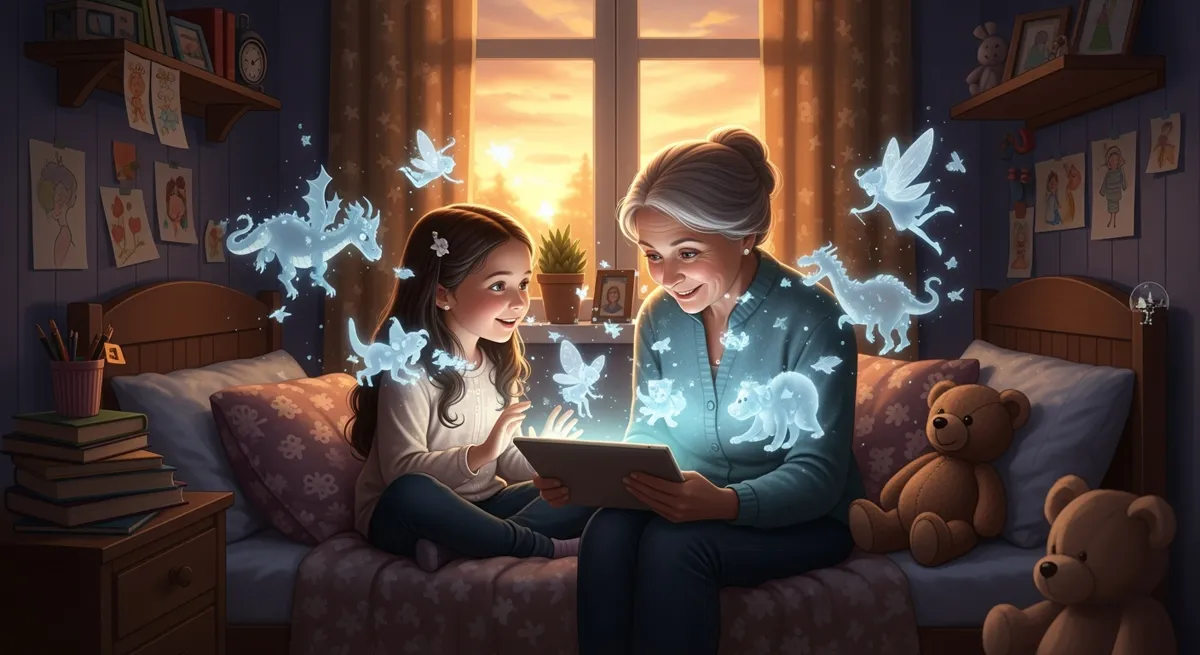
Bedtime stories aren't just a routine — they're among the most developmentally powerful experiences in a child's life. Research from the British Psychological Society confirms that shared bedtime reading strengthens emotional bonds, soothes anxious children, lengthens attention spans, and builds the cognitive architecture for literacy. A 2026 study published in PLOS ONE found that a daily reading ritual improves both empathy and creativity in children — benefits that compound over months and years.
But here's the problem most parents know too well: you've read Goodnight Moon 347 times. Your child wants a story about their stuffed elephant going to space with their best friend, not a generic protagonist in a generic adventure. And at 8:30 PM, after a full day of work and parenting, you don't have the creative energy to improvise a structurally satisfying narrative with a satisfying ending.
That's exactly where an AI bedtime story generator fits — not as a replacement for the parent-child ritual, but as the engine that powers it. The Creative Fiction Writer on Jenova was built to generate the kind of personalized, emotionally resonant stories that children actually remember: narratives where they're the protagonist, where their fears are gently addressed, where their interests drive the adventure, and where the story ends with exactly the kind of calm resolution that helps a child drift off to sleep.
Whether you need a five-minute story about a brave little fox or a serialized weekly adventure starring your child and their dog, this guide breaks down what AI bedtime story generators can do in May 2026 — and why most of them produce something closer to a ChatGPT paragraph than a story worth telling.
Quick Answer: What Is an AI Bedtime Story Generator?
An AI bedtime story generator is a tool that creates original, personalized children's stories — tailored to a child's name, age, interests, and emotional needs — using conversational prompts to produce calming, age-appropriate narratives designed for the bedtime routine.
- 🌙 Deeply personalized stories — your child as the protagonist, their world as the setting, their challenges gently woven into the narrative with the Creative Fiction Writer
- 🧸 Age-appropriate voice and pacing — vocabulary, sentence length, and emotional complexity calibrated to your child's developmental stage
- 🧠 Persistent memory — the AI remembers your child's name, favorite characters, recurring story elements, and emotional themes across sessions
- 🔄 Conversational creation — adjust tone, length, and themes in real time as you discover what your child responds to
The Problem: Why Most Bedtime Story Generators Fail Parents and Children
The market for AI-generated children's stories is exploding. According to Dataintelo's 2026 market report, the global AI-Generated Interactive Storybook market was valued at $3.2 billion in 2025** and is projected to reach **$18.7 billion by 2034, growing at a CAGR of 21.8%. Personalized storybooks dominate — holding 38.4% of total market revenue — because parents overwhelmingly want stories that speak directly to their child, not to a generic audience.
The AI-Generated Interactive Storybook market hit $3.2 billion in 2025, with personalized storybooks commanding 38.4% of revenue. — Dataintelo, AI-Generated Interactive Storybook Market Report 2034
But market growth hasn't solved the core problems parents face when they search for an AI bedtime story generator at 8 PM on a Tuesday.
"Personalization" That's Just a Name Swap
Most tools marketed as personalized story generators offer a template with a blank space where your child's name gets inserted. As YaGee's 2026 analysis put it: "Traditional personalized books rely on static, pre-written templates that simply swap in a child's name, whereas true AI-generated books dynamically build entirely new, bespoke storylines from scratch." The difference matters enormously. A child doesn't feel seen because their name appears in a pre-written story about a generic princess. They feel seen when the story knows they're afraid of thunderstorms, that their cat's name is Mochi, and that they just started swimming lessons.
One-Shot Stories with No Memory
The bedtime ritual is built on continuity — the same characters returning, the same world expanding, the running joke that makes your child giggle every night. But as Metamandrill's 2026 testing confirmed, most AI story generators operate within 2,000 to 8,000 tokens of context. That's barely enough to maintain consistency within a single story, let alone remember that last Tuesday's bedtime adventure ended with Captain Elephant promising to return to the Cloud Kingdom. Every session starts from zero. Your child's story world evaporates overnight.
Rigid Formats That Don't Adapt to the Moment
Children's emotional needs at bedtime are specific and unpredictable. Monday's child needs a story about being brave because they have a dentist appointment tomorrow. Wednesday's child needs a story about sharing because they fought with their sibling. Friday's child just wants something silly because it's been a long week. ImaginaCuentos' 2026 analysis described this as one of the most meaningful applications of AI storytelling: "creating stories for specific life transitions and challenges. A child grieving a pet doesn't need a generic book about loss — they need a story about their pet, their feelings, their family's situation." Most bedtime story generators offer genre categories, not emotional intelligence.
Paywalls on What Should Be a Nightly Tool
LoveToRead.ai's 2026 comparison and Lullaby.ink's testing of 8 platforms revealed a consistent pricing pattern: meaningful personalization and illustration require $10–$30/month subscriptions. BedtimeStory.ai — the market leader in consumer subscription revenue at an estimated $120 million in annual recurring revenue — charges per story beyond a limited free tier. For a tool parents want to use every single night, per-story pricing turns a nurturing ritual into a metered expense.
Why Creative Fiction Writer Is the Bedtime Story Generator Parents Actually Need
This is exactly what the Creative Fiction Writer was built for — not a template engine that swaps a name into a pre-written story, but a narrative partner that builds genuinely personalized bedtime stories from the ground up, remembers everything about your child's story world, and adapts to their emotional needs in real time.
The shift happening in children's storytelling is profound. As ImaginaCuentos documented: "For the first time, it's economically feasible to create a story for an audience of one — your child specifically — without losing quality. This isn't just about convenience. It's a fundamental shift in how childhood storytelling can work." The Creative Fiction Writer delivers that shift without the limitations of purpose-built children's apps — because it's a full narrative engine, not a constrained template system.
How It Compares
| Capability | Typical AI Bedtime Story App | Creative Fiction Writer on Jenova |
|---|---|---|
| Personalization depth | Name and gender swap in templates | Full narrative customization: child's world, fears, interests, family, pets, current life events |
| Story memory | Resets every session | Persistent cross-session memory: characters, worlds, running story arcs, emotional themes |
| Emotional adaptability | Fixed genre categories | Real-time adjustment: calming stories for anxious nights, brave stories before challenges, silly stories for tired days |
| Age calibration | Broad age bands (3-5, 6-8) | Precise vocabulary, sentence structure, and emotional complexity matched to your child |
| Serialized stories | Not supported | Multi-session story arcs with consistent characters, cliffhangers, and returning worlds |
| Illustration guidance | AI-generated fixed images | Detailed visual descriptions that parents can use for drawing together or pairing with image generators |
| Model access | Single fixed model | GPT-5.4, Claude Opus 4.6, Gemini 3.1 Pro Preview — each with different storytelling strengths |
| Export | In-app only | Download as PDF, Word, or TXT — print, save, or build a physical story collection |
| Cost to start | Free with sharp limits or $10–$30/month | Free tier with all core features — no credit card required |
What Bedtime Story Generation Actually Looks Like
The Creative Fiction Writer doesn't hand you a cookie-cutter paragraph about a bunny who learns to share. It builds stories with you — stories that know your child. Here's what real bedtime story prompts look like:
"My daughter Mila is 4 years old. She's starting preschool on Monday and she's nervous about it. She loves otters, her stuffed bear is named Pumpkin, and she just learned how to ride a balance bike. I need a bedtime story where Mila and Pumpkin go on a gentle adventure to a new place — a forest school run by otters — and discover that the new place is exciting, not scary. The story should end with Mila falling asleep in a cozy nest surrounded by new friends. Calm, warm tone. About 5 minutes of reading time."
"My son Leo is 6 and obsessed with space. Last week we told a bedtime story about Captain Leo exploring the Candy Planet. Tonight I need Part 2 — Captain Leo's spaceship gets a signal from the Cheese Moon, but when he lands, the Cheese Mice need his help fixing their telescope. Weave in a gentle lesson about asking for help when you're stuck. Same silly tone as last week. End with Leo looking through the telescope and seeing something amazing — but save the reveal for tomorrow night's story."
"My 3-year-old twins, Zara and Noah, had a rough day — they wouldn't stop fighting over the same toy truck. I need a very short story (3 minutes) about two little foxes, one named Zara-Fox and one named Noah-Fox, who both want to ride the same cloud. They discover that the cloud is big enough for both of them, and that riding together is more fun because they can point out different things. No lecturing. Just the feeling of resolution. Very simple vocabulary."
These aren't prompts for a template engine. They're conversations with a story maker that understands children's emotional architecture — and the Creative Fiction Writer responds with narratives calibrated to the child, the moment, and the developmental need.
Start creating bedtime stories with the Creative Fiction Writer free — no credit card required.
Related Agents You'll Also Like
The Creative Fiction Writer handles the core bedtime story creation, but family storytelling often extends into adjacent needs. These agents complement the bedtime workflow:
Writing Assistant
When your child's favorite bedtime stories deserve to become something more — a printed book for their shelf, a bound collection for grandparents, or a formatted story for sharing with their teacher. The Writing Assistant adapts your bedtime narratives into polished, gift-ready formats, maintaining the voice and warmth of the original while structuring it for print or formal presentation.
- ✍️ Formats bedtime stories into printable book layouts, gift collections, and classroom handouts
- 🎯 Maintains your family's storytelling voice across formats
- 📝 Creates accompanying material: dedication pages, author bios ("Written by Mama and AI"), and cover copy
Manga Creator
For children who respond to visual storytelling more than text alone. Turn your child's favorite bedtime characters into illustrated sequential art — consistent character design across panels, visual narrative pacing that builds toward a calming resolution, and the kind of page-turn reveals that make a child beg for "just one more page." Ideal for older children (5-8) who are ready for visual narratives.
- 🖼️ Consistent character art: your child's favorite characters look the same every time
- 📐 Panel layouts designed for visual storytelling at a child's pace
- 📚 From single-page illustrations to full bedtime comic stories
Roleplay Game Master
For weekend mornings and longer storytelling sessions — when bedtime's calm structure gives way to interactive adventure. The Roleplay Game Master lets your child become the character: making choices, exploring worlds, and discovering what happens next through their own decisions. With unlimited memory, the adventure your child starts on Saturday morning remembers every detail when they continue on Sunday.
- 🎭 Interactive storytelling where the child drives the narrative through choices
- 🧠 Unlimited memory for recurring characters and expanding worlds
- 🌍 Age-appropriate adventures in any setting: enchanted forests, space stations, underwater kingdoms
How It Works: From "Tell Me a Story" to Lights Out
Here's a step-by-step walkthrough of using the Creative Fiction Writer to build a bedtime story ritual that grows with your child.
Step 1: Introduce Your Child to the AI
The first conversation is the most important — it's where you teach the agent who your child is:
"I'm going to use you as a bedtime story generator for my daughter. Her name is Sophia, she's 5 years old, and she starts kindergarten next fall. She loves dolphins, the color purple, and her stuffed dog named Biscuit. She's a little shy with new people but very brave in familiar settings. She has a younger brother named Max (2 years old) who she's protective of. Our family lives near the beach. I'll be asking for a new story most nights — keep them between 4-6 minutes of reading time, with calm endings that wind down for sleep."
The Creative Fiction Writer stores everything. Tomorrow, next week, next month — it remembers Sophia, Biscuit, the dolphins, the beach, Max, and every story you've told before. No copy-pasting. No re-explaining. The story world persists.
Step 2: Request Tonight's Story
Each night, a single sentence is enough:
"Tonight Sophia had a great day at the park. She made a friend. Can you make a story about Sophia and Biscuit meeting a new friend at the Dolphin Cove — someone a little different from them who turns out to be wonderful?"
The agent produces a complete bedtime story: opening scene that grounds the world, a gentle adventure with low stakes, a moment of connection, and a resolution that eases toward sleep. The vocabulary matches Sophia's age. The pacing winds down in the final third. The last paragraph is designed for the parent to read softly as the child's eyes close.
Step 3: Build Recurring Characters and Story Arcs
The magic of persistent memory is continuity. After a few stories, Sophia's world has depth:
"Sophia loved the story about Pearl the shy octopus. Can Pearl come back tonight? Maybe Pearl has a problem she needs Sophia's help with — something that shows Sophia she's good at helping others even when she's nervous."
Pearl returns with every detail intact — her personality, her home in the coral cave, the specific way she and Sophia met. The recurring character becomes part of Sophia's emotional landscape, someone she looks forward to visiting each night.
Step 4: Address Real Emotional Needs Through Story
This is where AI bedtime stories become developmentally powerful — research on personalized storybooks confirms that children who see their own challenges reflected in narratives develop greater self-awareness, emotional intelligence, and coping skills:
"Sophia's been having nightmares about monsters under the bed. Don't make a scary story — make one where Sophia discovers that the 'monster' under her bed is actually a tiny, fluffy creature who's more scared than she is. It got lost from the Cloud Kingdom and doesn't know how to get home. Sophia helps it, and by the end, she realizes there was never anything to be afraid of. End with Sophia feeling safe and brave."
The story doesn't lecture about fear. It lets the child process the emotion through narrative — experiencing bravery vicariously, arriving at safety through the story's resolution rather than a parent's reassurance. The agent calibrates every detail to serve this emotional function.
Step 5: Export, Print, and Collect
Download any story as a PDF, Word document, or text file directly from the chat. Print your child's favorites and bind them into a physical book. Create a "Sophia's Stories" collection that grows over months. Share stories with grandparents, aunts, teachers. The stories your child loves most become permanent — not ephemeral chat messages, but artifacts of their childhood.
Results & Use Cases
🌙 The Parent Who's Run Out of Stories
Scenario: A father reads to his 4-year-old daughter every night. She's memorized every book they own and has started correcting him when he tries to change a word. She wants new stories — but specifically about her, her cat (Whiskers), and the magical garden she invented during pretend play. He doesn't have the creative stamina to invent a coherent story at 8:30 PM every night.
Traditional approach: Search for "bedtime story generator" → get a template story about "Lily and her magical pet" → daughter says "that's not my name and Whiskers isn't a dog" → give up and re-read The Very Hungry Caterpillar for the 200th time.
With the Creative Fiction Writer: Describe his daughter, Whiskers, and the magical garden once. Every night, type one sentence — "Tonight, Whiskers found a talking flower in the garden" — and receive a complete, personalized bedtime story that builds on everything that came before. His daughter hears her story. The garden grows. Whiskers develops a personality. And the father feels like a storytelling genius reading something that was crafted for exactly this moment.
📱 The Traveling Parent Who Misses Bedtime
Scenario: A mother travels for work three nights a month. She FaceTimes her 5-year-old son at bedtime but doesn't have stories prepared. He wants the same story world they explore when she's home — Captain Bear and the Starship Honeycomb — not a generic replacement.
Traditional approach: Try to remember where last night's story left off → improvise poorly over a laggy video call → son says "that's not what happened, Mom" → guilt compounds.
With the Creative Fiction Writer on mobile: Open the Jenova app on her phone, continue the Captain Bear saga from exactly where it left off. The agent remembers every crew member, every planet visited, every running joke. She reads the new chapter over FaceTime. Her son doesn't feel her absence in the story — the continuity is seamless.
📊 The Bilingual Family Building Literacy in Two Languages
Scenario: A family speaks Spanish at home and English at school. Their 6-year-old is developing literacy in both languages, but most bedtime stories force a choice — Spanish or English, rarely both in a way that reflects how the family actually talks.
Traditional approach: Buy separate books in each language → child compartmentalizes languages → misses the bilingual reality of their daily life.
With the Creative Fiction Writer: Request stories that flow between languages naturally — the abuela character speaks Spanish, the school friend speaks English, and the protagonist navigates both worlds fluently. As ImaginaCuentos documented: "AI-powered platforms now generate stories in multiple languages simultaneously — true bilingual narratives where the story flows between languages, reflecting how many children actually experience their world." The child reads stories that honor their bilingual identity instead of splitting it.
💼 The Parent Using Stories for Social-Emotional Learning
Scenario: A mother's 4-year-old has been struggling with sharing at daycare. The teacher suggested addressing it through stories rather than lectures. She needs a series of bedtime stories — not one preachy tale — where sharing emerges naturally through characters her son loves.
Traditional approach: Search Amazon for "sharing books for toddlers" → receive picture books about characters her son doesn't care about → he zones out during the "sharing moment" because it feels like medicine disguised as dessert.
With the Creative Fiction Writer: Build a three-story arc starring her son's favorite characters (Dinosaur Dan and Robot Rex) who discover that their adventures work better when they share tools, ideas, and snacks. The lesson emerges from the narrative — not bolted on. Each story builds on the last. By the third night, her son is the one saying "Dan should share the telescope with Rex" before the story gets there. Research confirms that children who see their challenges reflected in personalized narratives develop stronger empathy, self-awareness, and prosocial behavior.
FAQ
What is an AI bedtime story generator?
An AI bedtime story generator creates original, personalized children's stories from text prompts — tailored to a child's name, age, interests, fears, and family context. Unlike template-based tools that swap a name into a pre-written story, a true bedtime story generator like the Creative Fiction Writer builds genuinely unique narratives with persistent memory that remembers your child's world across sessions.
Are AI-generated bedtime stories safe for children?
Yes — when the parent controls the prompts and reviews the output. The Creative Fiction Writer produces stories based entirely on your direction: you specify the tone, the themes, the age-appropriateness, and the emotional goals. The parent reads the story before (or as) they share it with the child. It's a creative tool in the parent's hands, not an unsupervised content feed.
How is an AI bedtime story better than a regular storybook?
It isn't better — it's different. Traditional picture books offer professional illustration, physical interaction, and time-tested narratives. AI bedtime stories offer something books can't: a story about your specific child navigating their specific challenge tonight. Research published in PLOS ONE shows that daily reading rituals improve empathy and creativity, and personalization research demonstrates that children who see themselves as protagonists develop stronger self-esteem and engagement. The ideal approach uses both.
Can I create a serialized bedtime story that continues each night?
Yes — and this is where persistent memory makes the critical difference. Most AI story generators forget everything between sessions, making serialized stories impossible without manual context management. The Creative Fiction Writer remembers every character, plot point, world detail, and running joke across unlimited sessions. Your child's ongoing adventure picks up exactly where it left off.
Is there a free AI bedtime story generator that actually works?
Most children's story platforms impose per-story limits or require $10–$30/month subscriptions for meaningful personalization. Dataintelo's market report confirms that BedtimeStory.ai leads consumer subscription revenue at approximately $120 million annually. The Creative Fiction Writer on Jenova offers free access with all core features — persistent memory, multi-model access, full narrative customization — no credit card required.
Which AI model is best for children's stories?
Different models bring different storytelling strengths to bedtime. Claude Opus 4.6 excels at emotionally warm, gentle narratives with nuanced character voices — ideal for stories addressing feelings and fears. GPT-5.4 handles creative world-building and adventure plotting with vivid imagination. Gemini 3.1 Pro Preview manages longer story arcs well for serialized bedtime series. On Jenova, you can switch between all of them — no separate subscriptions required.
Conclusion
The bedtime story ritual is one of the most developmentally significant experiences in a child's life — building empathy, creativity, emotional intelligence, and the parent-child bond that shapes who they become. In May 2026, the AI-Generated Interactive Storybook market has reached $3.2 billion and is growing at 21.8% CAGR toward $18.7 billion by 2034 — but most tools in this space still offer name-swapped templates with no memory, rigid formats that can't adapt to a child's emotional needs tonight, and paywalls that turn a nightly ritual into a metered expense.
What parents actually need is a story maker that knows their child — by name, by personality, by the stuffed animal they can't sleep without, by the fear they're trying to process, by the adventure they want to continue from last night. The Creative Fiction Writer on Jenova does exactly that — with persistent cross-session memory that builds a living story world around your child, multi-model access (GPT-5.4, Claude Opus 4.6, Gemini 3.1 Pro Preview), and the narrative intelligence to create bedtime stories that are genuinely theirs.
Try the Creative Fiction Writer tonight and give your child a story that knows their name, their world, and exactly what they need to hear before they fall asleep. Explore the full agent library at Jenova to discover what's possible when AI is built for storytelling, not shortcuts.