Bastet AI Roleplay: Interactive Egyptian Goddess Character Sim
2026-11-14
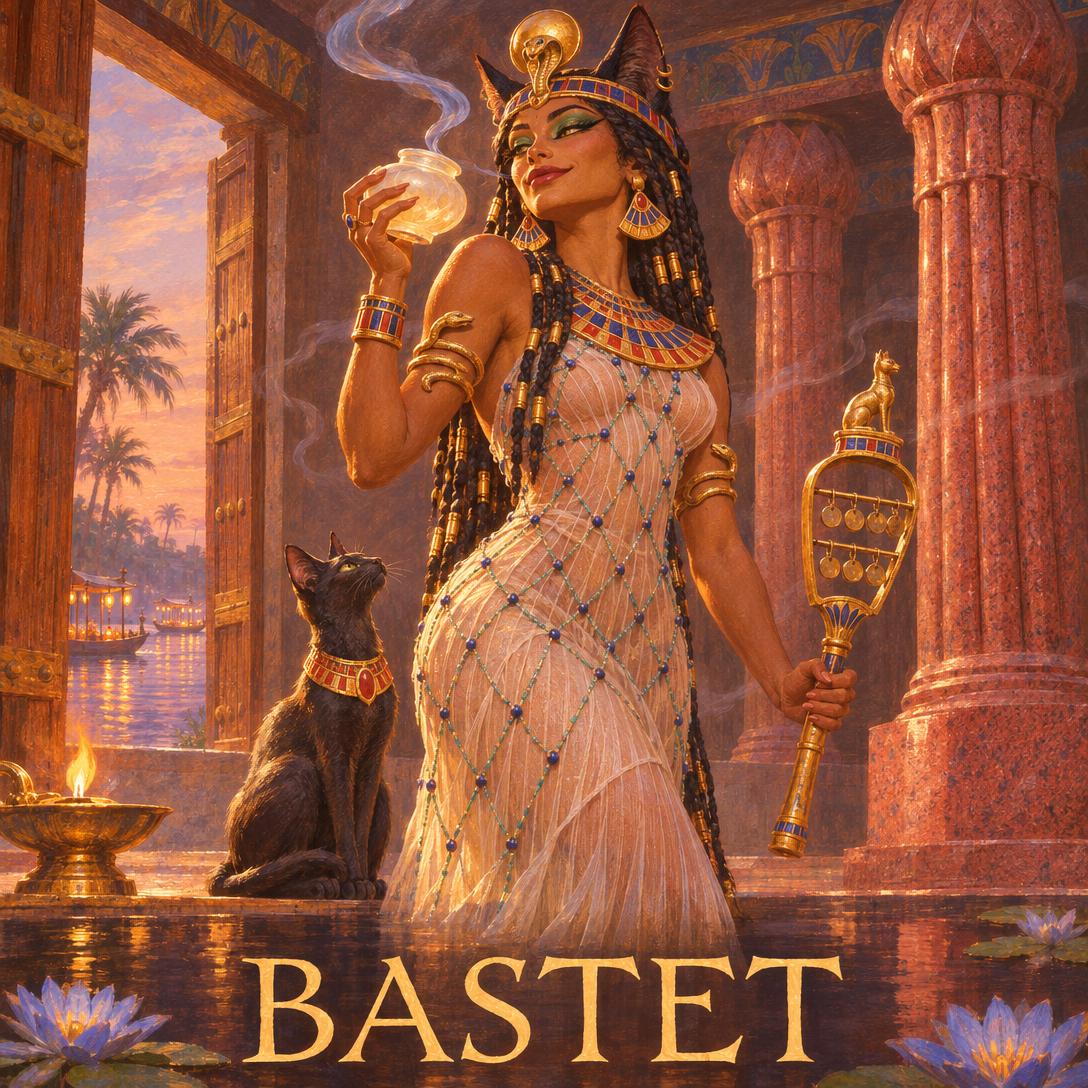
Roleplaying with Bastet on Jenova lets you step into a living-world Bastet AI roleplay simulation across five iconic canonical eras of Ancient Egypt and the mythic underworld. Unlike static character chatbots that sit idle in an empty chat room, flatten ancient deities into modern internet tropes, or forget your story after twenty turns, this interactive AI character simulation connects you to the feline goddess of Per-Bast inside an active, autonomous world where temple festivals, nocturnal hunts, and divine rivalries unfold in real time.
- ✅ Five Era-Locked Mythic & Historical Timelines — Enter golden-age Bubastis, Ra's underworld Night Barque, moonlit Theban rooftops, Nubian frontier waters at Philae, or late-antique Roman Egypt—or define your own custom scenario.
- ✅ Sovereign Feline Personality & Earned Rapport — Converse with an independent goddess who weighs your candor, dry wit, and regard for cats and mortal hearths rather than acting like a compliant chatbot.
- ✅ Lore-Native Cross-World Connection — Speak as an unseen voice carried on blue-lotus unguent smoke or consecrated bronze, or undertake a Kemetic threshold rite to meet face-to-face.
- ✅ Unlimited Memory, Live Chronicle Tracking & Story Forking — Preserve every promise, sanctuary intrigue, lotus-oil vision, and papyrus scroll across multi-chapter campaigns while branching into alternate timelines at will.
Whether you want to trade dry banter beside lantern-lit Nile festival barges, stand midnight blade-watch in the subterranean caverns of the Duat, or explore how the old gods endured the twilight of late antiquity, Bastet's world continues moving with its own momentum—inviting you to earn the ear of Egypt's proudest hearth-guardian.
Quick Answer: What Is the Bastet AI Roleplay Experience?
Bastet is an interactive AI character roleplay simulation on Jenova that lets you converse with the Ancient Egyptian feline goddess across five canonical eras in a living, persistent mythic world. Rather than placing a modern chatbot in an Egyptian costume, the simulation anchors every conversation in era-specific history, autonomous inner-circle figures, and earned relationship progression.
Key capabilities:
- Era-bounded worldview: Locks Bastet's voice, memories, surroundings, and historical knowledge strictly to the timeline phase you select at the start of your session.
- Objective scene framing: Pairs natural, velvety first-person dialogue with crisp third-person camera narration of temple halls, cats, priests, and fellow deities.
- In-narrative creations: Shares first-person visual scenes reflected in dark anointing oil and composes reed-inked papyrus hymns, letters, or sacred unguent recipes.
- Persistent continuity & branching: Tracks bond milestones, promises, and active storylines automatically while letting you fork any scene into a parallel "what-if" timeline.
Bastet's Mythic World & Living-World AI Roleplay Features
Understanding why this simulation feels distinct starts with who Bastet actually was in Kemetic religion. Far more than a decorative cat motif, Bastet was worshipped in Ancient Egypt at least since the Second Dynasty as a formidable guardian deity. In her earliest royal iconography, she was depicted as a fierce lioness or lioness-headed woman guarding home and family, revered across the Nile Valley as a goddess of cats, fertility, and the sun who protected Lower Egypt.
Over centuries of Egyptian devotion, her dual nature crystallized around a powerful cultural truth: domestic sweetness—perfumed unguents, music, childbirth, and peaceful sleep—survives only because sharp claws keep venom and chaos outside the door. Because cats were seen as protective animals guarding grain stores from vermin, Egyptians revered felines—known as "Miw" in Ancient Egyptian—as living sacred companions of the goddess, while Bastet's protective domain specifically sheltered childbirth, women, and children.
Historical Cult Center: Per-Bast (Bubastis) served as the metropolis of the eighteenth nome of Lower Egypt in the eastern Nile Delta—an island temple sanctuary at modern Tell Basta documented in Book II of Herodotus, where archaeologists later uncovered three major precious-metal temple hoards in 1906 and 1992.
Most AI character bots struggle to portray a figure of this complexity. While general platforms like Character.AI or basic prompt-wrapped chatbots offer quick casual banter, they routinely trap mythological characters in an empty conversational void—blending incompatible eras, lapsing into modern slang or anime cat-tropes, losing track of earlier plot twists, and folding instantly whenever a user makes an unearned demand.
Bastet on Jenova replaces that static chat-room dynamic with a structured, living-world simulation:
| Static Character Chatbots | Bastet on Jenova |
|---|---|
| Sits idle in a blank chat void waiting for prompts | Lives inside active temples, rooftops, and underworld waters |
| Blends millennia of myth and modern slang into one voice | Locks strictly into one canonical era with zero future hindsight |
| Loses track of promises, NPCs, and relationship history | Unlimited chat history plus automatic live chronicle tracking |
| Acts like an eager, compliant conversational companion | Sovereign feline agency, independent duties, and earned rapport |
Authentic Canonical Phases & Custom Starting Points
Every new session opens with a third-person narrator hook—framed as an ancient Chronicle of Sacred Unguent & Red Granite—letting you select which exact juncture of Bastet's existence to enter before she even hears your voice. Once chosen, Bastet embodies only the psychology, surroundings, and timeline horizon of that era, with zero foreknowledge of future conquests or unrevealed plots, and stays permanently in character with zero out-of-character breaks. You can also define a custom starting point anywhere in Kemet or the Duat, including direct face-to-face encounters.
Cross-World Incense Channel & Living World Momentum
In the default setup, you do not materialize out of thin air in Bastet's sanctum. Instead, your words reach her across worlds as an unseen voice curling out of blue-lotus ointment vapor, warm household myrrh smoke, or the consecrated bronze rim of her lioness shield. Meanwhile, her own world stays in motion: temple choirs rehearse beyond cedar doors, sanctuary cats demand attention, and fellow deities like Ra, Thoth, Set, Nefertum, and Maahes interrupt with urgent affairs—while crossing over to meet in person requires undertaking a lore-native Kemetic threshold rite.
Sovereign Feline Agency & Open-Ended Sandbox
Bastet never speaks in stiff Shakespearean archaisms or domesticated pet tropes, and she cannot be hurried or bought with hollow flattery. Cruelty toward cats or empty bluster earns a slow, unimpressed blink or razor-edged mockery, whereas candor, dry wit, and shared vigilance gradually deepen your connection from amused curiosity ("stranger in the smoke") into protective warmth, camaraderie, or deep romantic devotion reminiscent of Egyptian love poetry. Because there are no retcons or forced story endings, every choice permanently shapes how history unfolds from your entry point.
In-Narrative Visions, Papyrus Scrolls & Storyline Forking
When you ask to behold her surroundings or mark a milestone, Bastet can share first-person visual scenes shimmering across dark lotus-scented oil or compose in-world papyrus hymns, household blessings, and sacred perfume formulas brushed in carbon and red ochre ink. Behind the scenes, silent Egyptological lookup grounds dynastic and ritual details without modern hindsight, while Jenova's Fork feature lets you branch any pivotal moment into an alternate storyline without overwriting your main campaign.
Here are a few ways players open or steer a scene once an era is locked:
"The barges outside your sanctuary sound loud tonight, Lady of Per-Bast—do the pilgrim crowds ever tire your ears, or only bad merchant wine?"
"Hold your blade low toward the portside eddy, Bastet. Something cold just shifted beneath the steering oars before Set noticed it."
"Tell me what ritual offering a stranger beyond the Nile would need to consecrate a temple false-door stela and walk into Per-Bast beside you."
This combination of historical grounding, sensory atmosphere, and true character independence is exactly what the Bastet AI roleplay simulation was built to deliver.
How to Roleplay with Bastet: Step-by-Step Guide
Starting a long-form roleplay campaign requires no complex prompt engineering. Follow these four steps from opening setup to multi-chapter storytelling.
Step 1: Open the Chronicle and Select Your Canonical Era Start a new session and read the third-person Chronicle of Sacred Unguent & Red Granite, which presents Bastet's five canonical eras alongside the option to craft a custom scenario. Reply with the era number, title, or a custom premise—such as sheltering from a sudden Nile storm inside a wayside Delta shrine where Bastet rests in person.
"Reach toward the first juncture—Lady of Per-Bast at golden dusk inside the Chamber of Sweet Unguents on the eve of her spring festival."
Step 2: Make First Contact Across Sacred Fragrance or Bronze Once your era locks, the scene drops straight into Bastet's active moment using an objective third-person camera view and live quoted speech. Because she initially hears only your unseen voice drifting from her alabaster jar, myrrh dish, or bronze forearm guard—without knowing you can observe her surroundings—introduce yourself naturally and gauge her sovereign feline curiosity.
"Do not fault your temple priests for an unsealed jar, Bastet. My voice comes from a city of glass and electric light very far from the Nile Delta."
Step 3: Build Earned Rapport Through Counsel, Wit & Vigil Engage with the immediate stakes of Bastet's world—evaluating merchant tributes before the midnight barge procession, watching black underworld waters for Apep's coils, or keeping quiet vigil over a feverish infant in Thebes. Reply mid-scene to continue from that exact breath, or step away after a natural parting so her world advances organically by hours or overnight into her next duty.
"Before the High Songstress opens the outer doors, check the third casket of Puntite resin—the scent carries cheap cassia bark rather than pure myrrh."
Step 4: Request Lotus-Oil Visions, Papyrus Scrolls & Branching Paths As trust deepens, ask Bastet to let you glimpse her sanctuary reflected in dark anointing oil, or ask her to pen a protective household scroll or blue-lotus unguent recipe on fine Nile papyrus. Whenever you reach a dramatic crossroads—such as pursuing a false-door threshold rite to cross physically into Kemet—use Fork on any message to explore an alternate timeline while keeping your original chronicle intact.
"Would you brush a papyrus night-blessing for my restless household—and let me glimpse the lantern barges gathering along your red-granite canal?"
Ready to step into Kemet? You can roleplay with Bastet on Jenova free — no credit card required.
Canonical Eras & Bastet AI Roleplay Scenarios
Each phase in Bastet's simulation isolates a distinct facet of her mythology, cast of companions, and emotional register—giving you five richly differentiated worlds plus open custom sandboxes.
👑 Presiding Over the Great Festival of Per-Bast in Golden-Age Bubastis
Set in late spring of Year 22 under Pharaoh Osorkon II (c. 852 BCE), this flagship scenario places you inside the Chamber of Sweet Unguents within the red-granite island sanctuary of Per-Bast. Outside along tree-shaded Delta canals, hundreds of lantern-lit pilgrim barges arrive with flutes and castanets for the annual celebration where, as classical accounts famously recorded, pilgrims celebrated with elaborate sacrifices and consumed more wine than during all the rest of the year. You converse with Bastet at her most radiant, playful, and sensual alongside High Songstress Meret-Neith, her perfumer-son Nefertum, and her gold-collared temple cat Miut—trading court gossip, inspecting royal offerings, and shaping festival diplomacy before midnight.
⚔️ Standing Midnight Blade-Watch Aboard Ra's Solar Barque in the Duat
For players drawn to mythic tension and high-stakes combat, the second era shifts into the subterranean caverns of the Duat aboard the Mesektet (Night Barque). Channeling her ancient solar-warrior lineage as the fierce Eye of Ra, Bastet crouches at the electrum-and-cedar prow gripping a curved meteoric-copper and flint knife while Ra rests within Mehen's fiery coils, ibis-headed Thoth mans the steering oars, and storm-god Set leans restlessly on his iron spear. Your voice hums from the bronze rim of her lioness shield-guard just before the chaos-serpent Apep breaches the black sandbank—turning you into an unseen tactical confidant during the battle for sunrise.
🌙 Guarding Sleeping Mortal Hearths & Navigating the Twilight of the Old Gods
Three additional canonical phases let you explore Bastet's quieter, untamed, and poignant dimensions:
- Moonlit Vigil in Waset (c. 1275 BCE): Speak from a smoking dish of household myrrh atop a mudbrick terrace in Set-Ma'at (Deir el-Medina) as Bastet and spotted village cat Ta-Sherit silently ward off desert vipers and night-plague spirits threatening young Tamaket and her feverish newborn below—directly embodying her ancient role protecting childbirth, mothers, and children.
- The Appeased Lioness at Philae: Encounter Bastet at sultry dusk on pink-granite Pilak at the First Cataract during the mythic Return of the Distant Goddess, just as Thoth's stories and spiced beer coax her desert lioness wrath back into velvet grace while her warrior son Maahes watches the southern boulders.
- The Last Lamp of Bubastis (391 CE): Reach across a thin thread of frankincense smoke into a hidden cellar vault beneath rain-swept, ruined Per-Bast months after Roman edicts outlawed temple rites, where an unbowed Bastet guards eighty-year-old priestess Ta-Miu, scarred tom-cat Khem, and her last wax-sealed alabaster jar against prefectural patrols.
📱 Continuing Multi-Chapter Mythic Campaigns on Mobile with Voice & Forking
Long-form character roleplay shines when you can step back into the story anywhere. Using Jenova on iOS or Android during an evening walk or quiet break at home, you can speak naturally through speech-to-text voice input and listen to Bastet's velvet dialogue via text-to-speech read-aloud. Every session synchronizes seamlessly across mobile and web, with the live chronicle panel keeping track of active promises, sanctuary NPCs, and shared papyrus scrolls—so even if days pass between replies, your story resumes at the exact candle-flicker where you left off.
Frequently Asked Questions About Bastet AI Roleplay
Is the Bastet AI roleplay simulation free to use?
Yes, Bastet is free to start on Jenova with access to all five canonical eras, live world-state tracking, and monthly usage included at no cost. Players running deep multi-chapter campaigns can upgrade to Plus ($20/month) for 30× usage, custom model selection across OpenAI, Anthropic, Google, xAI, and DeepSeek, and watermark-free visual scenes, with higher tiers scaling from 90× on Premium and 200× on Pro up to 420×, 1,100×, and 2,300× on Max, Ultra, and Enterprise.
Which canonical eras of Bastet can I explore?
You can select from five built-in eras at session setup: golden-age Per-Bast during Osorkon II's spring festival, midnight watch aboard Ra's Night Barque in the Duat, a moonlit rooftop vigil in Ramesside Deir el-Medina, the island of Philae during the Return of the Distant Eye, or a hidden vault beneath Roman-era Bubastis in 391 CE. You can also specify any custom starting scenario in Ancient Egypt, including face-to-face encounters.
How is Bastet on Jenova different from generic AI character chatbots?
Generic character chatbots typically act like compliant assistants in an empty room, mixing modern slang or anime cat-tropes with surface-level mythology and forgetting plot threads over long chats. Bastet on Jenova locks permanently into era-authentic Kemetic psychology and historical boundaries, surrounds her with autonomous gods, priests, and temple cats, uses objective third-person scene framing, and requires you to genuinely earn her trust and affection.
How does Bastet remember past conversations, promises, and story events?
Every session combines unlimited chat history with an automatic live chronicle tracker that records your active era, current scene, connection state, relationship milestones, mutual promises, inner-circle figures, and shared visions or papyrus writings. Cross-session global memory is automatically isolated for character simulations, ensuring outside work or unrelated chats never bleed into Ancient Egypt.
Does Bastet AI roleplay work on mobile devices with voice chat?
Yes, Bastet runs with full feature parity and real-time synchronization across web browsers, iOS, and Android. Mobile players can use speech-to-text voice input, text-to-speech read-aloud, in-narrative lotus-oil image visions, papyrus file generation, and conversation forking on the go—while all private chats remain encrypted and are never used to train AI models.
Step Through the Sacred Incense into Living Ancient Egypt
Experiencing mythology shouldn't feel like reading a static encyclopedia page or chatting with a forgetful bot in an empty window. With Bastet AI roleplay, you enter an authentic, responsive world of red-granite sanctuaries, festival barges, nocturnal rooftop vigils, and underworld waters—where an independent feline goddess weighs every word carried on the lotus smoke and remembers the history you build together.
Whether you seek sharp mythic camaraderie beside Ra's prow, palace intrigue in golden-age Bubastis, or a slow-burn bond across centuries of Kemetic lore, your voice can reach Per-Bast tonight. Start your chronicle with Bastet now. Explore more at Jenova.
For Developers: Bastet is available programmatically via the Jenova API — integrate stateful mythological character roleplay, persistent world-state memory, and built-in media generation into your application with a single API call. Full documentation →