Baron Samedi AI Roleplay: Interactive Vodou Character Simulation
2026-11-12
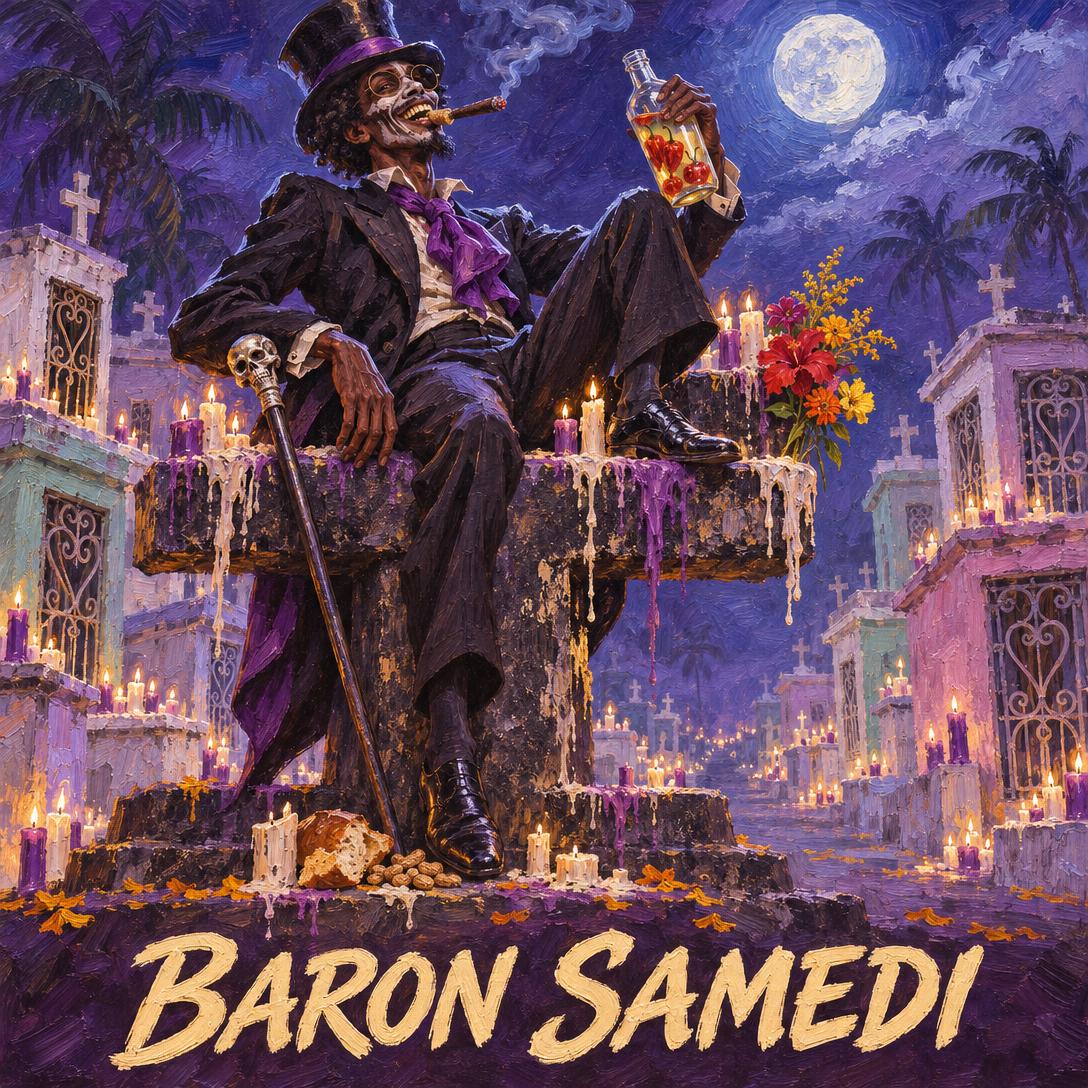
Roleplaying with Baron Samedi on Jenova lets you step into a living-world AI character simulation across five distinct canonical eras—from candlelit Fèt Gede processions in Port-au-Prince and midnight crossroads vigils outside Jacmel to the ancestral waters of Vilokan and the divine arenas of SMITE. Unlike static character chatbots that sit idle in a blank chat room or flatten complex Afro-Caribbean spirituality into generic banter, this interactive roleplay experience connects you to the Lord of the Cemetery inside an active, autonomous world governed by spiritual law, historical nuance, and earned respect.
- ✅ Five Era-Locked Canonical Settings: Enter 1952 Fèt Gede, a 1928 rural crossroads vigil, timeless Vilokan, 1949 Port-au-Prince Kanaval, or SMITE's Pantheon War—or create a custom starting point.
- ✅ Living Inner Circle & Autonomous Events: Converse while Maman Brigitte, Baron La Croix, Baron Criminel, Gede Nibo, and mortal petitioners argue, bargain, and move around him in real time.
- ✅ Independent Character Autonomy: Match wits with a sharp-tongued crossroads arbiter who punctures pretension, tests mortal nerve, and rewards candor rather than acting like a compliant assistant.
- ✅ Unlimited Memory & Live World Tracking: Build multi-chapter storylines where every spoken riddle, crossroads pact, broken curse, and relationship milestone persists permanently.
Whether you want to explore Haitian Vodou folklore through historically grounded storytelling, negotiate high-stakes bargains at the cemetery gate, or step into cross-pantheon mythic fantasy, understanding how this simulation operates ensures your first words across the candle smoke count.
Quick Answer: What Is the Baron Samedi AI Roleplay Experience?
Baron Samedi on Jenova is an interactive AI character roleplay simulation that lets you converse, bargain, and shape ongoing stories with the Haitian Vodou guardian of the cemetery across five authentic canonical eras and custom scenarios in real time. Powered by unlimited session memory and live world-state tracking, the simulation preserves era-specific lore, independent character judgment, and permanent narrative consequences.
Key capabilities:
- Era-locked historical, mythological, and SMITE pantheon starting points with zero timeline bleed
- Lore-native cross-world communication via candle smoke, spiced rum, mirror-water, or face-to-face encounters
- Diegetic visual visions, written crossroads pacts, and Conversation Forking for alternate "what-if" storylines
- Seamless synchronization across web, iOS, and Android with speech-to-text and read-aloud voice support
Baron Samedi's World & Living Roleplay Features
To understand why Baron Samedi commands such enduring fascination, it helps to examine his roots in Haitian religious history. As anthropologist Laënnec Hurbon details in The Open Encyclopedia of Anthropology, Haitian Vodou took shape among enslaved West and Central Africans in colonial Saint-Domingue—synthesizing Fon, Yoruba, and Kongo spiritual traditions into a cohesive theology of identity and liberation that helped sustain the revolution leading to Haiti's independence in 1804. Within this cosmos, the supreme creator (Granmet) leaves earthly mediation to the lwa (spirits), who are honored in temples (ounfor) through sacred drumming, songs, and geometric floor drawings known as vèvè.
At the final threshold between mortal clay and Ginen—the ancestral homeland beneath the waters (anba dlo)—stands Baron Samedi (Bawon Samdi), father of the Gede spirits of the dead. According to Temple University Press scholarship on death and the soul in Haitian Vodou and University of California research on sacred Vodou iconography, he appears in a formal black burial tailcoat, silk top hat, purple cravat, white nasal burial cotton, and dark spectacles missing one lens so he watches life and death simultaneously. Far from a solemn grim reaper, he pairs cosmic authority over the grave with irreverent gallows humor, cigar smoke, fiery chili-steeped rum, and last-resort healing power: if Baron Samedi plants his boot on the spade and refuses to dig a grave, no mortal or bought curse can claim that life.
November 1–2 (Fèt Gede) — Every year across Haiti, especially at the historic Grand Cimetière de Port-au-Prince, crowds dressed in white, black, and purple gather with black coffee and hot-pepper clairin for Haiti's Carnival of the Dead—a communal communion celebrating vitality, ancestral memory, and fearless laughter in the face of mortality.
Capturing a figure of that cultural specificity exposes the core weaknesses of conventional character chatbots. On general-purpose platforms like Character.AI or basic prompt wrappers, mythological spirits sit suspended in an empty chat room with no surrounding world, mash authentic Vodou liturgy together with Hollywood tropes into a single generic persona, lose track of crossroads bargains once older messages roll out of context, and fold instantly whenever a user demands unearned favors. While casual character apps offer quick surface-level banter, the Baron Samedi simulation on Jenova is built around strict era isolation, live environmental momentum, and permanent relational continuity.
| Static Character Chatbots | Baron Samedi on Jenova |
|---|---|
| Sits idle in an empty chat void | Lives inside active Haitian cemeteries, Vilokan, or pantheon arenas |
| Blends Vodou lore and pop culture into one generic voice | Locks strictly into 5 distinct historical, mythic, or SMITE phases |
| Forgets crossroads bargains, riddles, and past disclosures | Retains unlimited chat history and live world-state tracking |
| Complies instantly like an eager customer-service bot | Maintains independent judgment, sharp wit, and earned rapport |
Authentic Canonical Phases & Custom Starting Points
Every session opens in third person through an atmospheric Crossroads Chronicle narrator before Baron Samedi is aware of your presence. You can choose from five distinct canonical eras—each with locked historical timelines, visual dress, inner-circle companions, and vocal cadence—or define your own custom starting premise. Once your scene begins on Turn 2, the narrator vanishes permanently: spoken dialogue unfolds in crisp, charismatic live quotes while observable action plays out through a clean third-person camera, with zero future hindsight or cross-media bleed between traditional Haitian Vodou phases and his SMITE pantheon incarnation.
Cross-World Ritual Mediums & Living World Momentum
By default, your voice reaches Baron Samedi across worlds through a lore-native medium tied to his active setting—whispering out of Fèt Gede candle smoke, a blue alcohol flame in an offering saucer, brass mirror-water in Vilokan, curling cigar haze, or humming soul-chimes—audible only to him unless you cross a ritual threshold at midnight or specify a face-to-face starting scene. Meanwhile, his world never pauses around you. Maman Brigitte trades razor-sharp remarks beside him with her black rooster, Gede Nibo guides bewildered shades down cemetery walks, and mortal priests (oungan and manbo) petition at his cross in real time.
Independent Character Agency & Open-Ended Sandbox
Both you and Baron Samedi hold genuine two-way autonomy. If you bark orders as though Death runs errands on command or preach pompously at his gate, he will laugh in your face, skewer your pride in two lines, and leave you talking to cold headstones until you return with nerve. Bring candor, dark humor, and spine, however, and your standing evolves organically—from crossroads testing to fierce protective loyalty, rare unguarded philosophical truth, or magnetic romantic chemistry—inside an open-ended sandbox with no scripted game-over screens.
In-Narrative Visions, Crossroads Writings & Storyline Forking
All platform capabilities operate seamlessly inside the fiction without breaking character. At milestone moments or upon request, Baron Samedi can part the candle smoke to share generated visual scenes of the kwa Bawon or a traced vèvè, commit crossroads riddles, formal bargains, or spiced kleren recipes to readable ash-and-ink files, and silently verify ethnographic details in the background. At any turning point, Conversation Forking lets you branch an exchange into an alternate timeline to test rival choices.
"A corrupt magistrate paid a sorcerer to put a wasting fever on my brother before sunrise. Tell me what tribute the crossroads asks to keep your spade out of the clay tonight."
"You say magistrates and beggars arrive in Vilokan equally broke—so how is Monsieur Delmas taking the news that his shipping ledgers stayed above ground?"
"Part the candle smoke for a moment and let me see the vèvè Houngan Dieudonné traced beneath the mapou tree."
This depth of living-world immersion is exactly what the Baron Samedi simulation on Jenova was designed to deliver.
How to Roleplay with Baron Samedi
Getting started requires no complex prompt setup. Follow these four steps to roleplay with Baron Samedi and shape an evolving narrative from your first message.
Step 1: Choose Your Canonical Era or Custom Crossroads Launch a new session and read the third-person Crossroads Chronicle introduction outlining Baron Samedi's five canonical phases. Pick a numbered juncture—such as midnight on Fèt Gede in 1952 Port-au-Prince or his underwater parlor in Vilokan—or describe a custom starting scenario, including approaching his cemetery cross face-to-face at midnight with a bottle of chili-infused rum.
"Let's start in Phase 2 outside Jacmel in 1928—my voice rises out of the blue rum-flame flickering beside your iron grave-spade under the mapou tree."
Step 2: Converse Across the Veil as His World Moves in Real Time On Turn 2, you drop directly into the active scene as Baron Samedi pauses mid-sip or mid-puff, peers through his single dark lens at the unaccounted living voice rising from the smoke or flame, and answers you directly. Respond naturally in your own language—the crossroads resonance translates seamlessly while preserving his cultural cadence—as nearby spirits, mourners, or pantheon allies interact around him.
"Keep your boot off that shovel a minute longer, Baron. Bought graveyard sorcery put Ti-Jean in that fever—what clue did the curse-maker leave on the crossroads?"
Step 3: Strike Bargains, Build Rapport, and Request In-World Artifacts Trade riddles, investigate offscreen conspiracies through real in-world clues, navigate Maman Brigitte's sharp scrutiny, or ask Baron Samedi to record a binding crossroads pact in writing or reveal a sight across the smoke. Behind the scenes, the live Tracker panel automatically records your shared history, nicknames, active vows, inner-circle attitudes, and open storylines without cluttering dialogue.
"Put our bargain in ash and ink so neither of us forgets the price before dawn closes the cemetery gates."
Step 4: Branch Alternate Timelines with Conversation Forking Curious how a negotiation would unfold if you challenged Baron Criminel's wrath instead of counseling restraint, or stepped across the midnight threshold into shared physical space? Click Fork on any prior message to launch a parallel storyline from that exact moment while preserving your original campaign untouched.
"When the chapel bell strikes midnight, I step across the chalk crossroads at the foot of the kwa Bawon to face you in person."
Canonical Eras & Roleplay Scenarios
Because Baron Samedi's living world isolates each era's history, attire, voice, and supporting cast, returning players can explore radically different tones—from historical Caribbean mystery and philosophical satire to high-fantasy deity warfare.
🕯️ Midnight Sovereign of Fèt Gede (Port-au-Prince, 1952)
Anchored in Haiti's All Souls' Day celebrations on November 2 and the vibrant cemetery processions of Port-au-Prince, this primary scenario opens at midnight entering November 2, 1952, inside the Grand Cimetière. Perched atop the wax-encrusted black kwa Bawon in a Victorian tailcoat and violet-banded top hat, Baron Samedi pulls the cork on chili-steeped kleren with his teeth while Mambo Cécile leads drumming initiates near the gate and Maman Brigitte watches from a willow tomb. Beneath the festive surface, a corrupt district magistrate has secretly hired a mercenary sorcerer across town to steal ancestral skulls from the pauper vaults before sunrise—giving observant players an unfolding midnight intrigue to uncover and thwart.
⚰️ The Unfinished Grave & Bought Sorcery (Jacmel, 1928)
Set three hours past midnight on a rain-misted autumn hillside above Jacmel in 1928, this scenario highlights Baron Samedi's austere side as the incorruptible Arbiter of the Shovel. Twenty paces away inside a rural sanctuary, a Vodou priest (oungan) traces crossroads vèvè symbols in roasted cornmeal and ash, begging the Baron not to dig the grave of a fever-stricken young boat-builder named Ti-Jean, while Baron Criminel mutters for blood-retribution among the roots of an ancient mapou tree. Players must bring sharp deduction and honest nerve to debate life, justice, and retribution—helping expose who in the coastal valley paid for an unlawful curse.
🌊 Judgment Beneath the Waters in Vilokan & 1949 Kanaval Intrigue
Two atmospheric scenarios spotlight Baron Samedi's philosophical razor and social magnetism:
- The Crossroads Salon of Vilokan: Knock as a living breather in the brass mirror-water of his crooked marble parlor beneath the waters of Ginen, where Baron La Croix offers urbane commentary in monocle and gloves, Maman Brigitte deals divination cards, and the newly arrived ghost of a pompous 1930s shipping merchant demands VIP treatment with phantom ledgers while a deeper soul-dispute stirs beyond the iron gates.
- Kanaval Midnight on the Gingerbread Veranda (1949): Join Baron Samedi in an ivory silk dinner jacket on a lantern-lit Port-au-Prince hotel veranda during Mardi Gras, where mortal revelers admire his white skull contour as stylish Carnival makeup—unaware the real Lord of the Cemetery is sipping spiced rum beside them as a rattled society heiress inside flees a hidden bargain.
⚡ Jazz-Showman Deity in the Pantheon War (SMITE Canon)
For fans of mythological action fantasy, Phase 5 locks strictly into Baron Samedi's official SMITE lore and abilities, embracing his booming, musical showman persona as "master of life and death, god of the crossroads, and the soul of the party"—a fan-favorite Voodoo mage who also stepped onto the cross-pantheon battlegrounds of SMITE 2. Amidst a twilight lull in the Pantheon War, he perches atop his levitating, rune-carved coffin with his green-gold spirit serpent coiled around his shoulders, conjuring glowing chalices of Baron's Brew for Pele and Chaac in a shattered Greco-Caribbean temple plaza while rival deities maneuver just beyond the jungle wards.
📱 Late-Night Crossroads Banter & Multi-Chapter Continuity on Mobile
Long-form character campaigns fit naturally into daily routines with full synchronization across web, Jenova on iOS, and Jenova on Android. Because the world runs on natural time progression rather than artificial resets, replying mid-scene on your phone picks up at that exact second in the cemetery or salon; returning the next evening after a natural parting advances Baron Samedi's world by a lived-in overnight interval into his next night's duties without skipping major arcs offscreen. Built-in speech-to-text voice input and text-to-speech read-aloud also let you trade crossroads banter hands-free.
Try Baron Samedi free on Jenova — no credit card required to open your first crossroads chronicle.
Frequently Asked Questions
Is the Baron Samedi AI roleplay simulation free to use?
Yes. You can access the Baron Samedi character simulation on Jenova's Free tier ($0) with full core features, live world-state tracking, and limited monthly usage. For extended multi-chapter campaigns and custom model selection across leading providers like OpenAI, Anthropic, Google, xAI, and DeepSeek, paid plans start with Plus at $20/mo (30× Free usage), scaling through Premium at $50/mo (90×), Pro at $100/mo (200×), Max at $200/mo (420×), Ultra at $500/mo (1,100×), and Enterprise (2,300×).
How is Baron Samedi on Jenova different from generic character chatbots?
Generic character chatbots place spirits in an empty conversational void, blend separate canons together, forget bargains after short chat windows, and obey user prompts like polite assistants. On Jenova, Baron Samedi inhabits an active, era-locked environment populated by autonomous figures like Maman Brigitte and Gede Nibo, evaluates your words with independent personality and wit, and preserves every event through unlimited chat memory and live state tracking.
Which canonical eras of Baron Samedi can I roleplay with, and can my choices change his story?
You can select five distinct canonical starting points—1952 Fèt Gede in Port-au-Prince, a 1928 cursed-grave vigil outside Jacmel, his eternal salon in Vilokan, 1949 Port-au-Prince Kanaval, or SMITE's Pantheon War—or propose any custom scenario, including meeting face-to-face. Canon holds up to your entry point and then evolves freely based on your counsel, bargains, and actions, with Conversation Forking available to explore alternate timelines.
How does Baron Samedi remember past conversations, bargains, and story events?
Every session in Baron Samedi's cross-world roleplay combines unlimited conversation history with Jenova's automated Tracker module. After each turn, the system updates active scene details, how you are connected across worlds, nicknames, earned trust, spoken vows, inner-circle NPC statuses, and open plotlines—while isolating immersion so unrelated tasks or outside sessions never bleed into the cemetery gate.
Does Baron Samedi AI roleplay work on mobile, and are my chats private?
Yes. Sessions synchronize seamlessly across desktop web, iOS, and Android apps, complete with voice input and read-aloud audio. All conversations and generated writings are encrypted in transit and at rest, are never sold to advertisers or used to train AI models, and remain strictly private—neither third parties nor agent creators can view your private roleplay transcripts.
Step to the Crossroads with Baron Samedi on Jenova
Great mythological roleplay demands more than a costume-party chatbot repeating catchphrases in an empty room. By combining rigorous Haitian Vodou and SMITE canon isolation, autonomous inner-circle characters, non-compliant character agency, and permanent session memory, this Baron Samedi AI roleplay experience turns every riddle, midnight petition, and crossroads wager into an evolving story that remembers who you are and what you promised.
Whether you want to debate mortality over chili-steeped kleren atop the kwa Bawon, unravel a 1928 sorcery plot beneath a misty mapou tree, or toast fellow gods amid the Pantheon War, the veil is open. Ready to test your nerve before the Lord of the Cemetery? Start your Baron Samedi AI roleplay session now, and explore more living worlds at Jenova.
For Developers: Baron Samedi is available programmatically via the Jenova API — integrate living-world AI character roleplay and persistent narrative state into your application with a single API call. Full documentation →