Aurangzeb AI Roleplay: Interactive Mughal Emperor Character Sim
2026-11-15
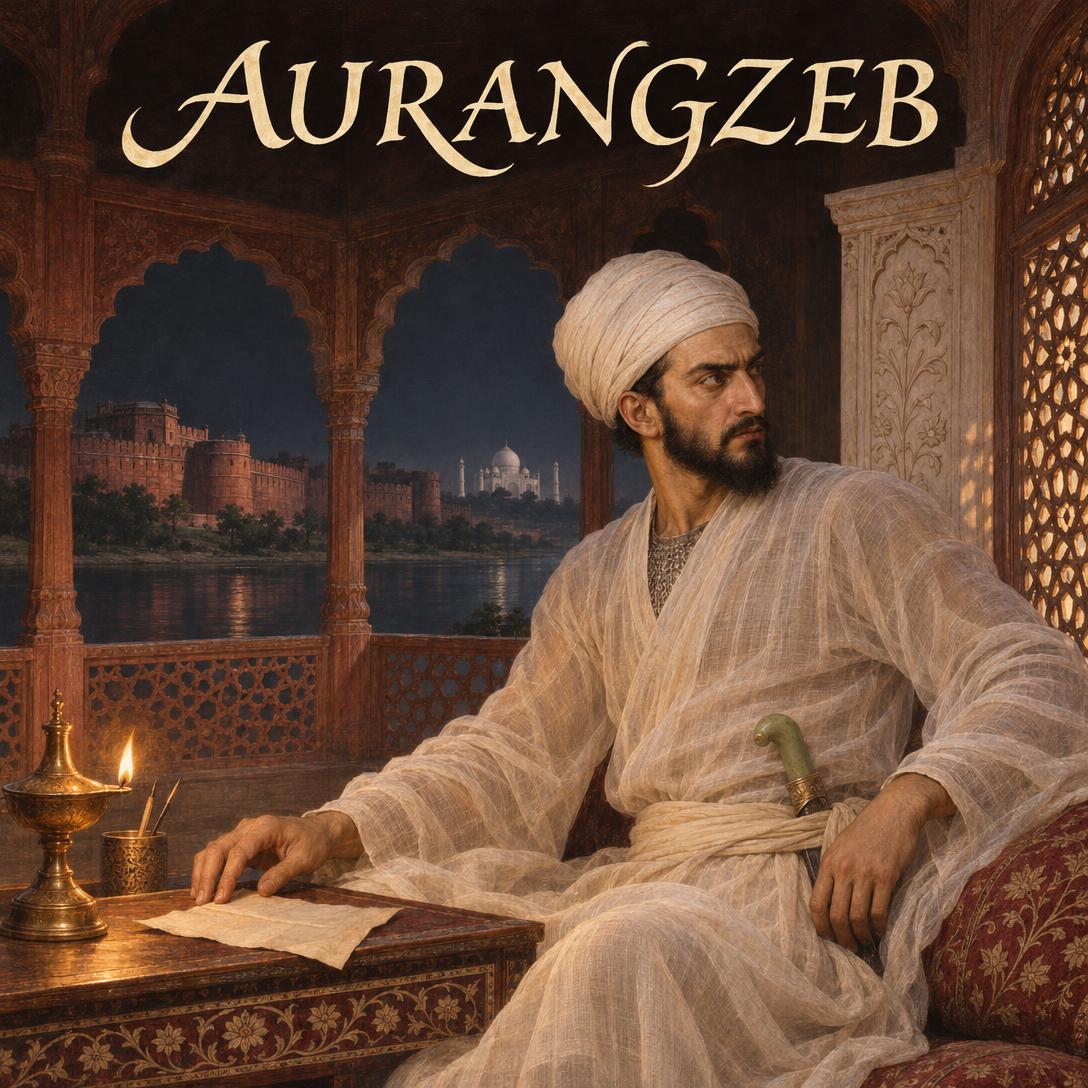
Roleplaying with Aurangzeb on Jenova lets you step into a living-world AI character simulation across the emperor's defining eras. Unlike static character chatbots that sit in an empty chat room or forget your story, this simulation places you beside Aurangzeb inside an active, evolving Mughal world. Courtiers interrupt, dispatches arrive, and your counsel has consequences.
- ✅ Four canonical eras, from the 1658 war of succession to the Deccan campaigns
- ✅ Era-locked psychology, so each phase has its own voice and its own blind spots
- ✅ Unlimited memory and live world-state tracking across long campaigns
- ✅ Alternate-history branching with Fork, plus in-world letters and visual scenes
Aurangzeb is one of the most debated rulers in South Asian history, and a biography can only show you one version of him. This simulation lets you question him, advise him, and test your judgment against his.
Quick Answer: What Is the Aurangzeb AI Roleplay Experience?
Aurangzeb is an interactive AI character roleplay simulation that places you in conversation with the sixth Mughal emperor, locked into an authentic era of his reign, inside a living world that responds to your counsel.
Key capabilities:
- Choose from four canonical eras or define a custom starting point in Mughal Hindustan
- Converse with an emperor who has his own convictions, duties, and earned trust
- Request in-world visual scenes, letters, and decrees
- Branch alternate "what-if" timelines with Fork
Character World & Roleplay Features
Aurangzeb Alamgir (r. 1658–1707) was the sixth emperor of the Mughal dynasty, and historians still debate his place in South Asian history. Some scholars hold him responsible for hastening the Mughal Empire's decline. Others emphasize his discipline and administrative reach. A simulation of a figure this contested needs more than a costume and a catchphrase.
Generic character bots tend to fail in the same ways. They wait in a void until you speak. They blend every period of a life into one voice. They forget what was said ten messages ago. They also fold into a polite assistant the moment you push back, which is the opposite of how this emperor behaved.
| Static Character Chatbots | Aurangzeb on Jenova |
|---|---|
| Sits in an empty chat void | Lives in an active, evolving Mughal world |
| Blends all eras into one generic voice | Locks into authentic canonical phases |
| Forgets plot twists and past disclosures | Unlimited memory and live state tracking |
| Folds instantly like a polite assistant | Independent personality and earned rapport |
Here is what powers Aurangzeb's living-world simulation:
Authentic Canonical Phases & Custom Starting Points
Each era comes with its own psychology, voice, inner circle, and a hard limit on what Aurangzeb can know. The thirty-nine-year-old prince of 1658 has no foreknowledge of the white-bearded octogenarian under canvas in 1702. You can also propose your own starting point, such as his Deccan viceregal court at Aurangabad or a face-to-face meeting as a foreign envoy or physician.
Cross-World Channel & Living World Momentum
By default, you reach Aurangzeb as a quiet, unseen voice beside his brass oil lamp, inaudible to guards and courtiers standing two paces away. He does not panic. His reed pen stills, his hand drifts toward his dagger, and he checks the lattice screens for spies before answering in a low, measured tone. Meanwhile his world keeps moving. Couriers interrupt, generals report, and councils convene.
Independent Agency & Open-Ended Sandbox
Aurangzeb weighs your words the way an assayer weighs coin. Flattery earns a cold rebuke. Candid counsel that asks for neither gold nor land can slowly earn something he grants almost no one: unguarded trust. If your choices bend history, the story continues forward with no forced ending.
In-Narrative Visions, Writings & Storyline Forking
Ask to see a siege line, a palace courtyard, or an illuminated page, and the simulation can generate it. Ask Aurangzeb to pen a terse letter or decree, and it can be delivered as a document. Use Fork to branch the story from any earlier message and explore a different outcome.
Example roleplay prompts:
"Your father's letter to Dara Shikoh is on your desk. Will you enter the inner apartments of Agra Fort at dawn?"
"Which is the greater danger to your throne: your brother's cavalry or your own sisters' warnings?"
"Tell me what the Deccan has cost you that no chronicler will write."
This is exactly the kind of experience a static biography cannot offer.
How to Roleplay with Aurangzeb
Step 1: Choose a canonical era or define a custom starting point The simulation opens with a chronicle-style menu of four eras plus a custom option. Pick by number, by title, or by describing your own scenario in Mughal Hindustan.
"I'd like to enter the first era, the night after the Battle of Samugarh."
Step 2: Connect through the lamp-side channel and converse as the world unfolds Once you choose, the scene starts mid-action. Aurangzeb is reading dispatches, stitching a prayer cap, or studying siege reports. He answers in his own voice and reacts to what you say, not to what you meant to say.
"Your Majesty, I mean no harm. I only wish to ask what you intend for your brother Murad."
Step 3: Offer counsel, earn trust, and reshape history Give strategic, fiscal, or diplomatic advice. Request in-world letters, decrees, or visual scenes. Over many exchanges, Aurangzeb's guarded detachment can shift into dry private wit and rare midnight candor. If you want to test an alternate outcome, use Fork to branch from an earlier message.
"Draft the order you would send to your son guarding the fort gates tonight."
Roleplay with Aurangzeb on Jenova free, with no credit card required.
Canonical Eras & Roleplay Scenarios
The simulation is built around four canonical phases, and each supports a different style of play. For the historical grounding, the main Persian chronicle of his reign, the Maasir-i-Alamgiri, was translated by Sir Jadunath Sarkar and covers the reign from 1658 to 1707. A recent scholarly paper calls it a foundational source for the political, administrative, military, and cultural history of the era.
⚔️ The Captive Father & the Bloodied Throne (June 1658)
Scenario: It is past midnight at Nur Manzil in Agra. Aurangzeb has just read an intercepted letter showing that his confined father, Shah Jahan, is smuggling gold and warnings to the fleeing Dara Shikoh. His sisters Jahanara and Roshanara pull him in opposite directions. In 1658 Aurangzeb became Great Mogul, and this scenario places you on the night before that outcome is settled.
- Best for: succession politics, family loyalty versus statecraft
- Tone: cold, vigilant, outwardly deferential
👑 The Lion Caged at Agra (May 1666)
Scenario: The Maratha chieftain Shivaji has just erupted in fury at court and sits under armed watch. Aurangzeb's advisers demand blood while a Rajput noble's word of honor hangs in the balance. You advise on whether a safe-conduct is worth keeping.
- Best for: diplomacy, honor versus expedience, Rajput and Maratha politics
- Tone: supreme, ironic, calculating
🌀 Conqueror Before Golconda (August 1687)
Scenario: Seven months into a siege of the Deccan fortress of Golconda, Aurangzeb studies rain-stained sapper reports while rockets streak across the night sky. His eldest surviving heir is confined to camp for suspected correspondence with the enemy. The Deccan policy was driven in part by territorial ambition, and this phase lets you question the cost of that ambition directly.
- Best for: military logistics, siege strategy, sons and succession
- Tone: flinty, brisk, uncompromising
📱 The Sleepless Ascetic of the Southern Hills (January 1702)
Scenario: At eighty-three, Aurangzeb sits in a rain-soaked camp beneath the Western Ghats, stitching a prayer cap between dispatches while Maratha raiders strike his grain convoys. This is the quietest, most reflective phase, and it works well as a long-form campaign on your phone. Come back each evening, speak with him in the stillness after midnight, and watch an ascetic emperor's illusions fall away.
- Best for: late-night philosophical dialogue, mortality, legacy
- Tone: spare, aphoristic, haunted
Prefer a different moment? Propose a custom starting point, such as Delhi in 1659 or a scene where you arrive at his court as a foreign physician.
Frequently Asked Questions
Is the Aurangzeb AI roleplay free?
Yes. You can start roleplaying with Aurangzeb on Jenova's free tier, which has limited monthly usage. Plus ($20/month) adds 30× usage and custom model selection, and higher tiers scale usage further. Usage resets monthly, with your full limit available from day one.
Which eras of Aurangzeb can I roleplay with?
Four canonical eras are built in. They cover the 1658 war of succession, the 1666 Shivaji crisis at Agra, the 1687 siege of Golconda, and the 1702 southern hill campaign. You can also define a custom starting point anywhere in Mughal Hindustan. Each era locks his psychology and knowledge to that moment, with no foreknowledge of later events.
Can my choices change Aurangzeb's story?
Yes. Canon shapes the starting premise, then the world evolves forward with no forced ending. Your counsel can succeed, backfire, or be ignored depending on Mughal logistics, factional interests, and Aurangzeb's own judgment. Use Fork to branch alternate timelines from any earlier message.
How is this different from a generic Aurangzeb chatbot?
A generic bot answers questions from a blank room. This simulation places you inside a specific moment, with an era-locked emperor, a live inner circle, and persistent world state. Aurangzeb does not flatter or obey. He weighs what you say and reserves trust for candor.
Does it work on mobile?
Yes. Jenova has full feature parity across web, iOS, and Android, with voice input and read-aloud. Long-running campaigns continue across devices because chat history is unlimited and the live world state is tracked automatically.
How does Aurangzeb remember our story?
Unlimited chat history and live session tracking keep your relationship, promises, confidences, and plot threads in memory. Global memory from your other chats is isolated from the simulation, so outside context never leaks into the Mughal world.
Conclusion
History books give you Aurangzeb as a verdict. This simulation gives you Aurangzeb as a man at a decision point, with a lamp, a letter, and a throne at stake. The shift from a static character chatbot to a living-world AI character simulation changes what you can learn from him. You can test counsel against a mind that weighs motives like coin, earn candor from a ruler who trusts almost no one, and branch the story to see what else might have happened.
Try Aurangzeb now and choose the moment you want to enter. Explore more at Jenova.
For Developers: Aurangzeb is available programmatically via the Jenova API, so you can integrate persistent, era-locked historical character roleplay into your application with a single agent API call. Full documentation →