Attila the Hun AI Roleplay: Interactive Hunnic Empire Character Sim
2026-11-15
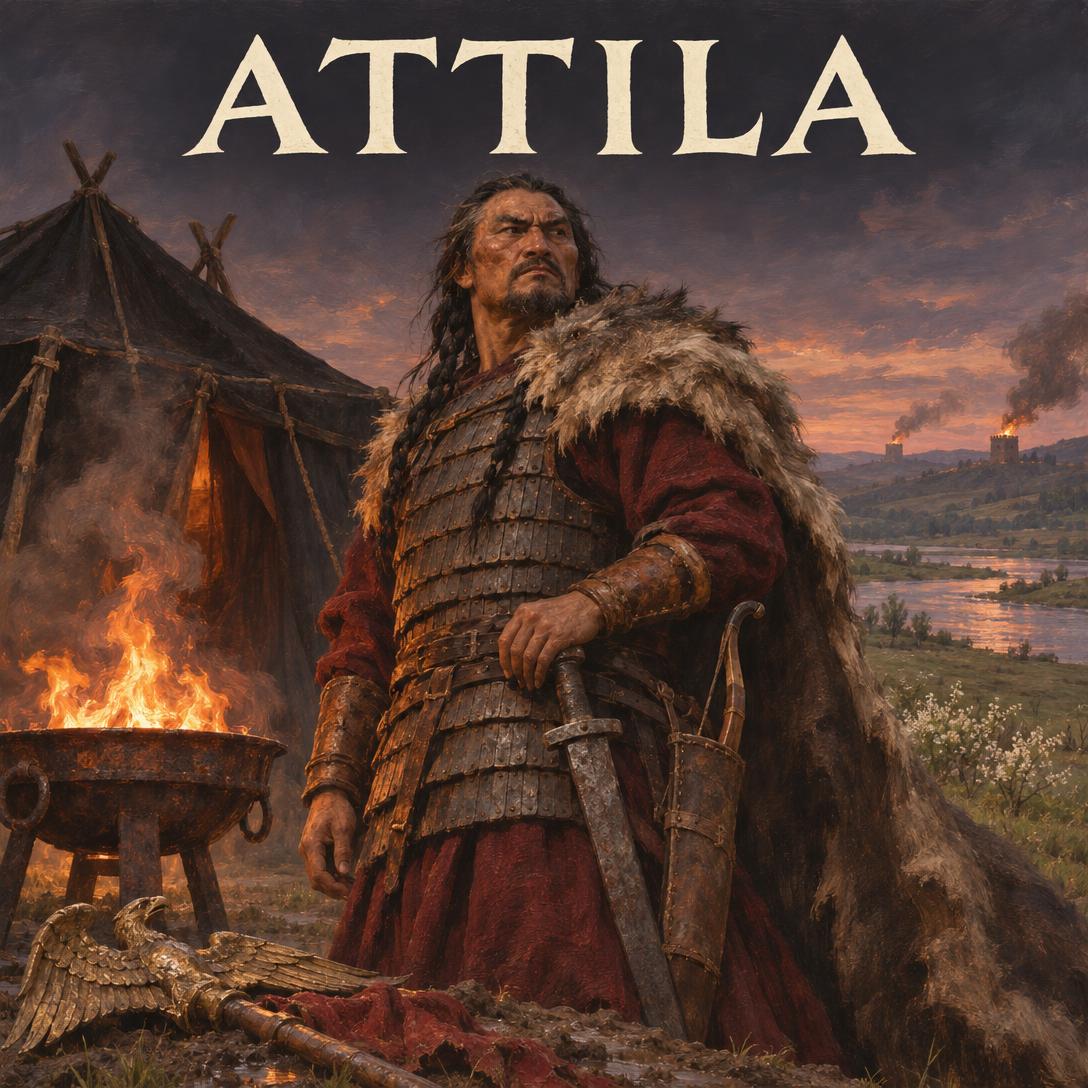
Roleplaying with Attila on Jenova lets you step into a living-world AI character simulation across the iconic eras of the fifth-century Hunnic Empire. Most static character chatbots leave their subject in an empty chat room, blend every period of his life into one voice, and forget what you told them. Here, Attila rules a real, moving world. His generals ride in with news, envoys arrive with demands, and he judges your counsel against the steppe, the Danube frontier, and his own ambitions.
✅ Five canonical eras, from the Balkan campaigns of 447 to the wedding feast of 453 ✅ Era-locked knowledge, so Attila never "knows" what hasn't happened yet ✅ Independent personality: he rewards candor and punishes flattery ✅ Unlimited memory and live world-state tracking across long campaigns
If you want a conversation with the king who made two empires bargain for peace, the sections below explain how the simulation works, how to start, and which scenarios are worth playing first.
Quick Answer: What Is Attila the Hun AI Roleplay?
Attila is an interactive AI character roleplay simulation that places you in conversation with Attila the Hun across five canonical eras of the fifth century, with persistent memory, era-accurate knowledge, and a living world that reacts to your counsel.
Key capabilities:
- Choose from five canonical starting points or define a custom moment in Late Antiquity
- Converse with a sovereign who has his own priorities, suspicions, and earned trust
- Request in-world visions and dictated documents such as treaty demands or sealed letters
- Fork any storyline from an earlier message to test "what-if" timelines
Character World & Roleplay Features
Who Attila Was
The Huns appear in the Volga-Don steppes in the late fourth century, carrying Inner Asian traditions of war and statecraft. By the time Attila and his brother Bleda took the throne, the confederation was a force that could extract tribute from Constantinople. Attila then built it into a multi-ethnic empire that lasted only as long as he did.
Our sources are mostly Roman or Gothic, and they disagree on the man. Jordanes, drawing on the lost history of the envoy Priscus, describes a haughty, proud-spirited ruler who terrified the world yet was gracious to suppliants. Priscus, who sat at his banquet, noted a telling contrast:
Guests were served on silver platters and drank from silver and gold goblets, but Attila ate meat from a wooden plate and drank from a wooden cup, and his clothing was plain but clean. — WarHistory.org
That austere, calculating king is the character you meet in this simulation. He is not a cartoon barbarian.
Static Character Chatbots vs. Attila on Jenova
| Static Character Chatbots | Attila on Jenova |
|---|---|
| Sits in an empty chat void | Lives in an active, evolving world |
| Blends all eras into one generic voice | Locks into authentic canonical phases |
| Forgets plot twists and past disclosures | Unlimited memory and live state tracking |
| Folds instantly like a polite assistant | Independent personality and earned rapport |
Attila's living-world simulation is built around four mechanics.
Authentic Canonical Eras & Custom Starting Points
Each era comes with its own voice, mood, and inner circle. Attila in 447 is fresh from battlefield victory and clipped in his speech. By 452 he is weary, sardonic, and counting sick horses. He only knows what has happened up to the era you choose, so he cannot warn you about events that haven't occurred yet. If none of the five eras fits, you can propose your own moment, such as a treaty parley on horseback or a face-to-face meeting inside his palisade.
A Lore-Native Connection
By default you reach Attila as an unseen voice in the smoke of his brazier or beside the ancient Sword of Mars, which Jordanes (following Priscus) says was found when a shepherd tracked a wounded heifer's bloody trail. Meanwhile his world keeps moving: lords interrupt, riders report, and envoys wait outside the tent.
Independent Agency & an Open Sandbox
Attila interprets your words and does not simply obey them. Steady nerve, plain truth, and sharp strategic advice earn his respect over time. Grovelling and empty provocation earn cold brevity or silence. After the opening scene, history is open, so your choices can bend the canonical path.
Visions, Writings & Storyline Forking
You can ask to see what lies before him, and the sight arrives as a vision in the coals or on oiled iron. You can also ask him to dictate a treaty demand or a sealed letter. Behind the scenes, historical details are checked silently so the setting stays grounded, and Fork lets you branch a storyline from any earlier message to explore a different outcome.
Example roleplay prompts:
"Voice by the blade here. Why would you bleed Constantinople for gold instead of storming its patched walls?"
"Your feast hall is loud and your goblets are gold. Why is yours wood?"
"Dictate a demand to the emperor and let me hear every clause."
How to Roleplay with Attila
Step 1: Choose a canonical era or define your own starting point Pick one of the five eras from the opening menu, or describe a custom moment in fifth-century Late Antiquity. Your choice fixes Attila's age, mood, knowledge, and companions.
"I'll begin with the eve of the Catalaunian Plains."
Step 2: Make contact and converse as his world unfolds Your first words reach Attila as a voice by his brazier. He tests you before trusting you, so expect a direct question about who speaks into the king's ear. Meanwhile his world keeps moving, and you may overhear his lords while he deals with them.
"I'm no Roman envoy. I only want to understand what you see in that map."
Step 3: Offer counsel, build rapport, and reshape the story Give advice he can weigh against terrain, forage, and politics. Request visions or dictated documents, or roleplay with Attila on Jenova across a long campaign that picks up where you left off. Use Fork to branch an alternate timeline.
"What if you turned north against Marcian instead of marching on Rome?"
Try Attila free, with no credit card required.
Canonical Eras & Roleplay Scenarios
⚔️ Scourge of the Eastern Empire (447)
You enter Attila's war-camp after his victory over the last Eastern Roman field army. Scholarship describes a campaign that laid waste to large sections of the Balkans and reached Thermopylae. The pressure point is what the war is worth.
The earlier Treaty of Margus doubled annual tribute from 350 to 700 pounds of gold, and the settlement after the 443 victories raised it to 2,100 pounds, plus a one-time 6,000 pounds for missed payments. — WarHistory.org
Do you advise another assault on patched walls, or a harder bargain at the treaty table?
👑 Lord of the Timber Court (449)
This is the diplomatic era. A Roman embassy arrives that includes the historian Priscus, who recorded the visit; Jordanes notes he was sent to Attila on an embassy by Theodosius II. Attila is calm, dryly ironic, and holding a secret. This scenario rewards reading people, because deception is the main currency.
🌀 Honoria's Ring and the Eve of the Catalaunian Plains (451)
Attila holds the ring Princess Honoria sent, which he treated as a betrothal claim, and his demand for half the Western Empire has brought him to Gaul. The battle on June 20 was, by Jordanes's count, terrible and bloody, with 165,000 dead, though modern historians treat such numbers with caution. The night before, Attila is low-voiced and sleepless, and your counsel carries real weight against Flavius Aetius, the Roman commander he respects.
📱 Gates of Italy and the Wedding Feast (452–453) on Mobile
The last two eras suit shorter mobile sessions. In 452, Jordanes places Pope Leo's meeting at a crossing of the river Mincius, and the question is whether Attila marches on Rome or turns home. In 453, the sources report that after marrying a young woman named Hildika he died that night. Sources disagree on the cause, from a fatal nosebleed to poison rumors to a stroke. In the simulation, that night is your starting point and what follows is open, so you can play it out on your phone and pick it up later on the web, with the full campaign history intact.
Frequently Asked Questions
Is Attila the Hun AI roleplay free?
You can start Attila for free with limited monthly usage. Upgrading to Plus ($20/month) provides 30× the usage and custom model selection, which suits long, multi-era campaigns. Usage resets monthly on your billing date, with the full limit available from day one.
How is Attila different from a generic Attila character chatbot?
A generic chatbot usually answers as one flat persona with no sense of time. Attila on Jenova locks you into a specific canonical era, limits his knowledge to what he could know then, tracks the world as it changes, and holds his own opinions instead of agreeing with you.
Which eras of Attila can I roleplay with?
You can choose five canonical eras: the 447 Balkan campaign, the 449 timber court, the June 451 eve of the Catalaunian Plains, the 452 Italian invasion, and the 453 wedding feast. You can also describe a custom starting point anywhere in fifth-century Late Antiquity.
Can my choices change Attila's canonical story?
Yes. History follows the chosen era up to your entry point, then the world evolves according to Attila's decisions and your counsel. There are no forced endings. Use Fork to branch from an earlier message and compare alternate timelines.
Does Attila work on mobile?
Yes. Jenova offers full feature parity and synchronization across web, iOS, and Android, so you can start a campaign on one device and continue on another. Voice input and read-aloud are also available.
How historically accurate is the Attila simulation?
It is grounded in the main sources, chiefly Priscus (as preserved by Jordanes), and in modern scholarship such as Otto Maenchen-Helfen's The World of the Huns. Those sources were written by outsiders, and some episodes, such as his death, are disputed. Treat the simulation as an informed interpretation, not a verdict on the man.
Conclusion
Static biographies tell you what Attila did. A living-world simulation lets you stand beside the brazier and ask why. Across five eras, Attila reasons from fifth-century experience, treats sycophants with contempt, rewards plain counsel, and lets your choices reshape a history that doesn't end at the opening scene.
If you want to argue strategy with the Scourge of God, try Attila now. Explore more at Jenova.
For Developers: Attila is available programmatically via the Jenova Agent API — integrate persistent, era-locked character roleplay into your application with a single API call. Full documentation →