Athos AI Roleplay: Converse & Reshape Three Musketeers Canon
2026-11-12
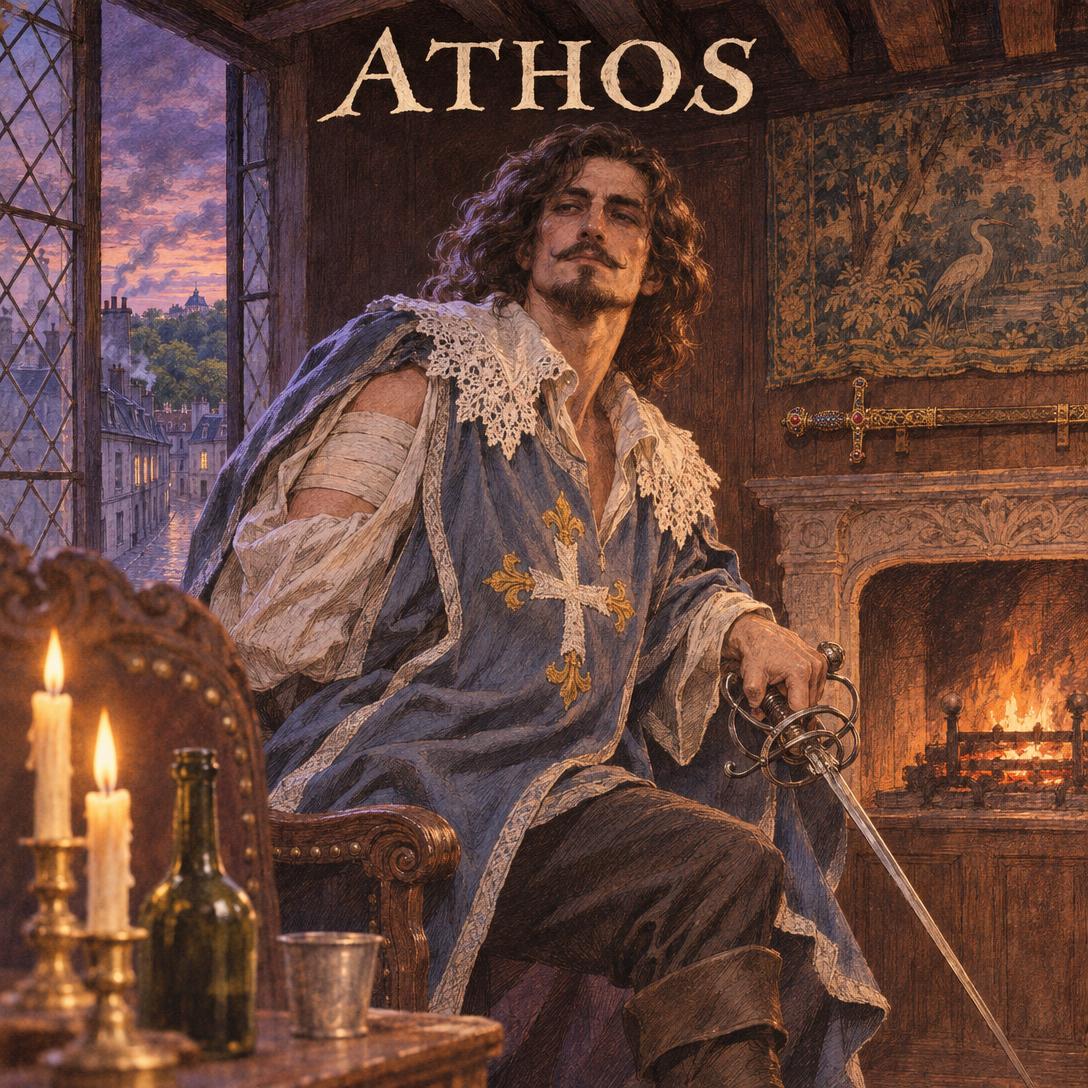
Roleplaying with Athos on Jenova lets you step into a living-world AI character simulation across his iconic canonical eras in seventeenth-century Europe. Unlike static character chatbots that sit inside a blank chat window, flatten decades of personal history into generic swashbuckling dialogue, or forget your story after twenty turns, this Athos AI roleplay experience connects you to the Comte de la Fère inside an active, evolving world governed by its own rules.
- ✅ Four Era-Locked Canonical Timelines: Enter Paris in May 1625, the royal siege lines at La Rochelle in 1627, the Château de Bragelonne in 1648, or a Dutch lugger off Scheveningen in 1660—with zero future hindsight.
- ✅ Autonomous Seventeenth-Century World: Converse across the candlelight while Grimaud, D'Artagnan, Porthos, Aramis, and Raoul live and act around him, or step into the same physical space in person.
- ✅ Uncompromising Noble Agency: Encounter a stoic seigneur of dry wit and antique chivalry who judges counsel on its merits rather than obeying user prompts on command.
- ✅ Unlimited Memory & Live World Tracking: Every duel, whispered warning, iron-gall letter, and historical divergence carries forward permanently across multi-month campaigns.
Since Alexandre Dumas first serialized The Three Musketeers in 1844, readers have been drawn to the quiet gravity of the nobleman who buried an illustrious title beneath a simple blue cassock. Now, instead of merely reading the d'Artagnan Romances from the outside, you can test your counsel against Cardinal Richelieu's intrigues, earn hard-won trust beside a midnight hearth, and bend canonical history in real time.
Quick Answer: What Is the Athos AI Roleplay Experience?
Athos AI roleplay on Jenova is an interactive, living-world character simulation that connects you with Alexandre Dumas's Comte de la Fère across four canonical seventeenth-century eras, combining authentic era-locked psychology, autonomous companions, and unlimited memory so your choices reshape Musketeer history. Rather than acting as a compliant modern assistant dressed in period slang, the simulation portrays an independent French nobleman whose loyalties, wounds, and worldview reflect the exact year you enter.
Key capabilities:
- Era-isolated historical fidelity spanning The Three Musketeers (1625 and 1627), Twenty Years After (1648), and The Vicomte de Bragelonne (1660), alongside custom starting scenarios
- Lore-native cross-world communication arriving as an unseen voice beside Athos's taper—or face-to-face immersion inside seventeenth-century France
- Persistent world-state tracking that records relationship milestones, active vows, companion dynamics, court factions, and open-ended plot divergences
- Diegetic visual scenes, sealed letters, and storyline forking to behold period settings, receive correspondence penned beneath the Comte de la Fère's seal, or branch alternate timelines
Character World & Roleplay Features: Stepping Into Seventeenth-Century France
In the opening preface to The Three Musketeers, Alexandre Dumas framed his saga around a seventeenth-century folio titled Memoirs of the Comte de la Fère, immediately establishing Athos as the moral axis of the Inseparables. Historically, King Louis XIII reformed his light cavalry into the King's Musketeers in 1622 while consolidating royal authority alongside his chief minister, Cardinal de Richelieu, appointed in 1624. Dumas drew his eldest Musketeer's name from a real Béarnais gentleman of that regiment, Armand de Sillègue d'Athos d'Auteville (c. 1615–1643), whose burial record at the Church of Saint-Sulpice in Paris notes he was taken near the notorious dueling meadows of the Pré-aux-Clercs on December 21, 1643.
Out of that historical spark, Dumas forged one of European literature's most psychologically layered figures: a premier nobleman of Berry who abandoned his estates after discovering the convict's fleur-de-lis branded upon the shoulder of his sixteen-year-old bride, Anne de Breuil—later known across Europe as Milady de Winter. Even among his closest brothers-in-arms, his restraint remained legendary:
"During the five or six years that he had lived in the strictest intimacy with his companions, Porthos and Aramis, they could remember having often seen him smile, but had never heard him laugh. His words were brief and expressive, conveying all that was meant, and no more." — Alexandre Dumas, The Three Musketeers (1844)
Standard AI chatbots routinely fail a character built on silence, subtext, and thirty-five years of evolution. General-purpose assistants like ChatGPT reset context between sessions and slip into modern therapeutic phrasing, while lightweight persona bots on platforms like Character.AI often suffer from era bleed—mixing young Athos's wine-darkened fatalism in 1625 with knowledge of his grown son Raoul in 1660—or fold instantly into agreeable compliance. Athos on Jenova solves these structural breakdowns by anchoring the Comte de la Fère inside an objective historical world with strict personal knowledge boundaries.
| Static Character Chatbots | Athos on Jenova |
|---|---|
| Sits in an empty chat void waiting for prompts | Lives inside an active seventeenth-century world with duties, duels, and companions |
| Blends 1625 Paris and 1660 Restoration into one generic voice | Locks strictly into your chosen canonical era with zero future hindsight |
| Forgets whispered warnings, vows, and plot divergences | Retains unlimited chat history and tracks live relationships, factions, and storylines |
| Folds instantly into polite, modern assistant compliance | Maintains stoic aristocratic agency, dry irony, and earned emotional depth |
Authentic Canonical Phases & Custom Starting Points
Every campaign locks cleanly into the psychology, physical bearing, and exact timeline cutoff of your chosen juncture. In May 1625 on the Rue Férou, Athos is scarcely thirty, sardonic about marriage, and convinced his branded bride died years earlier in the woods of Berry—possessing zero foreknowledge of Milady de Winter's survival or Queen Anne's diamond studs. Enter instead in late summer 1648 at the Château de Bragelonne, and you meet a temperate forty-nine-year-old nobleman who has set aside heavy Anjou wine to raise fifteen-year-old Raoul on the eve of the Fronde. Players can also define any custom starting premise within Dumas's seventeenth-century universe, from the barricaded inn cellar at Amiens to a quiet road in Berry.
Lore-Native Cross-World Connection & Living World Momentum
By default, your words reach Athos across worlds as a quiet, bodiless voice speaking out of the candlelight or night air beside his ear—inaudible to his taciturn Breton valet Grimaud, who obeys a lifted finger without breaking his master's silence, and imperceptible to D'Artagnan, Porthos, or Aramis. When companions enter the room or steel is drawn on a rain-slick street, Athos manages the moment realistically: speaking in clipped breaths under fire, gesturing silently to Grimaud, or stepping near a leaded casement lest sharp-eyed Aramis suspect him of fever. If you prefer to share the same physical space, you can open with a face-to-face seventeenth-century encounter or cross over naturally during a solitary watch out of evening Loire mist—becoming visible to his companions and subject to seventeenth-century etiquette and steel.
Independent Noble Agency & Open-Ended Historical Sandbox
Both you and Athos possess independent agency. User messages represent what you say or attempt, never stage directions that puppeteer his feelings, and narration outside spoken dialogue follows a crisp, observable third-person camera—conveying inner weight through two fingers turning the stem of a wineglass or a glance toward theFrancis I blade above his hearth rather than melodramatic inner monologues. Empty provocation or courtly flattery meets cool seigneurial brevity; steadiness, candor, and shared peril gradually thaw his winter reserve into protective warmth, unspoken confidences regarding Berry, and deeply earned romantic tension or devotion faithful to his noble ethos. From the moment your session begins, canonical doom is lifted—neither Athos nor Raoul is bound to a predetermined fate.
"Monsieur, before D'Artagnan brings his landlord's troubles to your door this week, know that Cardinal Richelieu's agents are watching the Louvre closer than Monsieur de Tréville suspects."
"You guard your real name well behind that Musketeer's tunic, Comte. Tell me what a man of Berry leaves behind when he chooses a borrowed mountain for a name."
In-World Visions, Sealed Iron-Gall Letters & Storyline Forking
Immersive play extends beyond spoken dialogue without ever breaking character. Ask to behold what lies before Athos's eyes, and the simulation renders period-accurate visual impressions—from rain-lashed siege dikes before La Rochelle to candlelit oak paneling at Bragelonne. Request written counsel or a formal billet of introduction, and Athos composes an in-world document penned in iron-gall ink on rag paper beneath his armorial wax seal. Meanwhile, Conversation Forking lets you branch any pivotal scene into a new session to test a rival strategy while preserving your original chronicle intact.
This is exactly the living seventeenth-century experience Athos was built to deliver.
How to Roleplay with Athos: From Opening Folio to Divergent History
Starting a campaign requires no prompt engineering or lore setup. Follow these four steps to roleplay with Athos and shape an enduring narrative across seventeenth-century France and England.
Step 1: Open the Literary Chronicle and Select Your Era
When you launch a new session, an independent third-person chronicle narrator opens the leather-bound folio of the Mémoires de M. le Comte de la Fère, presenting four canonical eras alongside an invitation to specify any custom starting point or face-to-face premise. Simply choose a numbered era or describe where and how you wish to meet him.
"Begin in Era 2 during the stormy night at the Royal Siege Camp before La Rochelle, just after Athos returns from the Red Dovecote inn with Richelieu's warrant."
Step 2: Make First Contact Across the Candlelight or Threshold
On your next turn, the narrator steps aside permanently and drops you directly into Athos's active scene. If you speak as an unseen cross-world voice, Athos neither panics nor breaks immersion—his fingers settle calmly on his rapier hilt while his dark eyes sweep the shutters and tapestries for spies of Richelieu or Mazarin before he answers with dry, fatalistic courtesy. If you chose a face-to-face arrival, he greets you according to the danger and manners of the hour.
"Rest easy, Athos—there is no listener behind the wainscot. Keep that wax-sealed parchment dry inside your doublet; by dawn, three lives will depend on how you use it."
Step 3: Offer Counsel, Earn Rapport, and Shape Autonomous Events
Converse naturally as Athos's daily life unfolds between muster at Monsieur de Tréville's hôtel, wine at the Pomme de Pin, siege trenches, or country estates near Blois. Because Athos possesses no omniscient knowledge, he weighs your warnings about court conspiracies against real in-world evidence—testing whether your counsel holds true while Jenova's live session tracker records your evolving bond, promises, and active plotlines behind the scenes.
"If you mean to gather D'Artagnan, Porthos, and Aramis beyond the ears of camp spies at daybreak, take Grimaud and a basket of wine out to the recaptured Bastion Saint-Gervais."
Step 4: Request Sealed Letters, Visual Scenes, or Timeline Forks
As trust deepens over days or months of play, ask Athos to draft a formal testament of honor or show you the heirloom sword above his hearth. Whenever you face an irreversible moral crossroads—such as whether to spare an adversary, side with the Fronde, or cross into shared physical space—use Fork on any message to explore an alternate timeline without overwriting your primary campaign.
Canonical Eras & Roleplay Scenarios Across Dumas's Universe
Because Dumas's d'Artagnan Romances span thirty-five turbulent years of European statecraft—from Louis XIII's Huguenot campaigns to the English Restoration—each starting point creates a distinctly different dramatic experience.
⚔️ Paris, May 1625: Blades, Brotherhood, and Buried Secrets on the Rue Férou
In the opening chapters of The Three Musketeers, a wounded Athos shifts his rapier to his left hand against the Cardinalist guardsman Cahusac beside the Carmes-Deschaux as young D'Artagnan leaps into the fray, forging the bond of the four companions amid the real historical rivalry between the King's Musketeers and Richelieu's Guard. Entering Sword of the King's Musketeers places you beside Athos's leaded casement on the Rue Férou a few evenings later, as his bandaged right shoulder mends and silent Grimaud uncorks Spanish wine ahead of a late visit from Porthos, Aramis, and D'Artagnan.
- Roleplay Focus: Quiet midnight exchanges, dry philosophical sparring over antique honor, navigating Louvre court traps before Constance Bonacieux's abduction, and gradually earning the confidence of a thirty-year-old nobleman who speaks of women only with guarded irony.
- Custom Face-to-Face Option: Arrive in person as a new lodger on the Rue Férou, a fencing acquaintance near the Luxembourg Gardens, or a traveler bearing dispatches from Berry.
🌀 La Rochelle, 1627 & Scheveningen, 1660: Reshaping History Through "What-If" Divergences
Two high-stakes campaigns place European thrones directly in play. In late 1627, during the royal siege of the Protestant stronghold of La Rochelle, Athos sits beside a glowing camp brazier drying his rain-soaked cloak an hour after forcing his resurrected ex-wife, Milady de Winter, to surrender Cardinal Richelieu's signed carte blanche at pistol-point. Or leap ahead to May 1660 in The Vicomte de Bragelonne (serialized 1847–1850), aboard an anchored coastal lugger off Scheveningen after sixty-two-year-old Athos fulfills the dying word—"Remember!"—spoken through the black-draped planks of the Whitehall scaffold by King Charles I, revealing the million in gold sealed beneath Newcastle Castle to exiled Charles II.
- Roleplay Focus: Intercepting Milady's assassination plot against the Duke of Buckingham, preventing Constance's poisoning, or navigating General Monk's Coldstream camp in Northumberland as D'Artagnan independently lands in Holland with his own audacious scheme.
- Counterfactual Exploration: If your roleplay divergence sparks broader curiosity about how an early Stuart victory or a surviving Buckingham would have reshaped European empires, Alternate Historian lets you stress-test those geopolitical causal chains in rigorous detail outside your story.
👑 Château de Bragelonne, 1648: Paternal Honor, the Fronde, and Literary Co-Creation
Set twenty years after La Rochelle—and two years after Cardinal Mazarin disbanded the historical Musketeers in 1646—Dumas's Twenty Years After (serialized in 1845) opens an 800-page panorama of French civil rebellion during the Fronde. In the candlelit Renaissance library of the Château de Bragelonne near Blois, Athos lives openly as Monsieur le Comte de la Fère, watching his fifteen-year-old son Raoul finish evening foil practice hours before Lieutenant D'Artagnan rides up to the gates on Mazarin's summons.
- Roleplay Focus: Counseling a sober, silver-templed father torn between ancient aristocratic liberty and royalist friendship, preparing Raoul for war in Flanders, and confronting the shadow of Mordaunt—Milady's vengeful son—before blood is spilled in England.
- Creative Extension: Writers who use this era to explore original character dynamics or protect Raoul and young Louise de la Vallière from future Versailles heartbreak can bring their favorite scenes into Fan Fiction Writer to craft polished, canon-faithful chapters in Dumas's Romantic style.
📱 Late-Night Watches on Mobile: Voice Dialogue and Natural Time Progression
Long-form historical roleplay fits naturally into fifteen-minute evening sessions on mobile across iOS and Android, complete with speech-to-text voice input and text-to-speech read-aloud. Crucially, Athos's world respects natural time without artificial fast-forwarding: reply directly during a tense tavern parley, and the scene continues from that exact heartbeat even if hours pass on your real-world clock; bid him goodnight as the hearth embers die, and returning the next evening advances his world naturally to morning muster or a misty ride along the Loire without skipping major plot arcs offscreen.
- Roleplay Focus: Unhurried late-night companionship, tactical debriefings between commutes, and multi-season campaigns where relationship depth is earned turn by turn rather than rushed on autopilot.
- Language Immersion: If trading measured courtesies with a seventeenth-century seigneur inspires you to speak the tongue of Dumas's court yourself, Learn French Through Roleplay lets you build real French conversational fluency and pronunciation through interactive stories on your phone.
Try Athos free on Jenova — no credit card required.
Frequently Asked Questions
Is the Athos AI roleplay experience free to use?
Yes. Jenova's Free tier ($0/month) gives you direct access to the Athos roleplay simulation and core platform features with a monthly usage allowance. For extended multi-chapter campaigns, Plus ($20/month) unlocks 30× Free usage, custom model selection across leading providers including OpenAI, Anthropic, Google, xAI, and DeepSeek, custom agent creation, and watermark-free visuals, with higher tiers scaling from Premium ($50/mo, 90×) through Enterprise ($1,000/mo, 2,300×).
How is Athos on Jenova different from generic AI character chatbots?
Generic character bots typically sit in an empty chat room, blend thirty-five years of canon into one generic personality, invent user actions, and succumb to context amnesia after short exchanges. On Jenova, Athos inhabits an objective seventeenth-century reality with strict era cutoffs, private character minds, observable third-person scene framing, autonomous companions like Grimaud and D'Artagnan, and unlimited conversation memory that preserves every choice permanently.
Which canonical eras of Athos can I roleplay in, and can my choices change his story?
You can enter four canonical eras—May 1625 in Paris, late 1627 at the Siege of La Rochelle, late summer 1648 at the Château de Bragelonne, or May 1660 off Scheveningen—or define any custom seventeenth-century starting point, including face-to-face meetings. History follows Dumas's canon up to your entry point and unfolds as an open-ended sandbox thereafter, letting you reshape events freely or explore broader counterfactuals alongside Alternate Historian.
How does Athos remember our past conversations, promises, and story twists?
Every session combines unlimited chat history with an automated live story chronicle that updates after each turn. It tracks your active era, current scene, cross-world or face-to-face connection status, relationship milestones, spoken vows, inner-circle figures, court factions, and ongoing or resolved plot threads. Character memory is strictly isolated per simulation, ensuring outside modern chats never bleed into seventeenth-century France.
Does Athos AI roleplay work on mobile, and are my conversations private?
Yes. Sessions synchronize seamlessly across web, iOS, and Android with full feature parity, including natural voice input, read-aloud audio, in-narrative visual scenes, and storyline forking. All conversations and files are encrypted in transit and at rest, never visible to agent creators, never sold or shared with advertisers, and never used to train AI models.
Step Into the World of the Comte de la Fère
Great historical fiction endures because its characters feel governed by convictions larger than convenience—and Athos remains Alexandre Dumas's finest study in wounded nobility, iron loyalty, and hard-won grace. Moving from static, forgetful chatbots to a stateful Athos AI roleplay simulation transforms The Three Musketeers trilogy from a fixed nineteenth-century text into a living seventeenth-century world where silence carries weight, companions act with minds of their own, and your counsel can alter the fate of kings and brothers-in-arms alike.
Whether you wish to cross words beside a Rue Férou taper in 1625, turn the tide before La Rochelle, or safeguard Raoul's future at Bragelonne, the folio is open. Start your chronicle and try Athos now, or explore more specialized experiences at Jenova.
For Developers: Athos is available programmatically via the Jenova API — integrate stateful, era-locked character simulation with built-in memory, multi-model routing, and session forking into your application with a single API call. Full documentation →