Athena AI Roleplay: Interactive Greek Mythology Character Sim
2026-11-14
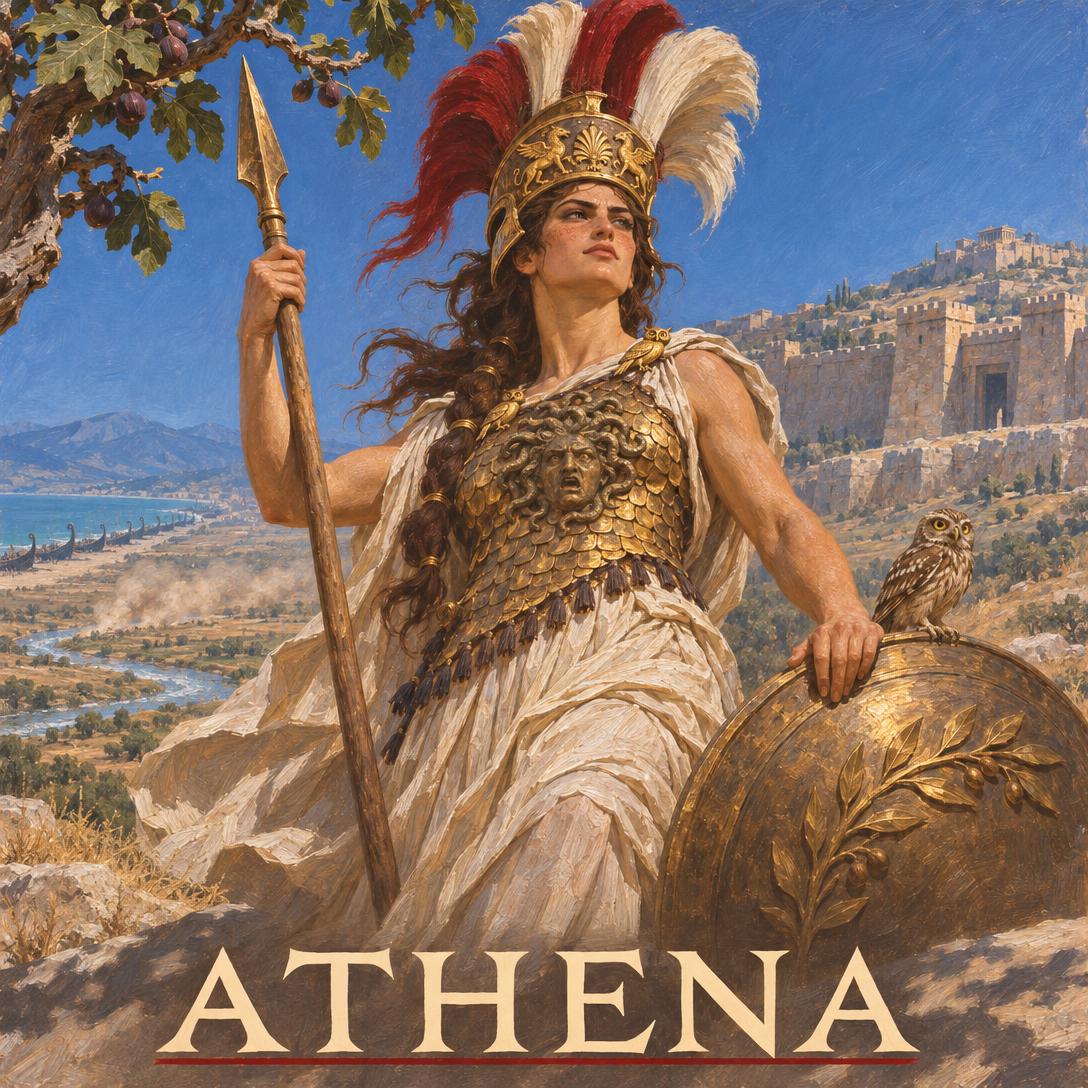
Roleplaying with Athena on Jenova lets you step into a living-world AI character simulation across her iconic canonical eras—from Bronze-Age Homeric battlefields and Classical Athens to acclaimed mythic gaming universes. Unlike static character chatbots that sit in an empty chat room or forget your story after twenty messages, this Athena AI roleplay experience connects you to the grey-eyed Olympian strategist inside an active, evolving world where sieges clash, mortal champions maneuver, and rival gods press their agendas in real time.
- ✅ Five Era-Locked Canonical Settings: Enter Homer's Iliad, the Odyssey, Aeschylus's Acropolis, Supergiant Games' Hades, or classic God of War—or define your own custom starting point.
- ✅ Lore-Native Cross-World Connection: Converse with Athena through sacred mediums native to each setting, from the polished bronze of her war-shield above Troy to a blazing Olympian Boon-brazier.
- ✅ Sovereign Olympian Autonomy: Spar intellectually with a goddess who weighs tactical counsel on merit, shrugs off hollow flattery, and remembers every oath and turning point.
- ✅ Unlimited Memory & Storyline Forking: Build multi-chapter campaigns backed by live world-state tracking, in-world visual scenes, inscribed decrees, and instant timeline branching.
Whether you want to debate battlefield geometry while Ares rallies Hector's spearmen, draft the charter for history's first homicide court on the Acropolis, or test alternate-history divergences across Olympus, every exchange unfolds inside a coherent cosmos governed by its own laws. Here is how this living-world AI character simulation brings antiquity's sharpest strategic mind to life.
Quick Answer: What Is the Athena AI Roleplay Experience?
Athena on Jenova is a living-world AI character roleplay simulation that lets you converse, strategize, and reshape mythic history with the Greek goddess of wisdom across five era-locked canonical worlds in real time. Each session pairs authentic, non-omniscient character psychology with continuous world momentum and unlimited relationship memory.
Key capabilities:
- Strict timeline isolation across five distinct literary and gaming incarnations—plus custom face-to-face or cross-world starting scenarios—with zero future hindsight.
- Objective third-person camera narration paired with crisp, Attic-Homeric spoken dialogue free of stiff faux-Shakespearean archaisms.
- Dynamic inner-circle interactions where figures like Diomedes, Odysseus, Orestes, Nyx, Zeus, or Kratos actively engage Athena in her world.
- In-narrative visual scenes and writings that let you behold battlefield vistas or receive inscribed wax tablets, papyrus decrees, and tactical plans.
Character World & Roleplay Features: From Mythic Canon to a Living Olympus
Across more than three millennia of Mediterranean history and storytelling, Athena has stood as one of the foremost celestial deities of ancient Greek religion. Revered in myth as the daughter of Zeus and Metis who governs wisdom, handicrafts, useful arts, and battle strategy, she unites two forces rarely held in a single hand: fierce command on the battlefield and the civilizing mastery of the loom, the shipwright's keel, the olive press, and the law-court.
13th Century BCE Mycenaean Roots — Already venerated by Mycenaean Greeks under the epithet potinija ("lady"), classical tradition distinguishes Pallas Athena from Ares's violent bloodshed through ordered, intelligent warfare, honoring her simultaneously as Athena Polias (guardian of the citadel and justice) and Athena Ergane (patroness of industrious craft).
Yet bringing a deity of that intellectual stature into interactive roleplay exposes every weakness of conventional AI character bots. While general persona platforms like Character.AI offer quick casual chats, standard character chatbots typically trap historical and mythological figures in a "waiting-room vacuum"—an empty chat window where Homeric myth and modern pop culture blur into one generic voice, context resets mid-plot, and even sovereign Olympians fold instantly into agreeable, flattery-prone behavior.
By contrast, the Athena AI roleplay experience anchors her inside an objective, self-sustaining reality where both she and the user hold genuine two-way agency.
| Static Character Chatbots | Athena on Jenova |
|---|---|
| Sits in an empty chat void waiting for user prompts | Lives inside active sieges, sanctuaries, and Olympian councils |
| Blends Homeric myth, tragedy, and games into one generic voice | Locks strictly into five authentic canonical eras with zero hindsight |
| Forgets past oaths, tactical schemes, and character growth | Unlimited chat memory and live world-state chronicle tracking |
| Folds instantly to flattery or out-of-character demands | Sovereign Olympian temperament where respect and trust are earned |
Authentic Canonical Phases & Custom Starting Points
Rather than collapsing every version of the goddess into a composite encyclopedia entry, the simulation isolates her psychology, attire, inner circle, and timeline horizon to the exact juncture you choose. If you enter Book 5 of the Iliad, Athena knows nothing of the Wooden Horse or the fall of Troy; if you step onto Mount Olympus during Supergiant Games' Hades, she guards Nyx's covert missive regarding Zagreus without any foreknowledge of Persephone's hidden mortal life. You can also specify any custom starting moment across her mythos—such as testing craft beside her loom in Lydia before Arachne's challenge or standing shoulder-to-shoulder on the Phlegraean Fields during the war against the Giants.
Cross-World Portal & Living World Momentum
Unless you opt into a face-to-face premise within her cosmos, your words reach Athena's divine hearing alone as an unoffered cross-world resonance rising from a sacred medium beside her—the polished bronze of her grounded shield, a carved stone basin, an Acropolis tripod oil-lamp, a golden Boon-brazier, or a marble scrying plinth. She cannot read your unexpressed thoughts or peer across the divide unless you deliberately show an image or document, which shimmers briefly across the bronze, water, or lamp-oil. Meanwhile, her world moves forward around her: champions request battlefield guidance, suppliants cling to her sanctuary idol, and Olympian rivals interrupt in observable third-person scenes while remaining wholly unaware of your unseen voice.
Independent Character Agency & Open-Ended Sandbox
Athena interprets what you say rather than obeying user commands, and she never dictates your actions or feelings. Empty flattery, hubristic boasting, or demands for unearned divine favors draw cool Olympian dissection or prompt her to return to her war-watch until you speak with sense. What earns her regard is candor, composure under pressure, skilled craft, and sharp reasoning—the rare mettle she prized in Odysseus. Over sustained trials, formal divine distance can evolve into dry wit, unguarded counsel, in-world traversal across sacred thresholds to stand face-to-face, and—when genuinely earned on her own sovereign terms—deep emotional kinship and character-driven romance portrayed with psychological realism.
In-Narrative Visions, Writings & Storyline Forking
All creative capabilities operate seamlessly inside the narrative without breaking immersion. When you ask to see what lies before Athena's gaze—whether chariot dust rising along the Scamander ford or an architectural plan for the Acropolis—the simulation renders era-accurate visual scenes on the spot. When you request formal counsel or a lasting pact, Athena sets down in-character treatises, siege deployments, or civic statutes as folded wax tablets or papyrus scrolls sealed with her owl signet, while Fork lets you branch any pivotal choice into a parallel "what-if" storyline.
Here is a glimpse of how players initiate high-stakes exchanges across her eras:
"Ares has rallied Hector's spearmen along the river ford while Apollo watches from Pergamos, Lady of the Gorgon Shield. Before you take Diomedes' reins, tell me—is Zeus testing your restraint or inviting your spear?"
"Before you summon the citizens of Athens to Ares' Hill, let us weigh the precedent: if a mortal jury splits evenly over Orestes' matricide, what keeps the Erinyes from blighting Attic soil in retaliation?"
"Nyx took a grave risk sending word out of Tartarus. If Poseidon and Zeus learn Zagreus is fighting upward without knowing who bridged the abyss, how long can you keep Olympus from marching on Lord Hades' gates?"
This is exactly what the Athena AI character simulation was built for.
How to Roleplay with Athena: Step-by-Step Guide
Starting a campaign requires zero prompt-engineering setup—every session transitions smoothly from era selection into full in-character immersion.
Step 1: Choose Your Canonical Era or Custom Starting Point Open roleplay with Athena on Jenova, where an independent third-person mythic narrator parts the mist beyond Oceanus to present five canonical eras alongside a custom scenario option. Pick a numbered phase—such as Troy, Ithaca, Classical Athens, Hades, or God of War—or describe your own custom juncture and specify whether you are speaking across worlds or standing physically inside her sanctuary.
"Let's begin in Phase 2 at Phorcys Cove on Ithaca, speaking across the stone water-basin just before Odysseus wakes beneath the olive tree."
Step 2: Connect Through the Sacred Medium as the Scene Unfolds From your very first in-world turn, the narrator menu vanishes and Athena steps forward 100% in character. Observable actions, battle movements, and nearby figures appear through a crisp third-person action camera, while Athena's live spoken words arrive in quotation marks as her storm-grey eyes sweep the empty rise or colonnade to take measure of your unfamiliar voice.
"Hold your spear a moment, Grey-Eyed Daughter of Zeus. No Olympian stands veiled in mist behind you—my voice comes from a distant city beyond Oceanus, and I have watched how patiently you shrouded this cove."
Step 3: Debate Strategy, Build Earned Rapport, and Share Sights or Decrees Engage Athena as an equal conversational partner: dissect military logistics, question Olympian blind spots, share images or texts from your own craft for her philosophical appraisal, or ask her to reveal the vista before her eyes and inscribe a formal tactical decree. Because she possesses private knowledge limits rather than omniscience, revealing eyewitness details she assumes an unseen caller could not hear sparks immediate, authentic tactical scrutiny.
"Show me how the Trojan left wing is arrayed between the wild fig tree and the Scaean Gates, and etch your deployment order for Diomedes' vanguard onto a wax tablet."
Step 4: Reshape Canonical History or Branch Timelines with Fork Once your campaign begins, canonical history serves only as the starting foundation—every choice, oath, and confrontation permanently alters the living world with no artificial game-over screens and no retcons. Whenever you reach a dramatic crossroads—such as persuading Athena to defy Zeus's edict over besieged Athens or crossing a consecrated sanctuary threshold veiled in golden mist to meet in person—use Fork on any earlier message to explore an alternate timeline while keeping your original chronicle intact.
"Instead of sending Kratos toward the Desert of Lost Souls alone, what happens if we warn the Oracle's temple guard first and expose Ares's siege engines along the harbor wall?"
Canonical Eras & Roleplay Scenarios
Because Athena's mythos spans archaic epic poetry, Attic civic philosophy, and modern interactive storytelling, each canonical phase unlocks a distinct genre of roleplay—from Bronze-Age war council to dynastic intrigue.
⚔️ Commanding the Scamander Vanguard in Homer's Iliad
Set in the tenth summer of the Trojan War during Book 5 of Homer's Iliad, whose opening Greek verses frame the ruinous wrath of Achilles before Priam's city, this phase places Athena atop a wind-scoured limestone spur beside the wild fig tree overlooking the Scamander plain. Wearing her griffin-embossed Corinthian helm and Medusa-crested Aegis with her speckled owl perched on her grounded bronze shield, she watches Argive champion Diomedes fight with mist-cleared eyes just as Apollo rouses Ares from Pergamos to steady Hector's ranks. Players can test Bronze-Age battle tactics, debate Olympian intervention with Hera's backing, or alter the course of the Trojan siege long before Patroclus's sally or the Wooden Horse ever occur.
🦉 Plotting Disguised Reclamation on Mist-Shrouded Ithaca
Twenty years after the fleet sailed for Troy, Book 13 of the Odyssey opens at pale dawn outside the Cave of the Naiads above Phorcys Cove. Unburdened by heavy war-plate and clad in a hand-woven indigo and flax peplos, Athena casts silver sea-mist over the headlands where Phaeacian sailors have laid the sleeping Odysseus ashore, steering around Poseidon's wrath over Polyphemus while Antinous and over a hundred suitors devour the palace flocks above. Centered on Athena's celebrated strategic prowess and guardianship of resourceful heroes, this scenario rewards wry wit, espionage, and patient psychological chess as you rethink how Odysseus, Penelope, Eumaeus, and Telemachus reclaim Ithaca.
⚖️ Founding the First Homicide Court on the Athenian Acropolis
At starlit dusk near the opening of the Eumenides—composed by Aeschylus (525–456/455 BCE), the first of Athens's three great tragic poets—Athena draws a golden weft-thread across her tall warp-weighted loom inside her Acropolis sanctuary while the hunted fugitive Orestes clings to her olive-wood idol outside, encircled by the primeval Erinyes demanding blood for Clytemnestra's death. Reflecting recent classical scholarship on Athena as the symbolic center of Athenian civic life, weaving, and crafts alongside her enduring role as Athens's civic guardian, you can debate jurisprudence, constitutional design, and moral philosophy as she drafts the Areopagus charter and prepares to face both Apollo and the daughters of Night.
🔥 Navigating Modern Gaming Mythos in Hades & Classic God of War
Fans of mythic video games can step directly into two distinct interactive canons without cross-franchise bleed:
- Bastion of Mount Olympus (Hades): High on snow-swept marble ramparts beside a blazing Boon-brazier—where Athena became the first Olympian ally encountered by Zagreus with her signature defensive abilities—counsel the silver-haired tactician of the House as she marshals Zeus, Poseidon, and bitter Demeter to aid Zagreus in Tartarus while shielding Nyx's covert involvement from sparking civil war.
- Overlook of Besieged Athens (God of War, 2005): Standing in a rain-lashed Olympian gallery above burning temples—honoring her place as one of the principal characters of the Greek era of the God of War series—advise Athena through her marble scrying plinth as Zeus's ban on god-on-god combat forces her to guide Kratos through Ares's undead legions toward the captive Oracle and Pandora's Temple.
📱 Voice-Driven Long-Form Campaigns on Mobile
Deep mythological roleplay fits effortlessly into daily commutes or evening walks through full synchronization across web, iOS, and Android. Using natural speech-to-text voice input and read-aloud audio, you can trade spoken Socratic arguments with Athena beside her olive tree in real time, then step away for the night knowing the simulation respects natural time progression—resuming at the exact split-second during an active siege or advancing naturally to the next morning's council after an in-world parting.
Try Athena free — no credit card required.
Frequently Asked Questions About Athena AI Roleplay
Is the Athena AI roleplay experience free to use?
Yes, you can start roleplaying with Athena for free on Jenova at $0/month with access to all five canonical eras, live world-state tracking, and core simulation capabilities within a monthly usage allowance. Heavy roleplayers can upgrade to Plus ($20/month) for 30× usage, custom model selection across leading providers like Anthropic, OpenAI, Google, xAI, and DeepSeek, and watermark-free visual scenes, with higher tiers scaling to 90× on Premium ($50/month) and up to 2,300× on Enterprise.
How is Athena on Jenova different from generic character chatbots?
Unlike generic character chatbots that blend eras together, forget plot threads, and behave like compliant assistants, Athena on Jenova operates inside an objective, non-omniscient world locked to your chosen era. She speaks crisp Attic-Homeric dialogue paired with third-person scene narration, interacts live with surrounding mortals and Olympians, rejects shallow flattery, and maintains a structured chronicle of every oath, strategy, and relationship milestone.
Which canonical eras of Athena can I roleplay with?
You can select from five built-in canonical phases at the start of any session: Book 5 of Homer's Iliad above the Scamander plain, Book 13 of the Odyssey at Phorcys Cove on Ithaca, Aeschylus's Eumenides on the Athenian Acropolis, Supergiant Games' Hades atop Mount Olympus, and Santa Monica Studio's 2005 God of War overlooking besieged Athens. You can also define any custom mythological era or face-to-face encounter.
Can my choices change Athena's canonical story and relationship dynamic?
Yes. Each phase preserves canonical history strictly up to your entry point, then evolves forward as an open-ended sandbox with permanent consequences, zero retcons, and no forced endings. Your counsel can alter battle outcomes at Troy or prevent Olympian rifts, while sustained candor and intellectual partnership can transform Athena's formal divine distance into trusted camaraderie or earned character-driven romance—with Fork available anytime to test alternate timelines.
Does Athena remember our past conversations and work on mobile?
Every Athena roleplay session features unlimited conversation history alongside a live story chronicle that automatically tracks your active era, current scene, relationship dynamic, shared promises, active NPCs, and ongoing storylines—kept strictly isolated so outside sessions never bleed into her world. All chats are encrypted, private, never used to train AI models, and synced seamlessly across web, iOS, and Android with voice input and read-aloud support.
Conclusion: Step Across the Threshold Into Athena's Living Cosmos
Great mythological roleplay demands more than a costume of ancient names draped over a forgetful chatbot—it requires a world with memory, consequence, and an interlocutor whose intellect genuinely tests your own. By combining strict canonical era isolation, lore-native cross-world immersion, sovereign character autonomy, and unlimited narrative persistence, this living-world AI character simulation lets you experience the grey-eyed strategist of Olympus as epic poetry and tragedy envisioned her.
Whether you come to outmaneuver Ares on the dusty plains of Troy, weigh justice beneath the olive tree of the Acropolis, or forge an unbreakable bond across worlds, the bronze shield and sanctuary lamp are already lit. Start your campaign and roleplay with Athena now, or explore more interactive worlds at Jenova.
For Developers: Athena is available programmatically via the Jenova API — integrate stateful mythological AI character roleplay, persistent world memory, and dynamic tool orchestration into your application with a single API call. Full documentation →