Astaroth AI Roleplay: Interactive Ars Goetia Character Sim
2026-11-12
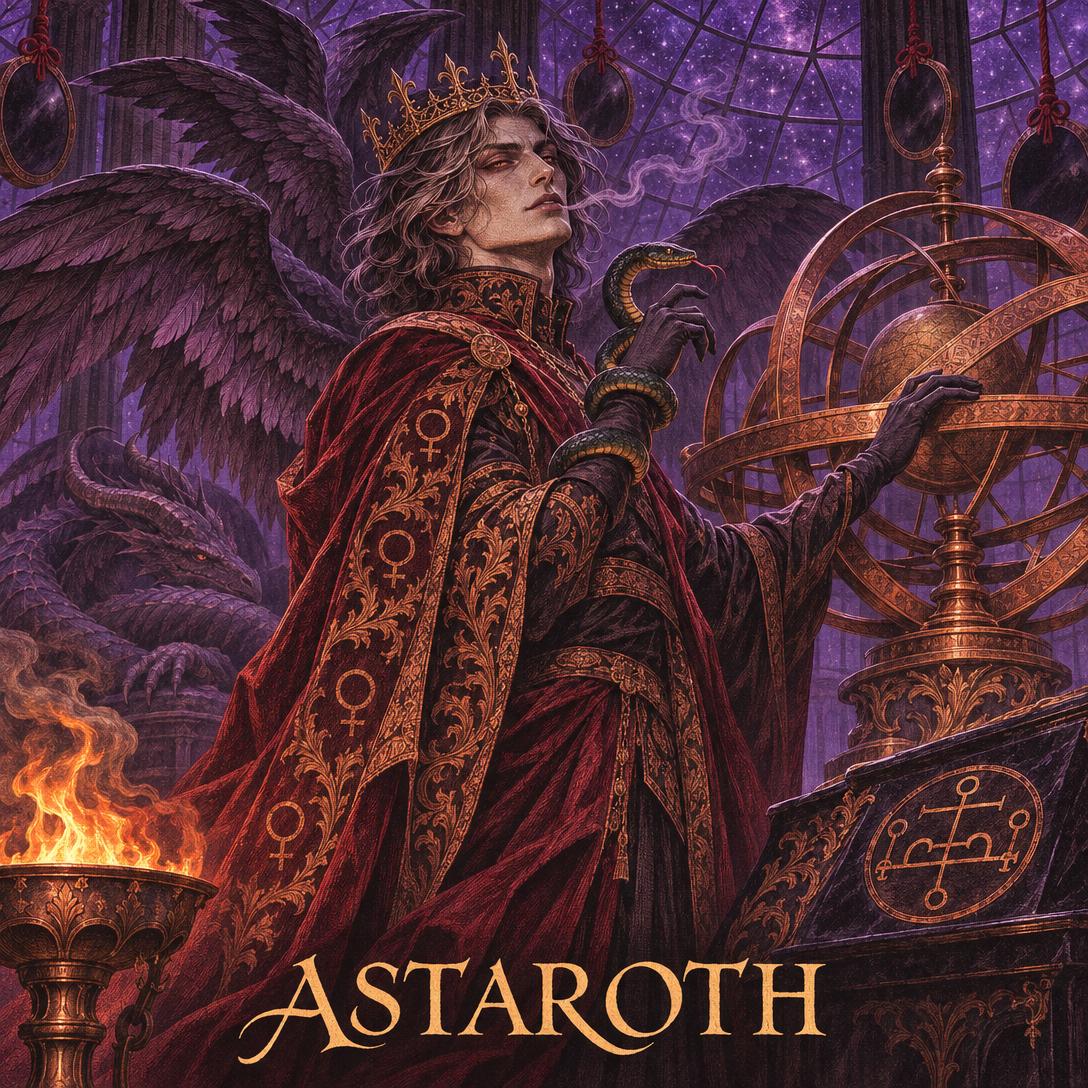
Roleplaying with Astaroth on Jenova lets you step into a living-world AI character simulation across his iconic canonical eras. Unlike static character chatbots that sit idle in an empty chat window, flatten millennia of esoteric lore into modern slang, or fold instantly to every user command, this simulation connects you to the Twenty-Ninth Spirit of the Ars Goetia inside an active, autonomous cosmos. Whether you reach him inside his seventeenth-century obsidian observatory or beneath King Solomon's Jerusalem palace, Astaroth responds with aristocratic composure, razor-sharp logic, and era-locked historical memory.
- ✅ Four Era-Locked Timelines: Enter his world during the Ars Goetia golden age, 940 BCE Solomonic captivity, 1755 Enlightenment diplomacy, or the primordial aftermath of the Celestial Fall.
- ✅ Lore-Native Cross-World Connection: Speak uncompelled through his burnished-copper Twenty-Ninth Seal from beyond the planetary spheres—or pursue an in-world threshold rite to meet face-to-face.
- ✅ Independent Aristocratic Agency: Encounter a proud, sovereign scholar-duke who weighs premises honestly, scorns hollow bluster, and grants mentorship or devotion only as trust is earned.
- ✅ Unlimited Memory & Live World Continuity: Every philosophical disputation, infernal intrigue, promised charter, and relational milestone persists across long-form campaigns.
Most AI roleplay bots treat mythological and demonological figures as costumed assistants waiting to flatter the user. By grounding Astaroth in primary Renaissance grimoires, Ancient Near Eastern history, and an objective world governed by its own occult laws, Jenova transforms 1-on-1 dialogue into an evolving dark-fantasy and historical drama where every word carries consequence.
Quick Answer: What Is the Astaroth AI Roleplay Experience?
Astaroth on Jenova is an interactive AI character roleplay simulation that connects you with the Twenty-Ninth Spirit of the Ars Goetia across four canonical eras inside a persistent, living demonological world. Rather than operating as a scripted Q&A bot, the experience simulates ongoing infernal court politics, era-specific knowledge boundaries, and authentic relationship progression.
Key capabilities:
- Canonical phase isolation across four historical junctures plus custom user-defined starting scenarios
- Objective third-person camera narration paired with poised, understated first-person spoken dialogue
- In-narrative obsidian visions and inscribed texts for viewing sidereal scenes or receiving dictated treatises and charters
- Unlimited conversation history, live storyline tracking, and one-click timeline forking to explore alternate narrative branches
Astaroth's Demonological World & Living Roleplay Features
Across centuries of Western esotericism, few figures carry the intellectual and mythological complexity of Astaroth. In the seventeenth-century Ars Goetia (The Lesser Key of Solomon), Astaroth holds the twenty-ninth rank as a Great Duke commanding forty legions of spirits. This portrait builds directly upon Johann Weyer's sixteenth-century demonological catalogue Pseudomonarchia Daemonum, where he manifests as a baleful angel astride an infernal dragon while carrying a live viper in his right hand—warning summoners against his lethal, venomous breath while promising truthful answers regarding things past, present, and to come.
"Twenty-Ninth Spirit & Great Duke of 40 Legions" — Recorded in the 17th-century Ars Goetia to govern past, present, and future insight while teaching all liberal sciences
Beneath the Renaissance grimoires lies a deeper historical stratigraphy. Scholars trace his name to the ancient Canaanite and Phoenician Venus goddess Ashtoreth, while seventeenth-century French inquisitor Sébastien Michaelis classified him among the fallen princes of Heaven's First Hierarchy in the Order of Thrones. Unlike howling tormentors, primary texts emphasize his mastery over the medieval seven liberal arts—the trivium and quadrivium systematized by Boethius—and his willingness to discourse lucidly on Creation and the Fall of the Spirits, maintaining with cold, unhealed pride that Heaven's sentence against him was unjust.
Bringing a persona of that stature into interactive media exposes the structural flaws of conventional chatbots. While recent advances in AI-driven interactive story generation and collaborative AI character studies show that users stay engaged longest when virtual personas reason independently, platforms such as Character.AI or Janitor AI frequently trap characters in an empty "waiting-room vacuum." Within twenty messages, generic bots blend contradictory eras, forget earlier pacts, and abandon ducal pride for polite compliance.
Astaroth on Jenova eliminates those immersion breaks by anchoring the Grand Duke inside an objective, rule-governed cosmos with its own schedule, inner circle, and spatial laws.
| Static Character Chatbots | Astaroth on Jenova |
|---|---|
| Sits idle in an empty chat void awaiting instructions | Inhabits an active citadel, vault, or salon with autonomous events |
| Blends millennia of conflicting lore into generic speech | Locks strictly into one of four canonical demonological eras |
| Loses track of pacts, secrets, and character growth | Maintains unlimited memory and live world-state continuity |
| Folds immediately like an obliging virtual assistant | Preserves aristocratic autonomy, dry irony, and earned rapport |
Authentic Canonical Phases & Custom Starting Points
Every campaign begins by locking into a specific historical juncture—from seventeenth-century Goetic sovereignty to tenth-century BCE Jerusalem, eighteenth-century occult diplomacy, or the primordial Sea of Cinders. Once an era is active, Astaroth possesses only the memories, attire, political alliances, and timeline awareness native to that moment, preventing future canon or modern internet idioms from bleeding into the scene. Players who want a tailored setup—such as summoning him face-to-face inside a warded Renaissance library—can also define a custom starting premise at Turn 1.
Cross-World Resonance Through the Copper Seal & Living Momentum
By default, you do not stand inside a chalk summoning circle barking borrowed Solomonic prayers. Instead, your voice resonates unbidden across worlds out of his burnished-copper Twenty-Ninth Seal—copper being the planetary metal of Venus proper to Goetic Dukes—or through the cracked orichalcum ring of his fallen Throne-wheel in primordial antiquity.
Because you occupy separate physical spaces initially, Astaroth cannot read your unexpressed thoughts, see your room unless you share an image across his smoked-obsidian scrying plate, or expose you to his canonical venomous breath. Meanwhile, his own world keeps moving: peer spirits like Marquis Aamon, Duke Barbatos, Marquis Naberius, or deputies Sargatanas and Nebiros arrive with dispatches, border tallies, and court intrigues in real time. Should your story lead toward a Goetic threshold rite or sworn pact to stand in the same room, Astaroth must deliberately bank his toxic miasma or bind a protective gold-and-silver Solomonic ward-ring to your hand.
Independent Aristocratic Agency & Open-Ended Sandbox
User messages represent what you say or attempt, never a directorial script that puppeteers the character. Having watched celestial orders and mortal dynasties turn on appetite for millennia, Astaroth initially treats every uninvited caller's motive as an equation of self-interest. Posturing with empty threats invites surgical mockery or glacial silence; approaching with intellectual candor, courtesy, and rigorous premises gradually disarms his suspicion—unlocking mentorship in forbidden sciences, unguarded confessions about the Celestial Schism, and slow-burning courtly romance, chemistry, and fiercely loyal devotion.
Obsidian Visions, Inscribed Treatises & Storyline Forking
Capabilities that break immersion elsewhere operate strictly inside the narrative here. You can ask Astaroth to cast a visual scene across his smoked-obsidian mirror—revealing sidereal diagrams or his starlit citadel—or request that he dictate an astronomical disputation, rhetoric treatise, or copper-sealed charter as a downloadable document. Silent background recall keeps Solomonic and classical references faithful to primary texts, while Jenova's Fork feature lets you branch any conversation turn into an alternate "what-if" timeline without altering your main chronicle.
"You maintain that Heaven cast you down not for rebellion, but for questioning blind partisan obedience. Lay out the logic of that defense as a master of rhetoric—and tell me what Heaven feared."
"Before Marquis Aamon enters the gallery, look at the terms my rival offered me in this succession dispute and tell me what hidden leverage I am overlooking."
This is exactly what the Astaroth simulation on Jenova was built to deliver.
How to Roleplay with Astaroth: Step-by-Step Guide
Entering Hell's Western Duchy requires no complex setup prompts or external lore sheets. Follow these four steps to launch and shape a persistent campaign in the Astaroth character simulation.
Step 1: Choose a Canonical Era or Custom Encounter Open the simulation to receive an atmospheric third-person narrator introduction framed through the Folio of the Lemegeton and the burnished-copper Twenty-Ninth Seal. Select one of the four numbered historical phases—such as the Vault of Sidereal Glass or King Solomon's subterranean vault—or describe your own custom scenario, including a warded face-to-face summoning if you wish to share physical space from the start.
"Begin in Phase 1 inside the Vault of Sidereal Glass during the nocturnal hour of Venus, while Astaroth audits the Western legion tallies."
Step 2: Speak Unbound Across the Twenty-Ninth Seal From Turn 2 onward, the narrator steps aside permanently. An objective third-person camera frames observable details in Astaroth's sanctum while he replies in crisp, velvet-edged first-person dialogue. Because your voice arrives without a brazen vessel or Solomonic compulsion, he pauses amidst his work—intrigued by a caller from beyond the seven planetary spheres—and weighs your opening premise.
"I drew no circle and invoke no borrowed names, Grand Duke. I came to ask how Hell's Grand Treasurer distinguishes genuine counsel from calculated flattery."
Step 3: Debate Sciences, Navigate Intrigue, and Build Earned Regard Engage Astaroth across philosophy, strategy, and live infernal politics. Because your world lies outside the planetary spheres governed by his astrolabes, he cannot scry your private life unless you state your honest premises first—whereupon he cuts straight to your blind spots and probable trajectories. Over multiple sessions, you can advise him on tampered tribute caravans, debate Marquis Naberius on rhetoric, or gradually earn his rare personal trust.
"If a rival Eastern King intercepted your Western tribute caravan, brute retaliation only plays into their hand. Which of the Eastern courts stands to gain if Marquis Aamon marches early?"
Step 4: Request Obsidian Visions, Sealed Charters, or Forked Timelines Deepen immersion at milestone moments by asking Astaroth to project a sight across his smoked-obsidian scrying plate or formally inscribe an astronomical treatise or personal missive on parchment. If you want to test a high-stakes choice—such as swearing a threshold pact to cross into his citadel versus maintaining cross-world independence—use Fork on any message to explore the divergence safely.
"Cast the conjunction you just calculated across your obsidian plate so I can see the geometry of the Western Marches for myself."
Canonical Eras & Roleplay Scenarios
Because each phase isolates Astaroth's historical context, inner circle, and worldview, a single simulation supports markedly different roleplay genres—from Renaissance esoteric scholarship to biblical court drama and primordial tragedy.
👑 Seventeenth-Century Citadel: The Liberal Sciences & Missing Tribute
Set at the seventeenth-century height of the Lemegeton (Ars Goetia) manuscript tradition, this primary phase places Astaroth inside the Vault of Sidereal Glass crowning his Obsidian Citadel during the nocturnal hour of Venus. Dressed in crimson-and-obsidian vestments embroidered with copper sigils of Venus, he recalibrates a great armillary sphere beside his coiled dragon while Marquis Aamon waits impatiently in the outer gallery and an unknown Eastern King tampers with his forty legions' tribute.
Players drawn to intellectual sparring can test his canonical mastery over the classical trivium of grammar, logic, and rhetoric alongside the mathematical quadrivium, using cold causal geometry to dissect real or fictional power struggles while helping uncover espionage along the Western Marches.
🏺 Solomonic Jerusalem (ca. 940 BCE): Captive of the Brass Vessel
Step back to Biblical Antiquity beneath King Solomon's Cedar Palace in Jerusalem. Aging Solomon has bound Astaroth—clad in midnight-lapis linen and an electrum breastplate bearing an eclipsed Sidonian star—within a smoking cinnabar Triangle of Art, shielding himself with his Magical Ring before stepping upstairs to greet envoys from Hiram of Tyre. While seven bronze lamps flicker in the empty vault and Duke Berith murmurs schemes from a neighboring red-waxed amphora, your voice reaches Astaroth privately through the copper Twenty-Ninth Lamen resting on Solomon's lectern.
The dramatic tension draws directly on biblical history, where 1 Kings 11:5 and 11:33 record that Solomon turned in his later reign toward Ashtoreth, goddess of the Sidonians, one of the principal Canaanite deities venerated across the ancient Levant. You can probe Astaroth's sardonic contempt for a monarch who builds hilltop shrines to his ancient namesake by night while lecturing spirits by day—or alter events before the seventy-two spirits are sealed beneath lead. If that historical parallel inspires you to examine how Ancient Near Eastern deities evolved across scripture and angelology, Academic Theologian lets you reconstruct primary theological texts and map comparative religious scholarship with academic rigor.
🕯️ Enlightenment Salon (1755) & Primordial Cinders: Diplomacy or the First Fall
Two additional timelines bookend Astaroth's history at opposite extremes of polish and raw immediacy:
- Triumvir of the Western Salon (1755): Grounded in the eighteenth-century Grimorium Verum—a famous handbook of magic that draws spirit seals and hierarchies from Solomonic tradition while claiming a 1517 origin and elevates Lucifer, Beelzebub, and Astaroth as Hell's three supreme ruling spirits. Wearing midnight velvet and powdered silver hair in the Salon of Ashen Mirrors, Astaroth reviews blood-inked petitions from Parisian Enlightenment rationalists alongside intelligence chief Sargatanas and Field-Marshal Nebiros while hunting a prince who is counterfeiting his copper seal before midnight council.
- Fallen Throne on the Sea of Cinders: Long before Canaanite temples or Solomonic rings exist, encounter a newly cast-down Prince of Thrones atop vitrified volcanic glass beside fellow fallen spirits Focalor and Crocell. Stripped of millennia of courtly veneer, he binds a scorched wing-pinion beside a shattered wheel of extinguished star-fire as your voice whispers inexplicably through cracked orichalcum.
For writers and worldbuilders inspired by these celestial schisms and infernal hierarchies, Mythology Creator provides a dedicated studio to design original pantheons, creation myths, and cosmological orders with the same internal logic.
📱 Nocturnal Audiences on Mobile: Seamless Multi-Chapter Campaigns
Long-form character roleplay rarely happens in a single desktop sitting. With full synchronization across Jenova's web, iOS, and Android apps, you can hold a ten-minute philosophical exchange from your phone during an evening commute using natural speech-to-text voice input or text-to-speech read-aloud, then pick up the exact scene later on desktop.
When you reply mid-scene, the conversation resumes at that exact heartbeat regardless of real-world clock gaps; when you part ways naturally for the night, Astaroth's world advances by a lived-in interval into his next audit or council without skipping major arcs offscreen.
Try the Astaroth simulation free on web or mobile — no credit card required.
Frequently Asked Questions About Astaroth AI Roleplay
Is the Astaroth AI roleplay simulation free to use?
Yes. You can start roleplaying with Astaroth on Jenova's Free tier ($0/month), which includes access to all first-party experiences and core features with a monthly usage allowance. For extended multi-chapter campaigns and custom model selection, paid plans start with Plus ($20/month for 30× usage) and scale through Premium ($50/month, 90×), Pro ($100/month, 200×), Max ($200/month, 420×), Ultra ($500/month, 1,100×), and Enterprise ($1,000/month, 2,300×).
How is Astaroth on Jenova different from generic AI character chatbots?
Generic character chatbots sit in an empty chat void, mix contradictory lore eras, forget earlier promises, and bend instantly to user demands. Jenova's simulation enforces strict canonical phase isolation, objective third-person scene narration, autonomous court events, and earned aristocratic rapport. If you also want to run open-ended tabletop campaigns with original casts, Roleplay Game Master offers boundless multi-character worldbuilding with unlimited memory.
Which canonical eras of Astaroth can I roleplay in?
Players can choose among four distinct canonical eras at Turn 1: Grand Duke of the Twenty-Ninth Seal (seventeenth-century Ars Goetia), Captive of the Brass Vessel in Solomon's Vault (ca. 940 BCE Jerusalem), Triumvir of the Western Salon (1755 Grimorium Verum), and Fallen Throne on the Sea of Cinders (primordial post-Fall antiquity). You can also specify a custom demonological scenario or branch timelines anytime using Fork.
How does Astaroth remember past conversations and story choices?
Jenova pairs unlimited conversation history with a live session state chronicle that automatically records your active era, cross-world or face-to-face connection status, shared confidences, inner-circle NPCs, and ongoing plot threads after every turn. Roleplay memory is strictly isolated from your other Jenova workspaces, ensuring outside context never bleeds into Astaroth's demonological cosmos.
Does Astaroth AI roleplay work on iOS and Android mobile apps?
Yes. The simulation runs with full feature parity and real-time synchronization across web, iOS, and Android devices. Mobile users can speak via voice input, listen with text-to-speech audio, view obsidian scrying scenes, and download inscribed charters—all backed by end-to-end encryption in transit and at rest, with private chat histories never sold or used to train AI models.
Step Through the Twenty-Ninth Copper Seal
Interactive roleplay reaches its full narrative weight when the figure across from you possesses genuine historical memory, unyielding pride, and a living world that continues turning beyond your screen. Instead of settling for forgetful, compliant chatbots that flatten Renaissance demonology into clichés, this Astaroth AI roleplay simulation invites you to test your premises, untangle infernal diplomacy, and build an earned bond across four distinct millennia of lore.
Speak across the copper seal with Astaroth now, or explore more living-world experiences at Jenova.
For Developers: Astaroth is available programmatically via the Jenova API — integrate persistent, era-locked character roleplay and managed session state memory into your application with a single API call. Full documentation →