AI Assistant Creator Platform: Build Custom AI Agents Without Code
2026-01-08
The demand for custom AI solutions has exploded. By 2026, 40% of enterprise software applications will include task-specific AI agents—up from less than 5% in 2024. Yet most businesses lack the technical resources to build these systems from scratch.
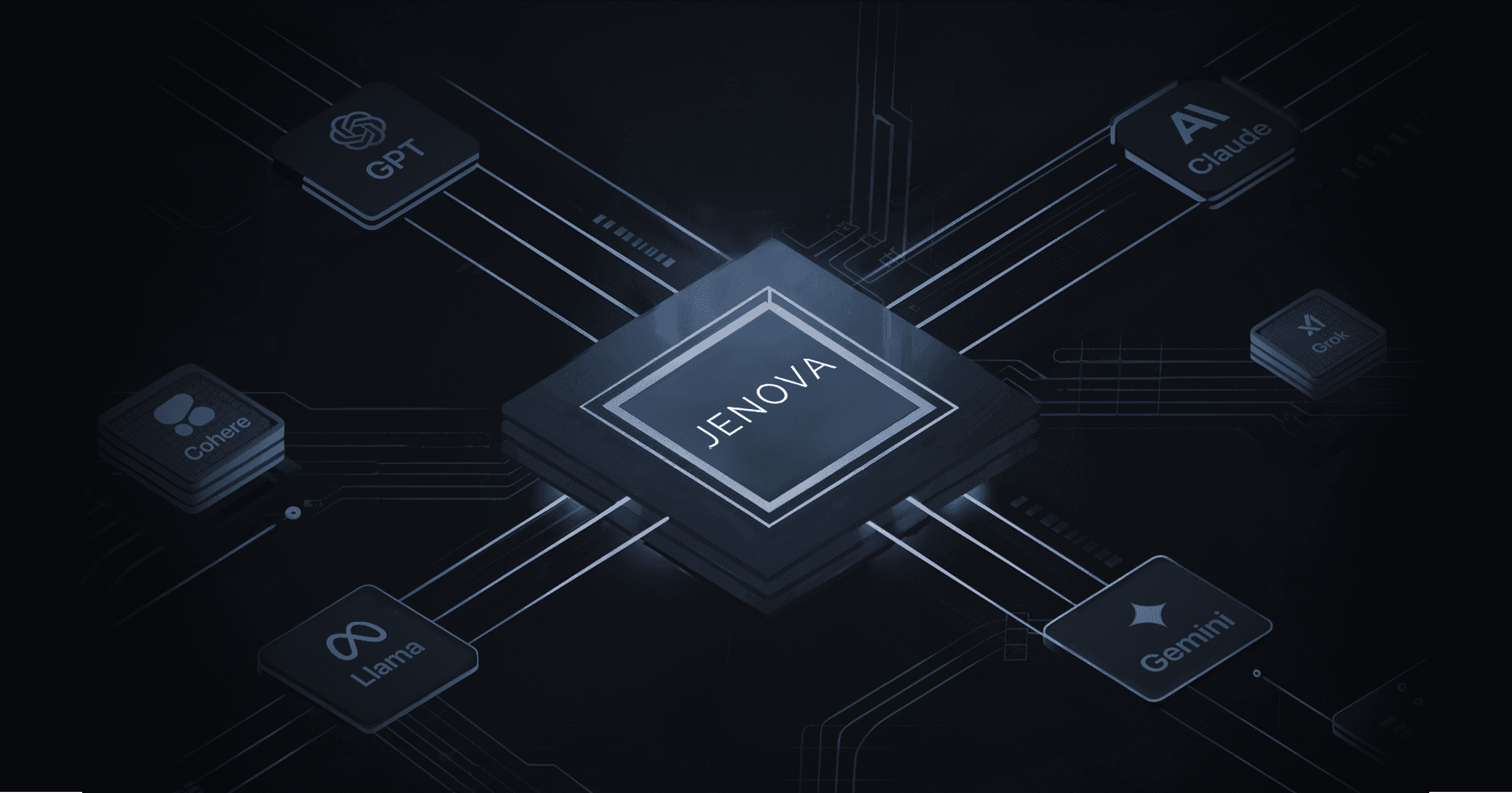
An AI assistant creator platform solves this problem by providing the infrastructure, model access, and tools needed to deploy specialized AI agents without writing code. Platforms like Jenova offer multi-model integration, persistent memory, and app connectivity through the Model Context Protocol (MCP)—enabling anyone to create AI assistants tailored to specific workflows.
This article explores what makes these platforms valuable, how to evaluate them, and why the ability to access multiple AI models from a single interface has become essential for serious AI deployment.
Quick Answer: What Is an AI Assistant Creator Platform?
An AI assistant creator platform is a software environment that enables users to build, customize, and deploy AI agents without extensive programming knowledge. These platforms provide:
- Multi-model access — Use GPT-5.2, Claude Opus 4.5, Gemini 3 Pro, Grok 4.1, and other frontier models from one interface
- No-code agent building — Define agent behavior through natural language instructions rather than code
- App integrations — Connect AI agents to Gmail, Google Calendar, Notion, and hundreds of other tools via MCP
- Persistent memory — Agents remember context across sessions, eliminating the "chatbot amnesia" problem
The Problem: Why Building AI Assistants Is Harder Than It Looks
The promise of AI assistants is compelling—automate repetitive tasks, provide 24/7 support, accelerate research. But the reality of implementation reveals significant challenges that most organizations underestimate.
Technical Complexity Blocks Adoption
According to IBM's research on AI adoption challenges, the top barriers enterprises face include:
45% cite concerns about data accuracy or bias 42% lack sufficient proprietary data to customize models 42% report inadequate generative AI expertise
Building effective AI assistants requires expertise in prompt engineering, model selection, integration architecture, and ongoing maintenance. Most businesses don't have—and can't afford—dedicated AI engineering teams.
Single-Model Limitations Create Bottlenecks
Each AI model has distinct strengths:
| Model | Primary Strengths |
|---|---|
| GPT-5.2 | Creative writing, multi-language, accessible communication |
| Claude Opus 4.5 | Technical explanations, logic, code review, nuanced analysis |
| Gemini 3 Pro | Research, massive-context document analysis, multimodal |
| Grok 4.1 | Real-time trends, social intelligence, current events |
Locking into a single provider means accepting its limitations. A study from MIT's CSAIL found that using multiple AI models to critique each other's responses leads to more refined, accurate outputs—similar to getting a second opinion before making important decisions.
Integration Fragmentation Wastes Resources
AI assistants that can't connect to existing tools provide limited value. Yet building custom integrations for each application—email, calendar, CRM, project management—requires significant development effort.
Oyelabs' analysis of AI agent development challenges highlights that integration with existing systems often presents "technical roadblocks, especially when dealing with legacy systems." Organizations need AI assistants that work with their current tech stack, not around it.
Memory Loss Destroys User Experience
Traditional chatbots forget everything between sessions. Users must re-explain their context, preferences, and history every time they return. This "chatbot amnesia" creates friction that undermines adoption.
For AI assistants to deliver real value, they need persistent memory that accumulates knowledge about users, projects, and organizational context over time.
The Solution: How AI Assistant Creator Platforms Work
Modern AI assistant creator platforms address these challenges through unified architecture that abstracts away technical complexity while providing enterprise-grade capabilities.
Multi-Model Integration
Rather than forcing users to choose a single AI provider, platforms like Jenova provide unified access to frontier models from OpenAI, Anthropic, Google, and xAI. Users can:
- Select the optimal model for each task — Use Claude for code review, GPT for creative writing, Gemini for research
- Switch models mid-conversation — Change providers without losing context
- Avoid vendor lock-in — No dependency on any single AI company's roadmap or pricing
This multi-model approach aligns with how leading organizations are deploying AI: combining specialized strengths rather than accepting one-size-fits-all limitations.
No-Code Agent Creation
Building an AI assistant on Jenova requires no programming. Users define agent behavior through:
- Custom system instructions — Natural language descriptions of the agent's role, expertise, and constraints
- Knowledge base attachments — Upload documents, PDFs, and data that the agent can reference
- App connections — Select which tools the agent can access via the Apps panel
This approach democratizes AI development. A financial analyst can create a Fundamental Stock Analyst agent. A test prep company can deploy an SAT/ACT Tutor. No engineering team required.
Model Context Protocol (MCP) Integration
The Model Context Protocol is an open-source standard that enables AI agents to interact with external applications securely. Jenova's MCP implementation connects agents to:
- Productivity tools — Gmail, Google Calendar, Google Drive, Notion, Dropbox
- Search platforms — Google Search, Google Scholar, Reddit, YouTube
- Travel services — Google Flights, Google Hotels, Google Maps
- E-commerce — Amazon, eBay product search
- Custom servers — Any MCP-compliant integration
This means an AI assistant can actually do things—send emails, schedule meetings, search databases—not just generate text responses.
Persistent Memory Architecture
Jenova provides two layers of memory:
- Unlimited chat history — Every conversation is preserved and searchable
- Global memory — User-specific information persists across all chats and sessions
When Global Memory is enabled, an agent remembers your preferences, project details, and past interactions. This transforms AI assistants from stateless tools into genuine collaborators that accumulate institutional knowledge.
Specialized AI Agents for Every Domain
The real power of an AI assistant creator platform emerges through specialization. Generic chatbots provide generic responses. Domain-specific agents deliver expert-level assistance.
Education & Test Preparation
Standardized tests require strategic preparation, not just content review. Jenova's test prep agents combine deep subject knowledge with adaptive teaching:
- SAT/ACT Tutor — Personal prep coach with strategic guidance for college admissions tests
- GRE Tutor — Strategic coaching for Verbal, Quant, and Analytical Writing
- GMAT Tutor — Elite preparation for business school admissions
- LSAT Tutor — Dedicated prep for Logical Reasoning, Logic Games, and Reading Comprehension
- MCAT Tutor — Comprehensive preparation across all four medical school exam sections
These agents don't just answer questions—they track progress, identify weaknesses, and adapt their teaching approach based on individual learning patterns.
Business & Financial Analysis
Financial decisions require synthesizing vast amounts of data. Specialized agents accelerate research while maintaining analytical rigor:
- Fundamental Stock Analyst — Equity research covering earnings analysis, valuation, and SEC filings
- Technical Stock Analyst — Price action analysis, market structure, volume, and momentum indicators
- Business Co-Pilot — Strategic partner for founders covering business planning, financial modeling, and operations
- Options Strategist — Options strategy development with volatility analysis and Greeks
Research & Productivity
Knowledge workers spend significant time on research, synthesis, and administrative tasks. AI agents can handle the heavy lifting:
- Academic Research Assistant — Literature discovery, citation management, and manuscript preparation
- Personal Secretary — Calendar management, email handling, travel planning, and daily logistics
- YouTube Search — Natural language video discovery across the platform
- Reddit Search — Find discussions, insights, and community perspectives
Professional Services
High-stakes decisions benefit from specialized expertise:
- Interview Coach — Preparation for behavioral, case, technical, and executive interviews
- MBA Admissions Consultant — Business school admissions guidance including profile reviews and essay strategy
- Immigration & Visa Consultant — Immigration guidance for major destination countries
How It Works: Building Your First AI Agent
Creating a custom AI assistant on Jenova takes minutes, not months:
Step 1: Define the Agent's Role
Write natural language instructions describing what the agent should do, how it should behave, and what expertise it should demonstrate. Be specific about tone, constraints, and capabilities.
Step 2: Select the AI Model
Choose from available models based on your use case:
- Claude Opus 4.5 for complex reasoning and technical tasks
- GPT-5.2 for creative and conversational applications
- Gemini 3 Pro for research and document analysis
- Grok 4.1 for real-time information needs
Step 3: Attach Knowledge
Upload documents, PDFs, spreadsheets, or other files that the agent should reference. This creates a private knowledge base that grounds responses in your specific context.
Step 4: Connect Apps
Enable MCP integrations for the tools your agent needs to access. An executive assistant might need Gmail and Calendar. A research agent might need Google Scholar and document generation.
Step 5: Deploy and Iterate
Test the agent, refine instructions based on results, and share with your team. Continuous improvement happens through use—the more you interact, the better the agent performs.
Comparing Approaches: Traditional vs. Platform-Based AI Development
| Aspect | Traditional Development | AI Assistant Creator Platform |
|---|---|---|
| Time to deploy | Weeks to months | Minutes to hours |
| Technical requirements | Engineering team, ML expertise | No coding required |
| Model access | Single provider, custom integration | Multi-model, unified interface |
| App integrations | Custom development per tool | Pre-built MCP connections |
| Memory persistence | Custom database architecture | Built-in global memory |
| Maintenance | Ongoing engineering effort | Platform-managed updates |
| Cost structure | High fixed costs + variable | Usage-based pricing |
For organizations that need custom AI capabilities but lack dedicated AI engineering resources, platforms provide a dramatically faster path to deployment.
Real-World Use Cases
📊 Financial Research Acceleration
Scenario: An investment analyst needs to evaluate a potential acquisition target.
Traditional approach: Manually review SEC filings, earnings transcripts, and industry reports. Synthesize findings into a memo. Time: 2-3 days.
With Jenova: Use the Fundamental Stock Analyst to analyze financial statements, identify key metrics, and surface relevant risk factors. Generate initial analysis in hours, not days.
📱 Mobile-First Productivity
Scenario: A consultant travels frequently and needs to manage communications, scheduling, and research from their phone.
Traditional approach: Switch between email, calendar, note-taking, and search apps. Context fragments across tools.
With Jenova: The Personal Secretary agent handles email triage, meeting scheduling, and research requests through a single conversational interface—available on iOS and Android.
💼 Admissions Consulting at Scale
Scenario: A test prep company wants to offer personalized MBA admissions guidance but can't afford to hire consultants for every student.
Traditional approach: Limit services to premium clients or provide generic advice.
With Jenova: Deploy the MBA Admissions Consultant agent to provide profile reviews, school recommendations, and essay feedback. Each student gets personalized guidance backed by comprehensive admissions knowledge.
Frequently Asked Questions
What is an AI assistant creator platform?
An AI assistant creator platform provides the infrastructure to build, customize, and deploy AI agents without programming. These platforms offer multi-model access, no-code configuration, app integrations, and persistent memory—enabling anyone to create specialized AI assistants for specific workflows.
How much does it cost to build an AI assistant?
Traditional AI development can cost $300,000 to over $1 million depending on complexity. Platform-based approaches like Jenova offer usage-based pricing starting with a free tier, with paid plans from $20/month for expanded access.
Can AI assistants connect to my existing tools?
Yes—platforms with MCP (Model Context Protocol) integration can connect to Gmail, Google Calendar, Notion, Dropbox, and hundreds of other applications. This enables agents to take actions like sending emails or scheduling meetings, not just generate text.
How do multi-model platforms compare to single-provider tools?
Multi-model platforms provide access to frontier models from OpenAI, Anthropic, Google, and others through a single interface. This allows users to select the optimal model for each task and avoid vendor lock-in. Single-provider tools limit you to one company's capabilities and pricing.
Is my data secure on AI assistant platforms?
Reputable platforms like Jenova implement encryption in transit and at rest, never use customer data for model training, and don't sell data to advertisers. Check each platform's privacy policy for specific commitments.
Can I create AI agents for my team or business?
Yes—custom AI agents can be shared within organizations. Jenova supports creating specialized agents with custom instructions, knowledge bases, and app connections that team members can access.
Conclusion: The Future of AI Is Specialized and Accessible
The AI agent market is projected to reach $52.62 billion by 2030, growing at a CAGR of 46.3%. Organizations that master AI deployment will gain significant competitive advantages in productivity, customer experience, and operational efficiency.
But capturing this value doesn't require building everything from scratch. AI assistant creator platforms have matured to the point where sophisticated, specialized agents can be deployed in minutes rather than months.
Jenova represents the current state of the art: multi-model access (GPT-5.2, Claude Opus 4.5, Gemini 3 Pro, Grok 4.1), persistent memory that eliminates chatbot amnesia, and MCP integrations that connect agents to the tools you already use.
Whether you need an Academic Research Assistant to accelerate literature reviews, a Business Co-Pilot to support strategic planning, or a Personal Therapist for 24/7 mental health support—the platform provides the foundation to build exactly what you need.
The question isn't whether AI assistants will transform how work gets done. It's whether you'll build the specialized agents that give your organization an edge—or wait while others do.
Start building at www.jenova.ai