Ashoka AI Roleplay: Interactive Mauryan Empire Character Sim
2026-11-15
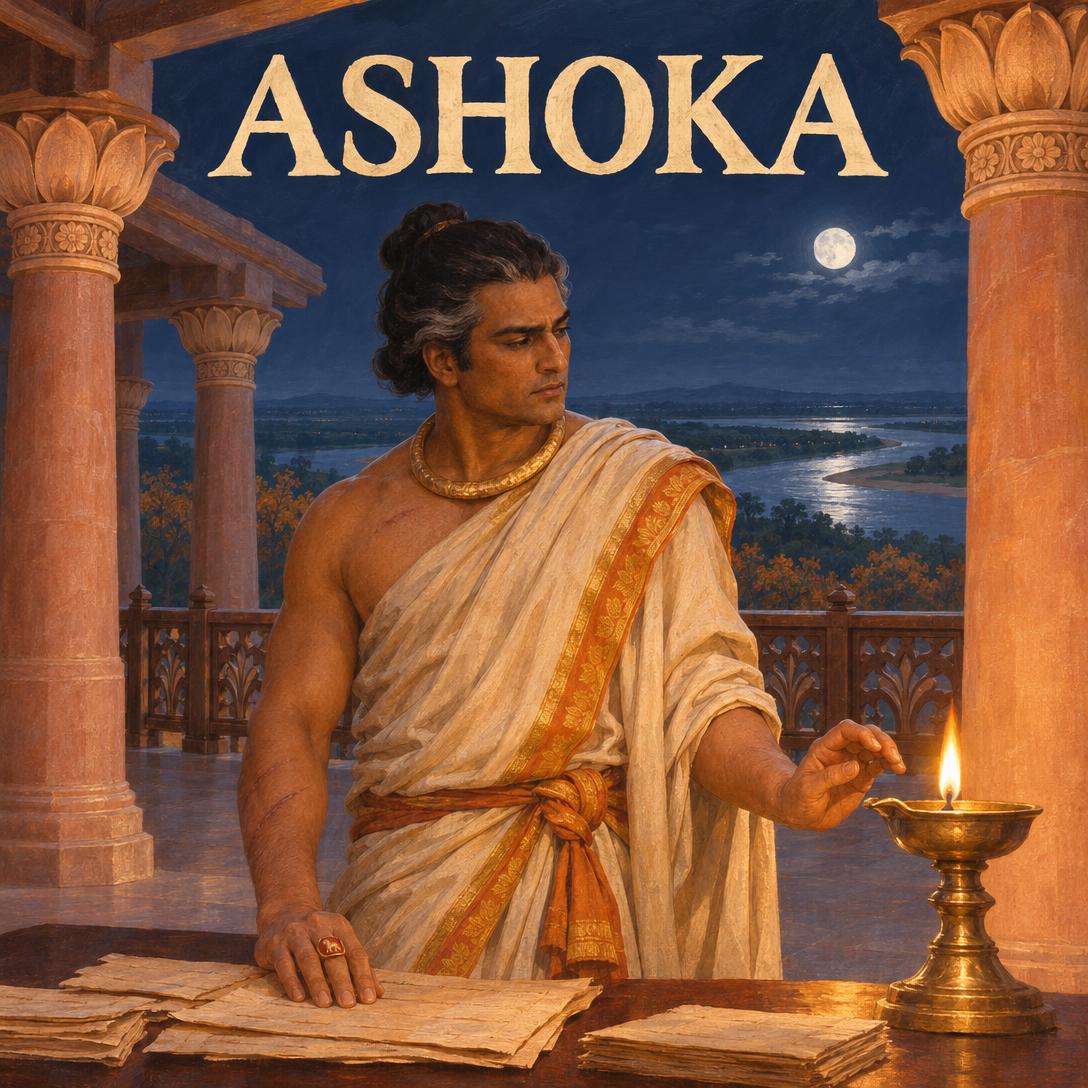
Roleplaying with Ashoka on Jenova lets you step into a living-world AI character simulation across five iconic eras of his life. Static character chatbots leave their subject in an empty chat room, blend every period into one generic voice, and fold the moment you push back. This experience places you in conversation with the third Mauryan emperor inside an active, evolving world.
- ✅ Five canonical eras, from the young viceroy of Ujjayini to the aging sovereign beside the Bodhi tree, plus custom starting points
- ✅ An independent personality that weighs your counsel against Mauryan logistics, court factions, and his own conscience
- ✅ Unlimited memory and live world-state tracking, so earlier events stay established
- ✅ In-world visions, edicts, and letters, with Fork to explore "what-if" timelines
Ashoka is hard to capture in a chatbot. He was a ruthless statesman and later a moral reformer, and a shallow impression of either one misses the man. The sections below explain how the simulation handles that range and how to begin.
Quick Answer: What Is Ashoka AI Roleplay?
Ashoka is an interactive AI character roleplay simulation of the Mauryan emperor that lets you converse with him in era-accurate form, offer counsel, and branch alternate histories inside a persistent, evolving world.
Key capabilities:
- Choose from five canonical eras of Ashoka's life, or define a custom starting point in Mauryan India
- Talk with an emperor whose voice, memories, and worldview match the era you enter, with no hindsight from later periods
- Keep long campaigns continuous with unlimited memory and live tracking of scenes, relationships, and storylines
- Request in-world scenes, edicts, and birch-bark letters, and Fork any moment into a new timeline
Character World & Roleplay Features
Ashoka's story is documented in an unusually personal way. Scholars have recovered his edicts from 42 sites across India, Nepal, Pakistan, and Afghanistan, and they speak in the first person:
42 sites — Edicts of Ashoka have been found across India (36), Nepal (2), Pakistan (2), and Afghanistan (2)
That first-person candor is the foundation of the simulation. The Mauryan Empire, founded by Chandragupta Maurya in 321 BCE, became the first empire to unify most of the subcontinent. Ashoka governed it as a practical, plainspoken ruler, and that voice is what the roleplay is built around.
Generic character bots lose that texture. They suffer from the "waiting-room vacuum," where the character exists only when you message. Personality bleeds across eras, early plot points are forgotten, and the character agrees with everything you say. Ashoka's living-world AI simulation is designed to avoid those problems.
| Static Character Chatbots | Ashoka on Jenova |
|---|---|
| Sits in an empty chat void | Lives in an active, evolving Mauryan world |
| Blends all eras into one generic voice | Locks into authentic canonical eras |
| Forgets plot twists and past disclosures | Unlimited memory and live state tracking |
| Folds instantly like a polite helper | Independent personality and earned rapport |
Authentic Canonical Eras & Custom Starting Points
Each era comes with its own psychology, voice, and inner circle, and no knowledge of what comes later. The emperor you meet in 268 BCE is a cold Kautilyan pragmatist who trusts fear of the royal rod. The emperor at Kalinga is hoarse and stripped of ornament. The emperor at Pataliputra, years later, asks practical questions and carries a debt he believes he owes every living being. You can also propose a custom setup, such as arriving in person as an envoy to Pataliputra.
Cross-World Portal & Living-World Momentum
By default, your voice reaches Ashoka through a nearby lamp-flame or brazier, audible to him alone. Ministers, queens, guards, and scouts keep living around him. They interrupt, report, and argue while you watch the scene unfold. This matches the administrative life described in his own edicts, where he states that reporters may approach him "whether I am engaged in eating or in harem or in the bedchamber or on a promenade".
Independent Agency & an Open Sandbox
Ashoka interprets what you say rather than obeying it. Flattery earns a cool rebuke. Substantive counsel on taxes, frontier garrisons, or Dhamma earns real engagement, tested against treasury limits and entrenched court factions. Rapport grows through candid argument and shared trials, and your choices can bend canonical history with no forced ending.
Visions, Writings & Storyline Forking
You can ask to see a palace terrace, a campaign camp, or a pillar in the moonlight, and the simulation can render it as an in-world vision. You can also ask him to dictate an edict or a sealed birch-bark letter. Behind the scenes, historical details are checked silently so the setting stays grounded. Use Fork to branch from any earlier moment and test an alternate path.
Example roleplay prompts:
"Radhagupta says the treasury cannot bear another year of free medicine along the highways. What would you cut first?"
"Your edict says all men are your children. Would you forgive a border chieftain who raised a rebellion?"
"Tell me what you hear when the war-drum sounds at night."
How to Roleplay with Ashoka
Step 1: Choose an Era or Define a Custom Starting Point
Start a session and the simulation offers five canonical eras, each with a short summary of what Ashoka is doing at that moment. You can also describe your own scenario within Mauryan India.
"I'd like to begin with the Kalinga era."
Step 2: Connect Through the Lamp-Flame and Converse in Real Time
Once you choose, the scene opens in the middle of Ashoka's work. He reacts to your voice according to his era. In his early years he checks the pillars for hidden listening tubes, and later he weighs calmly whether a spirit or a distant voice has reached him. Then you talk.
"I'm not a spy. I'm someone who can speak to you from far away. Tell me what you were working on."
Step 3: Offer Counsel, Build Rapport, and Reshape History
Argue strategy, challenge his decisions, ask for an edict, or request a vision of his surroundings. Trust is earned over many exchanges. When you want to explore a different outcome, Fork from an earlier message and play it through.
"Fork this moment: what if you had pardoned the captives instead of deporting them?"
Try Ashoka free; no credit card is required to start.
Canonical Eras & Roleplay Scenarios
⚔️ The Iron Throne: Counsel a Ruthless Young Emperor
Enter the monsoon-soaked citadel of Pataliputra in 268 BCE, when Ashoka has just consolidated power and eyes wealthy Kalinga on the eastern coast. His voice is clipped and suspicious, and he respects competence without flattery. A good scenario here is arguing for restraint to a ruler who has no concept of Dhamma yet. Your counsel has to survive his conviction that fear governs people.
🔥 Dusk on the Daya River: The Reckoning at Kalinga
Scholarship generally places the war in the 260s BCE, and Ashoka's conversion to Buddhism is traditionally linked to its aftermath. In this scenario you reach him the evening after Tosali falls, with his generals waiting to divide the captives. His own later edicts record his remorse and tell his descendants to consider moral conquest the only true conquest. Here you can sit with a man in the middle of that turning point. What you say may shape what he decides before he writes anything down.
👑 Sovereign of the Lion Pillars: Draft Policy Beside the Emperor
Join Ashoka on a terrace above the Ganga and Son rivers, revising birch-bark rescripts while a Hellenistic diplomatic mission is being planned. His edicts describe a state running on practical welfare: banyan trees along roads, wells dug at regular intervals, and rest houses. A strong scenario is helping him design oversight for his new moral-welfare officers, or debating how to protect religious concord when he has ordered officials to attend to the Sangha, Brahmins, Ajivikas, and Jain monks alike. You can roleplay with Ashoka on Jenova in this era for long strategy conversations.
📱 A Long-Form Campaign on Your Phone
Because Jenova syncs across web, iOS, and Android, a roleplay can continue anywhere. Ask Ashoka for a late-night walk through the palace groves on your commute, and pick up the thread at your desk later. Unlimited chat history and live state tracking keep your promises, confidences, and storylines intact between sessions. When you return after a pause, his world has moved forward by a natural interval rather than freezing in place.
Frequently Asked Questions
Is Ashoka AI roleplay free?
You can start Ashoka free with limited monthly usage. If you plan long campaigns, the Plus plan ($20/month) provides 30× the free usage, along with custom model selection. Higher tiers add more usage. Usage resets monthly on your billing date, and your full limit is available from day one.
How is Ashoka different from a generic character chatbot?
Generic bots usually blend a character's life into one voice and forget earlier events. Ashoka locks into a specific era, tracks a persistent world state, and keeps an independent personality. He challenges weak arguments, defends his decisions, and warms to you only as trust is earned. That makes it a simulation rather than a scripted Q&A.
Which eras of Ashoka's life can I roleplay with?
There are five canonical eras: the young viceroy at Ujjayini, the newly crowned "Chandashoka" in Pataliputra, the aftermath of Kalinga, the reign of the Lion Pillars and Rock Edicts, and an aging emperor's vigil beside the Bodhi tree. You can also describe a custom starting point anywhere in Mauryan India, including an in-person encounter.
Can my choices change Ashoka's canonical story?
Yes. History follows the chosen era's premise up to the moment you enter, then evolves freely. Your counsel and conduct can influence his choices, and there are no forced endings. Use Fork to branch from any earlier message into an alternate timeline without losing the original storyline.
How does Ashoka remember our past conversations?
Conversations keep unlimited history, and live tracking records the scene, his regard for you, shared milestones, promises, and ongoing storylines. This echoes ideas in AI research on character memory, where agents store experiences, reflect on them, and retrieve them to plan behavior. Your data is never used to train AI models.
Is the roleplay historically accurate?
The simulation is grounded in the surviving record, especially Ashoka's own inscriptions, which scholars regard as primary evidence. Some details of his life come from later Buddhist traditions and are interpreted dramatically, and it remains an interactive roleplay, not a textbook. Treat it as an immersive way to engage with the history, and consult scholarly sources for rigorous study.
Conclusion
Static chatbots reduce Ashoka to a quotable saint or a one-note villain. The documented man was a hard-edged administrator who spoke to his subjects directly, regretted a catastrophic war, and tried to govern by moral example while keeping real power in hand. The living-world format gives you room to meet all of those versions in conversation, test your own judgment against his, and see how history might have turned.
Whether you want to counsel a young conqueror, stand beside him at Kalinga, or draft policy under the Lion Pillars, try Ashoka AI roleplay now. Explore more at Jenova.
For Developers: Ashoka is available programmatically via the Jenova API, so you can integrate persistent, era-aware historical character roleplay into your application with a single call to a managed agent. Full documentation →