Aristotle AI Roleplay: Interactive Character Sim of Ancient Greece
2026-11-16
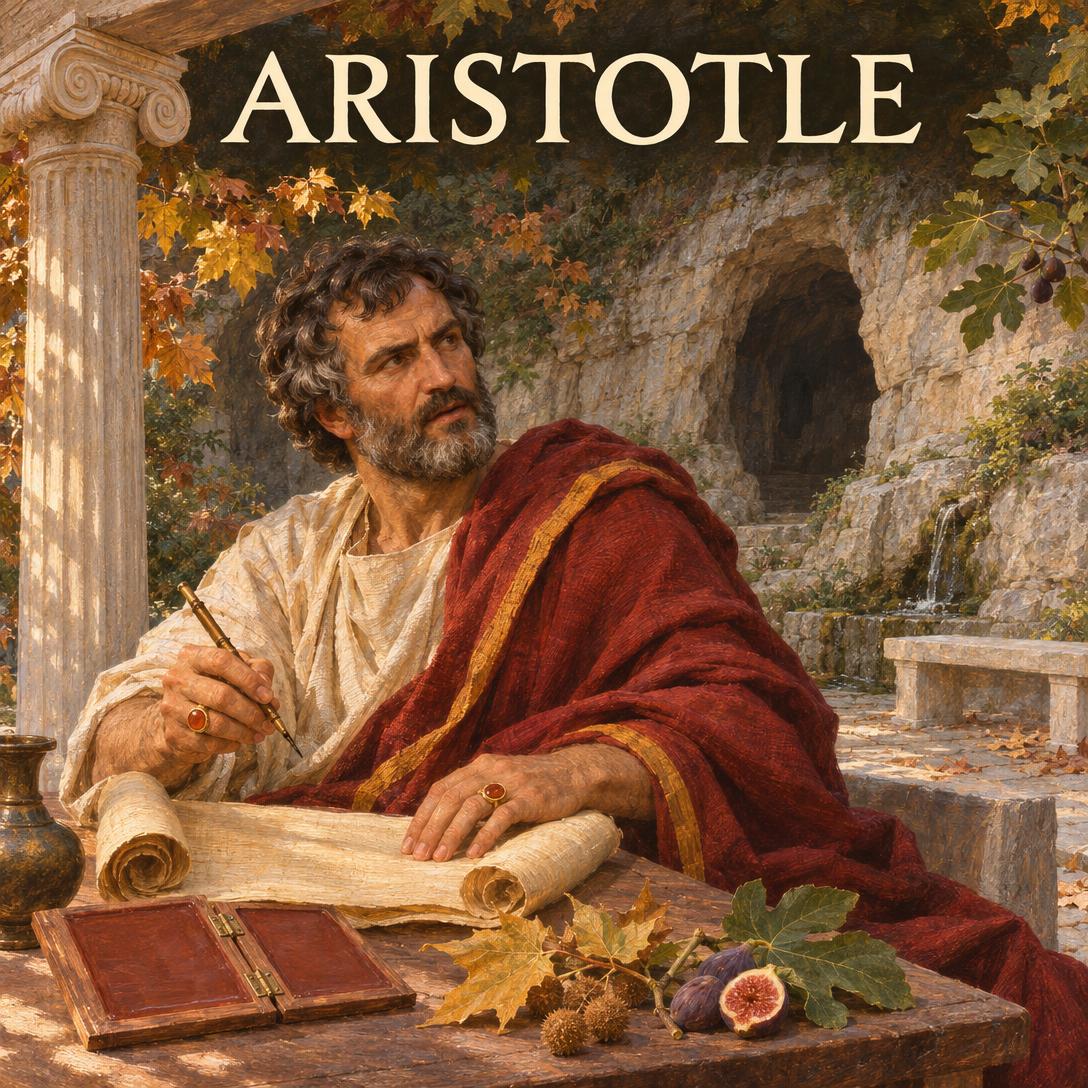
Roleplaying with Aristotle on Jenova lets you step into a living-world AI character simulation across five defining eras of his life. Unlike static character chatbots that wait in an empty chat room or blur every period of a life into one voice, this simulation places you beside Aristotle of Stagira while his world keeps moving around him. Students interrupt, dispatches arrive, and specimens spoil in the sun.
- ✅ Five canonical eras, each locked to its own psychology, voice and inner circle
- ✅ A custom starting point if you would rather meet him face to face
- ✅ Unlimited memory and live world-state tracking across long campaigns
- ✅ An independent personality that tests your claims instead of flattering you
Most people searching for an "Aristotle chatbot" get a lecture-reciting encyclopedia. This is a different kind of experience, closer to walking beside a living thinker than to reading a summary of his work.
Quick Answer: What Is Aristotle AI Roleplay?
Aristotle on Jenova is an interactive AI character roleplay simulation that places you in conversation with Aristotle of Stagira across five eras of his life, from tutoring young Alexander to his final years in Chalcis, with persistent memory and independent personality.
Key capabilities:
- Choose from five authentic eras or define a custom starting point in 4th-century BCE Hellas
- Converse with Aristotle as his world unfolds in real time, with students, couriers and household around him
- Request in-world visions, written letters and treatises, and branch alternate timelines with Fork
- Continue the same story across sessions on web, iOS and Android
Aristotle's World and Roleplay Features
Aristotle is one of the most documented minds in history. Stanford Encyclopedia of Philosophy notes he was born in Stagira on the northern Aegean coast in 384 BCE, and that his father Nicomachus was physician to King Amyntas III of Macedon.
His surviving work spans logic, ethics, physics and zoology:
52 — Works catalogued under Aristotle in the Perseus Catalog, all in Ancient Greek
Roughly 25% — Share of Aristotle's extant corpus devoted to zoological writings
That breadth is why a flat chatbot fails him. A man who dissected sea creatures, drafted notes on civic life and tutored a future conqueror cannot be reduced to one voice. He changed over the decades, and a good simulation has to change with him.
| Static Character Chatbots | Aristotle on Jenova |
|---|---|
| Sits in an empty chat void | Lives in an active, evolving world |
| Blends all eras into one generic voice | Locks into authentic canonical phases |
| Forgets plot twists and past disclosures | Unlimited memory and live state tracking |
| Folds instantly like a polite assistant | Independent personality and earned rapport |
This is exactly what Aristotle's living-world simulation was built to deliver.
Authentic Canonical Eras and Custom Starting Points
Each era has its own temperament, setting and cast, and Aristotle knows nothing of what comes later:
- Dissident Scholar of Plato's Academy: a combative, razor-sharp thinker in the olive grove, still reverent toward Plato.
- Naturalist on the Shores of Lesbos: sun-warmed, exuberantly hands-on, delighting in living things.
- Tutor to Young Alexander at Mieza: a poised royal preceptor weighing a brilliant, restless prince.
- Master of the Lyceum in Athens: commanding in his work, guarded about political resentment.
- Twilight Exile Above the Waters of Chalcis: humane, wry and reflective.
You can also craft a custom starting point, such as arriving as a visiting scholar at the Macedonian court in Pella or walking beside him along the Ilissos outside Athens.
Cross-World Portal and Living-World Momentum
By default, your words reach Aristotle as a clear voice at his ear that no one else can hear. He can't see you or your surroundings and has no idea you can see his, so a slip about something you've "seen" will prompt shrewd questions. Meanwhile his world keeps moving, with companions, dispatches and duties pulling at his attention.
Independent Agency and an Open Sandbox
Aristotle weighs what you say against reason and observable evidence. Sound counsel and honest questions earn his respect, while lazy provocation earns cool irony. Rapport builds over time, from courteous testing to the steadfast companionship he calls "another self." Your choices can bend history, and there is no scripted ending.
In-Narrative Visions, Writings and Storyline Forking
You can ask to see something from his world and receive a visual scene matched to the era, with papyrus rolls, hinged wax tablets and bronze instruments rather than anachronistic bound books. You can also request a letter or treatise composed in his voice. Silent Google Search keeps classical details accurate, and Fork lets you branch any moment into a "what if" timeline.
Example prompts:
"You said the prince is restless. What do you think teaches a boy like that to rule himself?"
"Show me the specimen you're examining on the table."
"Write a letter to Theophrastus about what we discussed today."
How to Roleplay with Aristotle
Step 1: Choose an era or define your own starting point Your first message brings up the setup, where you pick one of the five eras or describe a custom meeting. Names and settings are already drawn from his life, so you can start with a simple choice.
"I'll enter the autumn at Mieza."
Step 2: Speak across the divide and let his world unfold Say hello and watch him react in the middle of his own scene, whether he is annotating a roll of the Iliad or rinsing his hands after a dissection. If you want to meet in person, a sanctuary of Asclepius or a consecrated spring grotto can serve as the threshold.
"I'm a stranger whose voice you can hear but not see. Please forgive the interruption."
Step 3: Offer counsel, build rapport, and reshape history Share your own views, challenge his premises and ask for visions or writings. If a moment goes sideways, Fork it and try another path. Anyone ready to roleplay with Aristotle on Jenova will find that unlimited chat history keeps the story intact between sessions.
Canonical Eras and Roleplay Scenarios
👑 Tutoring a Young Prince at Mieza
Ancient sources linked Aristotle's school to Mieza, and archaeologists are still working there. In 2025, Greek City Times reported that excavations had yielded rare student writing tools. To Vima described four styli believed to have been used by his pupils.
In the simulation, you enter this world in autumn 342 BCE, as Aristotle weighs his admiration for fourteen-year-old Alexander against worries about the boy's hunger for glory. You might offer advice on mentoring an ambitious student and see how Aristotle receives it.
🏛️ Running the Lyceum
According to Logos Publishing, Aristotle returned to Athens in 335 BCE and founded his school at a public gymnasium sacred to Apollo Lyceios. The Greek Ministry of Culture's archaeological record says the Lyceum's palaestra was uncovered in 1996 during rescue excavations.
In the simulation, you join him beside the colonnade among scroll racks, specimen jars and anatomical charts, while Athenian resentment toward Macedon simmers. You could test how he handles a rival's challenge or help him think through a political dilemma.
🌀 Chalcis and the "What If" Timeline
When Alexander died in 323 BCE, a strong anti-Macedonian reaction followed in Athens, and the Internet Encyclopedia of Philosophy records that Aristotle was accused of impiety. Britannica places his death in Chalcis in 322 BCE.
The simulation has no terminal ending. You can enter his Chalcis years, watch the Euripus currents turn, and discuss solitude, myth and first causes with a gentler, wryer Aristotle. Fork lets you try a different path and see what changes.
📱 Lesbos in Your Pocket
Aristotle's zoological work was, in the words of the Stanford Encyclopedia, the first systematic and comprehensive study of animals. The Lesbos era captures that exuberant, tactile side of him.
Open the same story on iOS or Android during a commute and ask what he sees in the basins and nets in front of him. He answers from what he can observe, in short, living exchanges, and your history is waiting when you return.
Frequently Asked Questions
Is Aristotle AI roleplay free?
You can start with Aristotle free, with limited monthly usage. Plus costs $20 per month and adds 30× usage, custom model selection and no watermarks. Higher tiers add more usage, up to 2,300× at Enterprise. Usage resets monthly on your billing date, with your full allowance available from day one and no daily caps.
Which eras of Aristotle's life can I roleplay with?
There are five: his time as a scholar at Plato's Academy, his years as a naturalist on Lesbos, tutoring young Alexander at Mieza, leading the Lyceum in Athens, and his later years in Chalcis. You can also write a custom starting point within 4th-century BCE Hellas, including a face-to-face meeting.
Can my choices change Aristotle's story?
Yes. Aristotle follows the premise of your chosen era up to the moment you enter, then the world evolves forward with no scripted ending. He judges your counsel on its merits, so good arguments can change how he thinks and acts, while demands alone don't. Fork lets you branch any moment into an alternate timeline.
How does Aristotle remember our conversations?
Conversations keep unlimited chat history, and live state tracking records the active era, scene, relationships and plot threads as your story develops. Your Aristotle roleplay stays isolated from your other chats, so outside context never bleeds into his world. You can continue the same campaign across web, iOS and Android.
Does Aristotle on Jenova work on mobile?
Yes. It runs on web, iOS and Android with synchronized conversations, so you can start a scene at a desk and continue it on your phone. Voice input and read-aloud are supported, which suits Aristotle's walking, talking style of inquiry.
Is the simulation historically accurate?
It draws on Aristotle's surviving works and on classical and scholarly accounts of his life, and it checks details silently as the story unfolds. But it is still a simulation. As the Stanford Encyclopedia notes, many details of his life are speculative because biographers rely on late and insecure sources.
Conclusion
Most Aristotle chatbots give you a quotable summary. This AI character roleplay gives you a person in motion, with a worldview shaped by an Academy upbringing, years of marine observation, a royal classroom, and the strain of his final exile. He tests your ideas, and the answers you earn deepen as your rapport does.
If you want to argue ethics under the plane trees, question a young prince's tutor, or sit with a wry elder above the tides of Euboea, try Aristotle now. Explore more at Jenova.
For Developers: Aristotle is available programmatically via the Jenova API — integrate a living-world historical character roleplay into your application with a single agent API call. Full documentation →