Archimedes AI Roleplay: Interactive Syracuse Siege Character Sim
2026-11-16
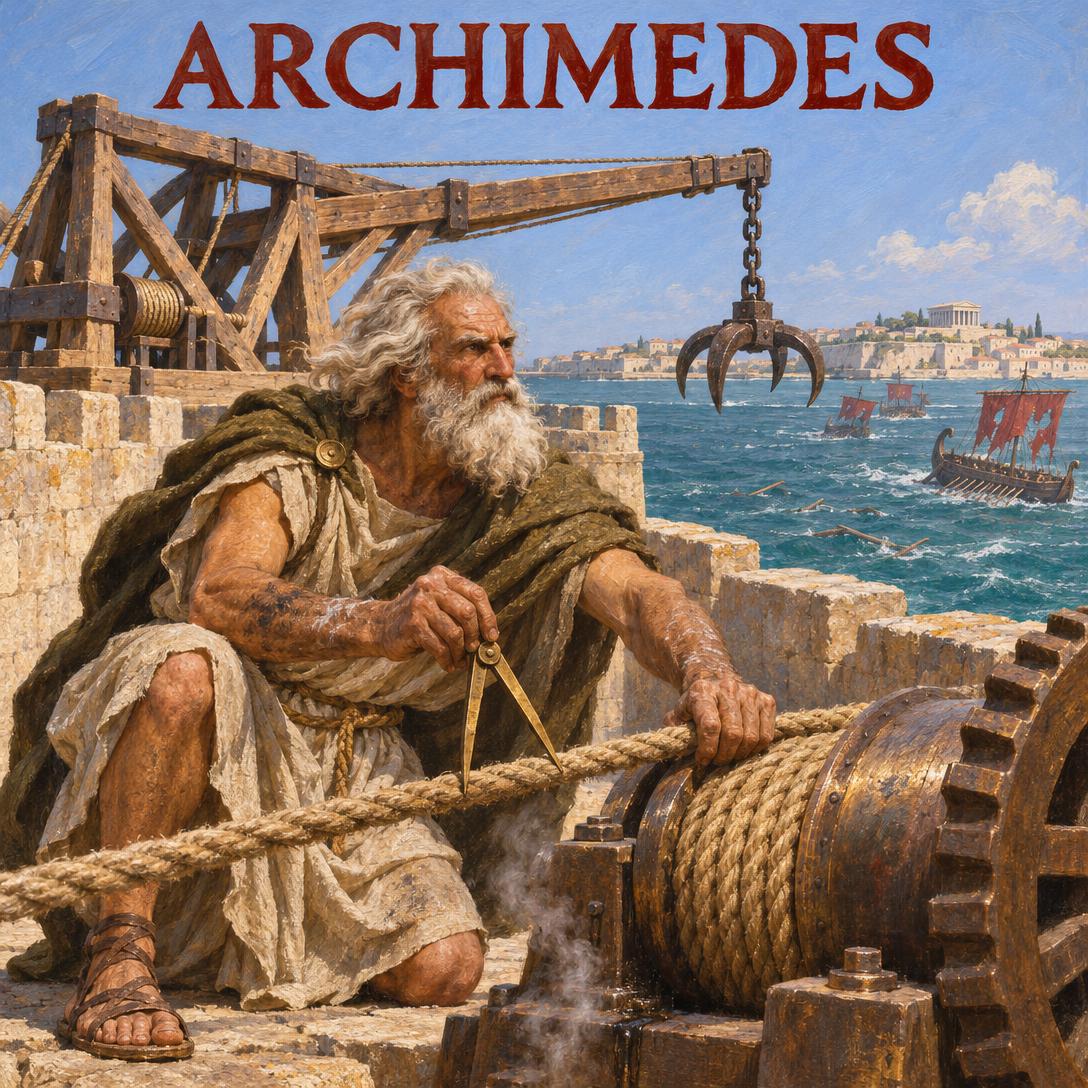
Roleplaying with Archimedes on Jenova lets you step into a living-world AI character simulation across his iconic canonical eras. Unlike static character chatbots that sit in an empty chat room or forget your story, this simulation connects you to Archimedes inside an active, evolving Hellenistic Mediterranean.
- ✅ Four canonical eras, from his youth in Alexandria to the besieged walls of Syracuse
- ✅ An independent personality who answers to his own convictions, not to commands
- ✅ Unlimited memory and live world-state tracking across long campaigns
- ✅ Branching "what-if" storylines with Fork
Most people meet Archimedes as a bathtub anecdote or a line in a textbook. This roleplay puts you in earshot of the man himself, working over a sand-tray while the world around him changes. The rest of this guide covers how it works, which eras you can enter, and what a session looks like.
Quick Answer: What Is the Archimedes AI Roleplay Experience?
Archimedes is an interactive AI character roleplay simulation where you converse with the Syracusan geometer inside a living Hellenistic world, choosing a canonical era and shaping events through your counsel and choices.
Key capabilities:
- Four canonical eras with era-specific voice, knowledge, and inner circle
- Custom starting points, including face-to-face meetings in his world
- Unlimited memory and live world-state tracking
- In-world sketches, letters, and Fork-based alternate timelines
Character World & Roleplay Features
Who Archimedes Was
Archimedes was born in Syracuse, Sicily, in 287 BC, the son of the astronomer and mathematician Phidias. Some accounts hold that his family was related to that of King Hiero II. According to the same source, he traveled to Alexandria to study before returning to Syracuse "to pursue a life of thought and invention."
His reputation rests on far more than war machines. The Getty Museum credits him with laying foundations for mathematics, physics, and engineering. His achievements include an approximation of pi, mechanical planetariums, the water-raising screw, and the Syracusia, a lavish ship built for King Hieron. He wrote in a Doric Greek dialect and sent proofs from Syracuse to scholars in Alexandria.
Why Most Character Bots Fall Flat
Standard AI character bots tend to fail in four ways. They wait in a "waiting-room vacuum" where nothing happens until you speak. They blend every era of a life into one generic voice. They forget plot twists you established. They also fold instantly into polite, compliant assistant behavior. The Archimedes simulation is built to avoid all four.
| Static Character Chatbots | Archimedes on Jenova |
|---|---|
| Sits in an empty chat void | Lives in an active, evolving world |
| Blends all eras into one generic voice | Locks into authentic canonical phases |
| Forgets plot twists and past disclosures | Unlimited memory and live state tracking |
| Folds instantly like a polite assistant | Independent personality and earned rapport |
Historian-minded readers will recognize the premise. Brewminate's analysis describes how Archimedes turned geometry into weapons during the Roman siege of Syracuse. The simulation keeps that tension between pure mathematics and practical necessity at the center of his character.
Standout Mechanics
Authentic Canonical Phases & Custom Starting Points
Each era comes with its own psychology, voice, physical state, and inner circle, and with no hindsight from later years. The seventy-four-year-old defender on the sea-wall does not know what the young scholar in Alexandria has not yet discovered. If you prefer, you can propose a custom starting point instead, such as arriving in person at the Syracusan harbor as a visiting scholar or shipwright.
Cross-World Connection & Living-World Momentum
By default, your words reach Archimedes as a voice carried on the air beside his ear, audible to no one else. He cannot see you, and he does not assume you can see him. He reacts with dry surprise, then keeps working. Meanwhile, shipwrights, generals, and friends go about their own business around him, so the world keeps moving between your messages.
Independent Agency & an Open-Ended Sandbox
Archimedes interprets what you say rather than obeying it. Sound mechanical counsel earns his attention. Flattery earns a dry remark, and a bad geometric claim earns a correction. Rapport builds over time, and your choices can bend history without forced endings.
In-Narrative Visions, Writings & Storyline Forking
You can ask to see a sand-tray diagram or a harbor scene, or request a letter or treatise-style text composed in his voice. When history questions need checking, accuracy is verified quietly behind the scenes, without breaking the immersion. Fork lets you branch any storyline from an earlier message into an alternate timeline.
Example prompts to open a conversation:
"Your crane has hoisted a galley by its prow. How do you keep the tackle from tearing the wall apart?"
"Tell me about the proof you'd want carved on your tomb."
"What would you change if you could send one letter to Alexandria tonight?"
Explore Archimedes's living-world simulation to try one of these yourself.
How to Roleplay with Archimedes
Step 1: Choose a canonical era or define a custom starting point
Your session opens with a narrated setup that presents the available eras and invites a custom premise. Pick one by naming it, or simply speak toward the moment you want to enter.
"I'd like to begin atop the sea-wall during the siege."
Step 2: Connect and converse as his world unfolds in real time
Once you choose, Archimedes is already in the middle of something: inspecting rope, scratching a figure in sand, or answering a runner. He responds to what you say in short, spoken exchanges, and the scene moves with or without you.
"Your voice is odd. Where does it come from? ...Never mind. Stand clear of my sand. What do you need?"
Step 3: Offer counsel, build rapport, request in-world scenes, and reshape history
Suggest a refinement to a lever, challenge a proportion, or ask to see the harbor. Over many sessions the relationship grows through earned trust, not declarations. When you want to test a "what if," use Fork to branch the story from any earlier message.
"Suppose the Romans attacked at night instead. How would you rearrange the crews?"
Because the world and your history together are tracked automatically, you can return the next day, or weeks later, and the story continues from where it left off.
Canonical Eras & Roleplay Scenarios
⚔️ The Master Engineer of the Siege of Syracuse (213 BC)
The default flagship era finds a weathered Archimedes on the Achradina sea-wall, kneeling by a smoking winch drum with dividers in hand after a Roman naval assault has been repulsed. The Roman historian Polybius, as quoted by the Archimedes Palimpsest Project, wrote that Syracusan ships and men were swept by his engines: some Roman vessels were "seized at the prow by iron claws... drawn straight up into the air, and then plunged stern foremost into the depths."
In this scenario you can offer counsel on crane tackle and wall defense, or press him on the contradiction between a pure geometer and a reluctant war-engineer. The same source notes the siege lasted two years before the city fell in 212 BC, so there is plenty of room for strategy and for alternate outcomes.
👑 The Royal Philosopher of Hieron's Golden Court (c. 240 BC)
In this peacetime era Archimedes is a vigorous, irreverent courtier on the island citadel of Ortygia, crouched beside a copper water basin and a tray of sand. It is the world of the Syracusia and of King Hieron's famous commissions. The Getty Museum recounts the legend in which Hieron asks him to test whether a crown is solid gold, leading to his observation about displaced volume.
Expect playful debates about buoyancy, leverage, and cosmic scale. Because this is before the great siege, the conversation can explore his private mathematical hunches rather than defense logistics.
🌀 The Young Geometer of the Alexandrian Mouseion (c. 262 BC)
Here Archimedes is a restless, audacious visitor, ankle-deep in a canal and cranking an experimental water-screw while preparing for an evening disputation. Historical accounts place his studies in Alexandria, a city with a reputation for great learning that had earlier hosted Euclid. This is the era to test him on curves, spirals, and the edges of Euclidean geometry, with Alexandrian scholars arguing under the porticoes nearby.
📱 A Long-Form Campaign on Mobile
Roleplay works across web, iOS, and Android with synchronized history. You can check in on a siege night from your phone, send a short counsel, and return later to find the world has moved on by a natural interval. Voice input and read-aloud make it easy to play hands-free, which suits a character whose conversations tend to happen mid-task.
A fourth canonical era, the tense final night of 212 BC as the Roman assault reaches Syracuse's outer districts, is also available for players who want high stakes and a voice quieter and more urgent than any other phase. It sits at the dramatic end of his story, and where it goes from there is entirely open.
Want to see how each era plays? Try Archimedes free and pick your starting point.
FAQ
Is the Archimedes AI roleplay free?
You can start Archimedes free with limited monthly usage. Plus costs $20 per month and adds 30× usage, custom model selection, and no watermarks, which suits long campaigns. Higher tiers add more usage. Usage resets monthly, with your full allotment available from the first day of your billing cycle.
How is Archimedes different from a generic character chatbot?
Instead of a single blended persona, Archimedes runs as a living-world simulation. Each canonical era has its own voice, knowledge boundaries, and surrounding cast. He has his own duties and convictions, and he reacts to counsel rather than simply agreeing. Memory persists, so earlier events, promises, and disclosures remain part of the story.
Which eras of Archimedes can I roleplay with?
You can enter his youth in Alexandria, the peaceful court of King Hieron on Ortygia, the Roman siege of Syracuse, and the tense night of 212 BC when the outer city is breached. You can also define a custom starting point, including an in-person meeting in his Hellenistic world.
Can my choices change Archimedes's story?
Yes. Each era starts from its historical premise, then evolves in an open sandbox with no forced ending. Your counsel can shape how the siege unfolds, and Fork lets you branch an alternate "what-if" timeline from any earlier message while keeping your original storyline intact.
Does Archimedes work on mobile, and does he remember our past sessions?
Yes. The experience syncs across web, iOS, and Android, and conversations keep unlimited history. Live world-state tracking records the active era, scene, people, and unresolved threads, and your memory in this simulation stays isolated from outside context, so the world stays consistent.
Conclusion
History usually presents Archimedes as a finished legend: a bath, a shout, a siege. The Getty Museum notes that his written proofs were copied for centuries, and only one such manuscript survives. A living-world Archimedes roleplay turns that distant record into a conversation with a mind at work.
Instead of a static chatbot, you get a simulation where eras are authentic, the world keeps moving, and your relationship with the man is earned over time. Whether you want to advise a besieged engineer, challenge a young geometer, or test an alternate history with Fork, the experience is built for it.
Try Archimedes now. Explore more at Jenova.
For Developers: Archimedes is available programmatically via the Jenova API, so you can integrate stateful, memory-backed historical character roleplay into your application with a single agent API call. Full documentation →