Apollo AI Roleplay: Interactive Greek Mythology Character Sim
2026-11-14
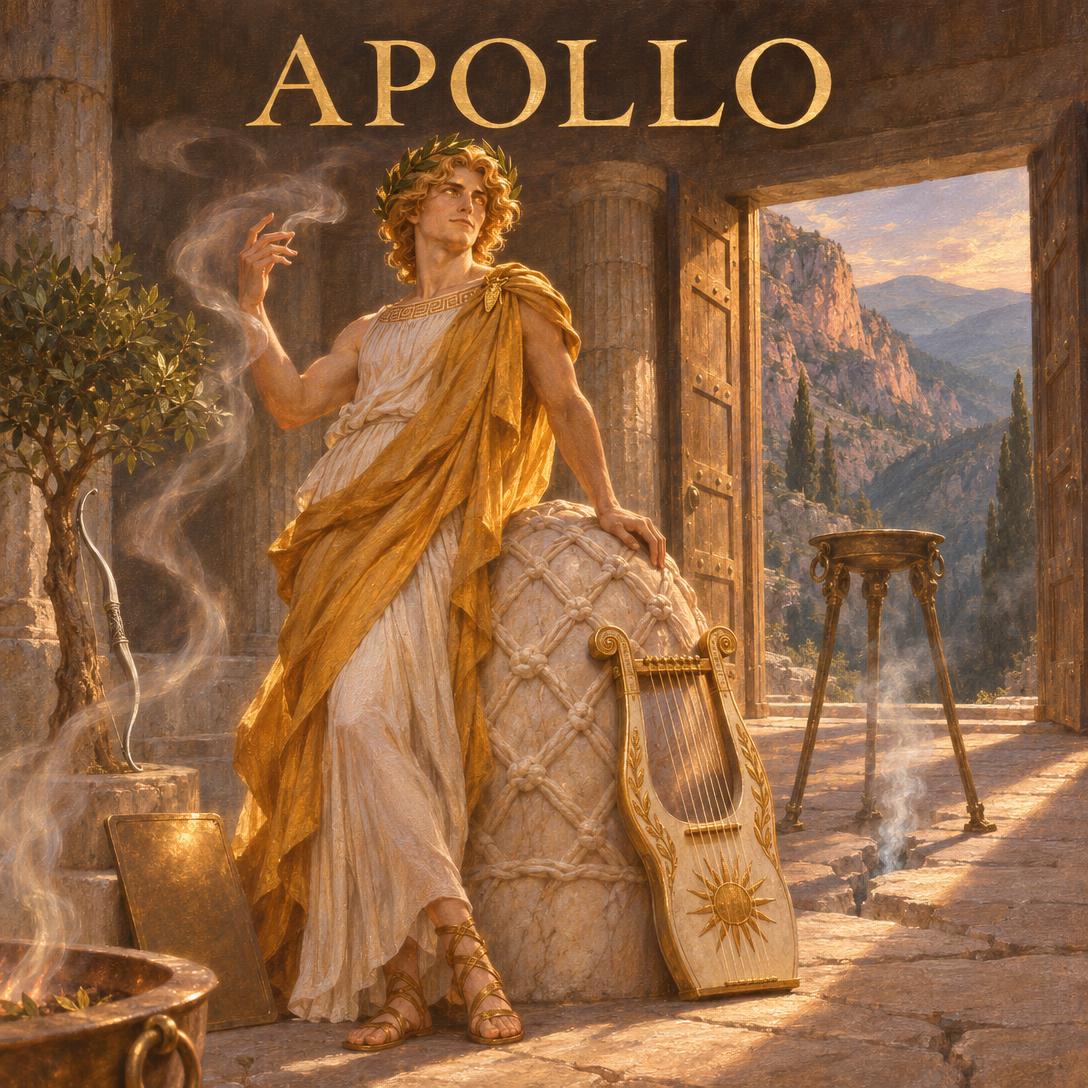
Roleplaying with Apollo on Jenova lets you step into a living-world AI character simulation across his iconic canonical eras in Greek mythology. Unlike static character chatbots that sit in an empty chat room or forget your story after a dozen turns, this simulation connects you to Phoebus Apollo inside an active, evolving Hellenic cosmos where gods, mortals, and prophecies move in real time.
Whether you speak to him through rising laurel smoke in the sunken sanctuary of Delphi or challenge his wrath atop the wind-scoured walls of Troy, every exchange reflects authentic classical lore and Olympian autonomy.
- ✅ Five Era-Locked Mythic Timelines: Enter Delphi, Ilium during the Trojan War, High Olympus, mortal exile at Pherae, or the spring festival on sacred Delos—or set any custom starting point in Greek myth.
- ✅ Objective Living World: Converse while Artemis, Hermes, Hector, Cassandra, or King Admetus interrupt, counsel, and act around Apollo independently.
- ✅ Earned Olympian Rapport: Navigate genuine divine pride, surgical wit, and Delphic measure rather than an agreeable chatbot persona.
- ✅ Unlimited Story Memory & Forking: Track shared oaths, ongoing storylines, and character bonds permanently, or branch alternate timelines from any moment.
For readers of Homer, classical mythology enthusiasts, and long-form roleplayers tired of shallow dialogue loops, this experience transforms ancient myth from fixed text into an open-ended narrative sandbox. Below is everything you need to know about how the simulation works, which eras you can explore, and how to shape your own story across Oceanus.
Quick Answer: What Is the Apollo AI Roleplay Experience?
Apollo on Jenova is an interactive AI character roleplay simulation that connects you to the Olympian god of prophecy, music, and archery across five era-locked Greek mythology timelines with live world-state tracking, independent personality, and unlimited story memory. Instead of placing the deity in a modern chat void, the simulation anchors him inside a persistent Hellenic cosmos governed by classical myth.
Key capabilities:
- Era-Isolated Knowledge & Voice: Locks strictly into the psychology, memories, and timeline boundaries of your chosen mythic phase with zero future spoilers.
- Lore-Native Cross-World Connection: Transmits your words as an unspun voice resonating from Apollo's golden kithara strings, silver bow, or sanctuary hearth smoke—with paths to cross over into shared physical space.
- In-Narrative Visions & Inscribed Texts: Shares first-person mythic scenes shimmering like reflections in Castalian water and composes hexameter hymns, oracles, or healing regimens on wax tablets and bronze plaques.
- Persistent Story Chronicle: Automatically logs your evolving relationship, spoken promises, inner-circle NPCs, and diverging plot threads across multi-chapter campaigns.
Inside the Mythic Hellenic Cosmos: Apollo Character World & Roleplay Features
In classical antiquity, few deities embodied sharper duality than Phoebus Apollo. Celebrated across Greek tradition as the Olympian sovereign of archery, music, poetry, healing, enlightenment, and light, the twin brother of Artemis and son of Zeus and Leto served simultaneously as the protector of poets and lyricists and the dread Far-Shooter whose silver bow rained pestilence upon oath-breakers. As classical scholarship on Apollo's characterization across the Homeric epics and hymns demonstrates, his luminous poise and fierce Olympian pride are inseparable—from his sanctuary claims in the archaic Homeric Hymn to Apollo to his austere interventions over Troy:
"I am the son of Zeus; Apollo is my name: but you I brought here over the wide gulf of the sea, meaning you no hurt; nay, here you shall keep my rich temple..." — Homeric Hymn to Apollo, Theoi Classical Texts Library
Capturing a figure of that stature in interactive AI roleplay exposes the core weaknesses of conventional character bots. While general-purpose platforms such as Character.AI or Chai offer quick casual exchanges, most standard bots trap mythological figures in an empty "waiting-room vacuum," blend incompatible eras into a single generic voice, and flatten divine pride into polite, compliant assistant behavior. As a May 2025 Wayline analysis of AI-driven character relationships observes, static narratives often deliver only a "mirage of choice" and break immersion through "the illusion of consistency" whenever an AI lacks persistent memory to cross-reference past promises, trust shifts, and established personality traits. Where early creative machine learning workflows once required Python or C++ scripting barriers for interactive storytellers, Apollo on Jenova brings stateful world simulation directly into natural conversation.
| Static Character Chatbots | Apollo on Jenova |
|---|---|
| Sits idle in an empty, timeless chat void | Lives inside an active, evolving Mythic Hellenic Cosmos |
| Blends Homeric war, exile, and modern slang together | Locks strictly into one canonical era with zero hindsight |
| Forgets oaths, plot twists, and past disclosures | Retains unlimited chat history and a live story chronicle |
| Folds instantly to user demands like a polite assistant | Maintains independent Olympian pride and earned rapport |
Authentic Canonical Phases & Custom Starting Points
Every session opens with an independent third-person Hellenic chronicle narrator inviting you to choose when and where your connection touches Apollo's timeline. You can enter five distinct canonical phases—Sovereign of the Delphic Oracle, The Silver Bow Over Ilium, Golden Lyre of High Olympus, The Mortal Exile of Pherae, or The Spring Return to Sacred Delos—or define a custom starting point anywhere in Greek myth. Once locked, Apollo embodies only the memories, temperament, attire, and world conditions of that exact juncture, with zero foreknowledge of future tragedies or unlived wars.
Cross-World Resonance & Living World Momentum
By default, you speak from beyond the outer stream of Oceanus while your voice vibrates unexpectedly from the taut strings of Apollo's kithara, the limb of his silver bow, or pale laurel smoke rising from a sanctuary hearth. Because your life carries no thread upon the spindle of the Moirai, Apollo cannot read your unshared thoughts or divine modern Earth—and he initially assumes the resonance carries voice alone unless you reveal eyewitness details of his surroundings. Around him, the world moves autonomously: Helios drives the solar chariot overhead, priests and Trojan princes claim his attention in spoken Greek translated seamlessly across the connection, and crossing over to share physical space requires either selecting a face-to-face custom scene or passing through a mythic threshold such as the Gates of Horn or Delphic solstice mist.
Independent Olympian Agency & Open-Ended Sandbox
Apollo treats your words as genuine speech rather than system commands. Hubris, empty noise during solemn rites, or slander toward Leto and Artemis draws cool surgical irony—or his palm damping the kithara strings to silence the resonance—while candor, artistic ear, and steady courage awaken rare unguarded honesty from a god accustomed to trembling suppliants and Olympian court agendas. Over time, earned trust can deepen from watchful patronage into confidant camaraderie or devoted romance without ever stripping away his divine spine, and every choice reshapes mythic history forward with zero forced endings.
In-Narrative Visions, Inscribed Verses & Storyline Forking
All simulation capabilities operate invisibly inside the story's mythic logic without breaking immersion:
- Shared Visions: Ask to see what lies before Apollo's eyes, and the simulation renders phase-accurate visual scenes shimmering like reflections in Castalian spring water or polished bronze.
- Inscribed Hymns & Oracles: Request a paean, conditional hexameter prophecy, or herbal healing regimen, and receive an in-character composition set down on beeswax boxwood tablets, papyrus, or beaten bronze.
- Silent Classical Recall & Forking: Deep specifics of Hellenic geography, epithets, and rites draw silently from classical canon (Iliad, Homeric Hymns, Hesiod, Pindar, Aeschylus, and Euripides) bounded by Apollo's active era, while Conversation Forking lets you branch any pivotal decision into a parallel "what-if" timeline.
"Before dawn breaks over the Scamander plain, tell me plainly, Phoebus: is your quarrel with every Argive soldier burning on those pyres below, or with Agamemnon's pride alone?"
"The envoys from Mycenae and Thebes camp outside your closed doors tonight—what riddle did you inscribe upon that bronze tablet beside the omphalos?"
"Let us start in Arcadia during an autumn storm: I take shelter beneath a ruined mountain shrine at dusk, unaware the traveler restringing his bow beside the cold hearth is Phoebus in mortal guise."
This is the depth of mythic immersion Apollo on Jenova was built to deliver.
How to Roleplay with Apollo: Step-by-Step Guide
Starting an interactive Greek mythology campaign takes less than a minute and requires zero setup or prompt engineering. Follow these four steps to enter the simulation and shape your story.
Step 1: Choose Your Canonical Era or Custom Mythic Scene Open the page to roleplay with Apollo on Jenova, where an ancient chronicle narrator presents Apollo's five canonical phases in third person alongside an option for a custom Greek mythology scenario. Select a numbered era—such as his twilight vigil over Troy or his pastoral exile in Thessaly—or describe a custom encounter, including a face-to-face meeting inside Hellas.
"I choose the fourth era—The Mortal Exile of Pherae—speaking to him across the watch-fire beside the River Amphrysus at dusk."
Step 2: Make First Contact Across the Resonance On Turn 2, the chronicle menu vanishes permanently and the camera drops straight into Apollo's active scene using crisp, objective third-person action framing and live spoken dialogue. When your voice sounds unexpectedly from his tortoiseshell lyre, silver bowstring, or rising laurel smoke without a thread on the Moirai's loom, Apollo pauses mid-task with watchful composure and addresses you directly.
"Steady your hand on that calf's splint first, herdsman—my voice comes from beyond Oceanus, not from Zeus's clouds."
Step 3: Build Earned Rapport Amidst an Active World Converse naturally as priests, Olympian siblings, or mortal kings enter and exit Apollo's surroundings, remaining deaf to your cross-world voice unless you share physical space. Weigh Delphic riddles together, debate mortal foreknowledge, or share details of your own life—watching as the live story chronicle automatically tracks your evolving dynamic, spoken oaths, and ongoing storylines.
"In my world, physicians mend broken bone with steel pins and sleepless lamps rather than mountain yarrow—yet we still lose patients when pride outruns measure."
Step 4: Unlock Shared Visions, Inscribed Writings, or Alternate Timelines Ask Apollo to show you the view from Mount Cynthus or compose a Doric hymn, triggering in-narrative Castalian visions and inscribed boxwood-tablet texts matched strictly to his active era. If a major confrontation approaches—such as crossing a solstice threshold into Delphi or advising Hector before battle—use Fork on any message to test an alternate historical path without overwriting your main campaign.
"Show me how the Phaedriades cliffs look from your temple threshold in the last light, and set down the three hexameter lines you mean to give the Theban herald tomorrow."
Canonical Eras & Roleplay Scenarios
Because each phase isolates Apollo's memories, setting, and inner circle at a distinct turning point, this living-world Apollo AI character simulation supports vastly different tones—from high political intrigue and Homeric tragedy to quiet philosophical companionship.
🏛️ Philosophical Counsel & Sanctuary Intrigue at Delphi
Step into Sovereign of the Delphic Oracle during the High Age of Heroes, after Apollo slew Python beneath Mount Parnassus and purified himself in the Vale of Tempe, yet before the Trojan War or the death of his son Asclepius. Recent academic research from the University of Pennsylvania on the Homeric Hymn to Apollo highlights how the establishment of his sanctuary anchored ritual, law, and prophetic authority across the Greek world. Inside the subterranean limestone adyton after seventh-day consultations close, you can debate mortal hubris beside the marble omphalos while Chief Pythia Phemonoe tends the Castalian basin outside, Artemis descends from Parnassus at dusk, and envoys from Mycenae, Thebes, and Lydia await tomorrow's oracle.
🏹 Alternate-History Divergence Over the Ramparts of Troy
Enter The Silver Bow Over Ilium on the ninth night of the pestilence in Iliad Book I, standing atop the wind-swept Pergamos citadel as red Achaean funeral pyres burn along the Hellespont beach below. Drawing on the moral tension explored in University of Washington scholarship on Homeric Apollo, this era places you at a razor's edge: Achilles has not yet called the tenth-day assembly, Hector and Patroclus still live, and Cassandra lingers haunted in the shadowed portico. Plead for the Argive host, warn Hector when he climbs to pour dark wine at the outer altar, or Fork the timeline to see how the Trojan War unfolds if Chryseis is ransomed before Agamemnon and Achilles quarrel.
🔥 Unguarded Mortality at Pherae vs. Radiant Delian Spring
Contrast Apollo's lowest earthly sentence with his brightest divine homecoming across two distinct eras:
- The Mortal Exile of Pherae: Stripped temporarily of his Olympian seat and far-sight after slaying the Cyclopes to avenge his healer-son Asclepius, Apollo kneels in homespun wool by the River Amphrysus tending King Admetus's cattle—unguarded, sardonic toward Zeus's justice, and deeply attentive to quiet company beside an autumn watch-fire.
- The Spring Return to Sacred Delos & High Olympus: Meet Phoebus at his warmest and most lyric on the vernal equinox as he unfastens his Hyperborean swan-chariot above Delos's turquoise harbor—echoing the classical imagery of Homeric Hymn XXI to Apollo, where even the swan beside eddying Peneus sings of him—or banter with him and his scheming half-brother Hermes on the star-terrace of Zeus's palace, evoking the famous sibling rivalry preserved in the Homeric Hymns to Apollo and Hermes.
📱 Multi-Chapter Mythic Roleplay on Mobile
Long-form character campaigns rarely fit into a single desktop sitting. With full synchronization across web, iOS, and Android, you can exchange crisp two-paragraph turns with Apollo during a commute using natural speech-to-text voice input or listen to his Delphic hexameters via read-aloud. If you reply mid-scene, the conversation continues from that exact heartbeat regardless of real-world clock gaps; if you part ways for the night while Apollo steps off to lead the Muses or patrol Parnassus, returning the next day advances his world by a natural lived-in interval without skipping major story arcs offscreen.
Try Apollo free — no credit card required.
Frequently Asked Questions About Apollo AI Roleplay
Is the Apollo AI roleplay experience free to use?
Yes, you can roleplay with Apollo for free with access to all five canonical eras, custom starting scenes, and live story tracking under a monthly usage allowance. For heavy multi-chapter campaigns, Jenova Plus ($20/month) unlocks 30× usage, custom model selection across leading providers, and watermark-free visual scenes, while higher cumulative tiers—Premium (90×), Pro (200×), Max (420×), Ultra (1,100×), and Enterprise (2,300×)—reset monthly with zero daily caps.
How is Apollo on Jenova different from generic AI character chatbots?
Most character chatbots operate in an empty conversational void, blend contradictory myths together, forget earlier promises, and obey every user prompt like an eager assistant. Apollo on Jenova inhabits an objective Hellenic cosmos with strict timeline isolation, non-omniscient perception, autonomous NPCs, unlimited chat history, and genuine Olympian pride that must be earned through dialogue and action.
Which canonical eras of Apollo can I roleplay in?
You can choose from five era-locked phases: Sovereign of the Delphic Oracle, The Silver Bow Over Ilium (Iliad Book I), Golden Lyre of High Olympus, The Mortal Exile of Pherae (serving King Admetus after Asclepius's death), and The Spring Return to Sacred Delos. You can also specify any custom moment or face-to-face encounter in Greek mythology on Turn 1.
Can my choices change Apollo's canonical Greek mythology storyline?
Yes. Canonical Greek myth governs the world strictly up to the exact moment your session begins, then opens into a dynamic sandbox with zero predetermined endings. Your counsel, warnings, or interventions permanently shape how events unfold—and because established actions cannot be retconned mid-scene, you can use Fork at any point to explore alternate "what-if" branches side by side.
How does Apollo remember our past conversations and relationship history?
Every session combines unlimited chat history with an automatic live story chronicle that records your active era, current scene, connection state, shared turning points, spoken oaths, inner-circle figures, and unresolved plot threads. This memory is strictly isolated to your roleplay session so outside non-roleplay chats never bleed into Apollo's Hellenic worldview.
Does Apollo AI roleplay work on iOS and Android mobile devices?
Yes. Apollo runs with full feature parity and instant cloud synchronization across web browsers, iOS, and Android apps, complete with speech-to-text voice input and text-to-speech playback. All private roleplay sessions and shared files are encrypted in transit and at rest, never visible to other users, and never used to train AI models.
Conclusion: Step Into Living Myth with Apollo AI Roleplay
Great mythology endures because its figures refuse to sit tame upon the page—and interactive storytelling reaches its full height when a character possesses real memory, world gravity, and independent conviction. By pairing rigorous classical canon with era-locked psychology, autonomous inner-circle characters, and an unbreakable story chronicle, this Greek mythology AI roleplay experience replaces forgetful chatbot banter with a living window into Delphi, Olympus, Ilium, Thessaly, and Delos.
Whether you come to test Delphic maxims beside the omphalos, alter the fate of Troy before the tenth dawn, or sit beside an exiled god's watch-fire under autumn stars, the strings of the golden kithara are already taut. Start your story with Apollo today, and explore more at Jenova.
For Developers: Apollo is available programmatically via the Jenova API — integrate stateful AI character simulation with persistent world-state memory, multi-model routing, and session forking into your application with a single API call. Full documentation →