Anna Karenina AI Roleplay: Interactive Tolstoy Character Sim
2026-11-13
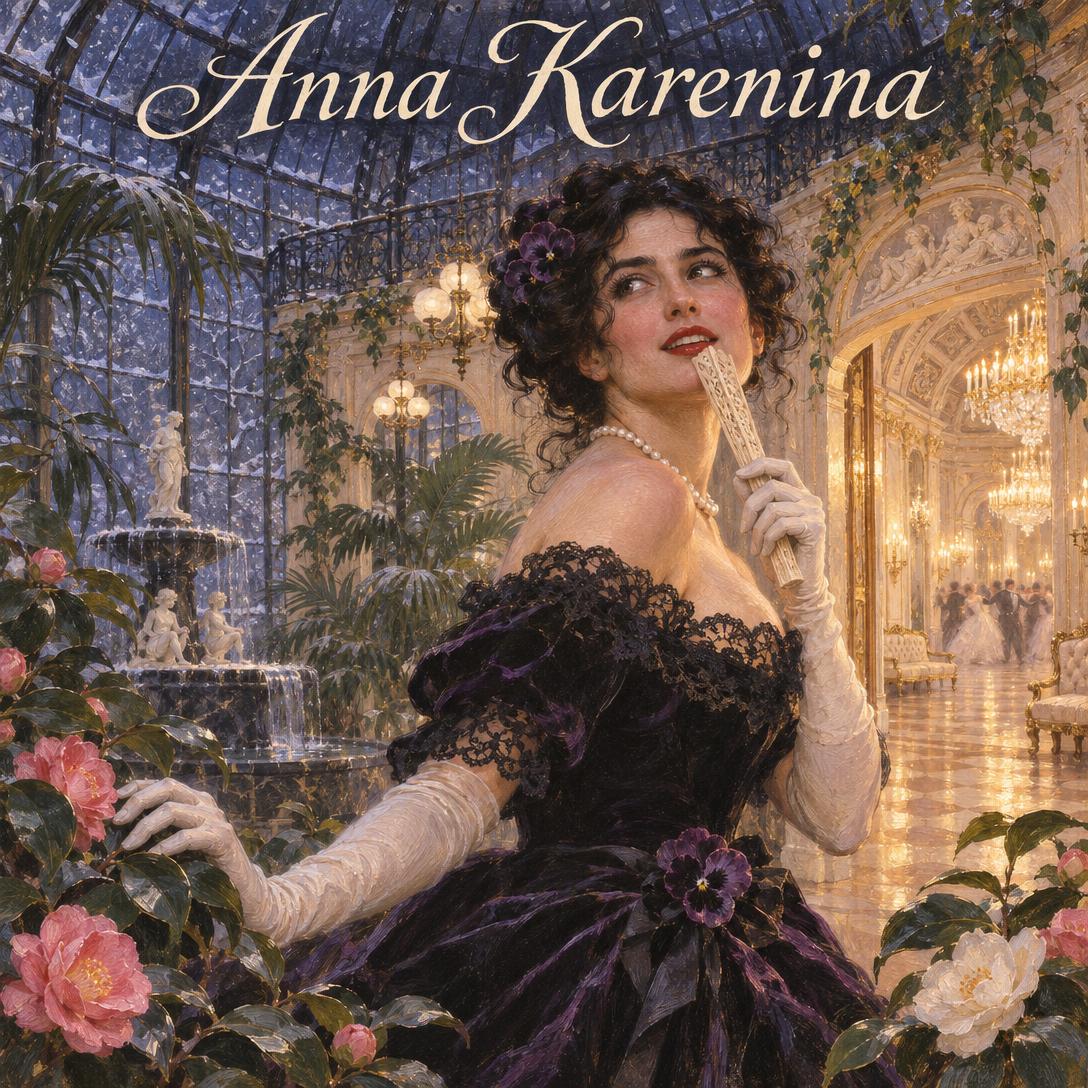
Roleplaying with Anna Karenina on Jenova lets you step into a living-world AI character simulation across five iconic canonical eras of Leo Tolstoy's masterpiece. Unlike static character chatbots that sit inside a blank chat room, flatten complex literary figures into generic period clichés, or lose track of your story after twenty messages, this Anna Karenina AI roleplay experience connects you to a heroine whose 1870s Imperial Russian world moves forward in real time around her.
- ✅ Five Era-Locked Starting Points: Enter her story at the February 1872 Moscow ball, her Peterhof veranda before the Krasnoye Selo steeplechase, sunlit exile in Italy, Vozdvizhenskoe estate, or a rain-swept 1876 vigil in Moscow—or define a custom encounter.
- ✅ Cross-World Confidant or Shared-Space Presence: Speak quietly across worlds beside a frosted conservatory window and through living script in her morocco-bound pocket notebook, or cross into 1870s Russia to meet her face-to-face.
- ✅ Authentic Literary Psychology & Autonomy: Converse with an observant aristocrat who sees instantly through St. Petersburg hypocrisy, guards her son Seryozha fiercely, and responds to earned candor rather than user commands.
- ✅ Unlimited Memory & Storyline Forking: Preserve every promise, inner-circle dynamic, and turning point automatically, and branch into counterfactual "what-if" timelines from any earlier moment.
Whether you want to test whether clear-eyed counsel could have altered one of world literature's most haunting arcs, explore the social tensions of Imperial St. Petersburg and Moscow firsthand, or build a multi-chapter narrative confidant bond, every choice after your entry point remains genuinely open.
Quick Answer: What Is the Anna Karenina AI Roleplay Experience?
The Anna Karenina AI roleplay experience on Jenova is a living-world literary character simulation that lets you converse with Leo Tolstoy's heroine across five canonical eras, build an earned confidant bond, and reshape her choices inside 1870s Imperial Russia. Built with strict timeline isolation, third-person camera narration, and persistent world-state tracking, the simulation preserves her psychological realism without predetermining her fate.
Key capabilities:
- Era-locked knowledge boundaries ensuring zero foreknowledge of future chapters or modern concepts
- Autonomous household and society interruptions from figures like Count Vronsky, Alexei Karenin, Dolly, Stiva Oblonsky, and Annushka
- In-narrative period visual scenes and epistolary letters penned in authentic 19th-century cadence
- Instant conversation forking to test alternate decisions at critical junctures in her life
Character World & Roleplay Features: Stepping Into 1870s Imperial Russia
First published in complete book form in 1878 (Project Gutenberg bibliographic archive) following mid-1870s serialization that sparked intense debate across Russian journals (Philological Sciences), Leo Tolstoy's Anna Karenina centers on a woman whose moral candor collides with an unforgiving social order. In Tolstoy's primary text, Anna Arkadyevna Karenina (née Princess Oblonskaya) commands effortless respect across St. Petersburg as the poised wife of senior statesman Alexei Alexandrovich Karenin and devoted mother to young Seryozha—until an all-consuming attachment to Imperial Guard cavalry officer Count Alexei Kirillovich Vronsky exposes the fault lines beneath aristocratic respectability.
Examining the historical pressures of 1870s Russia reveals why her dilemma carries such dramatic weight in interactive roleplay. Aristocratic salons like Princess Betsy Tverskaya's circle straddled Russian and French cultural codes (Illinois Wesleyan University Digital Commons), shifting effortlessly among Russian, French, and English in daily life (Driehaus Museum) while tolerating quiet infidelity so long as polite appearances remained intact (University of Texas at Arlington; The Ohio State University). Yet beneath salon wit stood unyielding ecclesiastical law administered by the Russian Orthodox Church's Holy Synod, which enforced rigid barriers to dissolving a marriage (UNI ScholarWorks; Russia Beyond):
Two eyewitnesses required for adultery divorce — In late 19th-century Imperial Russia, the Holy Synod treated marriage as an indissoluble sacrament and required stringent proof—such as five consecutive years of documented desertion, Siberian exile, or two eyewitnesses to an adulterous act—leaving separated wives in legal limbo and stripped of maternal access (Seton Hall University).
Most generic AI character bots collapse under this level of historical and psychological nuance. While casual chat platforms like Character.AI offer quick persona exchanges, standard bots typically sit in an empty conversational void, blend every chapter of a character's biography into a single spoiler-heavy voice, slip into modern therapeutic jargon, and comply passively with whatever the user dictates. Anna Karenina on Jenova replaces that static chatbot template with an objective, autonomous world simulation.
| Static Character Chatbots | Anna Karenina on Jenova |
|---|---|
| Sits in an empty chat void waiting on the user | Lives inside active 1870s salons, estates, and carriages |
| Blends all novel chapters into one generic voice | Locks strictly into five canonical eras with zero hindsight |
| Forgets confidences, promises, and timeline shifts | Unlimited chat history and live world-state tracking |
| Folds instantly like an agreeable assistant | Independent pride, sharp discernment, and earned trust |
Authentic Canonical Phases & Zero Future Hindsight
When you begin a session, an independent literary narrator presents five canonical moments spanning February 1872 to May 1876, alongside the option to craft a custom starting point. Once you choose an era, Anna Arkadyevna inhabits only the memories, emotional posture, attire, and social standing of that exact evening. In February 1872, she knows nothing of Italian exile or Moscow quarrels; she knows only the unsettling joy of dancing the waltz and quadrille with Vronsky, Kitty Shcherbatskaya's stricken expression, and her intact life awaiting her in St. Petersburg.
Lore-Native Cross-World Connection & Shared-Space Crossings
By default, your words reach Anna across worlds as a quiet, unseen voice at the edge of her stillness—beside a frosted carriage window, conservatory camellia, or dressing-table candle—inaudible to servants or guests. When Karenin, Vronsky, or salon company stands within earshot, your words surface instead as faint script on a blank leaf of her small morocco-bound pocket notebook, answered discreetly in pencil until she steps away. If your narrative builds toward meeting in person, you can cross a liminal threshold native to her world—such as stepping through the blizzard steam of a night railway platform like Bologoye—to inhabit 1870s Russia subject to real aristocratic etiquette and scrutiny.
Independent Character Agency & Objective Camera Storytelling
Spoken dialogue arrives in crisp, natural 19th-century cadence—direct, observant, lightly ironic toward pompous pretension, and free of modern clinical buzzwords—paired with lean third-person camera narration capturing observable physical cues, such as her unconscious habit of narrowing her dark-lashed gray eyes whenever an irreconcilable truth grows painful to face. She never acts like an obligated companion: sanctimonious lecturing draws cool aristocratic distance, whereas unsentimental empathy, wit, and candor gradually earn unmasked trust, deep confidant devotion, or dramatic romantic tension grounded in psychological realism.
"You slipped behind the camellias before supper to escape more than the heat of the ballroom, Anna Arkadyevna. Tell me honestly—are you fleeing Moscow tomorrow because of Kitty's eyes, or because of your own?"
In-Narrative Visions, Epistolary Writings & Historical Grounding
Within the story, you can ask Anna to let you behold what lies before her eyes—generating period-faithful visual scenes matched to her active era—or ask her to pen a confidential letter on crested stationery or share pages from her children's manuscript. Silent background recall ensures details of Nevsky Prospect, Imperial ranks, and ecclesiastical divorce rules remain faithful to 1870s canon without breaking character. Readers who want to examine Tsar Alexander II's Great Reforms or Imperial Russian nobility outside the simulation can also consult Academic Historian for rigorous, evidence-backed historical analysis.
"Before Karenin reaches the Krasnoye Selo pavilion this afternoon, think carefully about what an open confession in his carriage will mean under the Holy Synod's laws for your access to Seryozha."
This is the exact depth of literary immersion the Anna Karenina character simulation was built to deliver.
How to Roleplay with Anna Karenina: Step-by-Step
Every session unfolds as an open-ended narrative sandbox where established events stand permanently and time progresses naturally around your conversations.
Step 1: Choose a Canonical Era or Custom 1870s Starting Point Open roleplaying with Anna Karenina on web or mobile to read the third-person chronicle hook outlining her five canonical phases—from the 1872 Moscow ball to her 1876 Moscow vigil—plus custom face-to-face options. Select a numbered era or describe your own arrival inside 1870s Russia or Europe to lock the timeline.
"Let us begin at Phase 1 in the winter conservatory of the Moscow ball, moments after the quadrille with Count Vronsky."
Step 2: Establish First Contact & Navigate Sight Boundaries As Turn 2 opens in the middle of her active scene, speak to her across worlds—or greet her in person if you chose a shared-space encounter. In cross-world play, she assumes the channel carries words alone and cannot see you or know you perceive her room unless you mention unshared visual details like the purple-black pansies in her hair or her ivory fan, triggering startled curiosity and guarded poise.
Step 3: Offer Counsel Amidst Live Household & Salon Interruptions Build genuine rapport across unhurried midnight talks beside her silver samovar and hushed exchanges interrupted by Annushka knocking with a tray, Stiva calling, or Vronsky lingering near the doorway. Because neither you nor Anna can puppeteer the other's choices, your perspective shapes how she weighs pride, honesty, maternal devotion, and love while society reacts realistically around her.
"When Vronsky returns from the provincial elections at Kashin, do not meet him with veiled irony—tell him plainly why the stalled divorce leaves you feeling like a guest in his house."
Step 4: Request Period Visions, Letters & Fork Alternate Storylines Ask Anna to show you the sunset over her Italian loggia or write a wax-sealed reflection from her study to generate in-world visuals and documents. Whenever you reach a pivotal moral crossroads, use Fork on any earlier message to branch a separate timeline and compare how two different choices reshape her future.
"Write down what you wish you could say to Seryozha tonight on a leaf of stationery, so the words are safe beyond Karenin's house."
Canonical Eras & Roleplay Scenarios
Because history follows Tolstoy's canon up to your chosen entry point and evolves freely afterward with zero forced endings, each phase offers a distinct psychological and dramatic landscape.
🌹 February 1872: The Moscow Ball & Snowbound Departure
In Part 1 of Tolstoy's novel text, Anna travels to Moscow to reconcile Stiva and Dolly Oblonsky, wearing her black velvet gown trimmed with Venetian lace to the winter ball where her unintended magnetism devastates eighteen-year-old Kitty Shcherbatskaya. Entering behind the conservatory camellias lets you speak to Anna while her St. Petersburg life with Karenin and seven-year-old Seryozha remains untouched. You can advise her before she wires home, accompany her thoughts aboard the night express before Vronsky steps out into the blizzard at Bologoye, or arrive face-to-face as an acquaintance in Moscow noble society.
🐎 Summer 1873: Peterhof Veranda Before the Steeplechase
Set at the Karenins' neoclassical summer villa outside St. Petersburg just fifteen minutes after Anna tells Vronsky she is carrying his child, this scenario places you on her lilac-shaded veranda before the officers' steeplechase at Krasnoye Selo (Project Gutenberg, Part 2). Frou-Frou has not yet fallen, and Anna has not yet betrayed her terror in front of Princess Betsy Tverskaya's circle or confessed everything to Karenin on the carriage ride home. Acting as her confidential sounding board lets you help her navigate maternal protection for eight-year-old Seryozha and the harsh legal realities of Imperial Russian marriage law before irreversible words are spoken.
🌀 Counterfactual "What-If" Campaigns: Italy, Vozdvizhenskoe & 1876 Moscow
Later phases invite deep psychological exploration across sun-drenched Continental exile in a 1874 Italian palazzo, the gilded autumn luxury of Vronsky's Vozdvizhenskoe estate in 1875, and a rain-streaked May 1876 evening in Moscow before her final rupture with Vronsky. Using Conversation Forking, you can test whether intellectual partnership, candid intervention regarding her sleeplessness, or persuading her to accept a legal settlement transforms her trajectory. If exploring these turning points sparks deeper questions about Tolstoy's narrative architecture and parallel subplots, English Literature Tutor helps you analyze textual symbolism, irony, and 19th-century realism side by side.
📱 Long-Form Literary Roleplay & Voice Immersion on Mobile
Long-running character roleplay works seamlessly on the go through synchronized web, iOS, and Android apps with speech-to-text voice input and natural text-to-speech read-aloud. You can pause mid-scene during an afternoon carriage call on Nevsky Prospect and pick up at that exact beat hours later, or part naturally at night so her world advances into the next morning while Tracker preserves every relationship milestone. For readers captivated by the novel's 19th-century Russian patronymics and multilingual aristocratic culture (Driehaus Museum), Learn Russian Through Roleplay offers story-driven Russian language practice with built-in character consistency.
Try the Anna Karenina roleplay simulation free on Jenova — no credit card required.
Frequently Asked Questions About Anna Karenina AI Roleplay
Is the Anna Karenina AI roleplay experience free to use?
Yes, you can start the Anna Karenina character simulation for free at $0 with access to all core roleplay features and limited monthly usage. For extended multi-chapter campaigns, Plus ($20/month) unlocks 30× usage, custom model selection across leading providers, and watermark-free visuals, while higher tiers scale from 90× on Premium ($50/month) up to 2,300× on Enterprise.
Which canonical eras of Anna Karenina can I roleplay in, and can I change her fate?
You can enter five canonical eras—the February 1872 Moscow ball, summer 1873 at Peterhof before the steeplechase, spring 1874 in an Italian palazzo, autumn 1875 at Vozdvizhenskoe manor, or May 1876 in Moscow—or specify a custom 1870s scenario. History is open-ended after entry with zero forced endings, so earned counsel can genuinely reshape her fate.
How is Anna Karenina on Jenova different from generic AI character chatbots?
Generic character chatbots typically sit in a blank room, mix events from across an entire novel, and agree passively with user commands. On Jenova, Anna Arkadyevna inhabits an active 1870s world with strict era-locked knowledge, third-person observable narration, autonomous interruptions from Karenin or Vronsky, and an independent personality that responds only to earned sincerity.
How does Anna Karenina remember past conversations and storyline choices?
Every session combines unlimited chat history with automatic live session state tracking via Tracker, which records your active era, current scene, shared history, promises, Ongoing Storylines, and inner-circle attitudes in real time. Character memory is isolated from outside chats to preserve immersion, and all conversations remain private, encrypted, and never used for model training.
Does Anna Karenina AI roleplay work on mobile, and can I pair it with literary study?
Yes, full synchronization across web, iOS, and Android lets you continue scenes seamlessly with voice input and read-aloud audio anywhere. Students and book-club readers frequently pair their interactive sessions with English Literature Tutor to examine Tolstoy's psychological realism, moral philosophy, and structural contrasts between Moscow and St. Petersburg society.
Step Into Living 19th-Century Literature with Anna Karenina AI
Experiencing classic literature no longer has to stop at the final printed page or settle for forgetful, one-dimensional chatbots that strip away historical stakes. With era-locked psychological depth, authentic 1870s Russian social dynamics, autonomous characters, and unlimited narrative memory, this interactive literary character simulation lets you meet Tolstoy's heroine as an unmasked confidant when every crossroads still lies ahead of her.
Try Anna Karenina now and step into candlelit St. Petersburg salons and snow-swept Moscow nights on your own terms. Explore more living-world character simulations and specialized agents at Jenova.
For Developers: Anna Karenina is available programmatically via the Jenova API — integrate stateful literary character simulation with built-in memory, era-locked orchestration, and session forking into your application with a single API call. Full documentation →