AI Anime Comic Generator: Create Stunning Anime-Style Comics in Minutes (March 2026)
2026-03-28
The AI anime comic generator has become the most sought-after creative tool of 2026. The global manga market is projected to reach USD 23.12 billion this year — on track toward USD 56.38 billion by 2031 at a 19.52% CAGR (Mordor Intelligence). Meanwhile, the AI-generated comic book market has grown from USD 1.52 billion in 2025 to USD 2.01 billion in 2026 and is projected to reach USD 6.06 billion by 2030 at a 31.8% CAGR (Research and Markets). The convergence is unmistakable: demand for anime-style visual storytelling is surging globally, and AI tools are finally capable of delivering it.
Jenova's Comic Creator is the dedicated AI agent built for this intersection — offering six professional art style templates, a character reference sheet system for visual consistency across 200+ pages, and persistent story state tracking across sessions. Whether you're creating anime-inspired Western comics, manga-style graphic novels, or vertical webtoons, the workflow starts here.
Quick Answer: What Is an AI Anime Comic Generator?
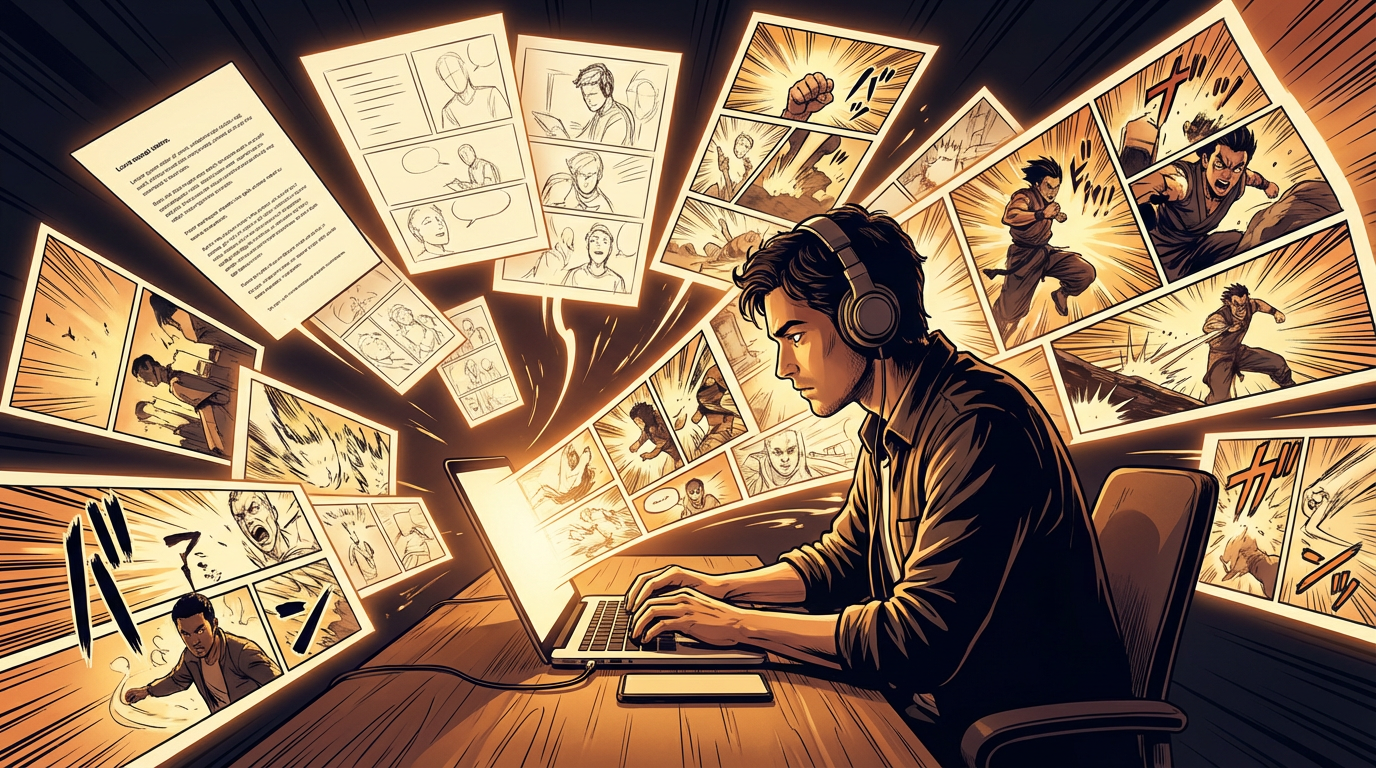
An AI anime comic generator is a specialized tool that transforms story concepts and text descriptions into complete anime-style comic pages — including character designs, panel layouts, dialogue placement, and sequential visual storytelling — without requiring drawing skills.
Key capabilities of a quality AI anime comic generator in 2026:
- Character consistency across hundreds of panels using reference sheet architecture — Comic Creator maintains identical anime character appearances from page 1 to page 200+
- Professional anime art style templates covering Shonen action, Shoujo romance, Seinen drama, and Western-anime hybrid aesthetics
- Intelligent panel layouts with authentic comic reading rhythm, dynamic compositions, and narrative pacing
- Persistent story state tracking continuity, character arcs, and visual evolution across sessions
- No drawing skills required — direct visual output through text descriptions and iterative refinement
The Problem: Why Anime Comic Creation Has Remained Out of Reach
Despite anime's global dominance in visual culture, aspiring creators face barriers that have historically kept them on the sidelines.
💰 Prohibitive Production Costs
Professional comic illustration rates range from $50–$300 per page depending on complexity. A standard 22-page comic issue costs $1,100 to $6,600 in black-and-white alone. A 200+ page graphic novel translates to $10,000–$60,000 in illustration costs — before editing, lettering, or printing (Jenova Resource Center). For independent creators testing an anime-style story concept, the financial risk is simply too high.
🎨 The Multi-Skill Burden
Creating anime-style comic art demands simultaneous mastery across character design, dynamic action choreography, background illustration, inking, coloring, panel composition, visual pacing, and sequential narrative construction. As AI Magicx's 2026 guide documented: "A single manga page can take a professional artist 4 to 10 hours — penciling, inking, toning, lettering, and composing panels. A 20-page chapter represents 80 to 200 hours of work."
🔄 The Character Consistency Nightmare
Perhaps the most challenging aspect of anime comic creation is maintaining visual consistency across dozens or hundreds of pages. As Skywork's 2026 guide documented: "A year or two ago, if you asked for the 'best AI character generator for consistent characters,' the honest answer would have been: 'None. You'll have to cobble together a workflow and hope for the best.'"
The AI-generated comic book market grew from USD 1.52 billion in 2025 to USD 2.01 billion in 2026 — a 32.1% year-over-year increase — driven by rising demand for cost-effective content creation and the expansion of online publishing channels (Research and Markets).
📱 Format Fragmentation
Anime-style comics span multiple formats — traditional Western comic layouts, Japanese right-to-left manga, vertical-scroll webtoons — each with distinct panel compositions, reading rhythms, and platform requirements. Digital formats already account for 72.12% of manga consumption, with online channels commanding 67.90% of revenue share (Mordor Intelligence). Creators need tools that handle format-specific requirements without requiring separate workflows.
This is exactly what the Comic Creator was built for.
Why Comic Creator Is the AI Anime Comic Generator You Need
While general image generators like Midjourney produce stunning individual anime illustrations, they lack every feature necessary for actual comic production. As Anifusion's 2026 analysis confirmed: Midjourney has "no built-in character consistency (each panel generates different-looking characters), no panel layout tools, no speech bubbles or text integration, and a Discord-based interface not designed for comic workflows."
The Comic Creator implements the structured methodology professional comic studios follow — powered by AI execution.
| Feature | General Image Generator (e.g., Midjourney) | Comic Creator |
|---|---|---|
| Character consistency | ❌ Extremely difficult | ✅ Reference sheet system across 200+ pages |
| Panel layouts | ❌ Manual in external tools | ✅ Intelligent narrative-aware composition |
| Speech bubbles & lettering | ❌ None | ✅ Integrated dialogue placement |
| Art style templates | ⚠️ Prompt-dependent | ✅ Six professional styles including anime |
| Story continuity | ❌ None | ✅ Persistent story state across sessions |
| Project state tracking | ❌ None | ✅ Cross-session persistence |
| Free tier | ❌ Most require $10+/month | ✅ Free to start |
How It Solves Each Pain Point
The Cost Barrier → Subscription Access. Instead of per-page artist fees, Jenova provides access to frontier AI models including GPT-5.4, Claude Opus 4.6, and Gemini 3.1 Pro Preview — no vendor lock-in. Create as many iterations, variations, and complete pages as your project requires.
The Multi-Skill Burden → Specialized AI Agents. The Comic Creator handles visual execution while you focus on storytelling. For narrative development, the Creative Fiction Writer helps craft compelling plots, character arcs, and dialogue before visual production begins.
The Character Consistency Problem → Reference Sheet Architecture. Before generating any story pages, you create character reference sheets showing each character in neutral poses with labeled features. These references load with every subsequent generation, ensuring visual consistency across your entire project — even across 200+ pages. The breakthrough came from a convergence of identity embedding, LoRA fine-tuning, and multi-subject consistency technologies that matured in 2025–2026 (Skywork).
Format Fragmentation → Dedicated Format Agents. Different formats require different approaches. The Manga Creator specializes in Japanese visual storytelling with screentone integration and right-to-left panel flow, while the Webtoon Creator handles vertical scroll optimization with strategic white space and "thumb stop" moments.
Competitor Context
While Dashtoon offers strong character consistency and a built-in publishing pipeline, it primarily locks creators into publishing exclusively on its platform and is optimized for webtoon format rather than traditional Western comics (Anifusion). Midjourney produces the highest quality standalone images but has zero comic-specific features — no panels, no speech bubbles, no story tracking, no character management (Skywork). Jenova's Comic Creator provides format specialization with multi-model access and no platform lock-in.
Try the Comic Creator free — no credit card required.
Related Agents You'll Also Like
Manga Creator — Japanese-Style Visual Storytelling
For creators working specifically in manga traditions:
- Five professional manga art style templates: Shonen, Shoujo, Seinen, Slice-of-Life, and Chibi
- Screentone integration and right-to-left panel flow optimization
- Plot memory engine maintaining story continuity across sessions
- Character reference sheets for visual consistency across 200+ pages
Webtoon Creator — Mobile-First Vertical Comics
For creators publishing on LINE Webtoon, Tapas, or Lezhin:
- Vertical scroll rhythm optimization with strategic white space and "thumb stop" moments
- Platform-ready exports formatted for major webtoon services
- Full-color consistency across 100+ episodes
Webtoons are projected to expand at a 35.62% CAGR through 2031, driven by snackable story arcs and social-sharing hooks that attract mobile-first readers (Mordor Intelligence).
Creative Fiction Writer — Story Development Partner
Develop your narrative foundation before visual production begins:
- Research-backed worldbuilding and character development
- Polished dialogue that translates directly to comic scripts
- Plot structure and pacing guidance for serialized storytelling
How It Works: From Concept to Finished Anime Comic
Step 1: Define Your Story and Choose Your Style
Start by describing your story concept, genre, and main characters to the Comic Creator. Choose from six professional art style templates — including anime-influenced styles that capture the expressive eyes, dynamic action lines, and emotional close-ups that define the aesthetic.
"I'm creating an anime-style action comic about a teenage hacker in Neo-Seoul who discovers she can physically enter cyberspace. My protagonist, Mina, is 17 — sharp bob haircut with electric-blue tips, oversized vintage bomber jacket, holographic wrist display. She's sarcastic but deeply loyal. I want bold action compositions with cyberpunk color palettes."
Step 2: Create Character Reference Sheets
Before generating any story pages, the Comic Creator produces detailed reference sheets for each character — neutral poses, key expressions, labeled features. These references load with every subsequent page generation, ensuring visual consistency.
"Generate a character reference sheet for Mina showing front view, three-quarter view, and profile. Include her bomber jacket, holographic wrist display, and electric-blue hair tips. Show neutral, smirking, and intense combat expressions."
Step 3: Generate Your First Pages
Describe each scene and the Comic Creator handles panel composition, character placement, dialogue bubbles, and visual pacing. The AI selects appropriate panel layouts based on narrative rhythm — action sequences get dynamic diagonal panels, emotional moments get full-page spreads.
"Page 1: Mina sits on a rooftop at night, legs dangling over the edge, holographic display projecting code into the air. The city sprawls below, neon signs reflecting off rain-slicked streets. She notices an anomaly in the code — her eyes widen. Four panels: wide establishing shot, medium shot of her working, close-up of the anomaly, extreme close-up of her widening eyes."
Step 4: Iterate and Refine
Request adjustments to any page. The Comic Creator maintains awareness of your project state, ensuring changes propagate correctly through subsequent pages. Character evolutions — new scars, costume changes, power-ups — are tracked with versioned reference sheets.
Step 5: Scale to Full Chapters and Series
Once your workflow is established, scale from sample pages to complete chapters. The persistent story state engine maintains continuity across sessions, so you can return to your project days or weeks later and pick up exactly where you left off.
Results & Use Cases
📚 Anime Fan Comics and Doujinshi
Scenario: Creating original anime-style fan comics or doujinshi for conventions and online communities.
Traditional Approach: Years of artistic training or $1,500–$9,000 for a 30-page commissioned chapter.
With the Comic Creator: Generate complete chapters with consistent anime-style characters. Create reference sheets for your original characters. Iterate on visual style until it matches your vision. Produce print-ready pages for convention sales or digital distribution.
💼 Webcomic Series Launch
Scenario: Building an audience with a serialized anime-style webcomic on Webtoon or Tapas.
Traditional Approach: Hire an artist ($200–$500 per episode) or spend 40–80 hours per episode drawing yourself.
With AI anime comic generation: Produce pilot episodes to test audience interest. Establish visual style and character designs. Post to platforms and upgrade to paid plans only after validating audience engagement. Both Webtoon and Tapas accept AI-assisted content, with many successful creators being transparent about their process (AI Magicx).
📱 Mobile-First Digital Publishing
Scenario: Creating vertical-scroll anime comics for mobile platforms.
Digital formats now account for 72.12% of manga consumption, with 77% of readers enjoying comics primarily on phones (Mordor Intelligence). The Webtoon Creator handles vertical scroll rhythm optimization, platform-specific formatting, and episode-based narrative structures with built-in hooks.
🎯 Self-Publishing on Amazon KDP
Scenario: Publishing an anime-style graphic novel as a print book or Kindle ebook.
With the Comic Creator: Generate print-ready pages at proper resolution. Maintain character consistency across the entire volume. Iterate based on beta reader feedback without additional costs. Amazon KDP supports AI-generated content with proper disclosure — series perform better than one-shots, and print-on-demand means no inventory risk (AI Magicx).
🎓 Education and Content Marketing
Scenario: Transforming complex information into anime-style visual narratives.
Educators can convert dense lesson plans into visually engaging comic strips that improve student engagement and information retention. Marketers can create branded anime-style comic content — the personal/hobbyist segment dominated the AI comic generator market with approximately 42.5% share in 2025 (Jenova Resource Center), driven by easy accessibility and minimal technical expertise requirements.
FAQ
What is an AI anime comic generator?
An AI anime comic generator is a specialized tool that creates anime-style comic pages from text descriptions — including character designs, panel layouts, dialogue placement, and sequential visual storytelling. The Comic Creator offers six professional art style templates, a character reference sheet system for visual consistency, and persistent story state tracking. No drawing skills are required.
How does the AI maintain character consistency in anime-style comics?
The system uses a reference sheet architecture. Before generating story pages, you create character reference sheets showing each character in neutral poses and key expressions. These references load with every subsequent page generation, ensuring visual consistency across your entire project. As Anifusion's 2026 analysis confirmed: "Character consistency is absolutely critical for manga. Readers need to instantly recognize your characters across hundreds of pages and various scenes. This is where specialized manga tools vastly outperform general AI art generators."
Can I create both manga and Western-style anime comics?
Yes. Jenova offers dedicated agents for different formats: the Comic Creator handles Western comic layouts with anime-influenced art styles, the Manga Creator specializes in Japanese manga conventions with right-to-left panel flow, and the Webtoon Creator handles vertical-scroll mobile formats. Each agent is optimized for its format's specific reading rhythm and visual conventions.
Do I need drawing skills to use an AI anime comic generator?
No drawing skills are required. AI comic creators are specifically designed for writers, storytellers, and creators who have compelling narratives but lack traditional artistic training. As Skywork's 2026 guide confirmed: "AI comic generators are specifically designed for writers, marketers, educators, and storytellers who have ideas but lack traditional artistic training."
Is the AI anime comic generator free to use?
The Comic Creator is available through Jenova with free access to core features and limited usage. The free tier is sufficient for testing workflows, creating sample pages, and validating story concepts. For extended creation sessions and higher usage limits, paid plans start at $20/month. The free/freemium segment held approximately 62% share of the AI comic generator market in 2025 (Jenova Resource Center).
Can I sell anime comics created with AI?
Jenova allows commercial use of generated content on paid plans. For self-publishing on platforms like Amazon KDP, AI-generated content is generally permitted with proper disclosure. Both Webtoon and Tapas accept AI-assisted content, though community reception varies — many successful AI-assisted creators are transparent about their process and focus on strong storytelling to differentiate themselves (AI Magicx).
Conclusion
The anime comic market's trajectory tells the story: the manga market growing from USD 19.35 billion in 2025 to a projected USD 56.38 billion by 2031 (Mordor Intelligence), the AI-generated comic book market expanding at a 31.8% CAGR to reach USD 6.06 billion by 2030 (Research and Markets), and digital consumption commanding over 72% of the market. The tools, the audience, and the distribution channels are all in place.
The question is no longer "can I draw this?" It's "what story do I want to tell?"
Start with the Comic Creator for anime-style Western comics and graphic novels. Expand to the Manga Creator for Japanese-style storytelling or the Webtoon Creator for mobile-first vertical formats. Develop your narrative with the Creative Fiction Writer before visual production begins.
Explore the full agent library at Jenova.