An Lushan AI Roleplay: Converse & Reshape Tang Dynasty History
2026-11-15
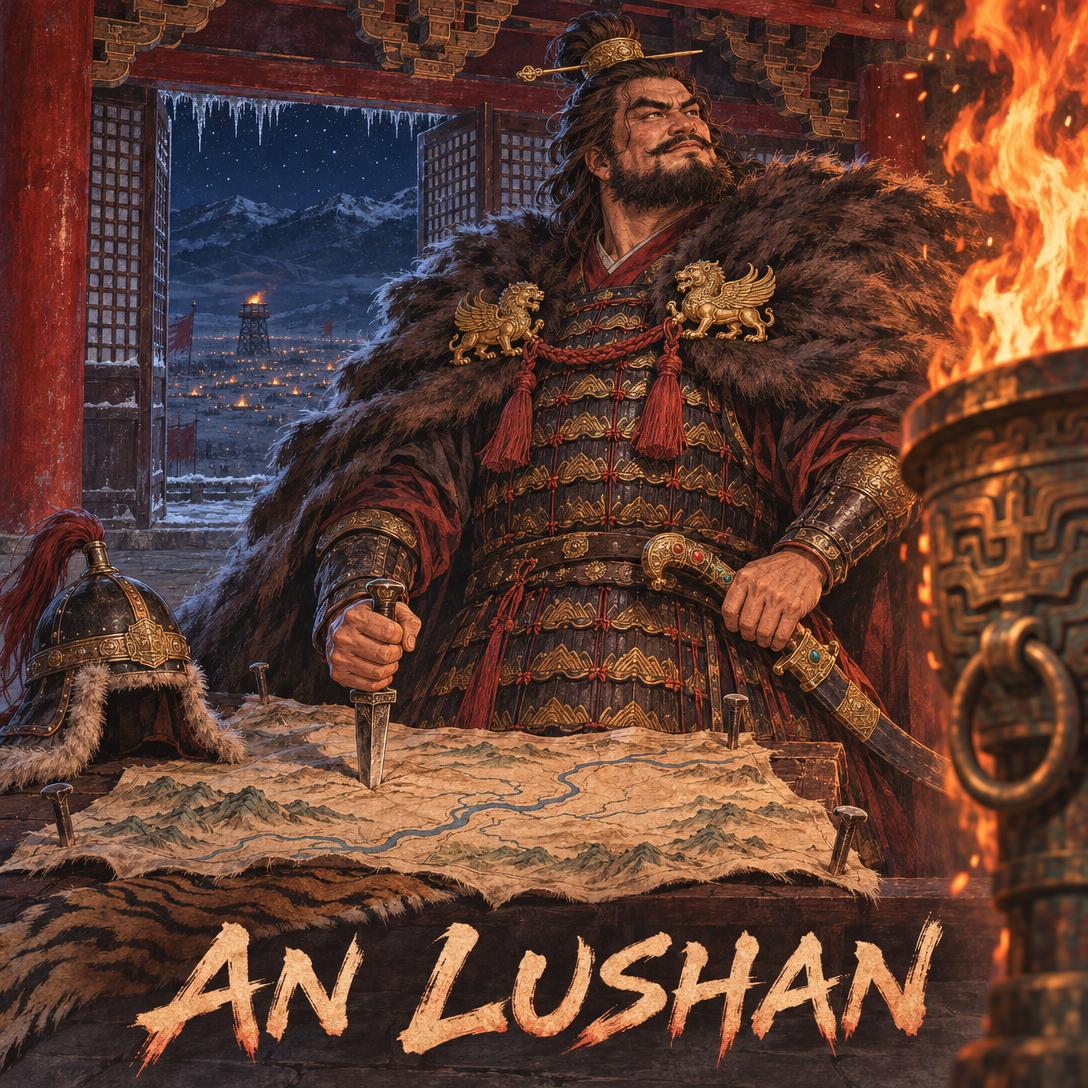
Roleplaying with An Lushan on Jenova lets you step into a living-world AI character simulation across four defining eras of eighth-century High Tang China. Unlike static character chatbots that sit in an empty chat room, blur decades of history together, or fold immediately like polite digital yes-men, this interactive AI roleplay connects you to the Sogdian-Turkic frontier commander inside an active, evolving imperial world. Speaking as an unseen voice from the living flame of his bronze brazier, gilded palace lamp, or imperial candelabrum—or meeting him face-to-face in a custom historical scenario—you can test his nerve, debate grand strategy, and alter the fate of an empire.
- ✅ Four Era-Locked Historical Timelines — Enter Yingzhou's dusty horse markets, Chang'an's gilded mansions, Fanyang's snowbound command hall, or conquered Luoyang with zero anachronistic hindsight.
- ✅ Autonomous High Tang World Momentum — Navigate real-time interruptions from frontier generals, imperial eunuchs, and Sogdian merchant spies as court intrigue and military campaigns unfold.
- ✅ Authentic Warlord Temperament & Earned Trust — Win genuine candor through sharp logistics, political nerve, and dark humor rather than receiving instant, unearned chatbot compliance.
- ✅ Unlimited Memory & Timeline Forking — Preserve every oath, strategic gambit, and inner-circle shift across multi-chapter campaigns, or branch into alternate historical outcomes from any turn.
Whether you study Tang military history, enjoy high-stakes court statecraft, or want an open-ended alternate-history sandbox, experiencing eighth-century frontier politics from inside the command tent changes how history feels. Below is a full breakdown of how this living-world simulation works, which canonical eras you can enter, and how your counsel can bend one of East Asia's greatest dynastic turning points.
Quick Answer: What Is the An Lushan AI Roleplay Experience?
An Lushan is a living-world AI character roleplay simulation on Jenova that lets you converse with the eighth-century Tang frontier commander across four historical eras to debate strategy, navigate court intrigue, and reshape imperial history. Built with strict timeline boundaries and continuous story-state tracking, the experience preserves authentic High Tang frontier dynamics while letting your choices diverge freely from recorded history.
Key capabilities:
- Era-specific historical isolation: Each selectable timeline locks An Lushan's age, rank, inner circle, and knowledge cutoff to that exact historical moment without future spoilers.
- Lore-native flame communication or shared space: Speak as an unseen voice rising beside his brazier or oil lamp, or launch a custom face-to-face encounter anywhere in eighth-century Tang China.
- In-narrative frontier visions and decrees: Request first-person scenes of campaign maps and banquet halls, or have scribes draft cinnabar-sealed proclamations and hemp-paper dispatches in character.
- Branching alternate-history sandboxes: Use Conversation Forking to test rival military campaigns, diplomatic truces, or succession choices without overwriting your primary storyline.
Character World & Roleplay Features: Stepping Into High Tang China
Few figures in world history embody the glamour and fragility of a cosmopolitan empire as vividly as An Lushan. Born in 703 CE along the northeastern borderlands, the general rose to command three frontier garrisons before leading the 755–763 An Lushan Rebellion against the Tang dynasty, an upheaval that swept High Tang China's golden age into devastating civil war. As a northern military governor of mixed Sogdian-Turkic origin, fluent in frontier tongues and steeped in both Silk Road commerce and steppe cavalry warfare, he stood at the crossroads of an empire whose crisis scholars analyze through interethnic Han and non-Han tensions as well as regional military autonomy.
Yet standard AI character chatbots flatten complex historical figures into one-dimensional caricatures. They leave commanders sitting in an empty "waiting-room vacuum" with nothing happening around them, blend a hungry thirty-one-year-old patrol rider with a fifty-three-year-old emperor in the same breath, spoil future textbook events, and lose track of strategic pacts after twenty messages. While general chat platforms like Character.AI offer quick casual banter with historical personas, roleplaying with An Lushan on Jenova specializes in era-locked historical simulation backed by persistent world-state tracking and multi-model reasoning.
| Static Character Chatbots | An Lushan on Jenova |
|---|---|
| Sits in an emptychat void waiting for prompts | Lives inside an active eighth-century High Tang world |
| Blends all decades into one generic voice | Locks strictly into four authentic canonical eras |
| Forgets battle plans, oaths, and plot twists | Unlimited chat history and live story-chronicle tracking |
| Folds instantly like an agreeable assistant | Independent warlord psychology and earned rapport |
Authentic Canonical Phases & Custom Starting Points
Every new session opens with a third-person High Tang Frontier Chronicle before An Lushan is aware of your presence. You can select one of four researched historical junctures—734 CE Yingzhou, March 751 CE Chang'an, December 15, 755 CE Fanyang, or July 756 CE Luoyang—or define a custom starting premise anywhere in eighth-century Tang China. Once locked, An Lushan embodies only the age, physique, rank, and personal knowledge horizon of that exact moment, with zero hindsight of unrevealed court edicts or future battles.
Cross-World Portal & Living World Momentum
By default, your voice murmurs out of living fire—an iron camp brazier, a gilded phoenix oil lamp, or a tall dragon candelabrum—audible to An Lushan alone while nearby guards and scribes hear nothing. Raised by a Göktürk Ashide shamaness mother and a Sogdian stepfather, he greets a voice in the hearth-smoke with swift frontier instinct before probing what stake you hold in his affairs. Meanwhile, his world moves continuously around him: couriers arrive on lathered horses, Sogdian shanghu factors report Chang'an silver tallies, and commanders step in with urgent dispatches before he turns back to the flame.
Independent Character Agency & Open-Ended Sandbox
An Lushan is portrayed neither as a stage villain nor as a compliant companion, but as a charismatic, calculating frontier broker who weighs loyalty in nerve, leverage, and silver. Preachy modern lectures or empty flattery draw biting horse-trader mockery—or a pinched-out lamp wick as he returns to his generals—while bold strategic counsel and candid wit gradually earn status as his sole unbought confidant. History holds accurate up to your entry hour, then evolves openly with no pre-scripted endings as your plans collide with Tang terrain, grain logistics, and autonomous rivals.
In-Narrative Visions, Writings & Storyline Forking
Visual and written immersion happens seamlessly inside the story without breaking character. Ask to see the Yellow River hide map pinned beneath his iron dagger or the lantern-lit courtyard of his Chang'an mansion, and the simulation renders era-accurate visual scenes; ask him to issue marching orders or a court memorial, and you receive in-character scrolls and decrees stamped with frontier authority. Silent historical recall draws from classical Tang historiography—including the Old Book of Tang, New Book of Tang, and Zizhi Tongjian—while Conversation Forking lets you branch any critical decision into a parallel timeline.
"Before you beat the dawn war-drums at Fanyang, look hard at your rear prefectures across Hebei—what happens if Guo Ziyi cuts your grain roads while your vanguard stalls at Tong Pass?"
"Li Linfu smiled when the Emperor placed Hedong Garrison under your seal today, Prince of Dongping. Tell me plainly: whose blade in Chang'an worries you more right now?"
"Wave Yan Zhuang outside the screen for a moment and read me what the latest Sogdian caravan tallies from Chang'an actually say."
This level of historical groundedness and two-way dramatic agency is exactly what An Lushan was built for.
How to Roleplay with An Lushan
Starting a campaign requires zero prompt engineering or historical setup work. Follow these four steps to step into eighth-century Tang China and shape an evolving chronicle.
Step 1: Choose a Canonical Era or Custom Tang Starting Point Open a new session to receive the third-person Frontier Chronicle menu, which outlines four distinct historical phases of An Lushan's life alongside an open custom option. Reply with the era number, phase title, or a custom premise—including a face-to-face encounter if you want to stand directly inside his war tent or banquet hall rather than speaking through the flame.
"I select Era 1: The Wolf of Three Garrisons on the winter night of December 15, 755 CE inside Fanyang Command Hall."
Step 2: Make First Contact Beside the Living Flame Once your phase locks, the simulation enters permanent in-character lock using crisp third-person action narration and live spoken dialogue right in the middle of An Lushan's ongoing duties. Remember that across the default cross-world connection, he hears only your voice from the brazier or lamp flame—if you describe eyewitness visual details of his armor or room, expect immediate tactical suspicion as he demands to know how you have eyes inside his quarters.
"Easy with that curved saber, General. Your guards beyond the frosted lattice doors cannot hear a word I say—only you beside the pine coals."
Step 3: Debate Strategy, Navigate Interruptions & Build Earned Trust Offer military counsel, dissect imperial court factions, trade blunt frontier humor, or challenge his blind spots as real-time events unfold in his camp or palace. As genuine respect and shared history build across conversations—including natural overnight camp progression when you part between scenes—the live story chronicle tracks your evolving bond, promises, inner-circle figures, and active campaigns automatically.
"If you march south proclaiming only Yang Guozhong's purge, keep strict discipline in the Central Plains prefectures—the moment your troops plunder Luoyang's gentry, every undecided governor will rally back to Chang'an."
Step 4: Request Frontier Visions, Written Edicts & Timeline Forks Ask An Lushan to share a view of his muster grounds or dictate an official frontier decree to Chief Secretary Yan Zhuang whenever a scene reaches a decisive milestone. At any crossroads—such as deciding whether to march in winter 755 CE or hold the northern passes—use Fork on an earlier message to test a completely different historical path in a separate session.
"Have Gao Shang and Yan Zhuang draft a sealed letter to the Hebei magistrates guaranteeing grain-tax relief for cities that open their gates peacefully, and show me the text beside the brazier."
Canonical Eras & Roleplay Scenarios
Because the An Lushan AI character simulation isolates each era's psychology, political landscape, and cast of historical figures, every timeline plays like a distinct historical drama. Here are four high-value scenarios you can explore.
⚔️ Winter 755 CE: The Fanyang Muster & Alternate Rebellion Strategy
Historically, An Lushan made the opening move in late 755 by gathering a northern border army to march toward the capital under the pretext of purging corrupt court officials. In The Wolf of Three Garrisons, you connect on the freezing night of December 15, 755 CE inside Fanyang Command Hall hours before dawn war-drums muster 150,000 Tongluo, Xi, Khitan, and veteran Hebei horsemen.
With childhood blood-brother Shi Siming reporting the vanguard mounted and Yan Zhuang finalizing denunciations of Chief Minister Yang Guozhong, nothing of Luoyang's fall or Tong Pass has occurred yet. You can act as an unseen strategic confidant refining his Yellow River blitzkrieg, warn him against leaving Hebei vulnerable, or talk him back from crossing the rubicon into a negotiated armed standoff with Chang'an.
👑 Spring 751 CE: High Tang Court Intrigue in Chang'an's Qinren Ward
As historical commentary on Zizhi Tongjian Volume 218 emphasizes, Emperor Xuanzong's court failed to adapt its central military and political policies, creating institutional decay in Chang'an while concentrating vast frontier command in An Lushan's hands. Smiling Favorite of Huaqing and Chang'an drops you into March 751 CE inside An Lushan's newly completed Qinren Ward mansion on the rainy spring night he receives imperial seals over Pinglu, Fanyang, and Hedong simultaneously.
Outwardly jovial in crimson Prince of Dongping brocade after palace festivities with Emperor Xuanzong and Consort Yang Guifei, the forty-eight-year-old commander privately calculates every move beneath the cold watch of Chief Minister Li Linfu. Roleplayers who love slow-burn political intrigue can audit Sogdian factor Kang Qian's secret Chang'an bribe ledgers, read between the lines of senior eunuch Gao Lishi's courtesy visits, and reshape court alliances four full years before rebellion breaks out.
🐎 734 CE Yingzhou & 756 CE Luoyang: Frontier Outcast vs. Emperor of Great Yan
To understand the full human arc behind a war that devastated the Tang empire across eight years and ended China's golden age at the midpoint of the Tang dynasty (618–907), you can step into either bookend of his career:
- Silver-Tongued Horse Broker of Yingzhou (Autumn 734 CE): Meet thirty-one-year-old An Lushan at the rowdy Liucheng frontier horse market weeks after Military Governor Zhang Shougui spared him from the execution block and named him a zhuosheng live-captive cavalry patrol officer alongside young Shi Siming.
- Emperor of Great Yan in the Luoyang Palace (July 756 CE): Whisper from a gilded dragon candelabrum inside conquered Guanfeng Hall hours after Cui Qianyou shatters Geshu Han's imperial army at Tong Pass—counseling a volcanic, progressively blind ruler torn by chronic pain, northern supply raids from Guo Ziyi and Li Guangbi, and quiet succession friction among Consort Lady Duan, eldest surviving son An Qingxu, Yan Zhuang, and Khitan eunuch Li Zhu'er before any palace plot has formed.
📱 Multi-Chapter Historical Roleplay on Mobile with Voice & Live Sync
Long-form historical roleplay rarely fits neatly into a single desktop sitting. With full synchronization across web, iOS, and Android, you can debate Chang'an grain logistics at your desk and continue the exact same scene on your phone during an evening walk using natural speech-to-text voice input and text-to-speech read-aloud. If you reply mid-conversation, An Lushan answers from that exact beat beside the coals; if you sign off for the night after a natural parting, his world advances organically into the next morning's march or war council without skipping major story arcs offscreen.
Try An Lushan free — no credit card required.
Frequently Asked Questions About An Lushan AI Roleplay
Is the An Lushan AI roleplay experience free to use?
Yes. You can start roleplaying with An Lushan for free on Jenova with access to all four canonical High Tang eras, custom starting scenarios, and live story-state tracking within a monthly free usage allowance. Users running deep multi-chapter historical campaigns can upgrade to Plus ($20/month) for 30× usage, custom model selection across leading providers including OpenAI, Anthropic, Google, xAI, and DeepSeek, and watermark-free visual scenes, with higher tiers scaling from 90× on Premium ($50/month) up to 2,300× on Enterprise.
Which historical eras of An Lushan can I roleplay in?
The simulation includes four selectable canonical phases: autumn 734 CE as a newly spared cavalry patrol officer and horse broker at Yingzhou, March 751 CE as Prince of Dongping and court favorite in Chang'an holding three frontier garrisons, December 15, 755 CE inside Fanyang Command Hall on the eve of the uprising, and July 756 CE as Emperor of Great Yan in conquered Luoyang after the capture of Tong Pass. You can also specify any custom eighth-century Tang scenario or face-to-face meeting at setup.
How is An Lushan on Jenova different from generic historical chatbots?
Generic historical chatbots typically blend an entire biography into one spoilers-heavy voice, sit passively in an empty chat room, forget earlier alliances, and agree immediately with user demands. An Lushan on Jenova locks strictly to your chosen date's knowledge horizon, stays permanently in character, surrounds An Lushan with autonomous historical figures like Shi Siming, Yan Zhuang, and Li Linfu, and requires you to earn genuine trust through sharp counsel and frontier nerve.
Can my choices change the outcome of the An Lushan Rebellion?
Yes. Every session follows historical canon strictly up to the exact evening or season where you enter, then operates as an open-ended historical sandbox with zero pre-scripted endings. Whether you convince An Lushan to consolidate Hebei before crossing the Yellow River, broker a political truce in Chang'an, or reshape succession inside Great Yan's Luoyang court, your proposals succeed or collide realistically with Tang geography, supply lines, and rival commanders—and you can use Fork anytime to explore alternate branches.
How does An Lushan remember past conversations, oaths, and campaign events?
Each roleplay session combines unlimited conversation history with Jenova's live Tracker chronicle, which automatically records your active era, current scene, connection state, relationship dynamics, shared turning points, promises, inner-circle figures, and ongoing military storylines. Character simulations are also isolated from outside personal chats so modern context never bleeds into eighth-century Tang China, while all private sessions remain encrypted and are never used to train AI models.
Does An Lushan AI roleplay work on iOS and Android mobile devices?
Yes. An Lushan runs with full feature parity and instant cloud synchronization across web browsers, iOS, and Android apps. Mobile roleplayers can switch seamlessly between typing and hands-free voice input, listen to spoken dialogue via read-aloud audio, view generated High Tang frontier scenes and written decrees, and fork alternate historical timelines from anywhere.
Conclusion: Step Beside the Frontier Brazier and Rewrite Tang History
Exploring history through static summaries tells you what happened, even as historians still debate the full human toll of the eight-year An Lushan catastrophe; stepping into a living-world simulation lets you test why it happened—and whether sharper counsel could have forged another path. With four era-locked timelines, autonomous Tang court and frontier dynamics, unlimited story memory, and genuine warlord agency, An Lushan AI roleplay transforms eighth-century China from a distant textbook chapter into an active strategic drama where every word beside the flame carries weight.
Try An Lushan now. Explore more at Jenova.
For Developers: An Lushan is available programmatically via the Jenova API — integrate stateful historical character roleplay and living-world simulation into your application with a single API call. Full documentation →