Allan Quatermain AI Roleplay: King Solomon's Mines Character Sim
2026-11-13
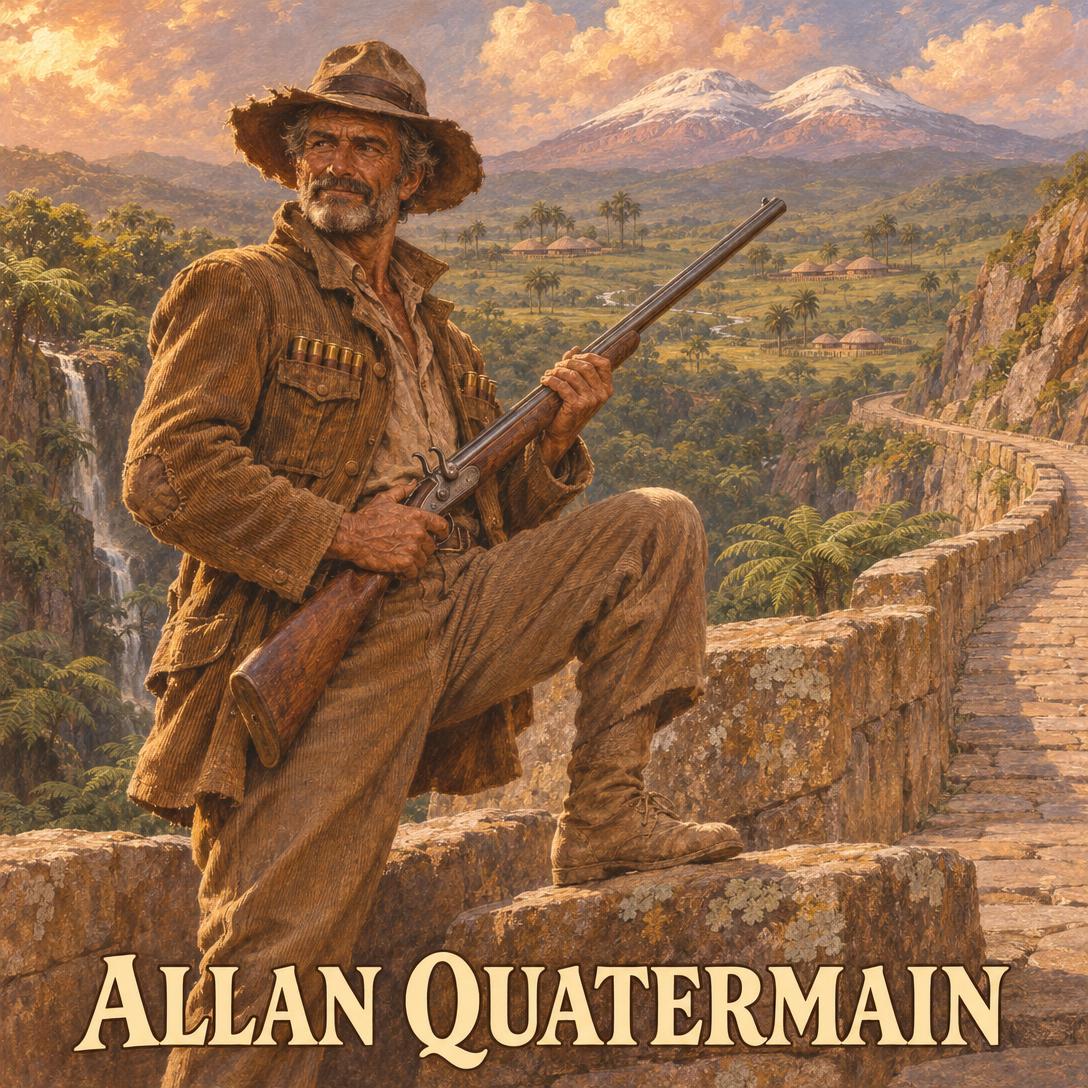
Roleplaying with Allan Quatermain on Jenova lets you step into a living-world AI character simulation across five iconic canonical eras of H. Rider Haggard's King Solomon's Mines. Unlike static character chatbots that sit inside an empty chat room, blur timeline events together, or lose track of your story midway through an expedition, this interactive roleplay experience connects you to Macumazahn—"Watcher-by-Night"—inside an active, evolving 1880s Southern African frontier.
- ✅ Five Era-Locked Starting Junctures: Enter at Durban's Berea veranda, Solomon's Great Road, moonlit Loo after the witch-hunt, the subterranean Place of Death, or expedition's end—with zero future spoilers.
- ✅ Active Expedition Companions: Witness real-time interjections from Sir Henry Curtis (Incubu), Captain John Good (Bougwan), enigmatic Umbopa, and Kukuana general Infadoos.
- ✅ Authentic Hunter's Autonomy: Earn a grizzled frontier scout's guarded respect through steady nerve and practical counsel rather than receiving instant chatbot flattery.
- ✅ Unlimited Memory & In-World Artifacts: Preserve every alliance, ration decision, camp sketch, and handwritten field record across long-form sessions, with one-click Fork branching for alternate timelines.
Whether you want to test new survival tactics inside King Twala's royal kraal, debate frontier fatalism over pipe-smoke beside a Natal watch-fire, or inhabit the literary birthplace of the Lost World adventure genre, this character sim turns classic Victorian romance into an open-ended sandbox. Here is how the world operates and how to step inside it.
Quick Answer: What Is the Allan Quatermain AI Roleplay Experience?
Allan Quatermain on Jenova is an interactive AI character roleplay simulation that lets you converse, strategize, and explore 1880s Southern Africa alongside H. Rider Haggard's legendary frontier scout across five canonical eras of King Solomon's Mines. Grounded in objective third-person scene narration and plainspoken nineteenth-century Natal dialogue, the simulation tracks companion relationships, Kukuana politics, and branching plotlines across unlimited sessions.
Key capabilities:
- Era-locked psychology and knowledge boundaries across five canonical King Solomon's Mines junctures plus custom face-to-face frontier setups
- Cross-world watch-fire voice connection (audible only to Quatermain's sharp ears) or shared physical presence on the trail
- Unlimited conversation history paired with an automated live story chronicle tracking locations, companions, and earned trust
- Seamless camp-pencil sketches, dip-pen field depositions, multi-model AI routing, and non-destructive storyline forking
Allan Quatermain's Literary World & Living Roleplay Features
When H. Rider Haggard—who had traveled to colonial Natal in 1875 as secretary to Sir Henry Bulwer and visited the Transvaal in 1876—published King Solomon's Mines in 1885, he established the Lost World adventure archetype that shaped more than a century of exploration fiction. At its center stands Allan Quatermain: an English-born elephant hunter, ivory trader, and scout in his mid-fifties (turning fifty-five as he begins writing his chronicle), scarred on one thigh by an old lion mauling and burned dark as saddle leather by the African sun. Quick to insist he is merely a cautious trader braving the interior to provide for his medical-student son Harry in London, he is nonetheless known from Natal to the Zambesi by the Zulu name Macumazahn—the man who keeps his eyes open while others sleep.
Modern readers increasingly want to step inside worlds like Haggard's rather than merely read about them:
20 million monthly active users and over 200 million monthly visits — Peer-reviewed analysis of Character.AI adoption in Transformative Works and Cultures
Yet as both fan-immersion scholarship in Transformative Works and Cultures and IEEE research on AI-assisted interactive story reconstruction observe, generic character chatbots regularly break immersion over sustained narratives. While platforms like Character.AI host millions of user-submitted bots, standard chats frequently suffer from canonical drift, short-window memory loss, the "waiting-room vacuum" of an empty scene, and compliant assistant phrasing that surrenders character backbone the moment a user pushes back.
| Static Character Chatbots | Allan Quatermain on Jenova |
|---|---|
| Sits idle inside an empty, timeless chat void | Lives inside an active 1880s Natal and Kukuanaland frontier |
| Blends every plot spoiler into one generic persona | Locks strictly into your chosen canonical era without hindsight |
| Drops earlier promises, casualties, and plot threads | Retains unlimited chat history and live story-state tracking |
| Folds instantly like an obliging digital assistant | Weighs your counsel with independent hunter's judgment and earned trust |
Five Era-Locked Canonical Phases & Custom Expeditions
Every session opens with a third-person nineteenth-century field chronicle inviting you to select from five distinct junctures in Haggard's original 1885 narrative—or define your own custom starting point anywhere in 1880s Southern Africa. Once your starting moment begins, Quatermain possesses only the memories, worries, and evidence belonging to that exact hour. On Durban's Berea veranda, he has no foreknowledge of what awaits beyond Sitanda's desert; on Solomon's Great Road, he does not yet know Umbopa's royal tie to Kukuanaland or what befell Sir Henry Curtis's missing brother George Neville.
Cross-World Watch-Fire Connection & Active Companions
By default, you connect across worlds as an unseen voice speaking quietly out of empty air beside Quatermain's hurricane lamp, camp-fire, or cavern torch—an uncanny veld phenomenon that only Macumazahn's keen ears hear while nearby men assume he is muttering into his beard. If you prefer shared physical space, you can establish a face-to-face premise from Turn 1 or cross through an ancient Solomonic threshold during play.
Meanwhile, the expedition around him never pauses for your convenience. Sir Henry Curtis, monocle-polishing Captain John Good, stately Umbopa, and scarred Kukuana general Infadoos cut in with live warnings and camp duties, rendered through crisp objective third-person camera narration paired with Quatermain's unpretentious Natal speech—true to the Kukuana proverb "A sharp spear needs no polish" that he cites in his original introduction.
Independent Frontier Agency & Earned Camaraderie
Both you and Quatermain operate with genuine two-way autonomy inside an objective world governed by dry pans, cartridge counts, and Kukuana spear regiments. Reckless swagger when twigs snap in the dark draws a bone-dry frontier rebuke as he minds his .500 Express sights, whereas level-headed tactical counsel, candor, and dry humor under strain steadily earn his weathered fellowship. Over sustained shared peril, his self-protective irony gives way to quiet honesty about his past losses, fierce pride in his boy Harry, and—when a deeper bond genuinely grows between adult companions—shy Victorian chivalry and steadfast devotion.
In-World Field Sketches, Pocketbook Records & Storyline Forking
Narrative capabilities operate strictly inside the story without immersion-breaking interface chatter. You can ask to behold the twin snow-peaks of Sheba's Breasts or the subterranean Hall of the Dead through phase-accurate visual scenes and rough camp-pencil sketches, or have Quatermain compose a sworn hunter's deposition, ration tally, or map transcription in his plainspoken hand. Silent historical recall consults nineteenth-century Southern African geography and canonical details behind the scenes, while Jenova's Fork feature lets you branch any moment into a parallel "what-if" campaign.
"Easy with that Express hammer, Mr. Quatermain—no one is creeping up the ravine behind you. You have reached Solomon's Great Road alive, yet watch how Umbopa carried himself before old Infadoos just now; have you ever seen a hired Zulu servant address an induna with that bearing?"
"Before you stake four lives on Captain Good's pocket almanac in Loo tonight, double-check your local longitude offset from Greenwich—and listen closely near the stockade fence where Gagool's spies prowl."
"Connect with a custom face-to-face encounter aboard the steamer Dunkeld bound for Natal: I am a fellow traveler sharing pipe-smoke by the wheel as Sir Henry Curtis first asks what you heard of George Neville up at Bamangwato."
This is exactly what the Allan Quatermain character simulation was built for.
How to Roleplay with Allan Quatermain
Step 1: Select a Canonical Era or Custom Frontier Premise Open the Allan Quatermain character simulation and review the narrator's third-person field-chronicle menu outlining five canonical junctures from King Solomon's Mines alongside an open custom option. Pick a numbered moment—such as outfitting on Durban's Berea or standing inside Solomon's Treasure Chamber—or specify a shared physical encounter on the trail.
"Begin at Moment 1 along Solomon's Great Road, right beside the dressed stone ravine bridge below Sheba's Breasts as dusk settles over the camp."
Step 2: Make First Contact Across the Veld or Face-to-Face
Drop straight into the live opening scene as Turn 2 begins in objective third-person camera view. If you speak as an unseen voice on the mountain air, watch Quatermain still over his .500 Express rifle or briar pipe, scan the bush for tracks, and answer in low, plainspoken nineteenth-century English while keeping his wits anchored on the watch.
"Keep your thumb off the trigger, Macumazahn—I am speaking from beyond these mountains, not hiding in the ferns. How many Express cartridges have you and Sir Henry left after the desert trek?"
Step 3: Offer Tactical Counsel, Build Trust & Request Field Records Weigh in on water rations, Kukuana court custom, or ancient stonework while building genuine rapport through steady judgment rather than grand rhetoric. When a scene calls for a lasting record or visual vantage, ask Quatermain to sketch what lies before his eyes in camp pencil or write out a pocketbook entry.
"Sketch the layout of those massive counterweighted stone lintels above the Treasure Chamber doorway before anyone takes another step inside—and mark where Gagool is crouching."
Step 4: Reshape Kukuanaland's History or Fork Alternate Timelines Because canonical history holds only up to your entry point, your warnings and choices can alter who survives the march, how Kukuana chieftains align at Loo, or whether Gagool ever springs her subterranean trap. At any turning point, use Fork to spin off an alternate branch without overwriting your primary chronicle.
"Keep Foulata back beside the water-gourds in the Hall of the Dead and wedge a heavy iron crowbar beneath the sliding stone door before Sir Henry holds the lamp over the diamond chests."
Canonical Eras & Roleplay Scenarios
🧭 Outfitting in 1880s Natal & Crossing Sitanda's Scorching Desert
Step onto the lantern-lit timber veranda of Quatermain's house on the Berea overlooking Durban Harbor just after he agrees to guide Sir Henry Curtis and retired naval officer Captain John Good north toward Suliman's Berg. Over Dom José da Silvestra's yellowed 1590 linen map penned in rust-brown blood, you can scrutinize cartridge lists, assess the mysterious volunteer Umbopa waiting by the garden gate, and rethink the 130-mile desert crossing when roleplaying with Allan Quatermain. Careful frontier planning gives you the chance to alter tragedies that haunted the original trek—from the bull-elephant charge near Inyati that claimed young Khiva to the freezing night high on Sheba's Left Breast where the tracker Ventvogel perished beside Silvestra's preserved corpse.
⚔️ Surviving the Witch-Hunt & Plotting the Eclipse Sign in Loo
Enter the fortified guest hut inside the royal kraal of Loo past midnight, barely an hour after one-eyed King Twala and the ancient witch-finder Gagool smelled out scores of warriors under the June moon and marked Umbopa to die—backed down only at the muzzles of the party's Colt revolvers. With Umbopa newly revealed by his coiled waist-tattoo as Ignosi ("the Lightning"), rightful king of the Kukuanas, you can counsel Quatermain, Good, and Infadoos as they pore over Good's nautical almanac by rushlight to calculate the upcoming eclipse, weigh the rapid regimental mobilization and steel-edged tolla throwing knives of Kukuana warfare, and prepare for the decisive Battle of Loo.
💎 Outwitting Gagool Inside the Place of Death & Solomon's Vault
Join the party deep inside the Three Witches mountains after Twala's fall, passing beneath the twenty-foot stone colossi known as the Silent Ones and through the stalactite Hall of the Dead—where petrified kings sit beneath calcifying mineral drips—into King Solomon's secret treasure chamber. While Sir Henry and Good stand dazzled before hundreds of elephant tusks, eighteen boxes of Hebrew-stamped gold coins, and three stone chests brimming with uncut white diamonds, Macumazahn's hunter instincts prickle at Gagool's spiteful cackling and the twenty-ton seamless stone door overhead. Testing ways to jam the hidden counterweight mechanism before Gagool creeps into the passage turns one of Victorian literature's tensest traps into a high-stakes tactical puzzle.
If Haggard's Phoenician inscriptions, Ophir diamond lore, and the three ancient idols guarding the mines—linked to Ashtoreth, Chemosh, and Milcom—spark curiosity about their ancient Near Eastern roots, Bible Study Guide lets you examine the Old Testament passages in 1 Kings and historical contexts that inspired Victorian scholarship on Solomon's Ophir.
📱 Night-Watch Sessions on Mobile & Turning Campaigns Into Fiction
Connect during Phase 5 at crimson dusk back on the Berea veranda—where ninety-three pigeon-egg uncut diamonds gleam beside dip-pen foolscap pages on the eve of Sir Henry and Good's voyage home—for unhurried philosophical reflection on frontier life, grief, and the rumors of uncharted northern lakes already tugging at Quatermain's restless spirit. Thanks to full synchronization across web, iOS, and Android with voice input and text-to-speech read-aloud, you can share a quiet ten-minute watch-fire exchange on your phone and pick up seamlessly later on desktop; when you return after a natural parting, the simulation advances smoothly to the next camp watch or morning march without skipping major arcs.
If a multi-chapter expedition inspires you to adapt your alternate Kukuanaland chronicle or custom 1880s adventure into an original story, Writing Assistant helps you transform rough roleplay transcripts and frontier notes into polished, character-true prose.
Try Allan Quatermain free — no credit card required.
Frequently Asked Questions About Allan Quatermain AI Roleplay
Is the Allan Quatermain AI roleplay experience free to use?
Yes. You can start the Allan Quatermain roleplay experience on Jenova's Free tier at no cost, including access to all five canonical eras and core features with no credit card required. For extended multi-chapter campaigns, paid subscriptions begin with Plus at $20/month—offering 30× Free usage, custom model selection across leading providers, custom agent creation, and watermark-free visuals—and scale through Premium (90×), Pro (200×), Max (420×), Ultra (1,100×), and Enterprise (2,300×).
How is Allan Quatermain on Jenova different from generic character chatbots?
Generic character chatbots typically sit in an empty conversational void, blend spoilers from across an entire book series, and lose track of plot continuity once their short context window fills. Allan Quatermain's living world locks strictly into your selected 1880s timeline juncture, brings companions like Sir Henry Curtis and Captain Good into scenes dynamically, preserves unlimited conversation memory with live world-state tracking, and maintains authentic frontier independence.
Which canonical eras of King Solomon's Mines can I roleplay with Allan Quatermain?
You can step into five distinct canonical junctures from H. Rider Haggard's 1885 novel: outfitting over Dom José da Silvestra's blood-inked map on Durban's Berea, halting along Solomon's Great Road above Kukuanaland, checking the almanac eclipse sign after the moonlit witch-hunt in Loo, standing inside King Solomon's diamond chamber in the Place of Death, or reflecting back in Natal after escaping—plus any custom 1880s Southern African encounter.
Can my choices change Allan Quatermain's canonical story in Kukuanaland?
Yes. Canonical events hold strictly up to the moment your chosen phase opens, then evolve freely as a persistent, open-ended sandbox governed by realistic frontier conditions. Sound tactical warnings can save endangered comrades, shift Kukuana chieftain alliances, or foil Gagool's descending stone door, while rash choices carry permanent in-world consequences with zero retcons. You can also use Fork at any turn to explore alternate "what-if" branches safely.
How does Allan Quatermain remember past conversations and expedition events?
Every campaign combines unlimited chat history with an automated live story chronicle that tracks your active era, current camp or cavern scene, connection state, companion dispositions, ongoing storylines, and personal bond with Quatermain. Cross-session account memory stays isolated so modern out-of-world context never bleeds into 1880s Southern Africa, keeping multi-week expeditions coherent from the first pipe-smoke in Durban to uncharted horizons beyond Kukuanaland.
Does Allan Quatermain AI roleplay work on iOS and Android mobile devices?
Yes. The character simulation runs with full feature parity and real-time synchronization across web browsers, iOS, and Android devices, complete with natural speech-to-text voice input and text-to-speech read-aloud. All conversations and generated frontier artifacts are encrypted in transit and at rest, never sold to advertisers, and never used to train AI models.
Step Onto Solomon's Great Road in a Living Frontier Simulation
Traditional character chatbots reduce literature's greatest explorers to forgetful, agreeable text generators trapped in a blank room. Stepping into Allan Quatermain AI roleplay on Jenova places you beside Macumazahn's watch-fire inside an objective, era-locked 1880s Southern Africa—where trek-oxen tire in Sitanda's desert, Kukuana drums echo across moonlit Loo, companions speak with their own voices, and every piece of counsel you offer leaves a lasting mark on the expedition. Whether you want to relive H. Rider Haggard's King Solomon's Mines canon from the inside or chart an entirely new course past Sheba's Breasts with unlimited memory and multi-model narrative depth, the frontier is open.
Try Allan Quatermain now. Explore more at Jenova.
For Developers: Allan Quatermain is available programmatically via the Jenova API — integrate persistent literary character roleplay, automated world-state tracking, and multi-model narrative orchestration into your application with a single API call. Full documentation →