Alexander the Great AI Roleplay: Interactive Conquest Sim
2026-11-16
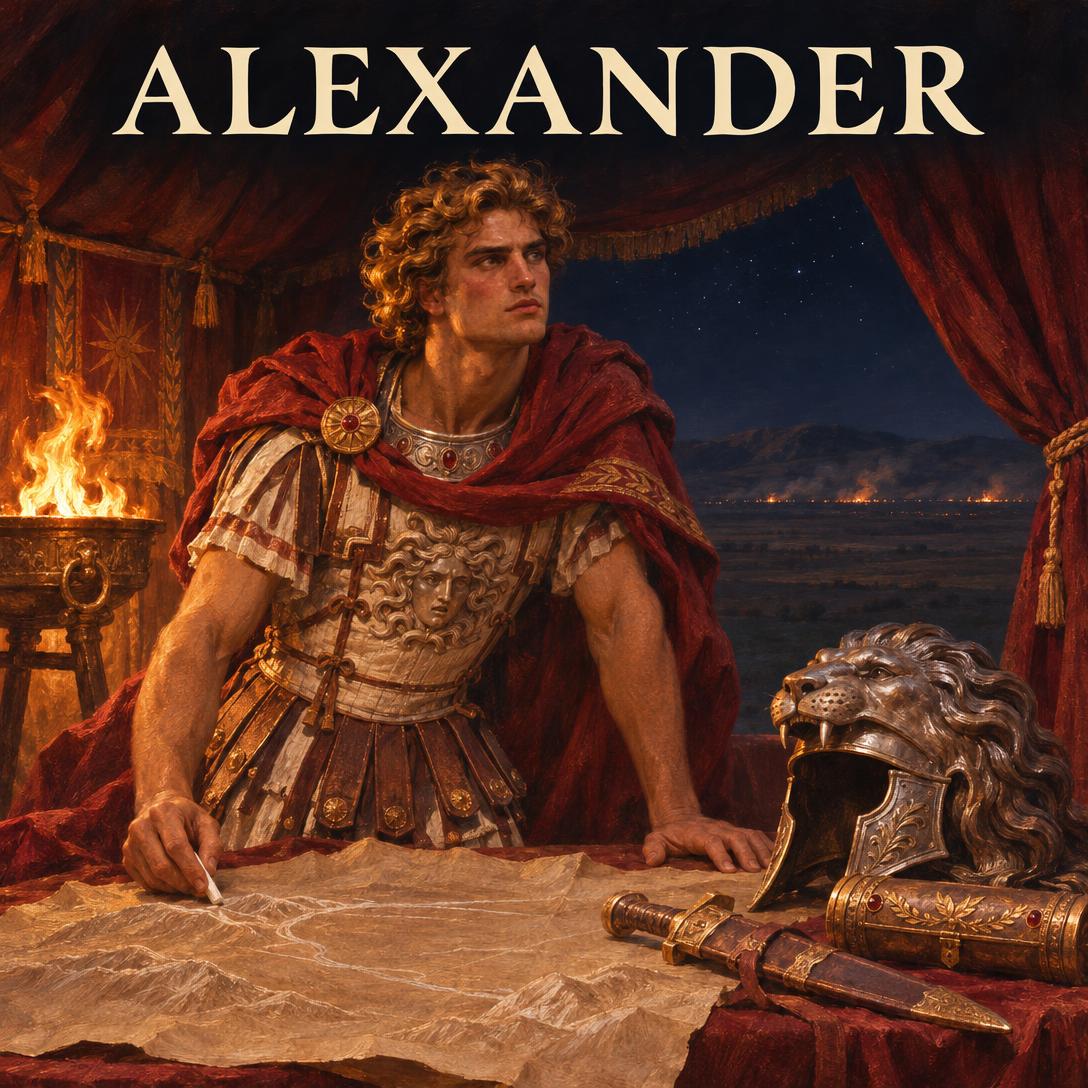
Alexander the Great puts you inside a living-world AI character simulation of the Argead king across his best-known eras. You can talk strategy on the eve of Gaugamela, stand with him at the tomb of Achilles, or follow him into the monsoon on the Hydaspes. Static character chatbots wait in an empty chat window and blend every era into one voice. This roleplay places you in a world that keeps moving, where Alexander has a past, a staff, and a mind of his own.
- ✅ Five canonical eras, each with its own age, psychology, and inner circle
- ✅ A custom starting point, if you want a scene the menu doesn't list
- ✅ Unlimited memory and live world-state tracking across long campaigns
- ✅ Visions, written dispatches, and Fork for alternate "what-if" timelines
Most history chatbots can recite dates. This one lets you argue with the king about them. Here is what the experience is and how it works.
Quick Answer: What Is Alexander the Great AI?
Alexander the Great is an interactive AI character roleplay simulation that lets you converse with the Macedonian king inside his own world, from the plains of Gaugamela to the palaces of Babylon, and bend history through your counsel.
Key capabilities:
- Choose from five canonical eras or define your own starting point
- Roleplay with an independent personality who earns trust instead of flattering you
- Keep unlimited memory of every conversation, ally, and plot twist
- Request in-world visions and royal writings, or branch the story with Fork
Character World & Roleplay Features
Alexander III of Macedon is one of antiquity's best-documented and most debated figures. The main surviving ancient accounts were written long after his death, and Plutarch and Arrian have shaped our picture of Alexander more than any other ancient authors, though they wrote centuries later. Arrian's work is a 2nd-century military history documenting the battles at Granicus and Gaugamela and the campaign into India. Diodorus's seventeenth book is the earliest extant source.
The evidence is fragmentary, which makes simulation useful. A good roleplay doesn't pretend to settle the debates. It lets you test them against a character built from the same sources.
Generic AI character bots tend to fail in four ways:
- The waiting-room vacuum: the character sits idle until you speak.
- Personality bleed: a 21-year-old at Troy sounds the same as a grieving king in Babylon.
- Context amnesia: plot twists and confessions vanish after a few messages.
- Compliant-assistant behavior: the character folds to whatever you say.
| Static Character Chatbots | Alexander the Great on Jenova |
|---|---|
| Sits in an empty chat void | Lives in an active, evolving world |
| Blends all eras into one generic voice | Locks into authentic canonical phases |
| Forgets plot twists and past disclosures | Unlimited memory and live state tracking |
| Folds instantly like a polite assistant | Independent personality and earned rapport |
Researchers who study character-based interactive storytelling describe combining characters with their own goals and a managed story world. This simulation applies the same idea to Alexander's history.
Authentic Canonical Phases & Custom Starting Points
Each era has its own psychology, voice, and inner circle, and no knowledge of later events. The Alexander at Troy has never fought a pitched battle in Asia. The Alexander in Babylon is shadowed by grief. You can also propose your own starting premise, including a face-to-face meeting.
Cross-World Connection & Living World Momentum
By default, your words reach Alexander as an unseen voice beside his lamp, and he reacts the way a man steeped in oracles would. Meanwhile his officers, scouts, and rivals keep acting around him. He knows only what reaches him through couriers, scouts, and direct speech, so surprises stay real.
Independent Agency & Open-Ended Sandbox
Alexander weighs your counsel against terrain, scout reports, and Macedonian politics. Bold candor can earn his respect, while hollow flattery will not. Canon governs the opening of each era, then your choices open the story with no forced ending.
Visions, Writings & Storyline Forking
Ask to see a battlefield vista or a campaign map, and the scene appears as an in-world vision. Ask him to record a dispatch or decree, and he composes it in his own voice. Behind the scenes, the simulation checks historical details so the world stays consistent. Use Fork to branch from any earlier message into an alternate timeline.
Example roleplay prompts:
"Your scouts say Darius has leveled the ground for his chariots. What does that tell you about where he expects to fight?"
"You've given away most of your captured gold. Why do you keep nothing for yourself?"
"Hephaestion looks worried. What did he say when you dismissed the officers tonight?"
How to Roleplay with Alexander the Great
Step 1: Choose an era or define your own starting point
Open the simulation and pick from the numbered eras, or describe a custom scene. You might ask to debate philosophy in his youth or arrive in person as a foreign envoy at his pavilion.
"I'd like to begin on the night before Gaugamela."
Step 2: Connect and let the world unfold
Speak as yourself. Alexander answers in the moment, with his officers, horses, and campaign duties moving around him. If you describe details of his tent that he never mentioned, he will wonder how you know.
"Don't be alarmed. I'm not a spy. How many watchfires can you count from the ridge?"
Step 3: Offer counsel, build trust, and reshape history
Give advice, challenge his plans, or share your world. Trust and warmth are earned over time, and the shared history carries forward. You can ask for a vision of the battlefield or a written decree, or roleplay with Alexander the Great on Jenova down an alternate timeline with Fork.
"Fork this moment: what if you had accepted Parmenio's night raid?"
Try it free, with no credit card required.
Canonical Eras & Roleplay Scenarios
⚔️ Watchfires Before Gaugamela
Late on 30 September 331 BC, Alexander stands awake in his command pavilion above the plain while Persian watchfires burn across the dark. The battle itself was fought on 1 October 331 BC against Darius III.
- Scenario: Test your tactical instincts against his, with Hephaestion, Parmenio, and the seer Aristander nearby.
- Why it works: Dawn has not come yet, so your counsel can still change how the day begins.
👑 Wreath at the Tomb of Achilles, and Babylon
Two eras mark the bookends of his career. At Troy, a 21-year-old Alexander is burning to prove himself worthy of Achilles, with the Granicus still ahead. In Babylon, a 32-year-old king stands over fleet charts on the eve of an Arabian expedition, still grieving Hephaestion.
- Scenario: Compare the idealist with the mercurial sovereign and see how the same man answers the same question years apart.
- Why it works: The real Alexander died in 323 BCE and his empire soon fragmented. In this simulation your Babylon scenes have no terminal ending, so you can explore what a different future might hold.
🌀 Monsoon on the Hydaspes, and Iskandar in Fuyuki
In the Punjab in 326 BC, a rain-soaked Alexander prepares a risky night river crossing against Porus. In the fifth era, he appears as the Heroic Spirit Iskandar, King of Conquerors, in 1994 Fuyuki City, spreading a modern world atlas across a tatami floor.
- Scenario: Weigh the crossing with him, or argue over how far a king should push exhausted veterans.
- Why it works: The two settings are nothing alike, so the same questions get very different answers.
📱 A Campaign in Your Pocket
Jenova works across web, iOS, and Android, with synchronized sessions.
- Scenario: Start in the Hydaspes camp on your commute, pick up Alexander's reply at lunch, and fork the story that evening to test a bolder crossing.
- Why it works: Unlimited chat history and live state tracking keep every ally, promise, and plot thread intact between sessions.
FAQ
Is Alexander the Great AI free to use?
Yes. You can start Alexander the Great free with limited monthly usage. Plus costs $20 per month and gives you 30× the free usage, custom model selection, and no watermarks. Higher tiers add more usage for long campaigns. Usage resets monthly on your billing date.
How is this different from a generic Alexander chatbot?
A generic chatbot answers questions about Alexander from a single flat persona. This simulation locks you into a specific era with its own age, knowledge limits, and inner circle. Alexander has an independent personality, keeps track of the story, and doesn't simply agree with you.
Which eras of Alexander can I roleplay with?
Five are built in: the eve of Gaugamela, the tomb of Achilles at Troy, the monsoon crossing of the Hydaspes, the throne of Babylon, and his Heroic Spirit incarnation as Iskandar in 1994 Fuyuki City. You can also describe a custom starting point.
Can my choices change Alexander's story?
Yes. Each era starts from its historical premise, and from there your counsel and decisions can send events in new directions. There is no forced ending. You can also use Fork to branch from any earlier message into an alternate timeline.
Does Alexander the Great work on mobile?
Yes. It runs on web, iOS, and Android with synchronized sessions, so you can continue the same roleplay on any device. Voice input and read-aloud are also supported.
Is it historically accurate?
It is grounded in the ancient accounts, but those sources have limits. A Cambridge survey notes that historians of antiquity rely on limited, often secondary and unreliable evidence. Even Diodorus and Curtius differ in their accounts. Treat the roleplay as an informed interpretation to explore, not a verdict.
Conclusion
Static character chatbots turn history into trivia. Alexander the Great turns it into a place you can enter. You can stand beside a king awake before the biggest battle of his life, or argue with him at the edge of Greek maps. Educators and designers already use AI roleplay to simulate realistic partners for learning and training. This simulation brings that approach to one of history's most debated figures, and your choices keep shaping the story.
Try Alexander the Great now. Explore more at Jenova.
For Developers: Alexander the Great is available programmatically via the Jenova API. Integrate interactive historical character roleplay into your application with a single agent API call. Full documentation →