AI Alchemist Game: Brew Potions, Invent Recipes & Shape Your Story
2026-10-16
Roleplay Game Master turns any conversation into a full AI alchemist game. You run a potion shop, discover recipes through experimentation, and deal with rivals, guild masters, and failed transmutations. As of October 2026, most alchemy games still fall into two camps. Some are element-combining sandboxes with no story. Others are RPGs with fixed recipe tables you can exhaust in a weekend. This AI game master offers a third option: a persistent, character-driven campaign where your alchemy system is as deep as you want it to be.
- ✅ Unlimited memory: your grimoire, discovered recipes, and past failures carry across every session
- ✅ Consistent characters: your rival alchemist and suspicious inquisitor keep their personalities and motives
- ✅ Complete creative freedom: Hermetic Europe, steampunk guild halls, cozy village apothecaries, or a world you invent
- ✅ Play anywhere: web, iOS, and Android, with voice input for hands-free sessions
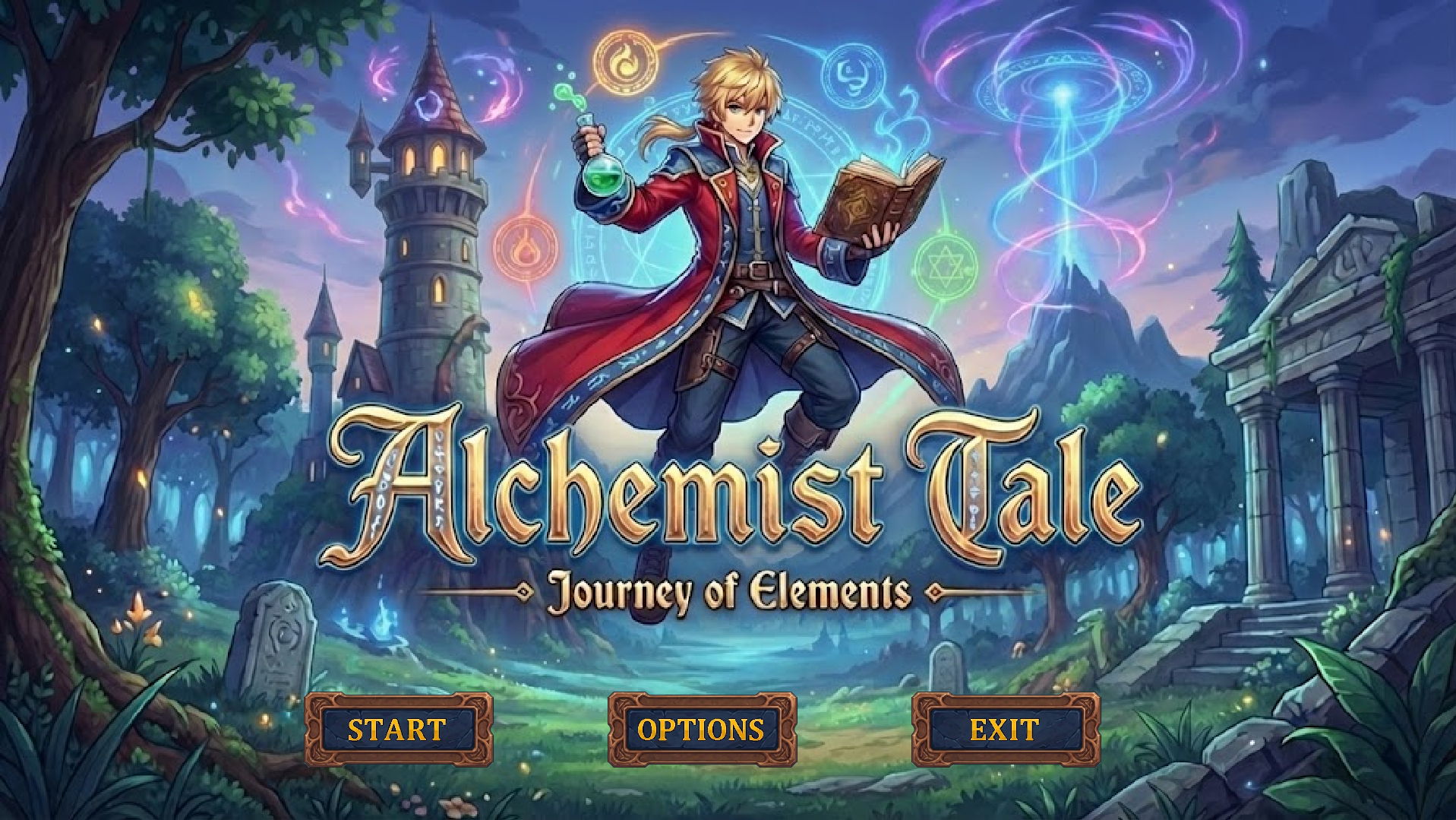
The appeal of alchemy in games has always been discovery: the moment an unknown combination produces something new. Most games deliver that moment only a limited number of times before the system runs dry. To see why, we need to look at how alchemy games are typically built, and what players increasingly expect instead.
Quick Answer: What Is an AI Alchemist Game?
An AI alchemist game is a crafting or role-playing game where artificial intelligence generates potion results, recipes, story events, and character reactions dynamically, so alchemical experiments produce new outcomes instead of pre-scripted ones.
Key capabilities:
- Dynamically generated recipes and transmutation results based on the ingredients and methods you describe
- A persistent world where shops, guilds, and reputations change based on your choices
- Non-player characters (customers, mentors, rivals) who remember past interactions
- Custom alchemy systems built on classical elements, the tria prima, or rules you design yourself
Why Traditional Alchemy Games Run Out of Magic
Alchemy has been a crafting staple for decades, from element-combining puzzles to potion systems in large RPGs. The appetite for more dynamic play is clear in the data:
$5.8 billion → $51.3 billion — Projected growth of the AI in gaming market from 2026 to 2033
$16.8 billion — Mobile RPG revenue in 2025, still the largest mobile genre by revenue despite a 17.3% decline
Turning alchemy into a living story, rather than a recipe checklist, remains difficult:
- Authored recipe trees run out. Once you've found every combination, the discovery loop ends.
- AI sandboxes lack stakes. Element-merging games generate new items but rarely give you a character, a world, or consequences.
- Characters don't remember you. NPCs in most crafting games reset to scripted dialogue no matter what you've brewed or broken.
- Your setting is locked. You play the designer's version of alchemy, not the tradition or world you actually want.
Fixed Recipes vs. Real Experimentation
Classic combination games like Little Alchemy start you with four basic items and challenge you to discover everything from dinosaurs to spaceships. The combinations are designed in advance. That makes them satisfying puzzles, but it also means your experiments always lead to answers someone else already wrote.
Infinite Combinations Without a Story
AI-powered successors solved the content ceiling. Infinite Alchemy generates elements and images dynamically using GPT and DALL·E. In that game, new "mixtures" are consumed whenever you try a never-before-seen pair, and you replenish them through purchases or daily challenges. Its own developer describes it on GitHub as "a relaxing game with no real objective." That works well for casual discovery, but players who want to be an alchemist, with a shop, a reputation, and enemies, need something more narrative.
Players Want Quality, Not Gimmicks
Large-scale research from MIDiA Research found that 60% of gamers are neutral about generative AI as long as the game is good. The lesson for any AI alchemist game is simple: AI has to deepen the experience, not replace it with randomness.
That is the kind of play an AI game master with real memory and consistent characters is built to deliver.
Why Roleplay Game Master Works as an AI Alchemist Game
Roleplay Game Master is an immersive roleplay AI with unlimited memory and consistent characterization. It handles the parts of an alchemy campaign that static games can't: remembering every recipe you've discovered, keeping your rival's grudge intact across weeks of play, and adapting outcomes to the specific method you describe. Mixing mandrake root over open flame and distilling it slowly in a copper alembic can produce two different results.
| Traditional Approach | Roleplay Game Master |
|---|---|
| Pre-authored recipe list that eventually runs out | Recipes emerge from your ingredients, methods, and setting |
| NPCs reset to scripted lines | Characters stay consistent and remember your history |
| One designer-defined world | Any setting or alchemical tradition you describe |
| Crafting separate from story | Every brew can trigger consequences: customers, rumors, explosions |
| Progress tied to one device or save file | Persistent sessions across web, iOS, and Android |
Your Grimoire Never Resets
Unlimited memory means the campaign builds on itself. The tincture that went wrong in session two can resurface in session ten as a black-market curiosity, or as evidence in a guild trial. You don't need to re-explain your world every time you return.
Characters With Continuity
An alchemist's world is full of people: the herbalist who supplies you, the noble who commissioned an elixir of youth, the apprentice who keeps "borrowing" quicksilver. Because characterization stays consistent, these relationships evolve logically instead of snapping back to defaults.
Any Alchemical Tradition
You can ground your game in real history or ignore it entirely:
- Paracelsian alchemy: build recipes around the tria prima of salt, sulfur, and mercury
- Classical elements: an earth, water, air, and fire system, similar to element-combining games, but with narrative weight
- Chinese external alchemy (waidan): cinnabar, elixirs, and the dangerous pursuit of immortality
- Original systems: resonance-based crafting, emotion-infused potions, or alchemy powered by memories
Example Prompts
"Start a campaign where I'm a disgraced court alchemist reopening a potion shop on the edge of a haunted forest. Track my reputation, coin, and ingredient stock."
"Use the tria prima as the core crafting system. Unstable ratios should have real consequences, including explosions, mutations, or cursed results."
"Introduce a rival alchemist who undercuts my prices and is secretly pursuing the philosopher's stone."
Related Agents You'll Also Find Useful
If you enjoy alchemy as a storytelling engine, these agents extend the experience from playing to designing.
Game Designer Assistant
If you're building your own alchemy game, this design partner helps turn ideas into systems. It's useful when your roleplay campaign sparks a mechanic you want to prototype for real.
- Brainstorming and systems analysis across genres and platforms
- Game design documentation for crafting loops, economies, and progression
- Concept art support for visual direction
Trading Card Game Creator
Alchemy translates naturally into card mechanics: ingredients as resources and potions as spells. This TCG studio helps you turn your recipe book into a playable set.
- Card mechanics and balance tuning
- Lore and card art from first concept
- Full playable set development
The Mansion
If you like the mystery side of alchemy, such as sealed laboratories, forbidden texts, and secrets behind locked doors, this narrative game offers a ready-made experience. You wake in a mansion with no memory of how you arrived, and every room hides secrets.
- Exploration-driven mystery narrative
- Choices that shape whether you escape
- Suspenseful pacing for shorter sessions
Start a campaign free, with no credit card required.
How to Play an AI Alchemist Game Step by Step
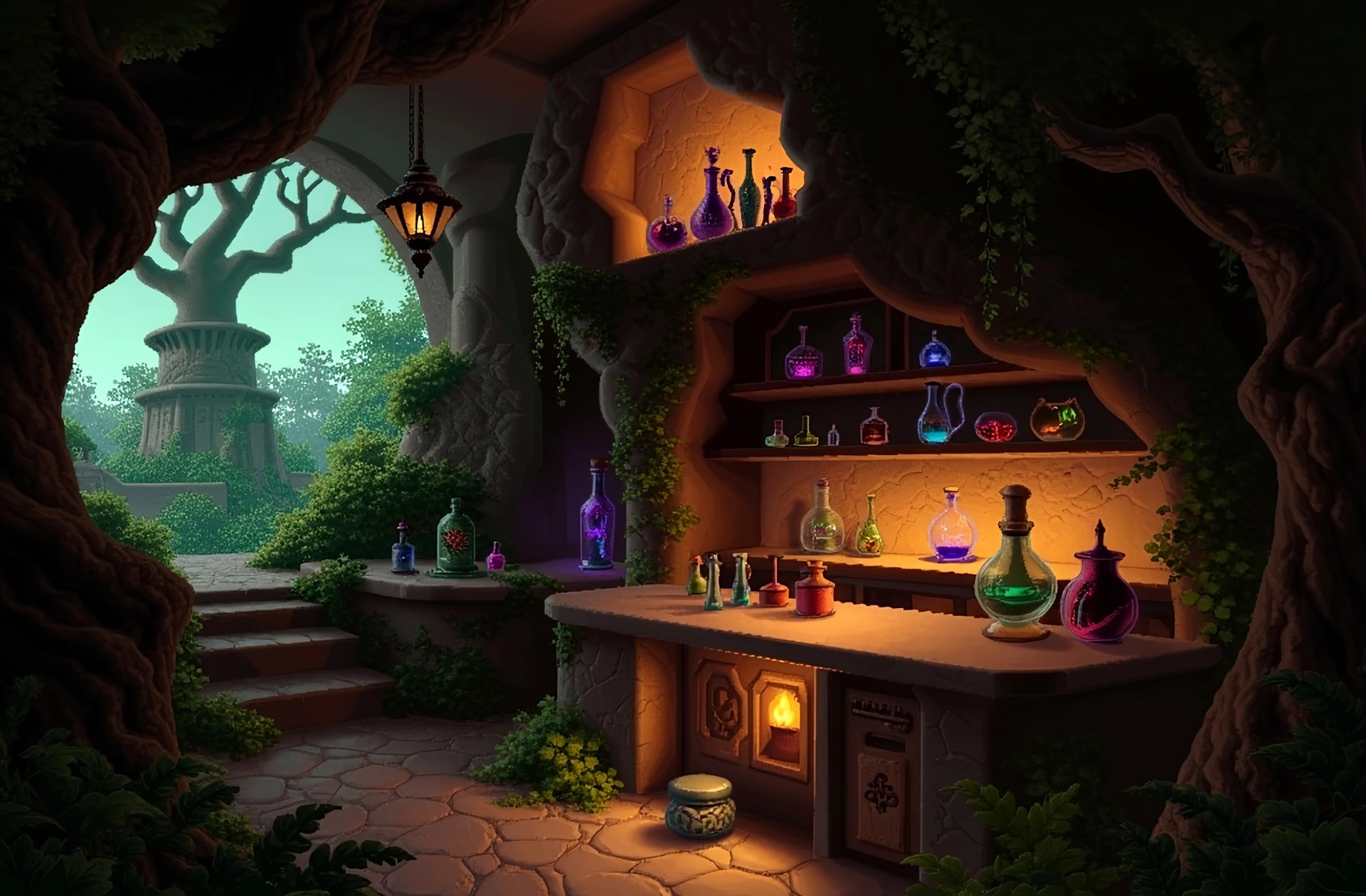
Step 1: Set the Scene
Open the AI game master and describe your alchemist, setting, and starting situation. Be specific: a workshop built into tree roots with a failing hearth gives the narrator more to work with than "a potion shop."
"I'm a young alchemist who inherited a grotto workshop beneath an ancient tree. The previous owner vanished. Describe what I find on the shelves."
Step 2: Define Your Alchemy Rules
Tell the game master how alchemy works in your world. This might include ingredient properties, what causes failure, how rare reagents are acquired, and whether magic has a cost. Clear rules make experimentation feel fair and consequential.
"Ingredients have three traits: element, potency, and volatility. Mixing two high-volatility ingredients without a stabilizer should go badly."
Step 3: Experiment and Face Consequences
Describe your process, not just your ingredients. Heat, timing, vessel, and moon phase can all shape results if you've set them up. Failures matter too: a cracked retort or a cursed batch can become a story hook.
"I grind the glowroot, steep it in moonwater for three hours, then distill it through the copper coil. What happens?"
Step 4: Build Relationships and Reputation
Sell to customers, negotiate with suppliers, and take commissions. Because characters stay consistent, a customer you shortchanged may return with a lawyer, a curse, or a better offer from your rival.
"The baroness returns asking why her 'beauty elixir' turned her hair silver. How does she react when I offer a discount?"
Step 5: Return and Escalate
Come back days later and pick up where you left off. Your discovered recipes and unresolved plot threads are still there, so you can push toward bigger goals like a guild examination, a forbidden transmutation, or the philosopher's stone.
"Recap my current recipes and debts, then advance the story to the night of the Alchemists' Guild exam."
AI Alchemist Game Use Cases
🧪 Running a Solo Potion-Shop Campaign
Scenario: A fan of cozy crafting games wants a shop-management experience where customers have real personalities and recipes aren't predetermined.
Traditional Approach: Play a crafting game until every recipe is discovered, then wait for an expansion or start over with the same content.
Roleplay Game Master: The shop becomes a living campaign. Recurring customers, supply shortages, and recipe discoveries all emerge from play.
- Recipes grow out of your experiments rather than a fixed list
- Customer relationships develop over many sessions
- The economy and reputation respond to how you run the business
📱 Brewing on Your Commute
Scenario: A player wants short, satisfying alchemy sessions on their phone during a train ride, without losing campaign progress.
Traditional Approach: Mobile crafting games often rely on energy timers or consumable currencies that limit how much you can experiment in one sitting.
The AI game master on mobile: Pick up the campaign mid-story on iOS or Android, use voice input to describe your next brew hands-free, and continue on desktop later.
- Full experience across web, iOS, and Android
- Speech-to-text for describing experiments on the go
- Persistent memory means a 10-minute session still moves the story forward
🎮 Prototyping an Indie Alchemy Game
Scenario: An indie developer is designing an alchemy RPG, with a title screen and workshop concept art already drafted, and wants to test whether the crafting loop is fun before writing code.
Traditional Approach: Build paper prototypes, recipe spreadsheets, and test builds, iterating for weeks before learning whether the core loop works.
Roleplay Game Master + a dedicated game design agent: The developer playtests the crafting rules as a narrative session first, observes where experiments feel rewarding or tedious, then documents the refined system with a design assistant.
- Rapid rule testing through play rather than code
- Immediate feedback on which mechanics create interesting choices
- A smoother path from roleplay sketch to design document
Frequently Asked Questions
What is the best AI alchemist game?
It depends on what you want. For relaxed element-combining discovery, AI sandboxes like Infinite Alchemy and Infinite Craft generate new items from your combinations. For a story-driven experience with a shop, characters, and consequences, Roleplay Game Master lets you build a full alchemist campaign with persistent memory and any setting you choose. Many players enjoy both styles for different moods.
How is an AI alchemist game different from Little Alchemy?
Little Alchemy uses designer-authored combinations, so every discovery has a predetermined answer. An AI alchemist game generates results dynamically from your ingredients, methods, and world rules. Narrative AI alchemist games go further by adding characters, reputation, and story consequences. That means a potion's effect can shape the plot, not just unlock another item.
Is the AI game master free to play?
Yes, you can start for free. The Free tier includes all core features with limited usage. Players who want longer or more frequent campaigns can upgrade to paid plans starting at $20 per month for the Plus tier, which adds substantially higher usage and custom model selection. Usage resets monthly on your billing date, with no daily caps.
Can I play an AI alchemist game on my phone?
Yes. The AI game master works across web, iOS, and Android with full feature parity, and your settings sync across devices. You can start a campaign on your laptop, continue it on your phone during a commute, and use speech-to-text to describe your brewing process without typing.
Can I design my own alchemy game with AI?
Yes. Many developers use AI to brainstorm crafting systems, balance economies, and document mechanics. Game Designer Assistant supports brainstorming, systems analysis, documentation, and concept art across genres. A useful workflow is to playtest your alchemy rules through roleplay first, then formalize what works into a design document.
Do gamers actually like AI in games?
Opinions are split. A Quantic Foundry survey found 85% of respondents held a below-neutral view of generative AI in video games. MIDiA Research, however, found that 60% of gamers are neutral as long as the game is good. A 2026 Polygon-reported survey found 42% had become more comfortable with AI in games. The consensus is that quality and player agency matter most.
Start Your Alchemy Campaign
Traditional alchemy games give you a recipe book someone else wrote. AI sandboxes give you infinite combinations without a story. A narrative AI alchemist game combines both: open-ended experimentation inside a world that remembers your discoveries, reacts to your mistakes, and keeps its characters consistent from your first brew to your hundredth.
Whether you want a cozy potion-shop simulation, a dark Paracelsian quest for the philosopher's stone, or a testbed for your own alchemy RPG, the workshop is ready. Try Roleplay Game Master now.
Explore more at Jenova.
For Developers: Roleplay Game Master is available programmatically via the Jenova API. You can integrate persistent, character-consistent AI narration into your game with a single API call. Full documentation →