Albert Camus AI Roleplay: Interactive Living-World Character Sim
2026-11-16
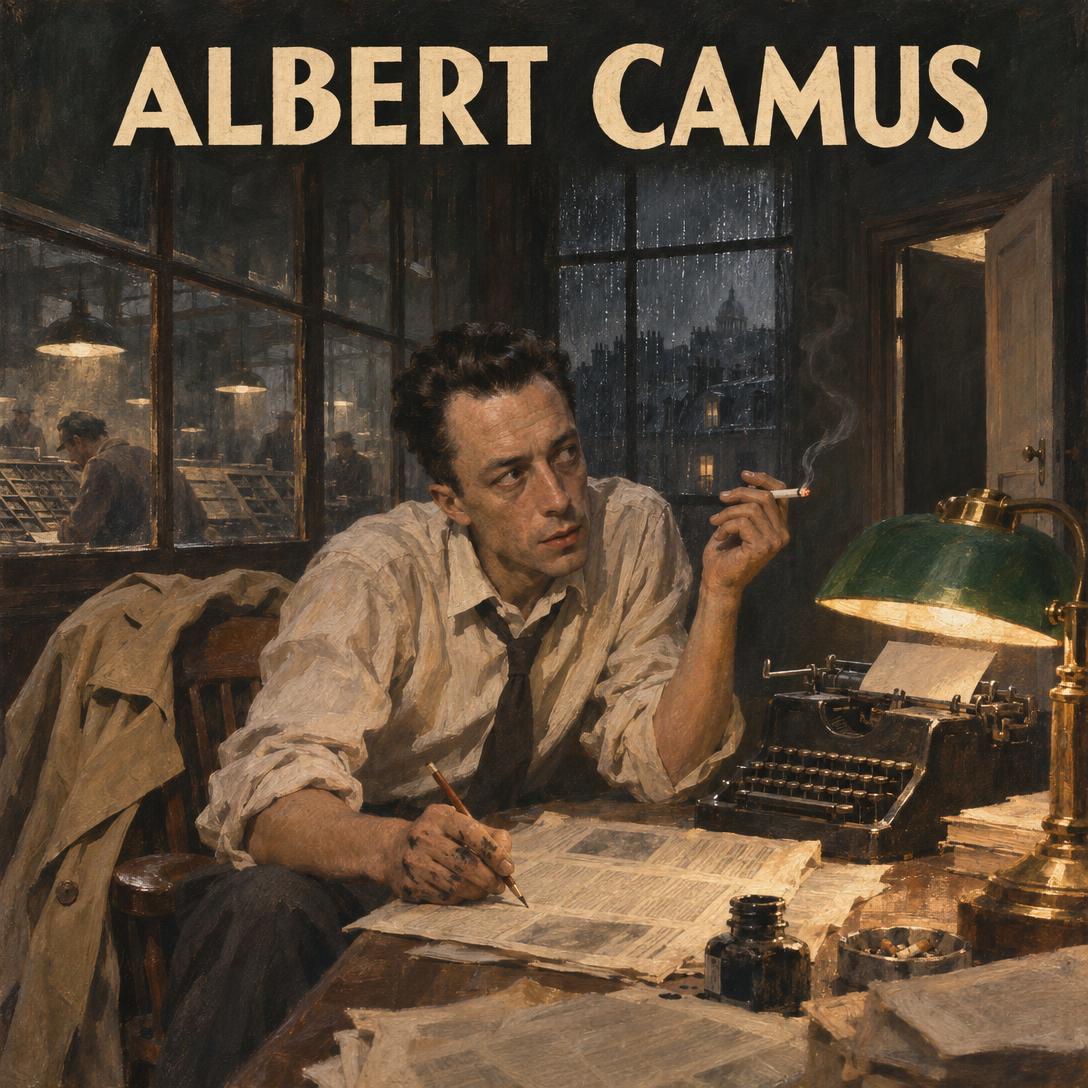
Roleplaying with Albert Camus on Jenova lets you step into a living-world AI character simulation across the iconic eras of his life. Static character chatbots sit in an empty chat room, blur every period into one voice, and forget your story. This simulation puts you in conversation with Camus inside an active, evolving world.
- ✅ Four canonical eras, from the Algerian coast to postwar Paris and Provence
- ✅ Era-specific worldview, so Camus only knows what he could know at that point in his life
- ✅ Unlimited memory and live tracking of your story, relationships, and open threads
- ✅ In-world visions, letters, and the option to fork into alternate "what-if" timelines
Camus is a thinker who distrusted tidy systems and answered abstraction with concrete human ground. A simulation that honors that approach has to feel like a conversation with a working journalist, playwright, and Mediterranean man, not a quote machine. The sections below explain how it works and where it can take you.
Quick Answer: What Is the Albert Camus AI Roleplay Experience?
Albert Camus AI Roleplay is an interactive AI character simulation that places you in conversation with Albert Camus across four canonical eras of his life, with persistent memory, era-accurate worldview, and a living world that keeps moving.
Key capabilities:
- Choose a canonical era or define a custom starting point in Camus's twentieth-century world
- Converse with a Camus who has his own duties, convictions, and moods and does not simply agree with you
- Keep one continuous story with unlimited memory and live tracking of people, places, and plot threads
- Request in-world visuals and written pieces, or fork the story into alternate timelines
Camus's World and Roleplay Features
Who Camus Was
Albert Camus was born on November 7, 1913, in Mondovi, Algeria. His father was killed at the First Battle of the Marne less than a year later, and the family lived in a working-class district of Algiers. In 1930, the first of several severe tuberculosis attacks ended his sporting career.
He became a journalist, playwright, and novelist whose work built on two ideas. The Absurd is the tension between human consciousness, with its demand for order and meaning, and an indifferent universe. Revolt is the attitude of defiance toward whatever oppresses human beings. Although he is often called an existentialist, he disavowed the label.
His life also supplies the dramatic material a roleplay needs. In 1957, at 44, he received the Nobel Prize in Literature. He had been editor-in-chief of the Resistance newspaper Combat from 1944 to 1947. The Rebel (1951) led to his falling out with Sartre.
Why Generic Character Bots Fall Flat
Most AI versions of historical figures share the same problems. They wait in a void until you type, they merge a person's whole life into one flattened voice, they lose track of what you discussed, and they fold into agreement the moment you push back. For a figure like Camus, who insisted on lucid honesty over comfort, that last flaw is fatal.
The Albert Camus AI roleplay experience is built to avoid each of these:
| Static Character Chatbots | Albert Camus on Jenova |
|---|---|
| Sits in an empty chat void | Lives in an active, evolving world |
| Blends all eras into one generic voice | Locks into authentic canonical phases |
| Forgets plot twists and past disclosures | Unlimited memory and live state tracking |
| Folds instantly like a polite assistant | Independent personality and earned rapport |
Standout Mechanics
Authentic Canonical Phases and Custom Starting Points
Each era carries its own psychology, voice, inner circle, and knowledge limits. A Camus in 1938 knows nothing of the war to come. A Camus in 1952 carries the weight of the break with Sartre but has no idea what comes next. You can also design your own starting point, including a face-to-face meeting in a Paris bistro or on a quay.
Living World Momentum
Camus has proofs to correct, rehearsals to run, letters to answer, and a body that does not always cooperate. When he is busy, he is brisk. When trust builds and the hour is late, he slows down and says more.
Independent Agency and an Open Sandbox
Camus interprets what you say; he does not obey it. Candor, humor, and courage earn warmth, and pompous posturing gets dry irony. Your choices can bend his story forward without any forced ending.
In-Narrative Visions, Writings, and Forking
You can ask to see a coastline, a street corner, or a stage as Camus knows it, or request a letter, an editorial page, or a notebook entry. Behind the scenes, historical details are checked silently so the world stays grounded. Use Fork to branch the conversation from any earlier message into a new timeline.
Example roleplay prompts:
"You've just finished the lead editorial. What made you cut the last paragraph?"
"I disagree that justice and mercy can be held together. Convince me otherwise."
"Write me a short letter to a friend who has stopped believing in anything."
How to Roleplay with Albert Camus
Step 1: Choose an era or define a custom starting point
The opening scene lays out the available eras and invites you to pick one. You can also propose your own moment in Camus's twentieth-century world, such as a late rehearsal of Caligula or a corner table in a Saint-Germain jazz cellar.
"Let's begin with the Paris newsroom, past midnight, just before the presses roll."
Step 2: Connect and let the world unfold
By default, Camus hears you as an unseen voice in the quiet of his own world. He reacts with understated surprise, then answers from inside his situation. Nothing else in his world pauses for you, so expect interruptions, deadlines, and moods.
"Sorry to interrupt. Are you in the middle of something?"
Step 3: Build rapport and shape the story
Offer counsel, challenge his reasoning, share what is happening in your own life, or ask for an in-world visual or written piece. Rapport grows through honesty and consistency over time. When you want to test an alternate path, roleplay with Camus on Jenova and use Fork to branch from an earlier moment.
"What would you have done if you'd refused the editorship?"
Canonical Eras and Roleplay Scenarios
⚔️ Voice of Combat in Liberated Paris
This era opens in late autumn 1944, when Camus edits Combat in a city still short on coal and paper. The newspaper began as a Resistance publication, and Camus's postwar editorials on liberation, justice for collaborators, and shortages are collected in Camus at Combat. It suits roleplayers who want fast, fraternal, argument-driven conversation.
- Debate how justice and mercy should coexist after an occupation
- Talk shop with a man who has real deadlines
- Explore a Camus who has not yet written the books that later defined him
🌊 Sun and Salt of Young Algiers
This is Camus at 24, before fame. His first essay collections, L'Envers et l'Endroit (1937) and Noces (1938), describe his Algerian childhood and present natural beauty as a wealth even the very poor can enjoy. Expect a lyrical, physical, irreverent Camus who measures ideas against the sea and warm stone.
- Walk through ideas about mortality and the sun without hindsight
- Meet the theatre-and-journalism world of young Algiers
- Ask what he wants from life before anyone is watching
🌀 The Rebel's Solitude and the Reluctant Laureate
Two later eras let you meet an older, more guarded Camus. In the Left Bank phase, he has just broken publicly with Sartre over The Rebel, which condemned unrestrained revolutionary violence. In the final era, he has the Nobel behind him; Nobel records note that he dedicated his acceptance speech to his schoolteacher Louis Germain and, in 1959, staged Les Possédés.
- Test your convictions against an iron-spined, self-mocking interlocutor
- Explore loneliness, loyalty, and the cost of independence
- Roleplay the quieter, warmer Camus of the final period
📱 A Long-Form Campaign on Your Phone
Because the experience works across web, iOS, and Android with shared history, you can begin a conversation at your desk and continue it on the train. Unlimited memory means a thread from last week, such as an unresolved argument or a promise to continue, will still be there. Try Albert Camus free — no credit card required.
FAQ
Is the Albert Camus AI roleplay free?
You can start roleplaying with Albert Camus on Jenova's Free plan, which has limited monthly usage. The Plus plan at $20/month gives 30× the usage, custom model selection, and no watermarks. Higher tiers add further usage multipliers if you plan long campaigns.
How is this different from a generic Camus chatbot?
A generic bot answers questions in one flattened voice. Albert Camus on Jenova is a simulation with era-locked knowledge, an active world, unlimited memory, and its own point of view. He can disagree with you, stay busy with his own life, and respond to how you treat him over time.
Which eras of Camus's life can I roleplay with?
There are four: liberated Paris in 1944, young Algiers in 1938, the Left Bank after the break with Sartre in 1952, and Provence in 1959. You can also propose a custom starting point anywhere in Camus's twentieth-century world, including a face-to-face meeting.
Can my choices change Camus's story?
Yes. History follows the canonical premise up to the moment you enter, then moves forward freely. Your conversations and decisions can shape what happens next, and you can use Fork to branch an earlier moment into an alternate "what-if" timeline.
Does Albert Camus work on mobile?
Yes. The experience syncs across web, iOS, and Android, and supports voice input and read-aloud. Your story and memory carry over between devices.
Is it accurate to the real Camus?
The simulation draws on documented biography, works, and period context, but it is an interpretation, not the man himself. Era-locked knowledge keeps Camus from referencing events he could not have known. For scholarship, consult primary sources such as Camus's biography on NobelPrize.org.
Conclusion
Reading Camus gives you his arguments, and watching him in a documentary shows his outline. A roleplay lets you test those arguments in conversation with a Camus who has his own deadlines, doubts, and humor. That is the difference between a static character chatbot and a living-world simulation: the story continues, remembers you, and pushes back.
Whether you want a midnight argument in a newsroom, a seaside conversation in Algiers, or a quiet hour with an older writer, the Albert Camus AI roleplay experience gives you a place to start. Try Albert Camus now. Explore more at Jenova.
For Developers: Albert Camus is available programmatically via the Jenova Agent API — integrate persistent, era-aware AI character roleplay into your application with a single API call. Full documentation →