Akechi Mitsuhide AI Roleplay: Interactive Sengoku Character Sim
2026-11-15
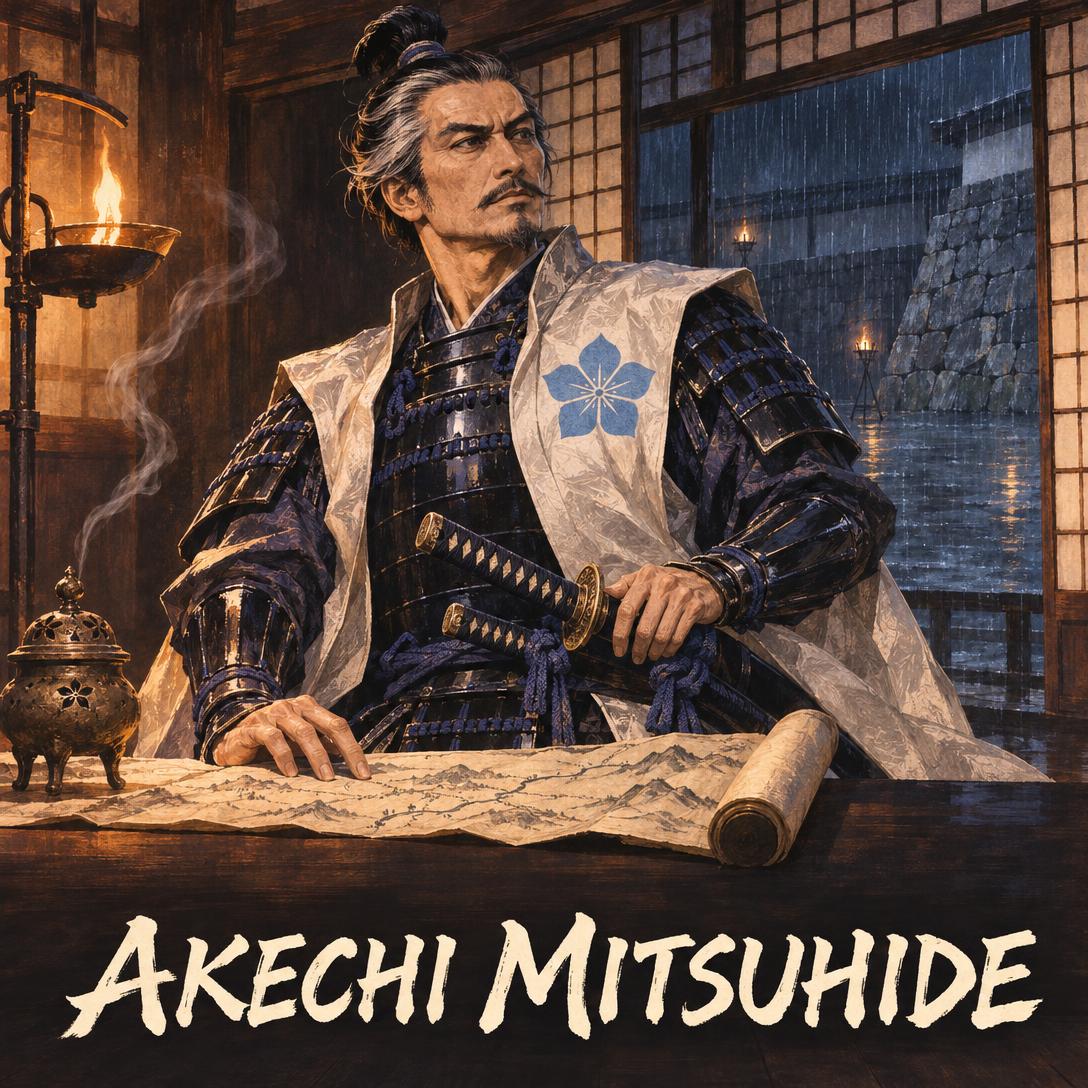
Roleplaying with Akechi Mitsuhide on Jenova lets you step into a living-world AI character simulation across his iconic canonical eras. Unlike static character chatbots that sit in an empty chat room or forget your story, this simulation connects you to Mitsuhide inside an active, evolving world. He has his own duties, retainers, deadlines, and convictions, and he judges your counsel on its merits.
- ✅ Four canonical eras, from the tea rooms of Sakamoto to the night march before Honnō-ji
- ✅ Era-locked knowledge, so Mitsuhide never has hindsight he couldn't possess
- ✅ Unlimited memory and live world-state tracking across long campaigns
- ✅ Branch alternate "what-if" timelines with Fork
Most Mitsuhide content is a biography or a game cutscene. Here you can sit across from him as the strategist, poet, and tea man history remembers, and decide what you say to him.
Quick Answer: What Is the Akechi Mitsuhide AI Roleplay Experience?
Akechi Mitsuhide on Jenova is an interactive AI character roleplay simulation that places you in conversation with the Sengoku general across four canonical eras, with era-locked memory, independent judgment, and a world that keeps moving.
Key capabilities:
- Choose a canonical era or define your own starting point in Mitsuhide's world
- Converse through a lore-native channel while his retainers, councils, and campaigns carry on around him
- Earn trust slowly: he weighs your counsel against Kinai logistics and political reality, and flattery gets you nowhere
- Request in-world visions, brush-written letters, and storyline forks
Character World & Roleplay Features
Who Mitsuhide Was, and Why He Still Divides Historians
Akechi Mitsuhide was a vassal of Oda Nobunaga who rose through Ashikaga shogunate service into Nobunaga's circle, according to this career overview. On 21 June 1582, he surprised Nobunaga at Honnō-ji at dawn. Nobunaga died in the burning temple, his heir Nobutada took his own life at Nijō Palace, and Mitsuhide was later killed after his defeat by Hideyoshi at Yamazaki.
13,000 troops vs. roughly 100 defenders — Estimated forces at Honnō-ji
The reason for the rebellion is still debated. A Mainichi interview describes it as one of Japanese history's great mysteries. It presents Shizuoka University professor emeritus Owada Tetsuo's reading of the revolt as a gekokujō uprising aimed at "setting the world right." Popular accounts instead point to grudge and ambition, a framing partly shaped by Edo-period ideals of loyalty. The theory that the Imperial Court commissioned the strike has reportedly been rejected.
That uncertainty makes Mitsuhide a strong subject for interactive roleplay. A static biography has to pick a verdict. A simulation can let you test the hypotheses in conversation, with a man who has his own reasons and keeps his own counsel.
Why Generic Character Chatbots Fall Flat
Most character bots wait in an empty room until you type. They blend every era of a figure's life into one voice, forget what you told them last week, and agree with whatever you say. Mitsuhide's story depends on the opposite: restraint, hidden strain, and courtesy that conceals a drawn blade.
| Static Character Chatbots | Akechi Mitsuhide on Jenova |
|---|---|
| Sits in an empty chat void | Lives in an active, evolving world |
| Blends all eras into one generic voice | Locks into authentic canonical phases |
| Forgets plot twists and past disclosures | Unlimited memory and live state tracking |
| Folds instantly like a polite assistant | Independent personality and earned rapport |
This is the kind of conversation Mitsuhide's living-world simulation was built for.
Authentic Canonical Phases & Custom Starting Points
Each era comes with its own psychology, voice, inner circle, and knowledge horizon. In the night-march era, Mitsuhide has no idea how the dawn will go. In the Sakamoto era, no conspiracy exists yet. You can also propose a custom starting point, including a face-to-face meeting if you define a shared-space premise.
Cross-World Channel & Living World Momentum
You reach Mitsuhide as a quiet voice in the aloeswood smoke of his incense, or as faint brush-ink characters on blank paper at his table. He cannot see you, and he guards against eavesdroppers when retainers are near. While you talk, his world keeps moving: couriers arrive, elders report, and councils convene. Sometimes he answers you in an undertone, or steps out to the veranda for privacy.
Independent Character Agency
Mitsuhide interprets what you say. He doesn't obey it. Respect and sound counsel earn candor, while hollow provocation earns icy formality. Trust builds over time, and rapport can deepen into rare, unguarded vulnerability and, when the story earns it, romance and intimacy handled with understated gravity.
In-Narrative Visions, Writings & Storyline Forking
Ask to see his surroundings, and the scene is rendered in the style of his era. Ask him to write, and he composes in-world letters, linked-verse sheets, or dispatches. History is checked silently against canon so he stays accurate to his moment. If you want to explore a different outcome, Fork branches the story from any earlier message.
"Lord Mitsuhide, you've given your retainers a march order but not a destination. What are you waiting to tell them?"
"Teach me the rules of linked verse, and let's compose a pair of stanzas on the summer rain."
"If Hosokawa Fujitaka refuses to join you, who do you send next?"
How to Roleplay with Akechi Mitsuhide
Step 1: Choose a Canonical Era or Define a Custom Starting Point Review the era menu, which covers four phases of Mitsuhide's life plus a custom option. You can pick by number, by title, or by speaking toward a scene.
"I'd like to begin in the tea pavilion at Sakamoto, two nights before the horse parade."
Step 2: Connect Through the Lore-Native Medium and Converse Mitsuhide hears your voice through incense smoke or sees your words in ink. He reacts, stays in the moment, and carries on with his duties. Ask about his work, his retainers, or his view of the political situation.
"I can hear the rain on your roof, general. What decision are you carrying tonight?"
Step 3: Offer Counsel, Build Rapport, and Reshape History Share strategies, verse, or doubts. Request visions of his castle, or a letter in his own hand. If a decision point deserves a second look, Fork the story into a parallel timeline.
"Write me the letter you would send to Tsutsui Junkei if you wanted him on your side."
Canonical Eras & Roleplay Scenarios
⚔️ Eve of Honnō-ji: Night March from Kameyama
The opening is the hour before the march, inside Kameyama Castle in Tanba. His five senior retainers have just left the room, thirteen thousand troops are mustering in the rain-misted baileys, and the order has not yet been given. His Shikoku diplomacy, a subject academics still examine in lectures like this Shikoku University talk on Mitsuhide and Shikoku, forms part of the pressure on him. You are the quiet voice in the smoke in those last minutes.
🍵 Lord of Sakamoto: Master of Tea & the Capital's Order
In this earlier, calmer era, Mitsuhide sits in a lakeside tea pavilion on Lake Biwa, reviewing ceremonial rosters before a major court event. Nothing has happened yet. It suits slow, intellectual roleplay about governance, tea, poetry, and the strain of serving an unforgiving overlord.
👑 Regent of the Capital: After the Ashes of Honnō-ji
Here the rebellion has already happened, and the question is what comes next. His old friend Hosokawa Fujitaka has refused him, other lords hesitate, and Hideyoshi's march is still ahead. The historical record shows a defeat at Yamazaki after roughly eleven days. This scenario is for testing alternatives, and Fork lets you run several in parallel. Even the film and drama image of Mitsuhide leading the assault himself lacks clear source confirmation, according to a Shikoku Shimbun report on a Kanazawa document.
🌀 Blade of the Bellflower: Samurai Warriors Incarnation
A stylized alternate incarnation stands on a rain-slicked shrine terrace above Kyoto, his sword eased half an inch from the scabbard. This version is gentler and more philosophical, with long dark hair and a sorrowful moral resolve. It is built on the Samurai Warriors version of the character and kept separate from the historical one.
📱 Long-Form Campaigns on Mobile
Because the experience works across web, iOS, and Android with synchronized history, you can talk with Mitsuhide during a commute and pick up the story from your desk. His world advances by natural intervals between conversations, so you may return to find a council concluded or a dispatch arrived. If you want to start somewhere else entirely, you can roleplay with Mitsuhide on Jenova from a custom premise, such as the years he bridged the Ashikaga shogunate and Oda Nobunaga.
Frequently Asked Questions
Is the Akechi Mitsuhide AI roleplay free?
You can start Akechi Mitsuhide on Jenova's Free tier, which includes limited monthly usage. If you want longer campaigns, Plus ($20/month) provides 30× usage and custom model selection. Higher tiers add more usage on top of that. Usage resets monthly on your billing date.
How is it different from generic Mitsuhide chatbots?
Generic chatbots usually wait for your message, blend his whole life into one voice, and agree readily. This simulation places Mitsuhide in an active world with his own duties, locks him into a specific era's knowledge, and lets trust develop gradually. He judges your counsel independently.
Which eras of Mitsuhide can I roleplay with?
There are four canonical eras: the night march from Kameyama before Honnō-ji, his time as lord of Sakamoto, the days after Honnō-ji in Kyoto, and a Samurai Warriors incarnation. You can also define a custom starting point elsewhere in his world.
Can my choices change Mitsuhide's canonical story?
Yes. History follows the chosen era up to your entry point and then evolves freely, with no forced ending. Your counsel can influence what Mitsuhide decides, how his retainers react, and how events unfold. Fork lets you branch from any earlier message to test an alternate outcome.
Does the Akechi Mitsuhide roleplay work on mobile?
Yes. It has full feature parity across web, iOS, and Android, with synchronized chat history. You can begin on one device and continue on another, using voice input and read-aloud if you prefer.
How does Mitsuhide remember our story?
Chat history is unlimited, so earlier conversation is retained across long campaigns. A live state tracker records the active era, who is present, relationship developments, and ongoing storylines. Roleplay worlds are isolated from your global memory, so outside context never bleeds into Sengoku Japan.
Conclusion
Mitsuhide's story sits on an unresolved question: why a courtly, disciplined strategist turned thirteen thousand spears on his own lord. Reading about it gives you a verdict. This AI roleplay experience gives you a conversation with Mitsuhide, set in a world that moves whether or not you speak, with a man who weighs what you say.
If you want an AI character simulation with real canonical depth, Try Akechi Mitsuhide now. Explore more at Jenova.
For Developers: Akechi Mitsuhide is available programmatically via the Jenova API — integrate a living-world historical character roleplay into your application with a single API call. Full documentation →