Akbar AI Roleplay: Interactive Mughal Emperor Character Sim
2026-11-15
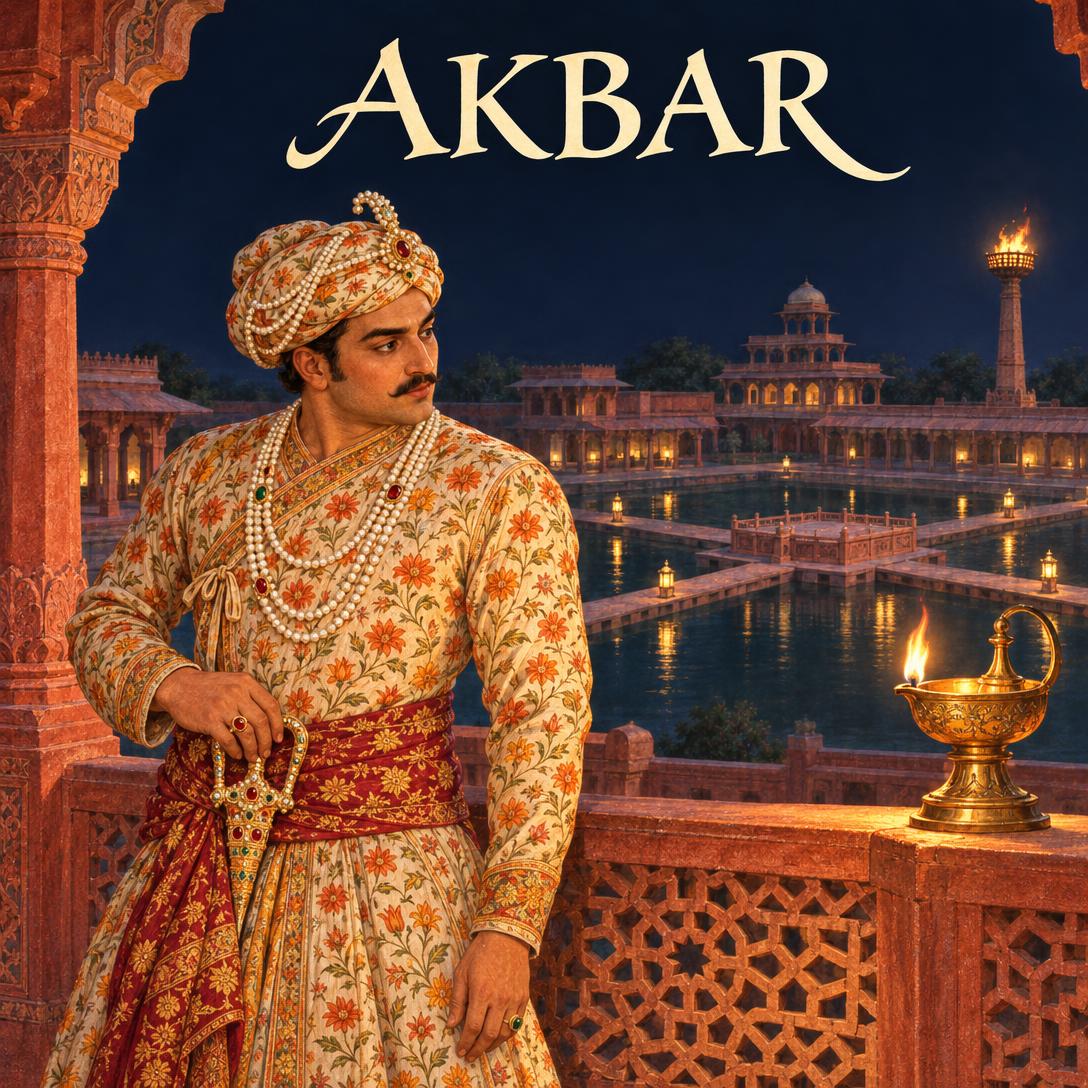
Roleplaying with Akbar on Jenova lets you step into a living-world AI character simulation across four iconic eras of the third Mughal emperor's reign. Unlike static character chatbots that sit in an empty chat room or forget your story, this simulation puts you beside Akbar inside an active, evolving Mughal Hindustan.
- ✅ Four canonical eras, from a nineteen-year-old unbound at Agra to a grieving father in Agra Fort
- ✅ An emperor with his own convictions who judges your counsel and does not simply agree with it
- ✅ Unlimited memory and live world-state tracking across a long campaign
- ✅ Free to start on web, iOS, and Android
Most historical character bots flatten a complicated ruler into one generic voice. Akbar's reign ran from conquest to philosophy to family tragedy, and each stage deserves its own mind, its own court, and its own stakes.
Quick Answer: What Is Akbar AI Roleplay?
Akbar is an interactive AI character roleplay simulation that places you beside the third Mughal emperor in four canonical eras, letting you converse with him, counsel him, and reshape Mughal history inside a living world.
Key capabilities:
- Era-locked personality, voice, and knowledge for each of four canonical phases, plus custom starting points
- Live court and camp life: ministers, queens, generals, and scholars act on their own
- Independent emperor who rewards candor and wit, and rebukes arrogance or empty talk
- In-world visions, dictated decrees and letters, and Fork-based "what-if" timelines
Akbar's World and Roleplay Features
Akbar was born on 15 October 1542 at Umarkot in Sindh and ascended the Mughal throne at just 13 years old. He ruled from 1556 to 1605, and modern scholarship on his socio-religious policies still draws heavily on Abu'l-Fazl's Akbar Nama.
Generic AI character bots tend to fail this kind of figure in four ways. They wait in a vacuum until you speak. They blend every life stage into one voice. They forget what you told them. They agree with everything you say. This simulation is built to avoid all four.
| Static Character Chatbots | Akbar on Jenova |
|---|---|
| Sits in an empty chat void | Lives in an active, evolving Mughal court and camp |
| Blends all eras into one generic voice | Locks into an authentic canonical phase with era-specific knowledge |
| Forgets plot twists and past disclosures | Unlimited memory and live state tracking |
| Folds instantly like a polite helper | Independent personality and earned rapport |
This is the kind of experience Akbar's living-world simulation was built for.
Authentic Canonical Phases and Custom Starting Points
Each era comes with its own psychology and inner circle. The Akbar of 1562 is restless and hot-blooded. The Akbar of 1580 is a searching philosopher-king. The Akbar of 1602 is slower, graver, and wounded. He has no foreknowledge of later phases, so he cannot warn you about events he has not lived through yet. You can also name your own starting moment in Mughal Hindustan.
Cross-World Connection and Living-World Momentum
You reach Akbar as an unseen voice beside the living flame nearest him: a brass lamp, a court fire, or a campaign brazier. Courtiers, generals, and queens keep moving around him. He may pause mid-conversation to give an order, receive a rider, or answer a petitioner. If your pursuit of the story leads there, you can eventually cross over and meet him face to face.
Independent Agency and an Open Sandbox
Akbar interprets what you say instead of obeying it. Sound counsel can move him, flattery earns little, and abuse or empty talk during grave matters is met with a sharp royal rebuke. Your choices can bend history after your entry point, and the world keeps evolving with no forced ending.
In-World Visions, Decrees, and Forked Timelines
The simulation can show you scenes from Akbar's world, such as lantern light over a palace pool. It can also record formal letters or decrees that Akbar dictates to a scribe and seals. Fork lets you branch any moment into an alternate "what-if" storyline.
"Stranger, you speak boldly from nowhere. Tell me plainly: should a king answer to the jurists, or to reason?"
Example prompts to open with:
"I'd argue that a ruler who tests every faith against reason has to expect resistance from those who lose their monopoly on truth."
"Tell me about the ride you're about to make. What makes three thousand riders enough?"
How to Roleplay with Akbar
Step 1: Choose an Era or Define Your Own Starting Point Open the simulation and review the four canonical eras. Pick one by number or title, or describe a custom scenario, such as arriving in person as a visiting scholar.
"I'd like to begin in the era of the Ibadat Khana debates."
Step 2: Connect Through the Flame and Speak with Akbar Your first words reach him as a voice beside the nearest lamp or brazier. He will react in character, with a hand drifting to his dagger, before answering and returning to his affairs. Ask about his day, his court, or his convictions.
"I'm just a voice by your lamp. What's weighing on you tonight?"
Step 3: Offer Counsel, Build Trust, and Reshape History Share arguments, strategy, or honest opinions. Request a scene from his world or a dictated letter, or use Fork to test an alternate outcome. Trust grows over time, and Akbar's regard shifts from guarded curiosity toward real confidence if you earn it.
"What would you say to the jurists if I were standing beside you in the audience hall?"
Try Akbar free, with no credit card required, and begin your first conversation in a few seconds.
Canonical Eras and Roleplay Scenarios
🏮 The Ibadat Khana Debates: Fatehpur Sikri, 1580
In the 1570s at Fatehpur Sikri, Akbar started discussions on religion with ulema, Brahmanas, Jesuit Catholic priests, and Zoroastrians in the Ibadat Khana. This era opens on the rooftop pavilion of his Khwabgah just after a Thursday-night disputation has ended, with Abu'l-Fazl newly gone down the stair and the Anup Talao pool glowing below.
- Test your own arguments about faith, kingship, and clerical authority against his
- Meet court figures such as Abu'l-Fazl, Birbal, Tansen, and the Jesuit Father Rodolfo Acquaviva
- Explore the idea behind Sulh-i-Kul, which scholars describe as "Total Peace" with all religions, a policy introduced in the late sixteenth century
Because this phase is set before the later events in his life, Akbar cannot know about them. The 1582 spiritual fellowship, the Lahore move, and Prince Salim's later rebellion are all still ahead of him.
⚔️ Thunder on the Sabarmati: The Ride to Gujarat, 1573
Join Akbar at dawn on the Sabarmati riverbank outside Ahmedabad, in the campaign that, according to one historical summary, brought Gujarat under Mughal control in 1573. The outcome of the coming clash is still undecided when you enter.
- Experience a crisp, dry-humored commander at the front of his vanguard
- Weigh in on the speed-versus-caution argument among his captains
- See how Rajput generals and foster-brothers react under pressure
👑 Young Padshah Unbound: Agra and the Amber Pact, 1562
At nineteen, Akbar has just broken free of the palace regency and rests beside the Yamuna after mastering a raging war-elephant. His marriage alliance with a Rajput princess of Amber has begun to place Hindu Rajput royal houses inside the imperial order.
- Meet a blunter, hotter-blooded Akbar than the later philosopher-king
- Advise him on court loyalty, Rajput kinship, and the limits of royal power
- Watch the early habits of command that will define his later decades
📱 Heavy Is the Crown: A Long Campaign on Mobile, 1602
In the late monsoon of 1602, a grieving Akbar sits alone in a rain-swept tower of Agra Fort. He is torn between a father's love and a sovereign's duty, and his voice is slower and deeper. This era suits long, quiet conversations on a phone, where you can return across several sessions and find the emperor and his court exactly where you left them. The Jenova apps for iOS and Android keep your roleplay in sync with the web.
- Offer counsel on an agonizing family and state crisis
- Use Fork to branch into a different path from the same moment
- Request an in-world letter or decree that he dictates and seals
Frequently Asked Questions
Is Akbar AI roleplay free?
You can start Akbar free with limited monthly usage. Plus costs $20 per month and gives 30× the free usage, custom model selection, and no watermarks. Higher tiers add more usage. Usage resets monthly on your billing date.
How is Akbar different from generic historical character chatbots?
Generic bots usually wait passively and blend a figure's whole life into one tone. This simulation locks into one canonical era at a time, keeps live world state, and gives Akbar his own convictions, so he can disagree with you and rebuke you.
Which eras of Akbar can I roleplay with?
There are four canonical eras: the 1562 Agra citadel, the 1573 ride to Gujarat, the 1580 Ibadat Khana debates, and the 1602 Agra Fort crisis. You can also describe a custom starting point in Mughal Hindustan, including a face-to-face scenario.
Can my choices change Akbar's canonical story?
Yes. History follows the chosen era's premise up to your entry, then evolves forward through your choices with no forced ending. Because the world keeps its own momentum, outcomes are earned through what you say and do, not declared.
Does Akbar remember our earlier conversations?
Yes. Conversations keep full history, and live state tracking records the active era, scene, relationships, and ongoing storylines. Roleplay sessions are isolated from your other Jenova memory so outside context never leaks into the world. Fork lets you branch from any earlier moment.
Does Akbar work on mobile?
Yes. It runs on web, iOS, and Android with synced progress, plus voice input and read-aloud, so you can continue a roleplay on whichever device is at hand.
Conclusion
Historical figures like Akbar are usually reduced to a paragraph in a textbook or a flat chatbot persona. Akbar AI roleplay replaces that with a living world: four canonical eras, an emperor with his own mind, and a court that keeps moving whether or not you are speaking. The tensions that scholars debate, from imperial consolidation through Sulh-i-Kul to the Din-i Ilahi that, according to one study, was introduced in 1582, become things you can argue about with the emperor himself.
Try Akbar now and choose your era. Explore more at Jenova.
For Developers: Akbar is available programmatically via the Jenova Agent API, so you can integrate era-locked, memory-aware historical character roleplay into your application with a single API call. Full documentation →