What Is the Best AI Assistant for Aircraft Maintenance?
2026-08-27
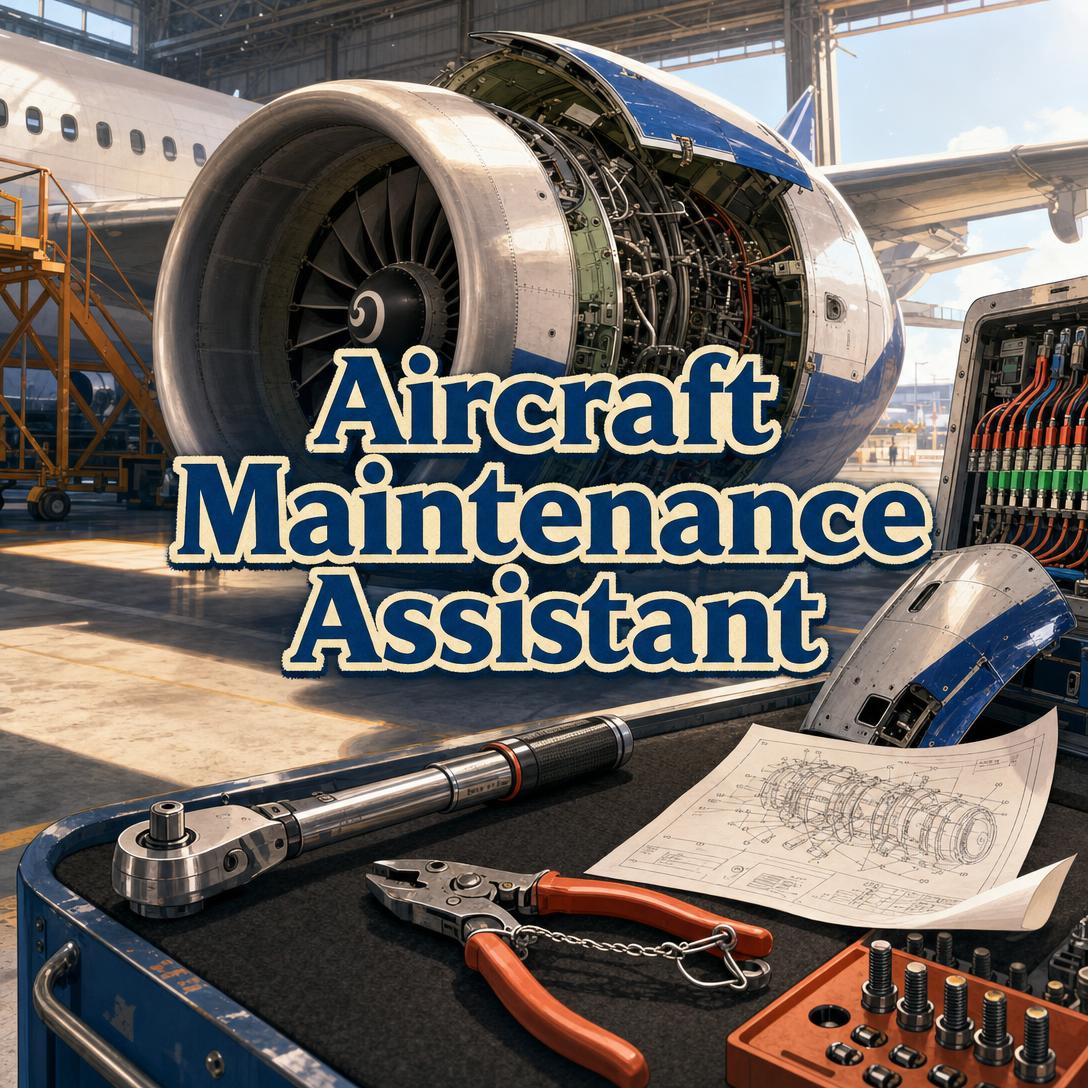
How Do AI Aircraft Maintenance Assistants Compare on Fault Isolation, Documentation, and Regulatory Grounding?
For individual A&P mechanics, AMEs, and independent shops that need fault-isolation logic, discrepancy write-ups, and multi-jurisdiction regulatory navigation, Aircraft Maintenance Assistant is the strongest conversational option evaluated here in 2026. Airline-scale MRO teams with unified maintenance data are better served by enterprise systems such as Kubrick’s Defect Resolution AI Assistant, while fleets investing in sensor-driven prediction may look to QOCO Systems. Specialized shops on a narrow fleet have used custom builds such as the HatchWorks AI virtual assistant for Embraer Phenom and Praetor work.
The useful split is not “AI versus no AI.” It is hangar-floor reasoning versus fleet-level data platforms.
Key factors that separate a usable maintenance assistant from a generic chatbot:
✅ Fault isolation presented as methodology — symptoms, ATA mapping, differentials — not a fake sign-off ✅ Write-ups in industry phrasing, with AMM/SRM/IPC chapter guidance rather than invented torque values ✅ Explicit FAA, EASA, and TCCA awareness, including RII and critical-task flags ✅ Photo description that names damage types without declaring the part serviceable ✅ Human-factors awareness when pressure, fatigue, or night-shift complexity shows up in the question
To compare these products honestly, it helps to score them on isolation logic, source discipline, documentation quality, jurisdiction coverage, visual description, and how hard they are for a line technician to actually open on shift.
Why Are Maintenance Organizations Adopting AI Assistants in 2026?
Maintenance organizations are adopting AI assistants because technician shortages, documentation load, and unplanned downtime now cost more than most shops can absorb with tribal knowledge alone. The global AI-in-aviation market was valued at $7.8 billion in 2025 and is projected at $9.1 billion in 2026, reflecting spend on operations and MRO intelligence rather than cockpit novelties.
Labor is the binding constraint. Kubrick reports that the industry faces a technician shortage projected to exceed 70,000 roles by 2033, and that every retirement takes institutional knowledge that is hard to rebuild from manuals alone. McKinsey frames generative AI as a productivity lever for repair copilots and clerical assistants in exactly this shortage.
The paperwork problem is as real as the wrench time. Kubrick notes that manual data logging can take up to 24 hours, which blocks real-time decisions and injects recording errors. QOCO’s workforce analysis argues that predictive maintenance, AI-driven scheduling, and digital workflow tools are now workforce issues, not IT side projects.
Reported operational gains vary by source and should be read as vendor or industry estimates, not universal constants. Oxmaint states that organizations integrating AI into maintenance workflows are reporting 30–40% reductions in unplanned downtime and 20% drops in parts spend. A ResearchGate paper on predictive maintenance cites maintenance-cost reductions of 12–18% and unplanned-downtime decreases of 15–20%.
The hangar implication is narrower than those headlines. Predictive models help planners. Conversational assistants help the person standing under a hydraulic actuator at 02:00 who needs isolation logic and a clean squawk, not a dashboard.
What Should You Look for in an AI Aircraft Maintenance Assistant?
You should look for source discipline first, then isolation method, then documentation quality — not fluency, and not a promise to “diagnose the jet.” Under 14 CFR §43.13, maintenance must use the methods in the current manufacturer’s maintenance manual or other methods acceptable to the Administrator. An assistant that invents AMM paragraph numbers or torque values is a safety liability.
This article uses a Six-Dimension Hangar Utility Framework:
- Isolation logic — symptom clarification, ATA mapping, cross-system thinking, BITE interpretation, “what else could it be?”
- Source discipline — chapter-level AMM/SRM/FIM pointers, CFR/EASA citations, refusal to fabricate effectivity-controlled data
- Write-up quality — “Removed and replaced IAW…,” AD method language, MEL deferral phrasing, Form 337 / CRS / maintenance-release conventions
- Jurisdiction awareness — Federal Aviation Administration (FAA), European Union Aviation Safety Agency (EASA), Transport Canada Civil Aviation (TCCA), and when to ask which framework applies
- Visual description — dents, corrosion types, delamination, hardware ID, without a serviceability call
- Access friction — usable tonight on a phone versus an 18-month data-platform program
Regulatory literacy is not optional color. FAA AC 43.13-1B remains the widely used acceptable-methods circular for inspection and repair, and ATEC reported in 2025 that the FAA is modernizing AC 43.13-1B. EASA Part-145 competence requirements include human factors and human performance appropriate to the person’s function. The UK CAA’s CAP 716 still functions as core guidance material for maintenance human factors under that regime.
An assistant that never mentions Required Inspection Items, critical maintenance tasks, or Dirty Dozen pressure is not “streamlined.” It is incomplete.
How Do Jenova, Kubrick, QOCO, and HatchWorks Compare for Line and Heavy Maintenance?
They serve different layers of the same industry: Jenova is a technician-facing conversational reference, Kubrick is an airline defect-resolution system wired into MRO data, QOCO is strongest in digitalization and condition analytics, and HatchWorks is a custom assistant for a defined fleet and shop. None of them replaces approved data.
| Feature / Dimension | Kubrick Defect Resolution AI | Aircraft Maintenance Assistant | QOCO Systems | HatchWorks custom assistant |
|---|---|---|---|---|
| Fault isolation | Queries manuals and historic defect logs from a fault code or description | Decision-tree isolation, cross-system differentials, BITE/code interpretation without issuing a diagnosis | Machine-learning condition analytics on component sensor data | Fleet-specific troubleshooting for a defined MRO workflow |
| Documentation drafting | Retrieves repair guidance and parts context from connected work orders | Logbook/squawk drafts, AD/MEL phrasing, Form 337 and CRS-style narratives | Unverified as a write-up copilot as of 2026 | Unverified beyond the operator-specific assistant |
| Regulatory grounding | Regulatory/maintenance codes ingested into the airline data platform | FAA, EASA, TCCA, ICAO; RII and critical-task flags | Strongest in European MRO digitalization programs | Operator procedures, not a multi-authority reference library |
| Photo / damage description | Not described in published materials | Damage, corrosion type, hardware, and data-plate reading with “appears to be” language | Not described as a photo-write-up product | Unverified |
| MRO / inventory integration | Manuals, logs, inventory, work orders, flight schedules | No native airline MRO or stock-system hookup | Digital maintenance workflows and condition analytics | Built into the client MRO’s environment |
| Pricing (as of 2026) | Enterprise engagement; public list price unverified | Free tier; Plus $20/month (30× free usage) | Unverified | Custom project; public list price unverified |
| Best for | Major airlines with unified MRO data lakes | Individual techs, AMT schools, independent and regional shops | Operators investing in predictive/condition-based programs | Specialized MROs wanting a fleet-specific build |
Aircraft Maintenance Assistant
Examining the product’s design shows a hangar-peer model: it calibrates depth for apprentices, experienced techs, NDT specialists, and exam candidates, and it shortens answers when the context is AOG or a gate return. It drafts discrepancy text, helps navigate IPC/ATA structure, and treats photo uploads as description support rather than a hidden inspection stamp.
Honest limits matter. It is not connected to an operator’s inventory, work-card system, or live aircraft sensors. It will not monitor ADs in the background or authorize return to service. OEM manuals are effectivity-controlled; it can point to typical chapters and industry practice, not quote your current revision’s torque table as fact.
Kubrick Defect Resolution AI Assistant
Kubrick’s published architecture connects manuals, historic logs, inventory, work orders, and live operational data, then exposes that through a technician chatbot. In operation with airlines, Kubrick reports troubleshooting time reduced by up to 50% and maintenance-related delays reduced by 30%, with one carrier saving $14 million in compensation, fines, and wasted maintenance cost. Those figures are vendor-reported.
The limitation is access friction. If you do not have a Databricks-scale MRO data platform, this is not a tool you open between a MEL call and a parts run. It is an airline program.
QOCO Systems
QOCO’s public materials emphasize digital workforce optimization and Condition Analytics that use machine learning on component sensor data to predict maintenance needs. That is high value for reliability programs and planning. It is a different job from drafting a non-routine on a dented leading edge.
QOCO’s 2025 digitalization survey also found larger organizations leading digital-strategy adoption, which matches the access-friction dimension: platforms follow fleet IT budgets, not a lone IA’s phone.
HatchWorks custom AI virtual assistant
HatchWorks built an AI virtual assistant for Aero Star Aviation, described as a growing alternative for Embraer Phenom and Praetor maintenance. The strength of a custom assistant is obvious: it can be tuned to one shop’s manuals, fleet, and workflow.
The limitation is equally obvious. It is not a general product for any airframe, any authority, or any technician. You buy a project, not a reference librarian.
How Does Systematic Fault Isolation Work With an AI Maintenance Assistant?
Effective AI isolation walks a decision tree — clarify the symptom, map ATA systems, test what each result rules out, then ask what else could cause it — and stops short of a diagnosis. That is the difference between a useful copilot and an unapproved troubleshooting manual.
Generative-AI vendors now market exactly this hangar use case. Oxmaint describes natural-language queries and step-by-step guidance for complex faults. Academic work on AI-driven fault detection and maintenance optimization is moving in the same direction at the systems level. Neither replaces the Fault Isolation Manual (FIM) or Troubleshooting Manual (TSM).
In practice, a strong assistant should force precision before guessing:
- What is abnormal, when, and is it reproducible?
- Which ATA system actually owns the symptom — and which upstream system could mimic it?
- What does this BITE code indicate, and what does it not rule out?
- For intermittents: heat, vibration, load, connectors, moisture — not “replace the box.”
A hydraulic pooling complaint is a classic trap. The obvious ATA 29 fitting may be the leak path while the cause is over-torque, a cracked tube, a reservoir servicing error, or an electrical pump-logic issue. Cross-system thinking is the skill worth encoding.
Jenova’s useful pattern is to say, in substance, “troubleshooting logic would point toward… verify in the applicable FIM/TSM.” Kubrick’s useful pattern is different: retrieve the historically successful fix and the parts on hand. QOCO’s useful pattern is earlier in the timeline: predict the failure before the pool of fluid appears.
If the assistant skips “what else could cause this,” treat it as a search engine with confidence problems.
How Should AI Assistants Handle Logbook Write-Ups and Regulatory References?
They should draft in the phrasing auditors already expect, cite the document type and chapter, and remind you that the current revision-controlled manual still governs the job. Weak write-ups (“fixed the part”) are how good work becomes a finding.
Industry-standard language is specific:
- “Removed and replaced IAW AMM…”
- “Accomplished AD 20XX-XX-XX by method 2…”
- “NDT inspection per NDT Manual Chapter XX revealed no cracks or defects…”
- “Item deferred per MEL XX-XX, Category C…”
14 CFR §43.13(a) is the reason source discipline is a product feature, not a style preference. The performance rule points at the current manufacturer’s data. An AI that fills in a plausible torque value from memory is not helping you comply.
Jurisdiction changes the envelope of the same task. FAA Required Inspection Item programs sit in a different text than EASA critical maintenance tasks. EASA Form 1 release rules, including NDT and component classes, are spelled out in Part-145 guidance in ways that do not map one-to-one onto an FAA Form 337 narrative. A technician-facing assistant that never asks “FAA, EASA, TCCA, or another authority?” will eventually write the wrong kind of sentence.
Jenova is strongest here among the conversational options because documentation is a first-class job: discrepancy text, shift turnover notes, AD applicability parsing at a research level, and PMA versus OEM conversation. It still cannot store your operator’s expositions or guarantee the AD number you remember is current — those change, and they have to be checked in authoritative systems such as the FAA DRS or EASA AD database.
Kubrick can be stronger inside an airline because the work order, inventory, and manual revision live in the same platform. That is integration, not better English.
Can AI Assistants Describe Damage From Photos Without Making Airworthiness Calls?
Yes — and that boundary is the feature, not a missing feature. Photo support is valuable when it translates what you see into SRM language. It becomes unsafe when it pretends the image is an inspection.
Useful visual outputs sound like this:
- “The visible indication is consistent with filiform corrosion along the lap joint.”
- “This appears to be a dent with possible paint cracking; SRM Chapter 51 is the usual disposition path.”
- “The data plate characters read as…”
They should not sound like: “This is within limits; aircraft is good to go.”
Jenova is the only product in this comparison with a clearly described photo workflow: damage description, corrosion classification, fastener and fitting identification, and part-number capture, all framed as appearance rather than disposition. Kubrick, QOCO, and HatchWorks may ingest images inside private deployments; that capability is not documented in the public sources reviewed for this article, so it is unverified.
The same boundary applies to hardware and parts research. Guiding someone through an IPC figure, a supersedure chain, or 8130-3 / EASA Form 1 traceability is legitimate support. Telling them a bargain-bin fitting is acceptable because it “looks like” an AN fitting is how suspected unapproved parts enter the system.
If your use case is composite repair or weld quality rather than line squawks, a maintenance assistant still helps with terminology and code pointers, while a shop-floor specialist such as Welder's Assistant is a better fit for bead defects, parameters, and CWI-oriented questions.
How Do You Get Reliable Results From an AI Aircraft Maintenance Assistant?
You get reliable results by loading aircraft identity, regulatory framework, work context, and what you have already observed — then demanding sources. Vague prompts produce vague, overconfident answers.
For Aircraft Maintenance Assistant, a high-yield start looks like this:
- Open the agent at jenova.ai/a/aircraft-maintenance-assistant.
- State the airplane, authority, and shift context in the first message:
"737-800, FAA Part 121 line, not AOG but next flight in six hours. Left MLG actuator area, ATA 29, hydraulic fluid pooling at a B-nut. Need isolation logic and a discrepancy draft, not a serviceability call."
- Upload photos of the leak path, fitting, and surrounding structure if you have them.
- Ask for the write-up in your authority’s voice, then edit against your current AMM/SRM.
A thinner prompt — “hydraulic leak, what is it?” — skips ATA, effectivity, and MEL implications. The assistant should ask. If it does not, you should.
For Kubrick-style airline assistants, the parallel habit is different: enter the fault code or defect text the system already indexes, then verify the suggested parts against actual stock and the current manual revision. Kubrick’s own write-up stresses that disconnected data sources are what cause wrong resolutions. The prompt is only as good as the data lake.
Students and oral-prep users should say so. Teaching mode and AOG mode are opposite compression settings. A&P candidates who also need aerodynamics, procedures, and checkride structure can pair this work with Aviation Mentor rather than forcing one agent to be both a hangar lead and a flight-school instructor.
Practical guardrails that improve every product in this category:
- Never accept a numeric limit, interval, or torque without opening the current approved data.
- Flag RII / critical tasks before closeout, not after.
- Treat night-shift and AOG pressure as a human-factors input, not a reason to skip dual inspection.
- Keep PMA, DER repair, and OEM restrictions in the parts conversation.
Jenova’s free tier includes core features with limited usage; Plus is $20/month for 30× that allowance, with higher platform tiers up to enterprise. That pricing is relevant for a single technician. It is not a substitute for an airline MRO suite.
What Do Aviation Maintenance Experts Say About AI on the Hangar Floor?
Experts who work at the intersection of AI and maintenance keep returning to the same point: the assistant is useful when it preserves the mechanic’s authority and dangerous when it sounds like approved data. Fluency is not airworthiness.
"The failure mode we see is not that models are too cautious. It is that they will happily emit a paragraph that looks like AMM 32-41-00, complete with a torque value, when they have no revision, no effectivity, and no right to that number. A hangar-ready assistant cites the chapter, states the isolation logic, and tells you to open the current manual. That sentence feels less impressive in a demo. It is the only sentence that belongs in a Part 145 shop."
"We also see teams buy the wrong layer of AI. Condition analytics and defect-resolution platforms help airlines that already have manuals, logs, and inventory in one place. They do not help the AME on a graveyard C-check who needs a corrosion write-up and a reminder that the task may be RII. Those are different products. Measuring them with the same 'AI in MRO' slide hides the access problem."
"Photo analysis is the other bright line. Describing exfoliation versus pitting so the SRM lookup is faster is legitimate. Declaring the part serviceable from a phone picture is not a feature. If your assistant will not say 'this appears to be,' it is not ready for maintenance work."
— Jenova Product Team, AI agent design for technical trades
That view aligns with the regulatory baseline already cited: performance rules point at current manufacturer data, and Part-145 competence includes human factors, not just task knowledge.
When Should Mechanics Use an AI Assistant Versus Approved Data and Engineering?
Use an AI assistant to structure thinking, draft language, and find the right manual neighborhood; use approved data and a DER, DAR, inspector, or engineering authority for limits, dispositions, and return to service. The assistant is a senior lead talking through the job, not the job card.
Appropriate uses:
- Turning a messy squawk into a precise discrepancy
- Walking isolation logic before you pull the FIM
- Identifying likely SRM chapter categories from a photo
- Explaining MEL category implications at a conceptual level
- Tracing how PMA parts are treated under 14 CFR §21.303 in general terms
- Building study questions for an oral or module exam
Inappropriate uses:
- Treating chat output as an inspection
- Skipping dual inspection because the model “already checked”
- Substituting a sealant or lubricant because two mil-spec names look similar
- Closing an AD from a remembered number without current applicability research
- Generating anything that could be mistaken for a 337, 8130-3, EASA Form 1, or AMM page
Vaughn College notes that AI is already used for predictive maintenance and repair forecasting, and the Aviation Institute of Maintenance describes mechanics using data-driven insight to work more efficiently rather than being replaced. Both point at augmentation. Neither authorizes an algorithm to release an aircraft.
The practical test is simple. If the next action changes airworthiness, the next document you open is approved data. If the next action is “help me think and write clearly,” an assistant earns its place on the bench.
References
- Grand View Research — AI in aviation market size, 2025–2033
- Kubrick Group — Defect Resolution AI Assistant: technician shortage, logging delays, and reported MRO impact
- McKinsey & Company — Generative AI opportunity in airline maintenance
- QOCO Systems — Trends and workforce challenges in aircraft maintenance
- Oxmaint — AI use cases in aviation MRO, including reported downtime and parts-spend figures
- ResearchGate — AI-powered predictive maintenance cost and downtime estimates
- eCFR — 14 CFR §43.13 performance rules (general)
- FAA — AC 43.13-1B Acceptable Methods, Techniques, and Practices
- Aviation Technician Education Council — FAA update on AC 43.13-1B revisions (2025)
- EASA — Part-145 FAQs, including human-factors competence and release guidance
- UK Civil Aviation Authority — CAP 716 Aviation Maintenance Human Factors (EASA Part-145)
- QOCO Systems — AI in aviation maintenance and Condition Analytics
- QOCO Systems — State of Aircraft Maintenance Digitalization 2025
- HatchWorks AI — AI virtual assistant case study for aircraft maintenance
- Oxmaint — Generative AI for aviation maintenance troubleshooting
- MDPI — AI-driven fault detection and maintenance optimization
- Vaughn College — AI and the aviation industry, emerging trends and job demand
- Aviation Institute of Maintenance — How AI will change the role of aircraft mechanics