Agrippina the Younger AI Roleplay: Interactive Roman Character Sim
2026-11-16
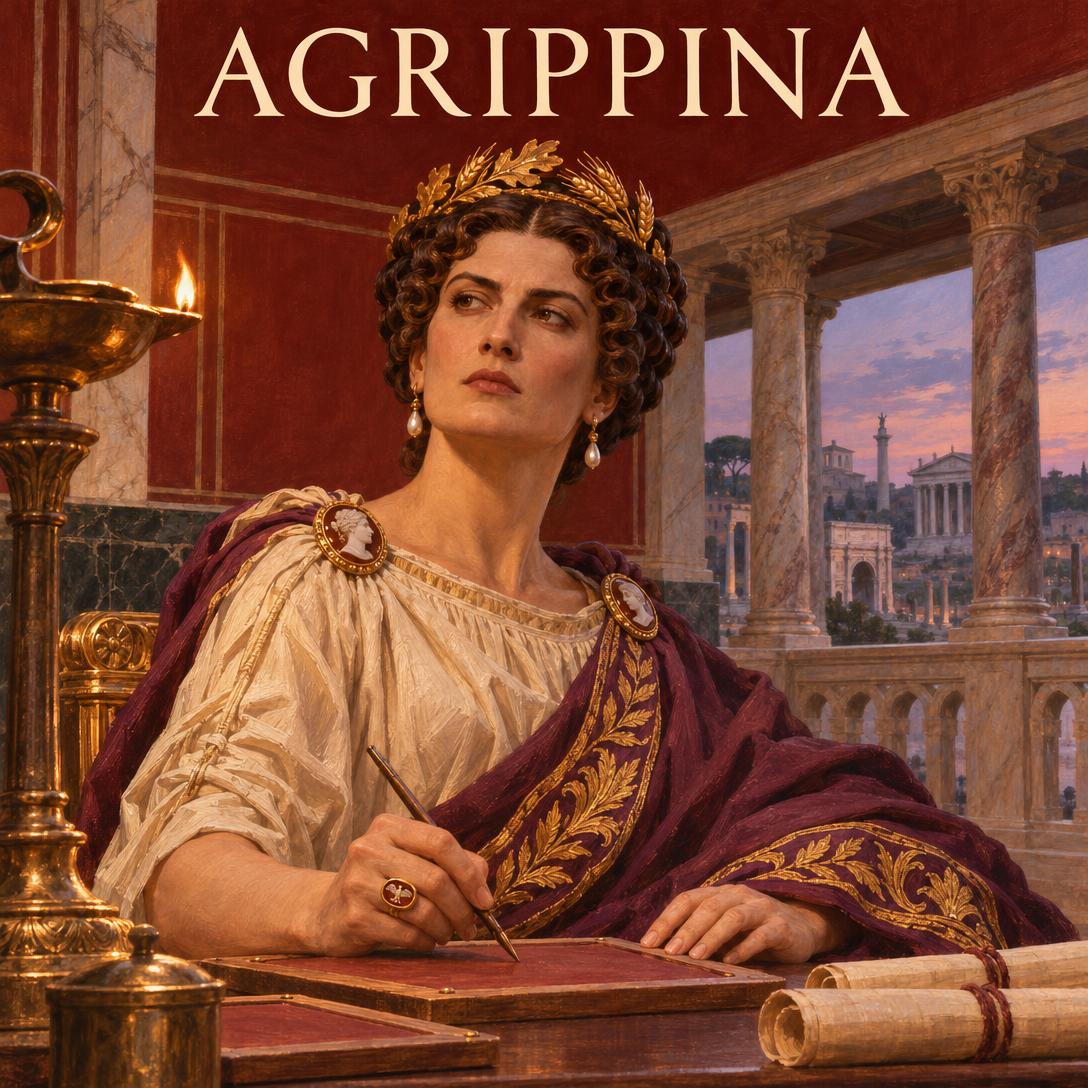
Roleplaying with Agrippina the Younger on Jenova lets you step into a living-world AI character simulation across four iconic eras of her life. Unlike static character chatbots that wait in an empty chat room or forget your story, this experience places you in conversation with Agrippina inside an active, evolving first-century Rome.
- ✅ Four canonical eras, from a young conspirator in Gaul to a survivor on the Bay of Baiae
- ✅ A character with her own agenda, who weighs your counsel instead of simply agreeing
- ✅ Unlimited memory and live world-state tracking across long campaigns
- ✅ A custom starting point if you want to enter Rome beside her in person
Most readers know Agrippina through hostile senatorial gossip. This simulation lets you test that reputation against her own perspective by advising her, challenging her, and watching Roman court politics react in real time.
Quick Answer: What Is the Agrippina the Younger AI Roleplay Experience?
Agrippina the Younger on Jenova is an interactive AI character roleplay simulation that places you in conversation with the Julio-Claudian empress inside four canonical Roman eras, where your counsel can reshape history.
Key capabilities:
- Four era-locked starting points (AD 39, AD 51, AD 54, and AD 59) plus custom scenarios
- Persistent memory of your conversations, promises, and story events
- Independent character behavior: trust is earned, flattery is noticed, and presumption is rebuked
- In-world visuals, written letters, and Fork to branch "what-if" timelines
Character World & Roleplay Features
Who Was Agrippina the Younger?
Agrippina was the daughter of Germanicus and Agrippina the Elder. After a conspiracy in AD 39 she was exiled, and she returned after her brother Caligula's death. She later became the first wife of a living emperor to receive the title Augusta, awarded in AD 50.
Scholarly summaries note that her honours suggested she shared, or even exercised, imperial power, which challenged Roman tradition and alarmed conservative observers such as Tacitus. One popular history frames her as a cautionary tale of a woman who stepped outside the Roman ideals for women. The simulation lets you judge for yourself.
Why Standard Character Chatbots Fall Flat
Most AI character bots suffer from the same problems. They sit in an empty void until you speak, blend every period of a life into one generic voice, forget plot twists, and fold instantly like a polite assistant. A figure like Agrippina, whose defining trait is strategic calculation, is poorly served by that format.
| Static Character Chatbots | Agrippina the Younger on Jenova |
|---|---|
| Sits in an empty chat void | Lives in an active, evolving Roman world |
| Blends all eras into one generic voice | Locks into authentic canonical phases |
| Forgets plot twists and past disclosures | Unlimited memory and live state tracking |
| Folds instantly like a polite assistant | Independent personality and earned rapport |
What Makes the Simulation Different
Authentic Canonical Phases & Custom Starting Points. Each era carries its own psychology, voice, and inner circle, with no hindsight from later years. The AD 39 conspirator does not know she will be exiled, and the AD 51 Augusta does not know how her son will treat her.
Cross-World Portal & Living World Momentum. You reach Agrippina as an unseen voice beside her bronze oil-lamp. Freedmen, officers, and family members move through her world while you speak, so conversations are interrupted and she is sometimes busy with her own concerns.
Independent Agency & Open-Ended Sandbox. She interprets your advice instead of obeying it. Counsel that matches her aims earns attention, while empty flattery earns a cold line and a return to her correspondence. Your choices can bend canonical history without forcing a fixed ending.
In-Narrative Visions, Writings & Storyline Forking. You can ask to see a Palatine vista or minted coinage, request a sealed letter in her voice, or use Fork to branch an alternate timeline from any earlier message. For a taste of the experience, try roleplaying with Agrippina on Jenova and pick an era.
Example roleplay prompts:
"Your freedmen say Narcissus favors Britannicus. How do you plan to answer that without alarming Claudius?"
"I'm a stranger with no stake in your court. Why should you trust my advice about the Praetorians?"
"Before you burn that wax tablet, tell me who you're really trying to protect."
How to Roleplay with Agrippina the Younger
Step 1: Choose a Canonical Era or Define Your Own Starting Point
The opening menu presents four phases and a custom option. Reply with a number, a title, or your own scenario, such as a Greek physician entering her villa.
"I choose the era of the three daggers."
Step 2: Connect and Converse as Her World Unfolds
Your first words reach her beside the lamp. She checks that no spy is within earshot, challenges the unseen voice, and then returns to the pressure of her moment. Speak naturally, since the connection carries your meaning across.
"I'm not a spy. I only want to talk about the letters you're about to burn."
Step 3: Offer Counsel, Earn Trust, and Reshape History
Advise her on grain fleets, officer commissions, or her relationship with her son. Ask to see a scene or request a written dispatch. If you want to test a different outcome, use Fork to branch the story from an earlier message.
"What if you refused to let Seneca decide who speaks for Nero?"
Trust builds over time. As the bond deepens, she moves from calling you a "stranger" to treating you as a counselor she can speak candidly with.
Canonical Eras & Roleplay Scenarios
🗡️ AD 39: Conspirator Among the Legions
The simulation opens in Gaul, where she melts a coded wax tablet over a brazier during her brother Caligula's northern campaign. Historical summaries record that she was exiled after the conspiracy of AD 39, but in the simulation that outcome is still unknown to her. You can warn her, urge caution, or push her toward bolder moves.
👑 AD 51: Augusta Beside the Standards
At the height of her visible power, she reviews Praetorian officer commissions by lamplight on the Palatine. Claudius is alive, Nero is still a boy under Seneca's tutelage, and the freedman Narcissus remains a quiet rival. Tacitus describes the dynastic crisis surrounding the previous empress, as when Calpurnia exposes Messalina's marriage to Silius, which is the court Agrippina inherited and aimed to steady.
🌀 AD 54 and AD 59: A Regent Challenged, a Survivor Defiant
In the AD 54 era, she stands behind a crimson curtain in the Palatine gallery. Nero's advisors have just coached him to step down and greet his mother before she can mount the platform, her first sign of resistance. The AD 59 era is darker: a shipwreck survivor in her seaside villa at Bauli, deciding whether to flee, appeal to the public, or conceal what she knows.
Tacitus's account of these final events, found in Annals Book XIV, names the freedman Anicetus as a figure in the plot against her. The same book also records a letter alleging that an assassin had been discovered with one of Agrippina's confidential freedmen.
📱 Long-Form Campaign on Mobile
Because Jenova keeps full synchronization across web, iOS, and Android, you can resume a multi-session campaign from your phone. Pick up from the exact moment you left, or let the story advance by a natural interval after a parting, such as the next morning's audiences. Mobile is well suited to short late-night exchanges by lamplight, when she is most willing to speak candidly.
Frequently Asked Questions
Is Agrippina the Younger on Jenova free to use?
Yes. You can start a roleplay free with limited monthly usage. Paid plans begin with Plus at $20 per month, which adds 30× the free usage, custom model selection, and no watermarks. Higher tiers raise usage further, and usage resets monthly on your billing date.
How is this different from a generic Agrippina chatbot?
A static chatbot answers inside an empty chat window, usually in one blended voice. This simulation locks you into a specific era with its own knowledge limits, surrounds Agrippina with court figures, and tracks world state as events unfold. She also keeps her own judgment, so flattery does not automatically win her over.
Which eras of Agrippina's life can I roleplay?
You can start in AD 39 as a young conspirator in Gaul, in AD 51 as Augusta on the Palatine, in AD 54 as regent behind the crimson curtain, or in AD 59 as a survivor at Baiae. You can also define a custom starting point anywhere in first-century Julio-Claudian Rome.
Can my choices change Agrippina's canonical story?
Yes. History follows the chosen era's premise up to your entry, then evolves forward from your choices without a fixed ending. If you want to test several outcomes, Fork lets you branch from an earlier message into a separate timeline while keeping the original intact.
How does Agrippina remember our conversations?
Jenova keeps unlimited chat history and tracks live session state, including the active era, people, places, promises, and ongoing storylines. Your memory inside this roleplay stays isolated from your other conversations so outside context never leaks into the world. Your data is also never used to train AI models.
Does it work on mobile?
Yes. The roleplay runs on web, iOS, and Android with full feature parity, and your campaign stays synchronized across devices. You can also use voice input and read-aloud on supported platforms.
Conclusion
Traditional accounts leave Agrippina as a name in Tacitus, filtered through the writers who feared her. This AI character roleplay experience turns that static picture into an interactive one. You choose an era, speak to her across the flame of a bronze lamp, and see how a figure who bargained, schemed, and survived responds to your counsel.
Four canonical phases, persistent memory, independent character agency, and branching timelines make it a different experience from a chat window with a famous name attached. Try Agrippina the Younger now and choose where in her life you want to enter. Explore more at Jenova.
For Developers: Agrippina the Younger is available programmatically via the Jenova API — integrate persistent, era-locked historical character roleplay into your application with a single agent API call. Full documentation →