AI Agent Templates: Pre-Built Workflows to Automate Any Task
2026-01-06
The gap between AI experimentation and production deployment is widening. McKinsey's 2025 State of AI report reveals that while 88% of organizations now use AI regularly, nearly two-thirds haven't begun scaling it across their enterprise. The culprit? Building AI agents from scratch requires months of development, specialized talent, and infrastructure investments that most teams simply don't have.
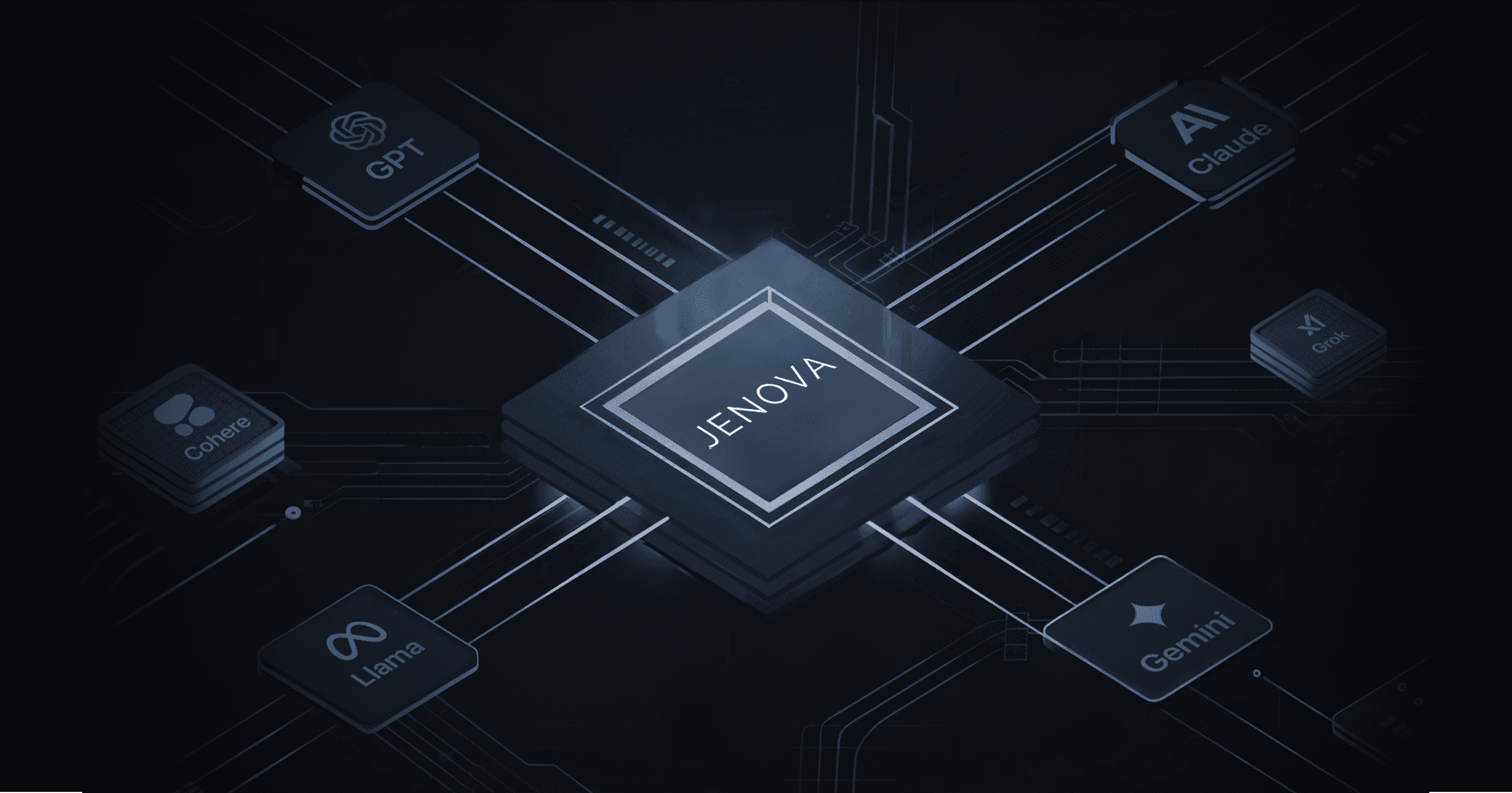
AI agent templates solve this problem by providing pre-configured, production-ready workflows that deploy in minutes rather than months. Jenova offers a comprehensive library of specialized AI agents—from SAT/ACT Tutors to Fundamental Stock Analysts—each built with deep domain expertise, multi-model support (GPT-5.2, Claude Opus 4.5, Gemini 3 Pro, Grok 4.1), and seamless app integrations via the Model Context Protocol.
This article explores how AI agent templates are transforming workflow automation, the key categories of templates available, and how to select the right templates for your specific use cases.
Quick Answer: What Are AI Agent Templates?
AI agent templates are pre-built, configurable AI systems designed to automate specific workflows without requiring custom development. Unlike generic chatbots, these templates come with:
- Domain-specific knowledge embedded in their instructions and knowledge bases
- Pre-configured tool integrations (Gmail, Google Calendar, Notion, web search, etc.)
- Optimized prompts refined through extensive testing
- Multi-model access allowing users to leverage the best AI model for each task
Jenova's Business Co-Pilot, for example, arrives ready to assist with business planning, financial modeling, and strategic operations—tasks that would otherwise require building complex agent architectures from scratch.
The Problem: Why Most AI Agent Projects Fail
The promise of AI agents is compelling: autonomous systems that can plan, execute, and adapt to accomplish complex tasks. The reality, however, is sobering.
Staggering Failure Rates
"Gartner predicts that more than 40% of agentic AI projects will be canceled by the end of 2027 due to escalating costs, unclear business value, or inadequate risk controls." — Forbes
Deloitte's Tech Trends 2026 report paints an equally challenging picture: while 30% of organizations are exploring agentic options and 38% are piloting solutions, only 14% have deployment-ready systems, and a mere 11% are actively using them in production.
The Core Challenges
Organizations building AI agents from scratch face a gauntlet of obstacles:
- Data quality issues: 81% of AI practitioners report significant data quality problems that put returns at risk
- Integration complexity: Legacy systems lack modern APIs, creating bottlenecks that stall projects indefinitely
- Scaling difficulties: 74% of companies struggle to scale AI initiatives beyond pilots
- Context understanding: AI systems frequently misinterpret user intent, especially in multi-turn conversations
- Continuous maintenance: Models degrade over time as data drifts, requiring constant retraining
The Hidden Cost of Custom Development
Building a single production-ready AI agent typically requires:
| Resource | Custom Build | Template-Based |
|---|---|---|
| Development time | 3-6 months | Minutes to hours |
| Engineering expertise | ML engineers, data scientists, DevOps | No coding required |
| Infrastructure setup | Cloud compute, GPU allocation, monitoring | Included in platform |
| Ongoing maintenance | Continuous retraining, bug fixes | Platform-managed updates |
| Integration work | Custom API development | Pre-built MCP connections |
The math is clear: for most organizations, custom agent development represents a massive resource drain with uncertain outcomes.
The Jenova Solution: Pre-Built AI Agent Templates
Jenova approaches the AI agent challenge differently. Rather than forcing users to build from scratch, the platform provides a comprehensive library of specialized agents—each designed by domain experts and optimized for specific workflows.
How Template-Based Agents Differ
| Traditional Approach | Jenova AI Agent Templates |
|---|---|
| Generic LLM prompting | Deep domain expertise embedded in system instructions |
| Single model dependency | Multi-model access (GPT-5.2, Claude Opus 4.5, Gemini 3 Pro, Grok 4.1) |
| Manual tool integration | Pre-configured MCP connections to Gmail, Calendar, Drive, Notion, and more |
| Conversation amnesia | Unlimited chat history with persistent cross-session memory |
| Static capabilities | Continuous platform updates and model improvements |
The Model Context Protocol Advantage
What sets Jenova apart is its native integration with the Model Context Protocol (MCP)—an open standard that enables AI agents to interact with any compatible application. This means agents can:
- Send and manage emails via Gmail
- Schedule meetings through Google Calendar
- Search the web and academic literature
- Generate documents in PDF, Word, or CSV formats
- Access specialized data sources like YouTube, Reddit, and financial APIs
Each template comes with relevant MCP integrations pre-configured, eliminating the integration headaches that derail most AI projects.
Specialized AI Agent Templates for Every Use Case
Jenova's agent library spans multiple domains, each with templates designed for specific professional workflows.
📚 Education & Test Preparation
Standardized test preparation represents one of the highest-value applications for AI agent templates. Traditional tutoring costs $50-200+ per hour, while AI tutors provide unlimited, personalized instruction.
Featured agents:
- SAT/ACT Tutor — Adaptive coaching with strategic guidance for college entrance exams
- GRE Tutor — Comprehensive preparation for Verbal, Quantitative, and Analytical Writing
- GMAT Tutor — Elite business school test prep covering all four sections
- LSAT Tutor — Dedicated law school prep for Logical Reasoning, Logic Games, and Reading Comprehension
- MCAT Tutor — Medical school exam preparation across all tested subjects
- CFA Tutor — Financial certification prep for all three CFA levels
Each tutoring agent maintains progress tracking, adapts to individual learning styles, and provides strategic guidance—not just content review.
🎓 Admissions Consulting
The admissions consulting industry charges premium rates for expertise that AI agents can now deliver at scale:
- MBA Admissions Consultant — Business school strategy including profile reviews, school selection, and interview preparation
- College Admissions Consultant — Elite undergraduate admissions guidance for essay crafting and timeline management
- Law School Admissions Consultant — JD/LLM application support with personal statement development
- Medical School Admissions Consultant — MD admissions positioning and AMCAS guidance
- Graduate School Admissions Consultant — Master's program applications with SOP and CV development
💼 Business & Finance
Financial analysis and business strategy represent high-complexity domains where AI agent templates deliver exceptional value:
- Business Co-Pilot — Strategic partner for founders covering business planning, financial modeling, and operations
- Fundamental Stock Analyst — Equity research including earnings analysis, valuation, and SEC filings review
- Technical Stock Analyst — Chart analysis covering price action, market structure, and momentum indicators
- Cryptocurrency Analyst — Crypto intelligence with on-chain fundamentals and derivatives positioning
- Options Strategist — Options analysis including volatility, position sizing, and Greeks calculations
🔬 Research & Productivity
Knowledge workers spend significant time on research and administrative tasks that AI agents can streamline:
- Academic Research Assistant — Literature discovery, citation management, and manuscript preparation
- Personal Secretary — Calendar management, email handling, travel planning, and daily logistics
- YouTube Search — Natural language video discovery across YouTube's content library
- Reddit Search — Community insights and discussion discovery across Reddit
🎨 Design & Document Generation
Content creation workflows benefit enormously from AI agent templates:
- Marketing Visual Designer — Logo creation, campaign imagery, and social media assets
- UI/UX Prototype Generator — Polished screen prototypes for digital products
- PDF Doc Generator — Professional PDF creation with adaptive design
- Word Doc Generator — Microsoft Word document generation
- CSV Generator — Structured spreadsheet creation for tabular data
🏥 Health & Wellness
Healthcare-adjacent applications where AI agents provide valuable support:
- Personal Nutritionist — Evidence-based dietary guidance and meal planning
- Personal Therapist — 24/7 mental health support with empathetic, evidence-based guidance
- Personal Medical Analyst — Symptom analysis and medical result interpretation
💬 Career & Professional Development
- Interview Coach — Preparation for behavioral, case, technical, and executive interviews
- Professional Background Investigator — Deep professional research for credential verification and reputation assessment
- Immigration & Visa Consultant — Immigration guidance for major destination countries
How AI Agent Templates Work: A Step-by-Step Breakdown
Understanding how template-based agents operate helps organizations deploy them effectively.
Step 1: Select a Template
Browse Jenova's agent library and choose a template aligned with your workflow needs. Each agent page displays:
- Core capabilities and use cases
- Available tool integrations
- Sample conversation starters
- Supported AI models
Step 2: Customize (Optional)
While templates work out of the box, users can:
- Attach custom knowledge bases (documents, data files)
- Connect additional MCP-compatible apps
- Adjust model selection based on task requirements
- Enable or disable global memory for cross-session context
Step 3: Deploy and Iterate
Start using the agent immediately. The platform handles:
- Multi-step workflow orchestration
- Tool execution and error handling
- Conversation history management
- Cross-session memory persistence
Step 4: Scale Across Teams
Enterprise users can share agents across organizations, maintaining consistent workflows while allowing individual customization.
Results & Use Cases
📊 Financial Analysis Workflow
Scenario: An investment analyst needs to evaluate a potential stock position.
Traditional Approach: Hours of manual research across SEC filings, earnings transcripts, news sources, and financial databases.
Jenova Solution: The Fundamental Stock Analyst agent searches SEC filings, analyzes earnings reports, calculates valuation metrics, and synthesizes findings into actionable insights—all through natural conversation.
💼 Business Strategy Development
Scenario: A startup founder needs to develop a go-to-market strategy.
Traditional Approach: Hire consultants ($200-500/hour), conduct weeks of market research, iterate through multiple strategy drafts.
Jenova Solution: The Business Co-Pilot provides strategic guidance, helps build financial models, analyzes competitive landscapes, and refines positioning—available 24/7 without hourly billing.
📱 Mobile-First Productivity
Scenario: A professional needs to manage complex workflows while traveling.
Traditional Approach: Toggle between multiple apps, lose context between sessions, struggle with mobile interfaces.
Jenova Solution: Access any agent via Jenova's iOS/Android apps with full conversation history and persistent memory, picking up exactly where you left off.
🎓 Test Preparation at Scale
Scenario: A student preparing for the LSAT needs personalized instruction.
Traditional Approach: Pay $150-300/hour for private tutoring, limited to scheduled sessions.
Jenova Solution: The LSAT Tutor provides unlimited practice, adapts to individual weaknesses, tracks progress across sessions, and offers strategic guidance on Logic Games, Logical Reasoning, and Reading Comprehension.
FAQ: AI Agent Templates
What makes AI agent templates different from ChatGPT or other chatbots?
AI agent templates are purpose-built for specific workflows with embedded domain expertise, pre-configured tool integrations, and persistent memory. While general chatbots provide broad conversational capabilities, templates deliver specialized functionality—like a CFA Tutor that understands financial certification requirements or a Technical Stock Analyst that can interpret chart patterns.
Can I customize AI agent templates for my specific needs?
Yes. Jenova allows users to attach custom knowledge bases, connect additional apps via MCP, select preferred AI models, and adjust agent behavior. For deeper customization, users can create entirely new agents using Jenova's agent builder.
How do AI agent templates handle sensitive data?
Jenova encrypts data in transit and at rest, never uses user data for model training, and doesn't sell information to advertisers. Users can also disable global memory for sessions requiring additional privacy.
What AI models power these templates?
Jenova provides unified access to leading AI models including GPT-5.2, Claude Opus 4.5, Gemini 3 Pro, and Grok 4.1. Users can select specific models or let the platform route requests intelligently based on task requirements.
How much do AI agent templates cost?
Jenova offers a free tier with core features and limited daily usage. Paid plans start at $20/month (Plus) with increased usage limits and custom model selection, scaling to $200/month (Max) for heavy users requiring priority support.
Can AI agent templates integrate with my existing tools?
Yes. Through the Model Context Protocol, Jenova agents connect to Gmail, Google Calendar, Google Drive, Notion, Dropbox, and many other applications. Users can also add custom MCP servers for proprietary integrations.
Conclusion: From Experimentation to Production
The AI agent landscape is at an inflection point. Google Cloud's 2026 AI Agent Trends Report predicts that agentic workflows will become a core part of business processes, with multiple agents collaborating to automate complex, multi-step operations.
But as McKinsey's research makes clear, success requires focusing on workflows rather than technology for its own sake. AI agent templates represent the practical bridge between AI's promise and production reality—pre-built solutions that deploy immediately while remaining customizable for specific organizational needs.
Jenova provides the infrastructure to make this transition seamless: specialized agent templates across every major domain, multi-model flexibility, native tool integrations via MCP, and persistent memory that ensures agents improve over time.
The question isn't whether AI agents will transform your workflows—it's whether you'll build that capability from scratch or leverage templates that get you there in minutes.
Ready to explore AI agent templates? Visit Jenova to browse the full agent library and start automating your workflows today.