AI Agent Backend: One API vs. Building From Scratch (July 2026)
2026-07-24
Every engineering team shipping AI features in 2026 hits the same fork in the road: build the agent backend from scratch, or integrate one. Building means stitching together model APIs, orchestration frameworks, vector databases, memory stores, and tool servers — a stack that consumes quarters of engineering time before your first user interaction. The Jenova Agent API is the alternative: a fully-managed agent backend where orchestration, memory, storage, RAG, and tools run behind a single integration.
- ✅ Replace the entire DIY agent stack — model routing, orchestration, memory, RAG, and tools — with one API
- ✅ Build and launch custom, production-grade agents defined by your instructions, models, knowledge bases, and tools
- ✅ Access models from OpenAI, Anthropic, Google, xAI, Qwen, and more through a single credential
- ✅ Run on infrastructure production-tested with 30,000+ users across 70+ countries
To make the build-vs-integrate decision honestly, you need the real numbers — what a from-scratch agent backend actually costs to build, run, and maintain in 2026.
Quick Answer: What Is an AI Agent Backend?
An AI agent backend is the infrastructure layer that makes an agent work in production: orchestration across models and tools, persistent memory and context, retrieval over private data, and the compute, scaling, and reliability systems underneath. Building it from scratch means owning five or more distinct systems; a managed agent API delivers all of them through one integration.
Key capabilities of a managed agent backend:
- Agent orchestration coordinating models, tools, memory, and retrieval across multi-step workflows
- Multi-model routing across providers — no vendor lock-in, no per-provider key management
- Unlimited conversation memory and context built into every session
- Fully-managed relational and vector storage with built-in RAG
- Tool integration via platform-native tools and any remote MCP server
The Problem: What Building From Scratch Actually Costs
The market pressure to ship agents is intense. Enterprise software is on track to include agentic AI in 33% of applications — up from under 1% in 2024 (Datagrid) — and 67% of C-suite executives expect AI agents operating independently inside their organizations by 2027 (VAST Data).
But building the backend to support one is brutally expensive and slow:
- Orchestration logic that becomes a second engineering discipline
- Stateless model APIs with no memory between calls
- RAG pipelines with documented, recurring failure modes
- Tool integration plumbing for every external capability
- Production infrastructure that must scale, stay reliable, and pass security review
- A total first-year cost that dwarfs every prototype estimate
The Real Budget: Model Calls Are 2% of the Story
The "$100/month agent" demo hides the actual cost structure. A detailed engineering breakdown puts the realistic first-year cost of one small-to-medium production agent at **$270,000–$690,000** — with model API calls representing roughly 2% of the total (Particle41).
The rest goes where nobody's demo video looks:
$30,000–$80,000 — initial prompt engineering and refinement alone, at 200–400 engineering hours priced at $150–200/hour (Particle41)
$1,000–$5,000/month — vector database hosting, plus another $1,000–$2,000/month for embedding generation (Particle41)
$30,000–$60,000 — data integration engineering to connect the agent to just 4–5 existing systems (Particle41)
$6,000–$10,000/month per FTE — human oversight for failure review, because even a 95%-accurate agent handling 10,000 monthly interactions produces 500 cases needing manual review (Particle41)
And it doesn't end at launch: year two still runs $150,000–$300,000 annually for operation and refinement (Particle41). Even narrower development-only estimates span $20,000–$60,000 for simple task agents (Biz4Group) and $10,000–$400,000+ for multi-agent systems (Azilen).
Orchestration Becomes a Product of Its Own
A production agent doesn't answer once — it plans, calls tools, retrieves context, evaluates intermediate results, and recovers from errors across multi-step runs. Building that coordination loop means state machines, retry logic, timeout handling, and cost guardrails that have nothing to do with your actual product.
Practitioners describe the gap bluntly: building an agent takes days — getting it to production takes six months, with unguarded loops spiking API bills and lost state killing long-running tasks (
). Frameworks like LangGraph and CrewAI provide abstractions for this layer (Speakeasy), but abstractions don't run themselves: you still host, scale, secure, and maintain everything underneath.RAG Pipelines Are a Permanent Obligation, Not a Project
Grounding an agent in your private data means owning ingestion, chunking, embedding, indexing, reranking, and synthesis — and practitioners consistently warn that a RAG pipeline "is not only harder than it looks but also requires continued expertise in LLMs, retrieval, specialized MLOps" (Vectara).
One documented case study: a "simple" in-house RAG project that started in January had, by March, consumed one full-time engineer debugging hallucinations, one full-time data engineer fighting ingestion problems, and one DevOps engineer battling infrastructure — with the budget tripled (Towards AI). The same account documents the typical eight-week lifecycle: latency issues, edge cases, a complete rewrite, new hallucination problems, a vector DB migration, and another rewrite.
Legacy Infrastructure Wasn't Built for Agents
Agent workloads demand continuous, real-time data access — and legacy data infrastructure built for transactional workloads "cannot support the continuous reasoning and action-taking required by autonomous AI agents" (VAST Data). Enterprise-grade agent infrastructure requires a unified data foundation, high-performance storage, real-time vectorization, intelligent orchestration, and zero-trust governance — five distinct capability layers before you write product logic.
40% — agentic AI projects that fail due to inadequate infrastructure foundations (Landbase)
This is exactly the problem the Jenova Agent API was built to eliminate.
The Solution: The Jenova Agent API
The Jenova Agent API is a fully-managed agent infrastructure service: one integration that replaces the DIY stack of model APIs, orchestration frameworks, vector databases, memory stores, and tool servers. You define your agent's instructions, select a model, upload a knowledge base, and configure tools — the API handles orchestration, memory, storage, and scaling, so you ship production-grade custom agents in days instead of quarters.
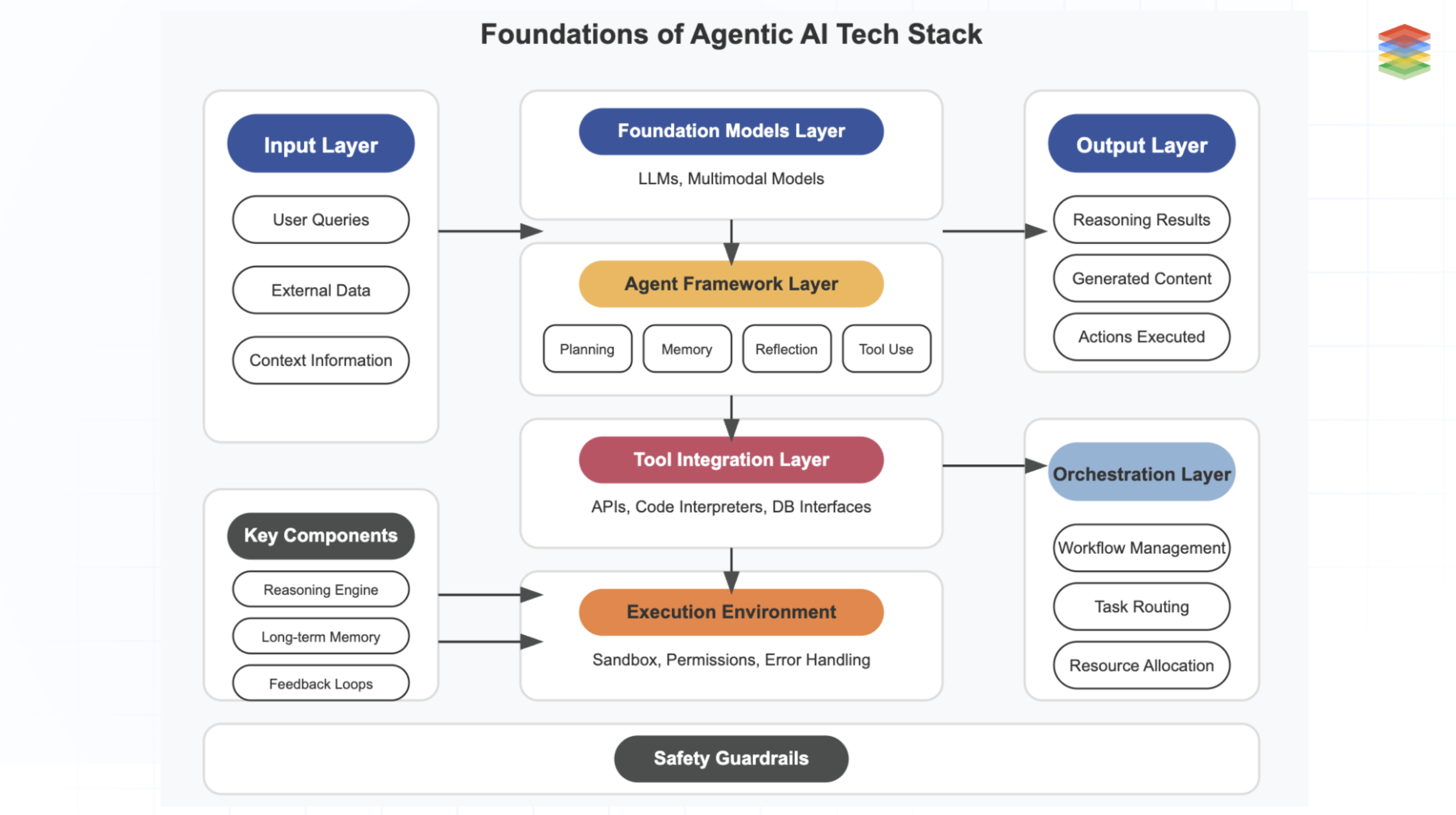
Every layer in the diagram above — the agent framework's planning, memory, reflection, and tool use; the tool integration layer's APIs and database interfaces; the execution environment's sandboxing and error handling; the orchestration layer's workflow management and task routing — is infrastructure the DIY path makes you build. The Jenova Agent API runs all of it.
| DIY Agent Backend | Jenova Agent API |
|---|---|
| Custom orchestration graphs, retry logic, state schemas | Battle-tested orchestration coordinating models, tools, memory, and retrieval |
| Separate SDKs, keys, and rate limits per model provider | Any major model through a single integration — no vendor lock-in |
| Session state in Redis/Postgres plus custom serialization | Unlimited memory and context built into every session |
| Provisioned vector database, chunking and embedding pipelines ($1,000–$5,000/month) | Fully-managed relational and vector storage with built-in RAG |
| Hand-written tool wrappers, auth flows, error boilerplate | Platform-native tools plus any remote MCP server, ready out of the box |
| Servers, containers, scaling policies, uptime monitoring | Production-grade managed infrastructure with stable APIs |
Agent Orchestration
Multi-step reasoning, tool invocation, retrieval, and response synthesis run inside the platform — no graph definitions, state schemas, or workflow DAGs to build and maintain. You define what the agent should accomplish; the infrastructure determines how, with the bounded, controllable execution that production reliability demands.
Use Any Model
Power agents with models from OpenAI, Anthropic, Google, xAI, Qwen, and more through one credential. Run a frontier model for complex reasoning and a cost-efficient model for high-volume sessions — switch freely per agent, with no per-provider key management and no migration work when new model generations ship. Your memory and knowledge layers survive every switch.
Memory & Context
Unlimited conversation memory and context are built into every session. Pass a consistent session identifier and your agent remembers each user's history, preferences, and long-running projects — no external state stores, no serialization code, no context-window engineering. The single most failure-prone layer of the DIY stack simply doesn't exist for you.
Fully-Managed Storage
Managed relational and vector databases with built-in RAG. Upload documents and knowledge bases; the platform handles chunking, embedding, indexing, and retrieval. There is no vector database to provision, tune, or scale — the $1,000–$5,000/month line item, and the engineer maintaining it, disappear.
Tools & MCP
Unlimited tool integrations with platform-native tools and any remote MCP server, ready out of the box — search, email, calendars, documents, and your own internal APIs. No wrapper code, no auth-flow plumbing, no boilerplate to maintain as third-party APIs change.
Production-Grade
Fully-managed infrastructure with stable APIs, built for production traffic — no servers, containers, or scaling policies on your side. The platform is production-tested with over 30,000 users across 70+ countries, so your agents inherit reliability your team never has to build.
A single call executes the complete agent:
bashcurl -X POST https://api.jenova.ai/v1/chat \
  -H "Authorization: Bearer YOUR_API_KEY" \
  -H "Content-Type: application/json" \
  -d '{
    "agent_id": "your-support-agent",
    "message": "Summarize this customer'\''s open issues and draft a reply.",
    "session_id": "user-4821-session"
  }'
Orchestration, memory, retrieval, and tool calls all execute within that request. Your application renders the response; the platform owns everything behind it.
What You Can Build
The API is designed for developers shipping custom, stateful agents as features inside their own products. Each of the following is an application you can build and launch — define the agent's instructions and knowledge base, and the API handles orchestration, memory, and scaling.
A Support Agent Trained on Your Product
Build a support agent grounded in your help center, changelog, and ticket history. Session memory tracks each customer's full support journey across interactions — no more "can you repeat your account number?"
- Document indexing and retrieval managed end to end
- Ticketing and CRM systems connected via MCP
- Ship in days instead of spending a quarter on state management
An Embedded Financial Analyst
Launch a portfolio advisor inside your fintech dashboard that remembers each client's holdings, risk tolerance, and goals across months of conversations.
- Longitudinal advisory context maintained automatically
- Market data and account systems connected via MCP
- Model switching per query complexity for cost optimization
A Personalized Tutor for Your Learning Platform
Deploy an adaptive tutor that tracks each student's progress, weak areas, and preferences across sessions, grounded in your curriculum.
- Per-student memory with no per-user database rows to manage
- Curriculum updates deploy on upload, no retrieval re-engineering
- Scales to thousands of concurrent learners on managed infrastructure
A Commerce Assistant That Knows Your Catalog
Embed a conversational shopping assistant that knows your catalog, remembers each shopper's preferences and purchase history, and guides discovery through dialogue instead of filters.
- Catalog grounded through managed RAG — updates deploy instantly
- Per-shopper preference memory without external state stores
- Production-grade concurrency for peak traffic
An Internal Ops Agent for Your Own Team
Build an operations agent connected to your internal documentation, ticketing, and data systems — answering employee questions and executing routine workflows with full organizational context.
- Private knowledge base indexed automatically
- Internal APIs connected through remote MCP servers
- New capabilities deploy as configuration, not code
Get your API key and ship your first agent in minutes.
How It Works: From API Key to Production Agent in Four Steps
Step 1: Get Your API Key
Create an account and generate your API key from the platform dashboard. One credential covers every model provider and every agent you build — no per-vendor key management across development, staging, and production.
Step 2: Build or Choose Your Agent
Define a custom agent with your own instructions, preferred model, knowledge base, and tool configuration — or start from a pre-built agent and adapt it. Creating the agent is configuration, not code: you describe the behavior, and the platform supplies the orchestration, memory, and retrieval behind it.
Step 3: Add Credits
Top up your account credits. Usage draws from your balance per call — no separate infrastructure bills, vector database invoices, or memory-store costs hiding in the background.
Step 4: Make the Call
From your backend, forward the user's message with your agent ID and a session identifier. Reuse the session ID and the agent picks up exactly where it left off with that user:
bashcurl -X POST https://api.jenova.ai/v1/chat \
  -H "Authorization: Bearer YOUR_API_KEY" \
  -H "Content-Type: application/json" \
  -d '{
    "agent_id": "your-commerce-assistant",
    "message": "Show me trail running shoes like the pair I bought last spring.",
    "session_id": "shopper-9317"
  }'
json{
  "response": "Based on your purchase last spring — the ridge-trail model in size 10 — here are three current options with similar cushioning and grip...",
  "session_id": "shopper-9317"
}
No memory store to configure, no retrieval pipeline to maintain, no orchestration graph to debug. Full endpoint specifications, request and response schemas, and integration details are in the API documentation.
Results & Use Cases
💼 SaaS Startup: One Sprint Instead of $270K–$690K
Scenario: A B2B SaaS company with 3,000 customers wants an in-app support agent that knows its documentation and remembers each account's history — with a three-person engineering team.
Traditional Approach: The DIY path prices out at $270,000–$690,000 for year one (Particle41): orchestration framework selection, vector database provisioning, per-tenant memory in Redis or Postgres, tool wrappers for the ticketing system, then hosting, scaling, and monitoring — before the first customer-facing answer.
Jenova Agent API: Define support instructions and escalation rules, upload the help center, connect ticketing via MCP. Persistent session memory gives every account continuous support history from day one.
- ✅ Days to production instead of months
- ✅ Six-figure infrastructure budget redirected to product engineering
- ✅ No memory system or vector database to provision or maintain
📊 Fintech: An Advisory Feature Without a Backend Team
Scenario: A fintech wants an AI portfolio analyst as a premium dashboard feature. Its two backend engineers have never built agent infrastructure.
Traditional Approach: Learn an orchestration framework, build stateful advisory workflows, implement memory persistence for ongoing client relationships, provision RAG for financial documents — the same four-to-six-month production gap practitioners describe between prototype and launch (
).Jenova Agent API: Configure a financial analyst agent with domain instructions, connect market data via MCP, and let built-in memory maintain portfolio context across every advisory conversation.
- ✅ No framework to learn, host, or maintain
- ✅ Longitudinal client memory out of the box
- ✅ Model switching for cost optimization with zero code changes
📱 Mobile EdTech: Tutoring at 30,000 Concurrent Students
Scenario: A mobile education app serving 30,000 students needs personalized tutors across four subjects, each with curriculum knowledge and per-student progress tracking.
Traditional Approach: Per-subject agent configs, per-student memory persistence in external databases, vector storage for curriculum — and infrastructure holding tens of thousands of concurrent stateful sessions without dropping context. This is precisely the workload legacy infrastructure fails (VAST Data).
Jenova Agent API: Create one tutor agent per subject with curriculum-specific instructions and materials. Session memory persists each student's progress automatically; RAG indexes curriculum on upload.
- ✅ Persistent, personalized learning context with no external state stores
- ✅ Curriculum updates deploy without retrieval re-engineering
- ✅ Production-grade concurrency from day one
🎯 Product Agency: Four Clients, One Integration
Scenario: A development agency is building AI features for four clients — healthcare intake, legal document review, commerce discovery, and enterprise search. The DIY route means duplicating memory stores, RAG pipelines, and hosting per client.
Traditional Approach: Four separate agent stacks — four retrieval pipelines, four scaling setups, four maintenance obligations. Given that 40% of agentic projects fail on inadequate foundations (Landbase), replicating the riskiest layer four times is a portfolio-level gamble.
Jenova Agent API: One integration and one API key across all four clients. Custom agents per engagement — domain instructions, models, knowledge bases, and tools — all running on the same managed backend.
- ✅ Single integration scales across unlimited client projects
- ✅ Per-client model selection without per-client provider management
- ✅ Engineering time invested in product logic, not infrastructure replication
FAQ
How much does it cost to build an AI agent backend from scratch?
Engineering analyses put the realistic first-year cost of one production agent at $270,000–$690,000 when you include infrastructure, prompt engineering, testing, data integration, vector databases, and human oversight — with model API calls representing roughly 2% of the total (Particle41). Ongoing operation runs $150,000–$300,000 annually thereafter.
How does Jenova Agent API pricing and credits work?
Usage is credit-based: you add credits to your account, and each API call draws from your balance. There are no separate infrastructure, database, or memory-store costs — the managed stack is included in usage, which consolidates what would otherwise be five or six vendor bills into one. See current rates on the platform page.
What models can I use through the API?
Agents can be powered by models from OpenAI, Anthropic, Google, xAI, Qwen, and more through a single integration. You select the model per agent and can switch freely — there is no vendor lock-in, and no migration work when new model generations release. Memory and knowledge persist across model changes.
How difficult is integration compared to building with LangChain or raw model APIs?
Integration follows a four-step flow: get an API key, build or choose an agent, add credits, and make your first call. One POST request executes the complete agent — orchestration, memory, RAG, and tools included. Raw model APIs provide inference only, and frameworks like LangChain provide abstractions you still host, scale, and maintain; the Jenova Agent API is the managed backend itself. Full schemas are in the API documentation.
Can I build custom agents with my own data and tools?
Yes. You define custom instructions, upload a private knowledge base (indexed automatically through managed RAG), select your model, and configure tools — including any remote MCP server, which covers most internal APIs. The agent behaves as your product's proprietary feature, not a generic assistant.
Is a managed agent API production-ready for real traffic?
Yes. The infrastructure is fully managed with stable APIs built for production traffic — no servers or scaling policies on your side. The platform is production-tested with over 30,000 users across 70+ countries, and usage scales with your credit balance rather than with infrastructure you provision.
Conclusion
The build-from-scratch path for an AI agent backend is well documented in 2026: $270,000–$690,000 in year-one costs, months of orchestration and RAG engineering, a vector database and memory layer to maintain forever, and a production gap that kills 40% of projects before they ship. The model call was never the hard part — everything around it is.
The Jenova Agent API replaces that entire stack with one integration: custom agents defined by your instructions, models, knowledge bases, and tools, running on fully-managed, production-grade infrastructure with built-in orchestration, memory, storage, and MCP tooling. Define your agent, make the call, and ship in days what the DIY path schedules in quarters. Start building with the API documentation, get your API key at the Jenova Agent API platform, and explore the broader platform at Jenova.