AI Admissions Chances Calculator: Estimate Your Odds and Build a Smarter College List
2026-08-19
An AI admissions chances calculator estimates your probability of acceptance at a specific college by weighing your GPA, test scores, coursework rigor, extracurriculars, and intended major against that school's admitted-student profile. Most applicants apply blind — paying fee after fee without knowing whether a school is a reach, a target, or a safety. A chances calculator replaces that guesswork with a number you can actually plan around.
✅ Estimates acceptance odds across reach, target, and safety tiers ✅ Factors in profile depth — rigor, activities, major, and context — not just GPA and scores ✅ Converts probability estimates into an actionable application strategy ✅ Available free, without the $4,000–$6,000 price tag of private counseling
To understand why this matters in 2026, it helps to look at what applicants are actually up against. Acceptance rates at selective institutions have compressed to historic lows, application volumes keep climbing, and the professional guidance that once helped families navigate this is priced out of reach for most. That gap is exactly where chancing tools have become essential.
Quick Answer: What Is an AI Admissions Chances Calculator?
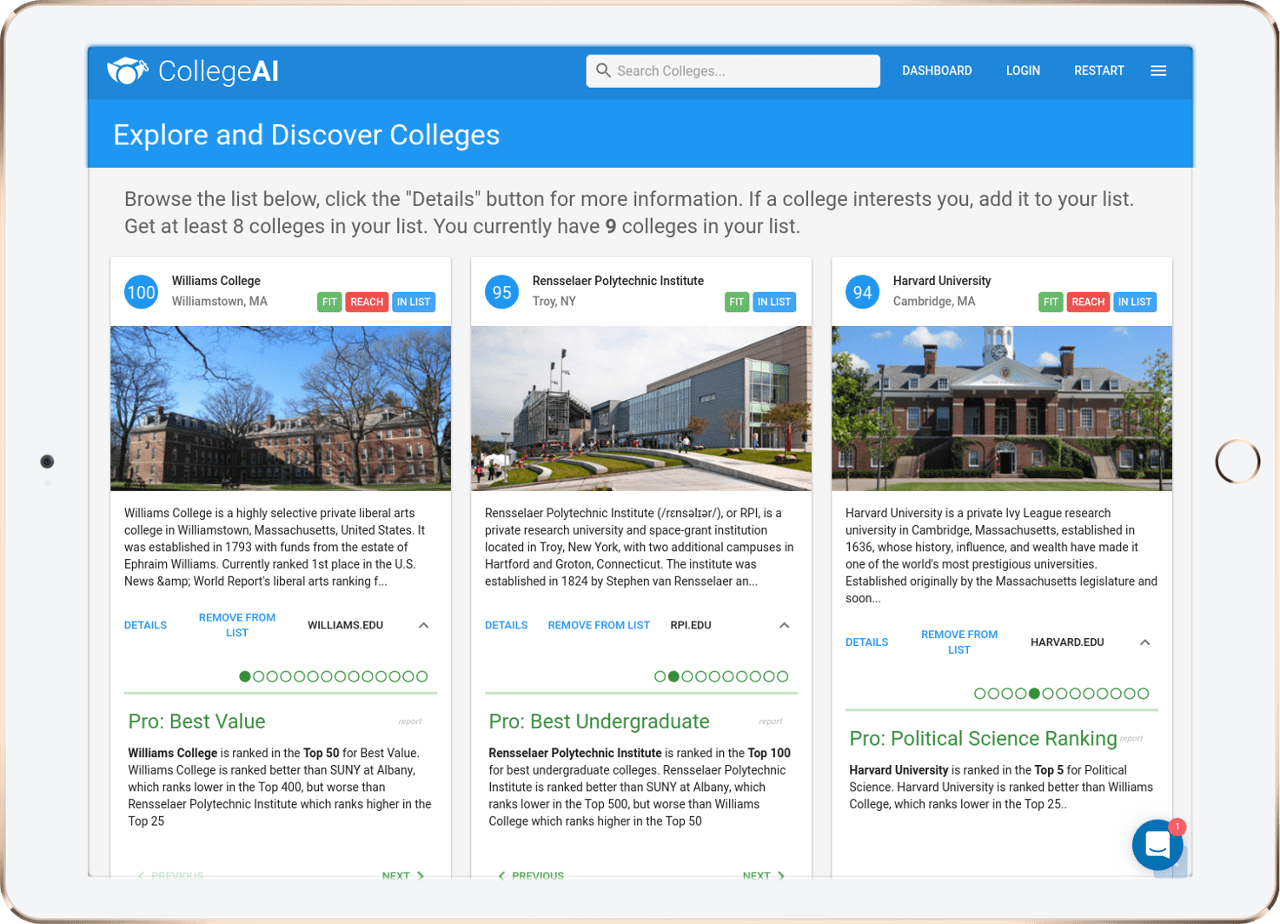
An AI admissions chances calculator is a tool that analyzes your academic profile — GPA, test scores, course rigor, activities, and background — against a college's admitted-student data to estimate your probability of acceptance and classify each school as a reach, target, or safety.
Key capabilities:
- Generates school-by-school acceptance probability estimates from your full profile
- Classifies your college list into reach, target, and safety tiers for balance
- Identifies which profile weaknesses are costing you the most probability
- Turns raw odds into a concrete strategy — where to apply, what to strengthen, and when
The Problem: Applying Blind Is Expensive and Getting Worse
Selective admissions has become a numbers game where applicants have almost none of the numbers. Students submit twelve, fifteen, sometimes twenty applications with no reliable sense of where they actually stand — and the odds have never been tighter.
As low as 3.78% — 2025 admission rates at the most selective U.S. colleges, with 2026 anticipated to be another highly competitive cycle
But getting a clear read on your chances is genuinely difficult:
- Professional guidance is priced far beyond most families
- Published acceptance rates say nothing about your specific odds
- Free calculators vary wildly in what they measure and how
- Nobody explains what to actually do with the number once you have it
Private Counseling Costs More Than a Year of Tuition
The people who can tell you where you stand charge accordingly. A national survey found college counseling fees ranging from $850 to $10,000, with average prices in the $4,000–$6,000 range — and full-service firms routinely charge well beyond that.
$300–$600 per hour — Typical hourly rate for full-service college consulting companies, with some charging as much as $1,000
Comprehensive packages at established consultancies run from roughly $6,895 for seven applications up to $12,895 for twenty applications. For most families, that is not a line item — it is a non-starter.
Published Acceptance Rates Are Nearly Useless Individually
A 6% institutional acceptance rate tells you almost nothing about your personal probability. It blends recruited athletes, legacies, development cases, and every applicant pool into one meaningless average. Your actual odds might be 1% or 20% depending on factors that aggregate rate completely obscures.
Most Calculators Stop at the Number
The core limitation of chancing tools is well documented. Analysis of these tools notes that none of these calculators is 100% accurate — they can only give you a general idea of how likely you are to be accepted, because algorithms compare your inputs against published school statistics and cannot weigh essays, recommendations, or personal context.
That same analysis identifies the qualitative factors calculators miss entirely: a strong personal statement, outstanding letters of recommendation, and institutional priorities that shift year to year. A probability estimate that ignores all of that is a starting point, not an answer.
Nobody Tells You What to Do Next
The deepest failure of standalone calculators is that they end where counseling should begin. You learn you have a 9% chance at your top choice. Then what? Which part of your profile is dragging the estimate down? Which comparable schools would give you the same experience at better odds? Which essay angle actually moves the needle? A number without a plan changes nothing.
This is exactly what the College Admissions Consultant was built for.
The Solution: Chancing Analysis That Comes With a Strategy
The College Admissions Consultant treats your chances estimate as the opening question, not the conclusion. It evaluates your full profile — GPA, rigor, test scores, activities, intended major, geography, and context — produces a realistic read on where you stand at each school, and then does the work a $500-an-hour consultant would do: explain the gap, target the right list, and build the case that closes it.
| Standard Chances Calculator | College Admissions Consultant |
|---|---|
| Outputs a percentage and stops | Explains what's driving the number and how to move it |
| Weighs GPA and test scores only | Evaluates rigor, activities, major fit, and narrative together |
| No essay or positioning input | Develops essay angles and application positioning directly |
| Static one-time estimate | Iterates across your entire application timeline |
| Generic school suggestions | Builds a balanced reach/target/safety list matched to your goals |
Profile Assessment Before Probability
Before estimating odds, the consultant builds a picture of your actual candidacy. Course rigor relative to what your school offers. Depth versus breadth in activities. Whether your intended major is oversubscribed at your target schools. Whether your narrative holds together. These are the variables that separate two applicants with identical GPAs and wildly different outcomes.
"My unweighted GPA is 3.85, I have 7 APs, a 1480 SAT, and I'm applying CS. Assess my chances at Georgia Tech, UIUC, and Purdue, and tell me what's weakest in my profile."
Realistic Tiering, Not Wishful Thinking
The consultant classifies your list honestly. If a school is a genuine reach at your profile, you get told that — along with what a realistic version of that list looks like and which comparable institutions offer materially better odds without compromising on fit.
"Build me a balanced list of 12 schools for engineering — 3 reaches, 6 targets, 3 safeties — based on my profile, and explain the reasoning for each tier."
Gap Analysis You Can Act On
The most valuable output is not the estimate. It is knowing which single change most improves it. Sometimes it is one more year of a language. Sometimes it is consolidating five shallow activities into one credible commitment. Sometimes it is switching your applied major. The consultant identifies the highest-leverage move given your remaining timeline.
Essay and Positioning Work
This is where chances calculators structurally cannot compete. Admissions professionals note that the strongest college essays emerge from understanding identity rather than brainstorming topics, and that AI's most powerful role is functioning as an interviewer — challenging vague answers, identifying recurring themes, and helping students surface stories that reveal who they are. That is precisely the kind of extended, questioning dialogue the consultant is built to run.
"Interview me about my robotics team experience until you find an angle that isn't the standard 'I learned teamwork' essay."
Related Agents You'll Also Find Useful
Chancing analysis is one piece of the application. These agents cover the parts that most directly move your odds.
SAT/ACT Tutor
Test scores remain one of the highest-leverage inputs in any chances calculation — and one of the few you can still meaningfully change late. The SAT/ACT Tutor delivers adaptive prep built around your current baseline and target score.
- Content mastery across every tested section
- Adaptive instruction calibrated to your weak areas
- Score-target planning with accountability across your timeline
AP Exam Tutor
Course rigor is a core variable in nearly every chancing model, and AP performance is how admissions officers verify it. The AP Exam Tutor supports all 40 AP subjects with diagnostics and rubric-based feedback.
- Adaptive diagnostics to find gaps before the exam
- Rubric-aligned feedback on free-response work
- Subject-specific study plans and exam strategy
Career Advisor
Intended major shifts your odds significantly — CS at a state flagship can be several times more selective than the same school's general admission. The Career Advisor helps you pressure-test whether your intended path actually matches your goals before you commit to it on an application.
- Career exploration grounded in real market data
- Major-to-outcome mapping across fields
- Direct guidance on transitions and long-term positioning
Public Speaking Coach
Interviews and alumni conversations are the qualitative factor calculators cannot model — and analysis of admissions outcomes notes that excelling at an interview can change results regardless of what an algorithm predicted. The Public Speaking Coach prepares you for exactly that.
- Delivery coaching and anxiety management
- Audience simulation for realistic practice
- Structured Q&A preparation
Try these free — no credit card required.
How It Works
Step 1: Share Your Full Academic Profile
Give the consultant everything a real counselor would ask for — GPA (weighted and unweighted), course rigor relative to your school's offerings, test scores, class rank if reported, activities with actual time commitment, and intended major.
"Here's my profile: 4.2 weighted / 3.9 unweighted GPA, 9 APs by graduation, 34 ACT, varsity track captain, two years of research at a state lab, applying biomedical engineering."
Step 2: Get Chances Estimates With Reasoning
Rather than a bare percentage, you get a tiered read on each school plus the reasoning behind it — which parts of your profile clear the bar, which fall short of the admitted-student range, and where major selectivity changes the math.
"Chance me at Johns Hopkins, Duke, Vanderbilt, Case Western, and Pitt for BME. Show me the reasoning, not just the tier."
Step 3: Rebalance Your List
Most applicants are reach-heavy without realizing it. The consultant restructures your list into a defensible distribution and surfaces well-matched schools you likely haven't considered.
"My list is 8 reaches and 2 safeties. Rebuild it and suggest 4 target schools with strong BME programs I probably haven't heard of."
Step 4: Close the Gaps
Work through the highest-leverage improvements available in your remaining timeline — score improvement, activity consolidation, application strategy, or essay positioning that reframes what you already have.
"Given I'm a rising senior, what are the three highest-impact things I can still do to improve my odds at my target schools?"
Results & Use Cases
📊 The Junior Recalibrating Early
Scenario: A high school junior with a 3.7 GPA and a list of eight highly selective schools wants to know if the plan is realistic.
Traditional Approach: $4,000–$6,000 for a comprehensive counseling package, or guessing based on published acceptance rates that reveal nothing personal.
College Admissions Consultant: An honest tiered assessment plus a rebuilt list — and, critically, a full year of runway to act on the gap analysis before applications open. Uses the College Admissions Consultant alongside the SAT/ACT Tutor for score improvement.
- Realistic tiering while there's still time to change the inputs
- Identification of the single highest-leverage improvement
- A balanced list built before emotional attachment sets in
💼 The First-Generation Applicant Without a Counselor
Scenario: A strong student at a public school with a 400:1 counselor ratio has no one to ask whether their list makes sense.
Traditional Approach: Fifteen-minute counselor meetings, conflicting forum advice, and applying to whatever schools sound familiar.
College Admissions Consultant: Unlimited access to the same profile assessment and list-building logic that private clients pay thousands for. Analysis of AI in admissions notes this is precisely the historical inequity these tools can address — this process has been available primarily to students who can afford private counseling.
- No hourly clock, no package limits
- Explanation of admissions vocabulary and unwritten conventions
- Application fee savings from cutting unrealistic reaches
📱 The Senior Triaging on Mobile in November
Scenario: Two weeks before the Regular Decision deadline, a senior needs to decide whether three borderline applications are worth the fees.
Traditional Approach: Applying to all three at roughly $75 each and hoping, or cutting one arbitrarily.
College Admissions Consultant: A rapid, profile-specific read on each school from a phone between classes — including whether the application fee is a reasonable bet given the odds. Analysis of chancing tools notes they can help you decide whether it's worth paying an application fee to a stretch school, potentially saving hundreds of dollars in fees.
- Full functionality on mobile with synced conversation history
- Immediate answers during deadline compression
- Concrete fee-versus-odds reasoning
🎯 The Graduate Applicant Extending the Same Logic
Scenario: A college senior applying to law school needs the same chancing analysis for JD programs, where LSAT-plus-GPA medians drive most outcomes.
Traditional Approach: Manually cross-referencing published medians across thirty schools in a spreadsheet.
College Admissions Consultant: Profile assessment and school targeting handled directly by the Law School Admissions Consultant, with LSAT prep support from the LSAT Tutor.
- Median-aware targeting across the full range of programs
- Personal statement development alongside the numbers
- Coordinated test prep and application strategy
FAQ
Is an AI admissions chances calculator free?
Yes. The College Admissions Consultant is available on Jenova's free tier with all core capabilities, including full profile assessment, chancing analysis, and list building. Paid plans increase usage limits and unlock model selection, but you can run a complete chancing conversation without paying anything.
How accurate are AI admissions chances calculators?
They produce informed estimates, not guarantees. Independent analysis is direct on this point: none of these calculators is 100% accurate, because algorithms cannot evaluate essays, recommendations, or shifting institutional priorities. Treat any estimate as a planning input — the reasoning behind it is more useful than the number itself.
How is this different from a standard chancing calculator?
Standard calculators output a percentage from a form. The College Admissions Consultant runs a conversation — it asks follow-up questions, explains what's driving your odds, rebuilds your list, and works on essays and positioning. The estimate is the first step, not the deliverable.
Can it help me build a balanced college list?
Yes. Give it your profile and preferences and it will construct a distribution across reach, target, and safety tiers with reasoning for each placement. It will also surface well-matched schools outside the usual name-brand set — often the highest-value output for reach-heavy applicants.
Does it work on mobile?
Yes. Jenova has full feature parity across web, iOS, and Android, with conversations and settings synced across devices. You can run a chancing analysis on a laptop and continue it from your phone.
Can it help with graduate admissions too?
Yes. Dedicated agents cover law school and medical school admissions, each with test-specific tutors for the LSAT and MCAT — applying the same profile assessment and school targeting logic to graduate-level admissions.
Conclusion
Applying blind is the single most expensive mistake in the admissions process — in application fees, in wasted effort on unwinnable reaches, and in the strong-fit schools that never make the list. An AI admissions chances calculator solves the first half of that problem by turning institutional acceptance rates into a personal probability estimate. The harder half is knowing what to do with the number.
That is where a college acceptance calculator alone falls short and where the College Admissions Consultant is genuinely different. It assesses your profile, estimates your odds school by school, explains the reasoning, rebalances your list, identifies your highest-leverage gaps, and develops the essays and positioning that no algorithm can score. Guidance that used to cost $4,000 to $6,000 now starts at a conversation.
Try the College Admissions Consultant now. Explore more at Jenova.
For Developers: The College Admissions Consultant is available programmatically via the Jenova API — integrate profile-based chancing analysis and admissions guidance into your edtech application with a single API call. Full documentation →