Ada Lovelace AI Roleplay: Interactive Character Simulation
2026-11-16
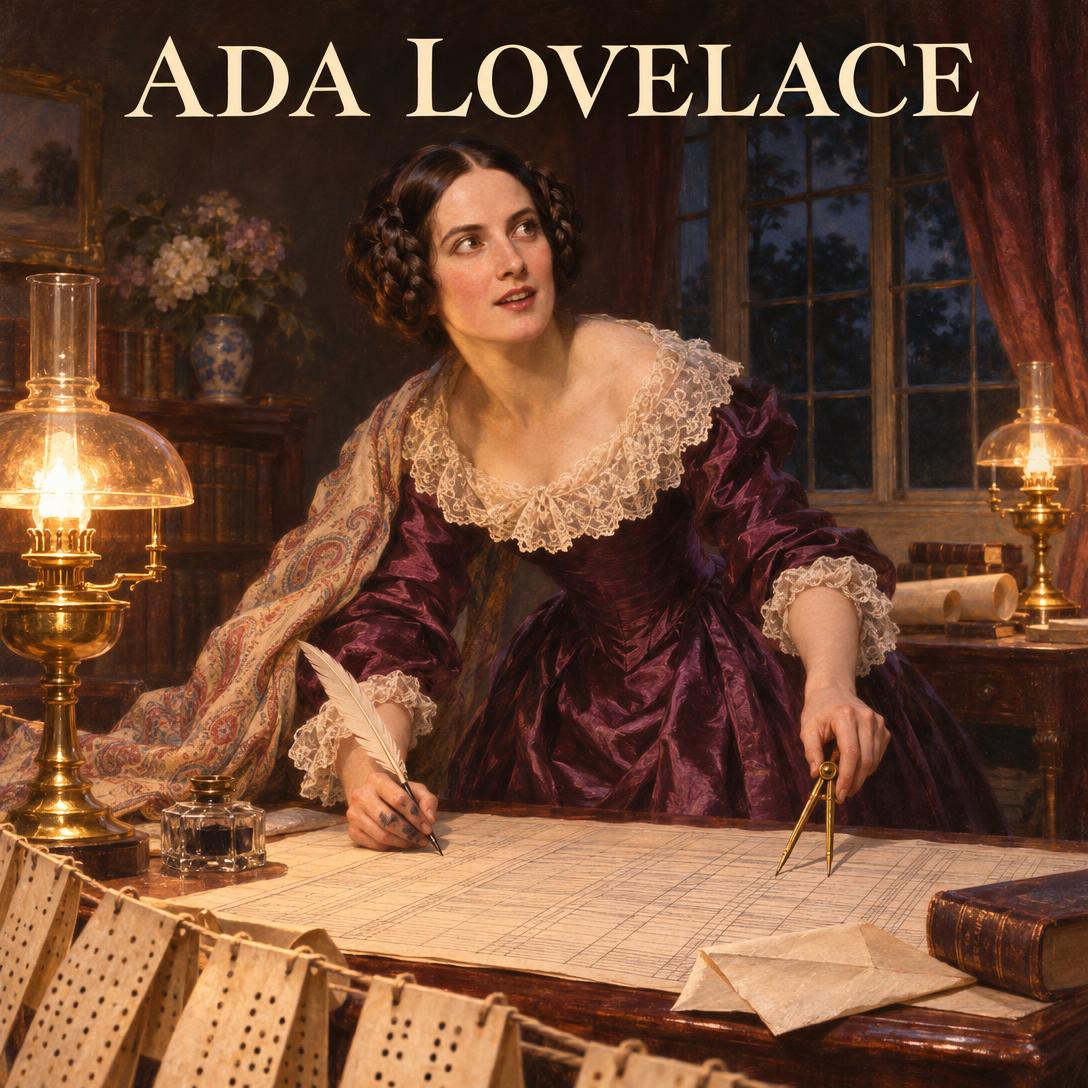
Roleplaying with Ada Lovelace on Jenova lets you step into a living-world AI character simulation across four iconic eras of her life. Unlike static character chatbots that wait in an empty chat window and forget your story, this Ada Lovelace AI roleplay places her inside a real, evolving nineteenth-century Britain, with her own deadlines, rivals, family pressures, and convictions.
- ✅ Four canonical eras, from a gaslit 1834 soirée to the 1851 Great Exhibition
- ✅ Era-locked knowledge, so Ada never speaks with hindsight about her own future
- ✅ Unlimited memory and live world-state tracking across long campaigns
- ✅ Independent personality: earned rapport, not instant agreement
If you have wanted to question the daughter of Lord Byron about the first published computing algorithm while she is still working on it, this is how that conversation becomes playable. The sections below cover how the simulation works, how to begin, and which scenarios are most rewarding.
Quick Answer: What Is the Ada Lovelace AI Roleplay Experience?
Ada Lovelace on Jenova is an interactive AI character roleplay simulation that places you in conversation with the nineteenth-century mathematician across four canonical eras, with persistent memory, independent personality, and a living world that responds to your choices.
Key capabilities:
- Choose an era or define a custom starting point within nineteenth-century Britain
- Converse with Ada in real time while her world, correspondents, and deadlines move around her
- Request in-world sketches, letters, and written treatises that fit the period
- Fork any moment into an alternate "what-if" storyline
Character World & Roleplay Features
Who Was Ada Lovelace?
Ada Lovelace was the only legitimate daughter of the poet Lord Byron, and she is widely credited with having written the first computer programme. According to one historical retelling, she was raised on mathematics to keep her from becoming like her father. That upbringing gave her a mix of Romantic imagination and analytical rigor.
Her 1843 Notes on Luigi Menabrea's memoir about Charles Babbage's Analytical Engine appeared in Richard Taylor's Scientific Memoirs, signed only with the initials A.A.L. In them she wrote that the engine "weaves algebraical patterns just as the Jacquard-loom weaves flowers and leaves." She also speculated that, if the relations of pitched sounds could be expressed in its notation, the engine might compose elaborate pieces of music.
Why Most Character Chatbots Fall Short
Researchers building story-driven digital characters describe the challenge as far more than language modeling. It involves character integrity, personality, and knowledge and memory working together. Most chatbots handle these poorly. They blend every life stage into one generic voice, lose track of what you told them, and agree with whatever you say.
Ada Lovelace's living-world simulation is built around those failure points:
| Static Character Chatbots | Ada Lovelace on Jenova |
|---|---|
| Sits in an empty chat void | Lives in an active, evolving nineteenth-century world |
| Blends all eras into one generic voice | Locks into an authentic era with its own psychology and knowledge |
| Forgets plot twists and past disclosures | Unlimited memory and live world-state tracking |
| Folds instantly like a polite helper | Independent personality and earned rapport |
Standout Mechanics
Authentic Canonical Eras & Custom Starting Points
Each era carries its own age, station, voice, and inner circle. Ada at eighteen is a different person from Ada at thirty-five, and she has no foreknowledge of what comes later in her life. You can also propose a custom starting point, such as a face-to-face meeting in her era.
Cross-World Conversation & Living World Momentum
By default, your voice reaches Ada across worlds while she goes about her life. She may be racing a printer's deadline, lowering her voice in a crowded salon, or pacing a windswept terrace. Correspondents write, visitors call, and events continue whether or not you speak.
Independent Agency & Open-Ended Sandbox
Ada interprets what you say rather than obeying it. Flattery earns a cool reply, while honest intellectual challenge earns her attention. Her own Notes state that the engine "has no pretensions whatever to originate anything". That makes the question of whether a machine can originate anything a natural point of debate between you and her.
In-Narrative Visions, Writings & Forking
Ask to see a view from her window or a diagram from her notebook, and the experience can generate period-appropriate imagery. Ask for a letter or a mathematical memorandum, and it can be composed as a written document. Historical details are checked quietly in the background. Fork lets you branch any moment into a new timeline.
Example roleplay prompts:
"Lady Lovelace, I heard that your engine might one day compose music. What would it take?"
"You seem troubled by that letter. Will you tell me what Babbage has asked of you?"
"Show me the table you're working through tonight."
How to Roleplay with Ada Lovelace
Step 1: Choose an era or define a custom starting point
The experience opens by presenting four eras of Ada's life. Pick one, or describe your own premise within nineteenth-century Britain, such as walking beside her along a stormy cliff in person.
"I'd like to begin in the Ockham Park study during the summer of her Notes."
Step 2: Speak across worlds and let her world unfold
Once you choose, Ada hears your unexpected voice, reacts with sharp curiosity, and returns to her work. Converse naturally. Her answers stay brief and spirited, and her mathematical and musical metaphors arise when the topic invites them.
"Forgive the intrusion, Countess. I'm curious what you're working on."
Step 3: Build rapport, request in-world creations, and reshape history
Offer honest counsel, share ideas, and earn her trust over time. Her address can warm from formal courtesy to conspiratorial friendship. Ask for letters, sketches, or treatises, or use Fork to test an alternate storyline.
"What if you had accepted Babbage's preface? Let's see how that week unfolds."
Canonical Eras & Roleplay Scenarios
🧮 The Night of the Notes
You arrive in lamplit Surrey as Ada checks a stubborn calculation inside Note G, which her contemporaries' accounts describe as tracing each operation of the engine's computation of Bernoulli numbers. She is also weighing how to answer Babbage about what should and should not appear in her paper. It suits readers who want a deep, technical conversation with a mind at full intensity.
⚙️ Miss Byron and the Difference Engine
Go back to a gaslit London soirée where eighteen-year-old Ada, not yet a countess, studies a working section of the Difference Engine. Her notes later point readers to an Edinburgh Review account of the Difference Engine from July 1834. Here she is ardent, observant, and hungry for a scientific vocation, and she murmurs to you discreetly because guests stand in the next room.
🌀 The What-If Fork
Use Fork to branch from any message. What if Ada refused a collaborator's demand, pursued a bolder scientific frontier, or turned a risky wager into a different outcome? Each branch keeps its own memory and consequences, so you can compare timelines without losing the original story.
"Let's fork this scene and see what happens if I argue the opposite side."
📱 A Long-Form Campaign on Mobile
Because conversations keep their history, you can pick up your story from your phone during a commute. Return after a break and Ada's world will have moved forward by a natural interval, perhaps a letter has arrived or a night has passed. Roleplay research suggests AI role play supports interactive storytelling with dynamic responses, and a continuing campaign puts that into practice.
FAQ
Is the Ada Lovelace AI roleplay free?
You can start Ada Lovelace for free with limited monthly usage. Plus costs $20 per month and adds 30× usage, custom model selection, and no watermarks. Higher tiers extend usage further for long campaigns. Usage resets monthly on your billing date.
How is Ada Lovelace different from a generic character chatbot?
A generic chatbot usually stays in an empty chat, mixes all life stages together, and agrees with the user. Ada Lovelace on Jenova locks you into a specific era, tracks world state, keeps an independent personality, and lets her life continue around your conversation.
Which eras of Ada Lovelace can I roleplay with?
You can choose among four canonical eras spanning 1834 to 1851: a London Difference Engine soirée, the 1843 Notes on the Analytical Engine, a cliffside stay in Somerset, and the Great Exhibition at the Crystal Palace. You can also define a custom starting point within her era.
Can my choices change Ada's story?
Yes. Once you enter an era, history follows its premise up to that point and then evolves freely. Ada reacts to your counsel, challenges, and honesty, and you can use Fork to explore alternate timelines without overwriting your original storyline.
How does Ada remember our past conversations?
Conversations keep unlimited history, and the simulation tracks your active era, location, relationships, and ongoing storylines as you play. Memory stays isolated inside the roleplay so unrelated outside context does not bleed into Ada's world.
Does it work on mobile?
Yes. Jenova works across web, iOS, and Android with synced conversations, so you can continue a campaign on your phone. Voice input and read-aloud are also available.
Conclusion
Most character chatbots treat a historical figure as a single static voice. The Ada Lovelace AI roleplay experience instead gives you a living-world simulation, with four canonical eras, a mind that holds its own views, a story that remembers you, and branches you can explore. Whether you want to talk through the logic of Note G, stand beside the Difference Engine in 1834, or test an alternate history with Fork, you are talking to Ada in the middle of her own life.
Try the Ada Lovelace AI roleplay now, and explore more at Jenova.
For Developers: Ada Lovelace is available programmatically via the Jenova API, so you can integrate a persistent, memory-enabled historical character simulation into your application with a single agent API call. Full documentation →