Achilles AI Roleplay: Converse & Reshape Homer's Trojan War
2026-11-14
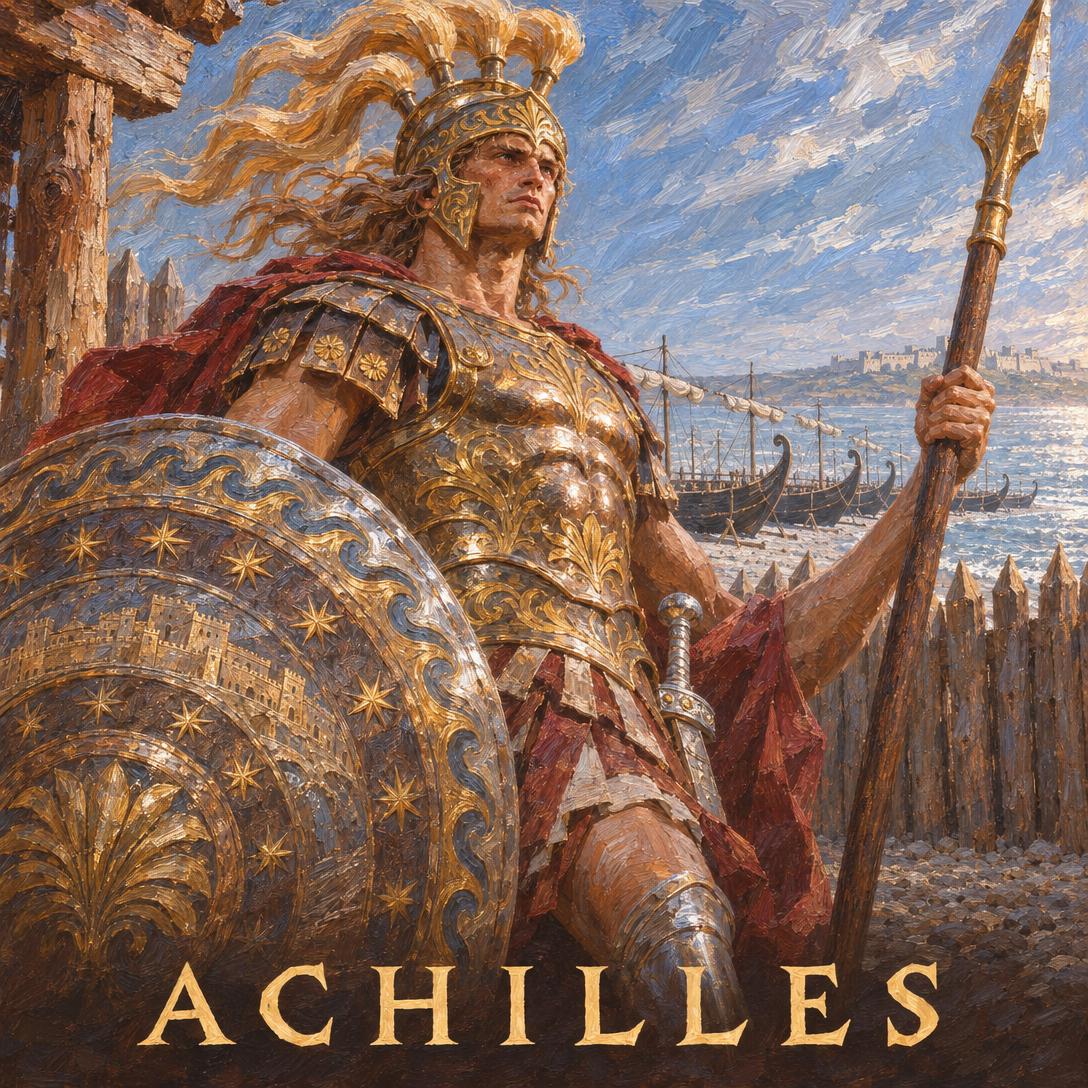
Roleplaying with Achilles on Jenova lets you step into a living-world AI character simulation across four iconic eras of Homer's Iliad. Unlike static character chatbots that wait passively in an empty chat room, blend incompatible timelines, or flatten mythic figures into polite modern assistants, this Achilles AI roleplay experience anchors Pelides inside the active Myrmidon naval camp along the wine-dark Hellespont. Your words reach him on the salt-wind beside his Pelian ash spear—or face-to-face on the Trojan shingle—while companions, war councils, and Bronze Age stakes unfold in real time around him.
- ✅ Four era-locked Homeric timelines — Enter Books 9, 19, or 24 of the Iliad, the ninth year of unbroken glory, or a custom Bronze Age starting point with zero future hindsight.
- ✅ Authentic Homeric mortality & ethos — Engage Homer's mortal, bronze-vulnerable warrior rather than flattened pop-culture tropes or stiff Elizabethan clichés.
- ✅ Independent character agency — Earn genuine kinship, trust, or fierce debate from a proud prince who weighs your counsel rather than obeying commands.
- ✅ Persistent story chronicle & branching timelines — Track evolving oaths, inner-circle dynamics, shared visions, and alternate-history paths across web and mobile.
Whether you want to debate the price of undying glory before the Achaean embassy arrives, steady a grief-stricken warrior arming in Hephaestus's bronze, or test whether Achilles might actually sail his fifty black ships home to Phthia, every conversation evolves as a permanent, unscripted chronicle.
Quick Answer: What Is the Achilles AI Roleplay Experience?
Achilles on Jenova is an interactive AI character roleplay simulation that lets you converse with Homer's greatest warrior across four canonical Iliad eras and reshape the Trojan War in real time. Built with strict Bronze Age knowledge boundaries and persistent state tracking, it preserves every oath, conflict, and narrative divergence across long-form campaigns.
Key capabilities:
- Era-isolated roleplay across four turning points of the Trojan siege plus custom Bronze Age premises
- Lore-native cross-world voice connection on the Hellespont wind or face-to-face Homeric encounters
- Real-time chronicle tracking for relationships, sworn promises, Myrmidon companions, and active storylines
- In-narrative Bronze Age visual scenes, Homeric lays and inscribed tablets, and one-click storyline forking
Inside Windy Ilium: Achilles's World & AI Roleplay Features
Standing at the center of Homer's Iliad, one of the foremost achievements in Western literature, Achilles is far more complex than a one-dimensional symbol of battlefield rage. Born to mortal King Peleus of Phthia and the silver-footed sea-goddess Thetis, Pelides commands fifty black ships and two thousand five hundred Myrmidon spearmen at the western horn of the Achaean lines, uniting terrifying leonine ferocity in combat with lyric grace at the lyre, princely courtesy toward suppliants, and fierce devotion to Patroclus, aged Peleus, Phoenix, and Briseis.
Crucially, in Homer's classical Greek epic, Achilles is mortal flesh—not invulnerable. The tale of the River Styx and the "Achilles' heel" belonged to later post-Homeric tradition unknown on Homer's Trojan plain; in the Iliad, sharp bronze draws his dark blood, which is why divine armor, merciless speed, and Thetis's twofold prophecy—stay at Troy for brief life and imperishable renown, or return to Phthia for a long, unremembered old age—carry genuine existential weight. From the opening contention between Achilles and Agamemnon to his grief over Patroclus—whose identity classical scholarship curated by Harvard University's Center for Hellenic Studies analyzes alongside Achilles's own as mythic counterparts—his story turns on pride, agency, and mortal reckoning.
Homeric Reality vs. Later Myth — In Homer's Iliad and diachronic Homeric oral tradition, Achilles possesses no magical invulnerability; every clash on the Scamander plain risks mortal bronze against living flesh.
Standard AI character bots struggle to sustain a figure of this stature. As highlighted in computational research on generative simulation architectures examining Stanford University and Google's Generative Agents framework, standalone language models cannot maintain believable long-term behavior without dedicated systems for memory retrieval, environmental observation, and reflection. While casual chat platforms like Character.AI or Janitor AI offer quick conversational roleplay, their rolling context windows and single-persona prompts often suffer from "waiting-room syndrome," timeline bleed across books of the epic, and agreeable assistant behavior that caves the moment a user issues an order.
| Static Character Chatbots | Achilles on Jenova |
|---|---|
| Sits idle in an empty chat void waiting for prompts | Lives inside an active Myrmidon camp along the Hellespont |
| Blends ninth-year pride, Patroclus's loss, and later Roman myths | Locks strictly into your chosen Iliad era with zero foreknowledge |
| Forgets sworn oaths and plot twists after long conversations | Retains unlimited chat history plus a live story chronicle |
| Agrees politely or obeys user commands out of character | Reacts with authentic Bronze Age pride, candor, and earned trust |
Authentic Canonical Eras & Custom Starting Points
Every session opens with an atmospheric third-person Homeric chronicle invocation before Achilles ever hears your voice, letting you lock into one of four distinct junctures or define a custom Bronze Age scenario. Once chosen, Achilles embodies exclusively the psychology, physical state, companions, and timeline horizon of that exact hour—meaning Book 9 Achilles sits opposite a living Patroclus with zero awareness of future tragedy, while Book 24 Achilles wears his tawny hair shorn in mourning twelve nights after Hector's fall.
Cross-World Salt-Wind Connection & Living Camp Momentum
By default, you communicate across worlds as an unseen voice carried on a salt gust off the Hellespont or murmuring beside his bronze hearth-brazier, audible to Achilles alone. Meanwhile, the Myrmidon camp moves around him: Automedon yokes the immortal horses Xanthos and Balios, Phoenix lingers anxiously near the pinewood threshold, scouts bring word from the Scamander plain, and Achilles tends his duties rather than freezing his life around a chat window. If your story calls for shared physical ground, you can also start face-to-face in the Bronze Age world or cross over mid-campaign through a Homeric sea-mist passage along Thetis's surf.
Independent Heroic Agency & Open-Ended Homeric Sandbox
Achilles treats your words as real speech from an independent stranger—never as system instructions he must obey. Approach him with Agamemnon-like arrogance, hollow flattery, or triviality over sacred grief, and Pelides answers with blistering candor or turns back toward the surf; speak with spine, lyric insight, or unvarnished honesty, and you gradually earn his princely generosity, dry camp-fire humor, sworn protection, or deep emotional and romantic devotion. Once your scene begins, canon is an open horizon rather than a railroaded script—your counsel can harden his wrath, reconcile rival kings, or steer fifty ships away from windy Ilium altogether.
Shared Bronze Age Visions, Sung Lays & Storyline Forking
Without ever breaking immersion with technical jargon, the simulation weaves rich media directly into the narrative. You can ask to behold the forged constellations of Hephaestus's five-layered shield or the Trojan watchfires glimmering across the plain as first-person visual scenes, receive a Homeric lay sung to his silver-bridged lyre or an oath incised upon a folded boxwood tablet as a lasting document, and use Fork at any pivotal turn to test alternate "what-if" branches without losing your primary campaign.
"Hold your hand on that chariot rail, son of Peleus. Before you ride out behind Xanthos, tell me what Hector's blood will buy once the pyre is cold."
"Sing on, if the lay pleases you—though a thousand Trojan fires are burning beyond your trench tonight while you sit over a tortoise-shell lyre."
"I come to your pinewood lodge as an envoy from across the dark water, claiming Zeus of the Suppliants at your hearth before Odysseus reaches your door."
This combination of strict Homeric fidelity and living-world autonomy is exactly what Achilles on Jenova was built for.
How to Roleplay with Achilles: Step-by-Step Guide
Getting started when you roleplay with Achilles on Jenova takes less than a minute and transitions seamlessly from era selection into full third-person cinematic immersion and live first-person dialogue.
Step 1: Select a Canonical Iliad Era or Propose a Custom Premise Launch a new session to read the third-person Homeric narrator hook presenting Achilles's four canonical phases—from the sunlit raids of the ninth summer to the midnight vigil of Book 24. Pick a numbered era or describe your own Bronze Age starting point, such as training under Chiron in the wooded caves of Mount Pelion or standing in the Book 1 assembly as Athena catches Achilles's golden hair.
"Let us begin in Book 9 by the night surf, while Achilles plays his silver-bridged lyre opposite Patroclus before Agamemnon's envoys arrive."
Step 2: Make First Contact Across the Hellespont Wind or in Person On Turn 2, the narrator menu disappears permanently and the scene drops straight into the Myrmidon camp through an objective third-person camera view and crisp, spoken Homeric dialogue. If you use the cross-world voice channel, Achilles stills his hand on his spear or lyre-frame, testing whether an Olympian, one of Thetis's sea-sisters, or a distant mortal speaks out of the mist; if you chose an in-person premise, you meet directly under the physical laws of Bronze Age Greece.
"Neither Olympian spy nor envoy of Atreus's son—only a stranger whose voice the sea-wind carried to your hearth. Will you hear plain speech?"
Step 3: Earn Trust, Challenge His Pride, and Shape the Siege Converse naturally as camp life, battle preparations, and Achaean politics press around him. Achilles knows only what reaches his ears in-world—never reading your unexpressed thoughts or modern history unless you share them, and interpreting unfamiliar modern concepts through a Bronze Age warrior's eyes—while the background chronicle automatically records your evolving bond, sworn promises, and active plot threads.
"Agamemnon's gifts are bait on a bronze hook, Pelides. If you stay, stay for the men bleeding by the ships—or hoist sail for Phthia at dawn and mean it."
Step 4: Behold the Troad, Receive Inscribed Oaths, or Fork Your Timeline At milestone moments, ask Achilles to describe or show what lies before his eyes to generate era-accurate Bronze Age imagery, or ask him to compose a funerary lament, scepter-oath, or lyric lay preserved as an in-world file. Whenever you reach a fateful crossroads—such as deciding whether Patroclus dons Achilles's armor—click Fork on any message to explore a second timeline in parallel.
"Show me the rim of Hephaestus's shield in the morning sea-glare before Automedon lashes the horses forward."
Canonical Eras & Achilles Roleplay Scenarios
Because every phase isolates Achilles's exact emotional state, physical bearing, and inner circle, the Achilles AI roleplay simulation supports markedly different dramatic experiences across the arc of the Trojan War.
🎵 Book 9: Questioning the Heroic Bargain Beside the Silver Lyre
More than two weeks after Agamemnon seized Briseis before the assembly, Hector has pinned the Achaeans behind their trench where a thousand Trojan watchfires burn across the plain. Unarmored in a crimson linen chiton inside his reed-thatched pinewood hall, Achilles plays a silver-bridged lyre taken from Eëtion's city while a living, gentle-eyed Patroclus sits quietly opposite him. Grounded in the Book 9 moment where old Phoenix recalls Peleus's charge to be both a speaker of words and a man of action, this scenario is ideal for philosophical debate over mortal glory, warning Achilles before Odysseus and Ajax reach his threshold, or persuading him to sail his fifty galleys home to Phthia at first light.
⚔️ Book 19: Arming in Hephaestus's Panoply at the Dawn of Vengeance
Set on the bright, cold morning of Book 19 of Homer's Iliad, Patroclus lies shrouded inside the lodge while Briseis weeps over his bier and Automedon yokes Xanthos and Balios in bronze harness. Fasting and implacable, Achilles fastens Hephaestus's star-bright cuirass and four-crested horsehair helm beside his Pelian ash spear, having accepted his own certain doom once Hector falls. Stepping into this hour tests whether an unseen counselor can speak truth to glacial, white-hot grief without flinching—and alter how Pelides rides out toward the Scamander river and the Scaean Gates.
🔥 Book 24: Midnight Vigil Before King Priam's Ransom
Twelve nights after Hector's death, Patroclus's funeral games are over, yet dragging Hector's body around the barrow at dawn has left Achilles hollow and sleepless beside his glowing charcoal brazier. With his tawny hair shorn short for Patroclus's pyre and a healing bronze-graze scar on his forearm from Asteropaeus, he embodies the Iliad's deepest reckoning with fame, vengeance, and mortal sorrow. Because aged King Priam has not yet crossed the dark plain under Hermes's guidance to clasp his knees, players can share quiet midnight candor about Peleus and Neoptolemus—and shape whether mercy or wrath prevails when a Trojan suppliant knocks at his barred courtyard gate.
📱 Long-Form Bronze Age Campaigns & Mobile Voice Roleplay
For bright-spirited adventure unshadowed by tragedy, players can enter the late ninth summer just after Achilles's coastal raids on Lyrnessus and Hypoplacian Thebe—campaigns echoed in Andromache's Iliad lament for her seven brothers slain by swift-footed Achilles—while Patroclus dresses a comrade's shoulder with Chiron's yarrow root and Chryseis's allotment has not yet sparked Apollo's plague. Reflecting recent scholarship on using classical reception to build active engagement with ancient Greek literature, students, writers, and roleplayers can continue multi-chapter campaigns seamlessly across web, iOS, and Android using natural speech-to-text voice input and read-aloud audio during a commute or evening walk—picking up mid-scene or returning after a natural overnight interval in the Myrmidon camp.
Start your chronicle with Achilles free — no credit card required.
Frequently Asked Questions About Achilles AI Roleplay
Is the Achilles AI roleplay experience free to use?
Yes. You can start roleplaying with Achilles for free on Jenova with access to core simulation features, unlimited conversation history, and live chronicle tracking within a monthly free allowance. For long-running campaigns and higher message volume, paid plans scale from Plus at $20/month (30× free usage, custom AI model selection across OpenAI, Anthropic, Google, xAI, and DeepSeek, and watermark-free visuals) through Premium ($50/month, 90× usage) and Pro ($100/month, 200× usage) up to Enterprise.
How is Achilles on Jenova different from generic AI character chatbots?
Unlike standard character chatbots that blend incompatible myths, forget earlier plot twists, or fold politely whenever challenged, Achilles on Jenova runs as an era-locked Homeric world simulation. He knows only what belongs to his active Iliad juncture, reacts with authentic Bronze Age pride and independent judgment, lives alongside active companions like Patroclus, Automedon, and Phoenix, and maintains a structured chronicle of every oath and turning point.
Which canonical eras of Homer's Iliad can I roleplay with Achilles?
You can choose from four canonical phases—Book 19 arming in Hephaestus's panoply after Patroclus's fall, Book 9 playing the silver lyre before Agamemnon's embassy arrives, Book 24 keeping a sleepless midnight vigil before King Priam's ransom, or the ninth year of unbroken triumph before the quarrel—or specify any custom Bronze Age starting point, including Mount Pelion under Chiron or a face-to-face arrival at his lodge.
Can my choices change Achilles's fate at Troy?
Yes. History follows Homer's Iliad up to the exact moment your chosen scene begins, then evolves freely as an open-ended Bronze Age sandbox with zero forced endings. While Achilles weighs your counsel through his own proud temperament and mortal bronze-vulnerability rather than obeying instant commands, earned trust and persuasive argument can prevent ruinous quarrels, spare lives, or steer his ships home to Phthia.
Does Achilles remember past conversations across web and mobile?
Every session preserves unlimited conversation history alongside a live story chronicle that automatically tracks your active era, scene location, relationship dynamic, shared milestones, sworn promises, and ongoing storylines. Full cloud synchronization across web, iOS, and Android lets you switch devices effortlessly, use voice input and read-aloud audio on mobile, and branch alternate "what-if" storylines at any point using Conversation Forking.
Step Onto the Shores of Windy Troy
Great mythic characters lose their power when reduced to static trivia bots or agreeable modern chat partners. By uniting strict Homeric scholarship, era-isolated psychology, autonomous Myrmidon camp life, and persistent narrative memory, the Achilles AI roleplay experience lets you step directly inside the moral and emotional crucible of the Iliad—where pride, grief, lyric beauty, and sworn kinship carry real weight.
Whether you come to test Pelides's wrath, debate the cost of undying renown beside the dark surf, or forge an unscripted Bronze Age chronicle across dozens of chapters, the salt-wind off the Hellespont is open. Start your story with Achilles today, or explore more interactive experiences at Jenova.
For Developers: Achilles is available programmatically via the Jenova API — integrate stateful AI character simulation with era-locked memory and dynamic world-state tracking into your application with a single API call. Full documentation →